Benji Was Supposed to Stay for a Few Months
For four years, my house served as a temporary stop for dogs who needed somewhere safe to land.
Some arrived frightened. Others came in loud, energetic, and determined to investigate every room before I had even put their food down. A few needed medical care or time to recover from whatever disruption had brought them to the shelter.
Eventually, each one moved on.
More than thirty dogs passed through my home during those years. I watched families meet them, fill out paperwork, ask questions, and leave with new leashes in their hands.
Then there was Benji.
Benji was never supposed to be different.
The first time I saw him, on a cold November morning, I told myself what I always did.
A few months.
Maybe less.
I had no idea he would still be beside me four years later.
He Sat With His Back to the Kennel Door
Benji was about three years old when I first met him at the shelter.
He was a large mixed-breed dog with a brown coat and the beginnings of silver around his muzzle. Even then, he had an older look about him, although his body was still strong and healthy.
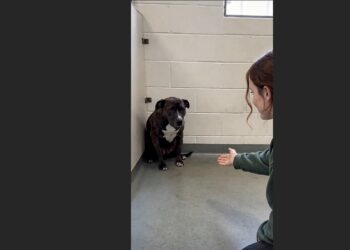
While several dogs rushed toward their kennel doors, Benji did the opposite.
He sat toward the rear of his enclosure.
His back faced the wire.
He was not cowering or shaking. He simply seemed uninterested in competing for attention.
A volunteer explained that Benji had already been overlooked several times.
At three years old, he was hardly elderly. Still, many visitors arrived asking for puppies or very young dogs.
His size did not help.
A big adult dog meant more food, more space, and often more exercise. For families renting apartments or managing busy schedules, those details mattered.
The shelter staff did not blame people for having preferences.
They simply worried about how long Benji might wait.
I stood outside his kennel for several minutes.
Eventually, he turned his head toward me.
That was all it took.
I Brought Him Home as a Foster
Fostering had become familiar by then.
I knew the routine.
Bring the dog home.
Give him space.
Learn what frightened him and what interested him.
Schedule whatever appointments the shelter required.
Take photographs.
Write a short description.
Attend adoption events.
Then, when the right family came along, say goodbye.
That last part was never easy, but I had learned to see it as the point of the work.
A foster home was a bridge.
It was not supposed to become the destination.
Benji settled into my house more quickly than many of the dogs before him.
He did not chew furniture.
He did not bark much.
He preferred lying in whichever room I occupied, usually several feet away rather than directly underfoot.
At night, he slept on a dog bed near the bedroom door.
Within a few weeks, he had learned the rhythms of the house.
So had I.
Still, I kept telling people the same thing.
“He’s available for adoption.”
The First Adoption Event Went Nowhere
Benji’s first adoption day took place at a community center.
The shelter set up folding tables, water bowls, signs, and portable pens. Families moved from dog to dog, asking questions about age, breed, training, and energy level.
Benji behaved beautifully.
He greeted strangers calmly.
He accepted treats.
When children passed, he watched without pulling toward them.
A couple stopped and spent several minutes with him.
I thought they might be interested.
Then they asked his age.
“About three,” I said.
Their expressions shifted.
“We were hoping for something younger.”
They thanked me and moved toward a row of puppies.
That happened several times.
Nobody was cruel.
Nobody insulted Benji.
People were simply making choices based on the kind of dog they imagined living with.
At the end of the day, several younger dogs left with families.
Benji came home with me.
I told myself there would be another event.
There was.
Then another.
Twenty-Seven Adoption Days Passed
Over the years, Benji attended twenty-seven adoption events.
I remember the number because eventually I started counting.
The pattern rarely changed.
Someone would notice his calm temperament.
They would ask to pet him.
Benji would lean slightly into their hand, sometimes wagging his tail.
Then the questions came.
“How old is he now?”
“How big is he?”
“How active?”
“Any health problems?”
Each year, the age answer became less appealing to certain adopters.
Four.
Five.
Six.
Eventually seven.
People often said they wanted more years.
They used different words, but the meaning was similar.
They wanted a dog who felt like a longer investment.
I understood the practical concern.
Dogs do not live long enough as it is, and some people feared adopting an adult only to face aging sooner than they expected.
Still, watching Benji get passed over became harder.
After each event, I loaded him into my car.
He usually climbed into the back seat, circled once, and lay down.
He never knew the purpose of those days.
He did not understand adoption applications or why one dog left while another stayed.
To him, the ride home was simply part of the routine.
Meanwhile, Benji Became Part of My Life
The strange thing was that while I kept trying to find Benji a permanent family, our daily life became more permanent without my noticing.
He learned exactly when I made coffee.
He learned which cabinet held his treats.
He knew the sound of my walking shoes being pulled from the closet.
If I worked in the yard, he found a shaded place nearby.
If I sat on the porch in the evening, he eventually appeared and lowered himself beside the chair.
Nothing about our relationship announced itself dramatically.
There was no single day when I thought, This dog is becoming important.
It happened through repetition.
Morning after morning.
Night after night.
A dog bowl beside the kitchen wall.
A leash hanging by the door.
Brown hair on the back seat of the car.
The sound of nails crossing the hallway.
By the time I realized how much space Benji occupied in my routine, he had already been there for years.
Margaret Had Been Gone Before He Arrived
My wife, Margaret, died before Benji came into my life.
There is no simple way to describe the shape grief leaves inside a house.
At first, the absence is everywhere.
A chair.
A coffee mug.
A coat no one wears.
A side of the bed nobody sleeps on.
Later, those details become part of the background, but the absence does not disappear.
For years, I had a habit of going outside at night and looking at the sky.
Margaret and I had done that together.
We were never serious astronomers. We could identify a few constellations and not much more.
Mostly, we liked the quiet.
After she died, I kept going outside.
Some nights, I sat alone.
Then Benji started following me.
He never interrupted the moment.
He would settle near my feet and look out into the yard while I looked upward.
I never believed he understood what I was remembering.
He did not have to.
He was there.
He Gave Me Routine Without Asking for Explanations
Grief can make days feel shapeless.
A dog does not care about that.
Breakfast still needs to happen.
Water bowls still need filling.
Someone has to open the door.
Someone has to take the walk.
Benji gave structure to parts of my life that might otherwise have drifted.
He did not cure grief.
No dog can replace a spouse or erase decades of shared history.
What he gave me was companionship inside that grief.
On difficult mornings, there was still a reason to get dressed and step outside.
In the evenings, the house did not feel completely empty.
If I sat too long in one place, Benji eventually appeared.
Sometimes he wanted food.
Sometimes he wanted to go outside.
Often, he simply lay down.
That was enough.
Then I Had Knee Surgery
A few years after Benji arrived, I had surgery on my knee.
Recovery was slower than I expected.
For a while, my movement around the house became awkward and deliberate. Stairs required planning. Getting out of chairs took concentration.
Friends helped with errands.
Neighbors checked in.
For Benji, the change mostly meant shorter walks and more time indoors.
He adjusted.
During the worst part of recovery, he spent hours lying near the bed.
Not on it.
Not pressed against me.
Just close enough that I could hear him shift occasionally.
When someone came to the door, he lifted his head.
When I stood, he usually stood too.
Again, I did not turn the behavior into something mystical.
Dogs notice when household routines change.
They follow familiar people.
They often choose proximity.
Still, when you are hurting and alone in a quiet room, proximity matters.
Benji never asked me to talk about the pain.
He simply stayed nearby.
I Still Kept Trying to Find Him a Family
Looking back, this is the part that makes the least sense.
Even after years together, I continued introducing Benji as my foster dog.
Somewhere in my mind, I had built a rule.
Foster dogs leave.
Therefore, Benji would leave.
I had done the same thing with every other dog.
Why should this one be different?
The shelter continued listing him.
I continued attending events.
Potential adopters continued asking questions.
As Benji grew older, interest declined further.
He remained healthy, but his muzzle became noticeably grayer.
He moved with less urgency than he had at three.
For me, those changes were ordinary.
I saw him every day.
For strangers seeing him for the first time, they sometimes read as age.
And age often sent them toward another dog.
One Adoption Fair Finally Broke Something Open
The moment came after another adoption event at a local park.
The day had been long.
Several dogs found homes.
Benji did not.
One family spent nearly fifteen minutes with him.
They liked his temperament.
They liked that he was house-trained.
They liked that he was calm indoors.
Then they learned his age.
The conversation changed.
They walked away.
I told myself not to take it personally.
They had every right to choose the dog that fit their lives.
Still, disappointment settled heavily that afternoon.
After the event ended, I took Benji for a short walk through the park.
Then I sat on a bench.
For a while, I stared at the ground.
Benji sniffed nearby.
Eventually, he came back.
He Put His Head on My Knees
Benji stood in front of me for a moment.
Then he sat.
A second later, he rested his heavy head across my knees.
His amber-colored eyes looked upward.
There was nothing unusual about the gesture.
He had done similar things before.
Yet that afternoon, after twenty-seven adoption events and four years of explaining why someone else might want him, the obvious finally became impossible to ignore.
I had spent years trying to find Benji a home.
Meanwhile, he slept in my house.
He knew my schedule.
He had stayed beside me through surgery.
He followed me outside when I thought about Margaret.
His bowl had occupied the same place in my kitchen for years.
His leash hung beside my coat.
I knew which foods upset his stomach.
He knew what time I usually went to bed.
What exactly did I think a home was?
Benji Had Not Been Waiting for Someone Else
That realization changed the way I understood the previous four years.
Benji had not been participating in my foster plan.
That was my framework, not his.
From his perspective, the arrangement was much simpler.
He lived with me.
I fed him.
We walked together.
I left and returned.
He slept in the same place every night.
Whatever name I gave that arrangement, it was already his daily life.
The problem had never been that Benji could not find a home.
The problem was that I had become so committed to the idea of helping him move on that I had failed to recognize what was already in front of me.
I rubbed the gray fur beneath his chin.
He sighed and kept his head on my knees.
For the first time, I stopped imagining the family that might someday take him.
I Called the Shelter the Next Morning
I did not wait long.
The following morning, I called the shelter director.
She answered in the middle of what sounded like a busy start to the day.
“I need to talk to you about Benji,” I said.
There was a pause.
“All right.”
“I want to adopt him.”
Another pause.
Then she laughed.
Not at me.
More like someone hearing news she had expected for years.
“Michael,” she said, “we’ve all been waiting for you to figure that out.”
I looked across the kitchen.
Benji was asleep near the window.
“He’s been your dog from the beginning,” she added.
Technically, that was not true.
The paperwork still belonged to the shelter.
Emotionally, though, I understood exactly what she meant.
Signing the Papers Felt Almost Ridiculous
The adoption process itself was simple.
I already knew Benji’s medical history.
The shelter knew my home.
They knew how I cared for dogs.
There were still forms to complete and responsibilities to acknowledge.
Food.
Veterinary care.
Licensing.
Exercise.
The realities of an aging large dog.
None of it surprised me.
By then, I had already been doing most of it for four years.
I signed my name.
The shelter transferred ownership.
Just like that, the dog I had spent years trying to place somewhere else officially became mine.
I drove home with the papers on the passenger seat.
Benji, of course, had no idea anything had changed.
“You’re Home, Benji”
When I walked inside, Benji met me in the hallway.
His tail moved once, then faster when he realized I had returned without another foster dog.
I put the paperwork on the table.
Then I knelt in front of him.
My knee complained, reminding me that I was no younger than he was.
“You’re home, Benji,” I told him.
“For good.”
He wagged his tail.
Then he licked my hand.
I knew better than to imagine he understood the legal meaning of what I had said.
He did not know what “adoption” meant.
He did not understand paperwork or permanent ownership.
What he knew was that I was home.
So was he.
In practical terms, nothing changed that afternoon.
His bowl stayed in the kitchen.
His bed stayed in the same place.
We took the same evening walk.
Yet something had shifted for me.
For the first time, I stopped thinking of our life together as temporary.
Our Walks Are Slower Now
Benji is older these days.
So am I.
His muzzle has gone mostly gray.
He takes a little longer to stand after a nap, especially on cold mornings. Our walks have shortened, and I let him choose the pace more often.
If he wants to stop and smell the same tree for two minutes, we stop.
There is no reason to hurry.
I keep an eye on his joints and make sure he gets the veterinary care an aging dog needs.
He still follows me around the house, although now he sometimes decides that getting up is not worth the effort.
I respect that.
Age has made him more selective.
Dinner remains worth standing for.
The mail usually does not.
I Still Think About Those Twenty-Seven Adoption Events
Sometimes I wonder what would have happened if someone had adopted Benji during that first year.
He might have had a good life.
There were kind people who showed genuine interest in him.
I do not tell myself that I was the only person capable of loving him.
That would not be true.
Still, our lives happened to remain connected long enough for something permanent to grow.
Not through one dramatic rescue.
Not through destiny.
Mostly through ordinary time.
That may be why I did not recognize it sooner.
We tend to expect important changes to announce themselves.
Benji never did.
He simply remained.
People Ask About Him on the Street
These days, strangers sometimes stop during our walks.
Benji’s gray face attracts attention.
Older dogs have a way of making people soften.
“What’s his name?” someone will ask.
“Benji.”
“How long have you had him?”
That question still makes me smile.
There are several possible answers.
I could say I fostered him for four years.
I could explain the adoption events.
I could tell them about the park bench or the phone call to the shelter.
Usually, I keep it simple.
“This is Benji,” I say. “He’s my dog.”
Those words still feel good.
Maybe because it took me so long to say them.
He Had Already Found What I Kept Searching For
At night, I still sometimes go outside and look at the stars.
Benji comes with me less often now.
Some evenings, he prefers his bed.
When he does follow, he lowers himself slowly onto the porch and settles nearby.
I still think about Margaret.
That has not changed.
Love for one companion does not erase love for another, and grief does not vanish because a dog enters the house.
What changed was the emptiness around it.
Benji brought routine.
Company.
A warm body asleep nearby.
A reason to walk.
A quiet presence during difficult days.
For four years, I kept thinking my responsibility was to find him a permanent home.
Eventually, I understood that permanency is often built before we name it.
It happens in repeated mornings.
In water bowls filled without thinking.
In vet appointments.
In slow walks.
In nights spent sitting near someone who does not want to be alone.
Benji did not arrive with fanfare.
He walked through my door as a foster dog and gradually became part of the shape of my life.
Now, when he settles beside me, there is no paperwork left to complete and no adoption event waiting on the calendar.
He is simply where he has been all along.
Home.
Editor’s Note: The characters in this story are fictional. Through these stories, we hope to share the intelligence, loyalty, compassion, and loving nature of dogs with people everywhere.