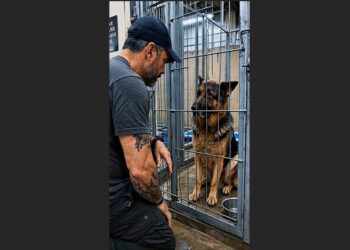
For 47 days, Milo watched people come and go without once approaching the front of his kennel.
Families stopped.
Volunteers offered treats.
Shelter workers brought toys and sometimes spent long stretches sitting quietly outside the gate.
Milo noticed all of it.
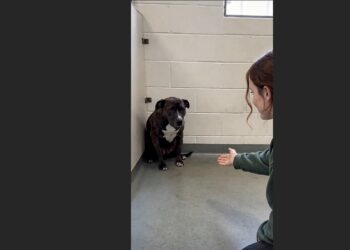
He simply stayed near the back wall.
The small dog never barked at visitors or showed his teeth. He did not lunge when people approached.
Instead, he watched every movement with careful attention.
When someone stepped closer, Milo’s eyes followed.
When that person eventually walked away, he remained where he was.
After several weeks, the staff had learned not to measure progress by whether Milo came forward.
Some days, success meant he stayed visible.
Other days, it meant he accepted food after a person backed away.
Then, on a rainy Tuesday afternoon, an 81-year-old woman named Eleanor Price entered the shelter.
Before anyone introduced them, she stopped in front of Milo’s kennel.
For several seconds, she simply watched him.
Then she asked one question.
“Does he hear anything?”
Milo Had Been Found Behind a Furniture Store
Nobody knew much about Milo’s life before the shelter.
He had been discovered behind a closed furniture store wearing a faded teal collar.
There was no identification tag attached.
A scan found no microchip.
No owner came forward with a clear claim.
The collar was the only obvious sign that Milo had once belonged somewhere.
During his veterinary examination, staff discovered another important detail.
Most of his hearing was gone.
That explained some of the behavior workers had noticed during his first days.
Calling his name often produced no response.
A person could approach from behind and startle him without meaning to.
Sounds that made other dogs lift their heads sometimes seemed to pass Milo by completely.
Once the staff understood that, they adjusted.
They tried to approach where he could see them.
If he was facing away, they sometimes created a light vibration through the floor rather than suddenly touching him.
The goal was simple.
Let Milo know someone was nearby before that person entered his space.
Losing Hearing Did Not Mean Milo Was Unaware
A dog with severe hearing loss still receives enormous amounts of information.
Milo watched movement carefully.
He noticed doors opening.
He tracked people crossing the hallway.
He used his nose.
He responded to changes in light and physical vibration.
Most of all, he relied heavily on vision.
The staff gradually realized how much Milo studied people.
A visitor might assume he was ignoring them because he did not respond to his name.
He was not.
Often, his eyes had already found the person.
He knew someone was there.
He simply chose not to come closer.
The shelter could account for his hearing loss.
What nobody could know was exactly why he remained so cautious.
There was no confirmed history of abuse.
His faded collar and unknown past did not explain everything.
So the staff avoided inventing a story for him.
They responded only to the dog in front of them.
And that dog needed space.
Forty-Seven Days Passed Slowly
Shelter life creates repetition quickly.
Morning cleaning.
Meals.
Fresh water.
Walks or outdoor time when appropriate.
Visitors.
Evening routines.
Milo learned the rhythm without appearing particularly comfortable with the people inside it.
Workers experimented gently.
Some sat outside the kennel and turned their bodies slightly away instead of staring at him.
Others placed treats within reach and backed off.
Toys were offered.
Nothing was forced.
Milo occasionally ate after the person moved away.
Still, the distance remained.
Day after day, he stayed close to the back wall.
There was no dramatic incident behind his reluctance that anyone could point to.
Only a pattern.
People came.
Milo watched.
People left.
Eleanor Wasn’t Looking for a Puppy
Rain tapped against the windows when Eleanor Price arrived.
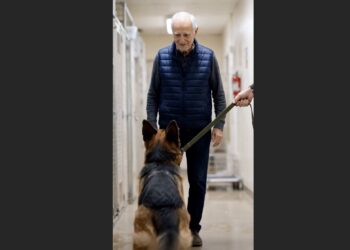
At 81, she moved carefully through the shelter corridor.
One hand rested on the rail.
Her pace was steady but slow.
At the reception desk, she had already made one thing clear.
“I am not looking for a puppy.”
Her apartment was small.
Her days followed a simple routine.
A young, high-energy dog would not have fit either one well.
Eleanor understood that before she saw a single kennel.
Since her husband’s death the year before, she had been living alone.
The apartment had grown noticeably quieter.
There were no conversations across the kitchen table.
No television playing in another room because someone else had turned it on.
No familiar footsteps moving through the hallway.
Eleanor was not trying to replace her husband.
She knew a dog could not do that.
She was considering something smaller.
Companionship.
Routine.
Another living presence in the apartment.
She Stopped Before Anyone Suggested Milo
The volunteer walking with Eleanor had not yet begun explaining Milo’s situation when she paused.
Milo was sitting toward the back.
His dark eyes followed them.
Eleanor studied him.
The faded teal collar was still around his neck.
He did not move forward.
After several seconds, she asked, “Does he hear anything?”
The volunteer explained the veterinary findings.
Most of Milo’s hearing appeared to be gone.
Staff had begun using visual approaches and floor vibration to avoid startling him.
Eleanor nodded.
Then she said something the workers did not expect.
“Could everyone stop calling his name for a minute?”
The hallway became quieter around the kennel.
Milo continued watching.
Eleanor Had Spent 30 Years Teaching Children With Hearing Loss
For more than three decades, Eleanor had worked with children who had serious hearing loss.
That did not make dogs and children comparable.
Milo’s needs were canine, not human.
Still, Eleanor understood something useful about communication.
Not every interaction begins with sound.
And repeating a spoken word more loudly does not make it meaningful to someone who cannot hear it.
She had spent years learning to pay attention to where someone was looking.
She understood the importance of visual cues.
Most of all, she knew that attention could not always be demanded.
Sometimes the first step was simply making yourself available to be noticed.
So Eleanor did not stand over Milo.
She lowered herself carefully beside the gate.
Then she waited.
She Kept Her Hands Still
Eleanor sat where Milo could see her.
Her hands rested quietly.
She did not wave at him repeatedly.
She did not tap the kennel bars.
She did not try to lure him forward with a treat.
For a while, Milo’s gaze shifted between her and the rest of the hallway.
Eleanor remained where she was.
The volunteer stayed back.
Nobody tried to manufacture a breakthrough.
Rain continued against the windows.
Elsewhere in the shelter, dogs moved around their kennels and people spoke in low voices.
Inside Milo’s space, very little happened.
Then he looked directly at Eleanor.
She noticed.
But she did not immediately reach toward him.
One Open Palm
Once Milo’s eyes were on her, Eleanor raised one hand.
Her palm remained open.
Then she made a slow, simple motion toward herself.
It was not a formal command Milo necessarily knew.
There was no reason to assume he understood its meaning.
What mattered was that he could see it clearly.
Milo watched.
Eleanor lowered her hand slightly and waited again.
Then Milo stood.
The volunteer beside her noticed immediately.
For 47 days, staff had watched him stay back while visitor after visitor tried to encourage him forward.
Now he was on his feet.
Eleanor did not clap.
She did not smile broadly or lean toward the bars.
She stayed still.
Milo remained standing.
The First Step Was His
After several seconds, Milo moved.
One step.
Then he stopped.
Eleanor did not change position.
Milo watched her face.
Eventually, he took another step.
His body remained low.
There was no burst of confidence.
Whatever made him willing to move forward had not erased his caution.
That was fine with Eleanor.
She knew progress did not have to be fast to be real.
The volunteer waited near the gate.
When Milo was close enough and his body remained relatively settled, the door was opened carefully.
Nobody pulled him out.
He chose whether to continue.
For another moment, he hesitated.
Then Milo stepped through.
Eleanor Let Him Investigate
Milo approached with his head lowered.
Eleanor kept her hand where he could see it.
As he came closer, his nose began gathering the information his ears could not.
He smelled her fingers.
Her sleeve.
The air around her.
Eleanor did not move her hand over his head.
She knew an unfamiliar touch from above could be uncomfortable, especially for a dog already wary of people.
So she waited.
Milo sniffed her palm for several seconds.
Then something changed.
Instead of backing away, he remained there.
Slowly, he lowered his muzzle into Eleanor’s open hand.
No one in the hallway spoke.
“Hello, Milo”
Eleanor smiled.
“Hello, Milo,” she said softly.
She knew he likely could not hear the words.
That did not matter.
Speaking was natural for her.
What Milo could see was the rest of the interaction.
The relaxed expression.
The still body.
The open hand that did not suddenly close around him.
He continued watching her face.
To Eleanor, that seemed important.
Dogs pay close attention to human posture and facial movement.
For a dog with little hearing, visual information may become even more central.
Milo did not need to hear Eleanor say hello.
He could see how she behaved when she said it.
She Did Not Mistake One Moment for Trust
It would have been easy for Eleanor to decide that Milo had chosen her completely.
She did not.
One approach did not erase 47 days of caution.
Milo had come closer once.
That was all anyone could responsibly claim.
So Eleanor did not ask to take him home that afternoon.
Instead, she spoke with the staff.
She asked about his health.
She asked how he behaved outside the kennel.
She wanted to know whether he startled easily, how he handled being touched, and whether anyone had begun teaching visual cues.
She also discussed her own situation.
Small apartment.
Quiet routine.
Limited interest in long, strenuous walks.
A dog who was calm indoors and comfortable with slower activity would fit better than one who needed hours of intense exercise.
Milo might fit.
But Eleanor wanted to know him before deciding.
She Came Back the Next Morning
The following day, Eleanor returned.
This time, Milo saw her entering the corridor.
He remained toward the back at first.
Eleanor approached in the same way.
No calling from across the hallway.
No sudden gestures.
She positioned herself where he could see her.
Then she sat.
Milo watched.
After a while, he came forward again.
The second meeting was not dramatically different from the first.
That was probably useful.
Eleanor gave Milo something shelters often struggle to provide consistently because so many people come and go.
Repetition with the same person.
Same posture.
Same quiet movements.
Same patience.
For a dog learning whether someone is predictable, repetition matters.
Two Days Later, She Returned Again
Eleanor’s third visit followed the same pattern.
By then, Milo began standing sooner when he saw her.
He was still cautious around other people.
The change was specific.
That helped everyone understand that he was not suddenly transformed.
He had simply begun building familiarity with Eleanor.
She never treated that as permission to rush.
Instead, she introduced simple visual communication.
A clear hand movement.
A pause.
A reward when Milo responded appropriately.
Then another repetition.
Because he could not rely on spoken commands, the signals needed to be visible and consistent.
Milo watched carefully.
That turned out to be one of his strengths.
Visual Cues Began to Make Sense
Within a week, Milo was responding to three simple hand cues.
They were not complicated.
Eleanor kept each movement distinct.
One sign indicated a basic request.
Another sign marked a different action.
Consistency mattered more than complexity.
She did not wave her hands constantly.
Too much movement would make individual signals less clear.
Instead, Eleanor waited until Milo was looking.
Then she gave one cue.
If he responded, he received reinforcement.
If he did not, she reset and tried again rather than punishing him.
Milo learned quickly.
His hearing loss had changed how people needed to communicate with him.
It had not made him incapable of learning.
Deaf Dogs Still Learn
A dog does not need hearing to understand structure.
Visual cues can replace many spoken commands.
Dogs with little or no hearing can learn signals for sitting, waiting, coming closer, going to a bed, checking in with a handler, or other useful behaviors.
They may also learn to pay close attention to a person’s body.
However, safety requires extra planning.
A deaf dog cannot hear a car coming.
He may not hear someone calling from behind.
Off-leash freedom in unsecured areas can be especially risky.
Eleanor understood that communication would need to remain visual and physical.
She would have to make sure Milo saw her before expecting a response.
At home, predictable routines would help too.
For Eleanor, none of that felt like a reason not to adopt him.
It simply described the dog she was considering.
Eleanor’s Apartment Was Already Quiet
Some households might have been difficult for Milo.
Constant visitors.
Small children running unexpectedly behind him.
Doors opening frequently.
People forgetting that he could not hear their approach.
Eleanor’s home was different.
Her apartment was small and calm.
Most days followed a predictable rhythm.
Breakfast.
A little housework.
A walk.
Reading.
Perhaps errands.
Then another quiet evening.
Since her husband’s death, Eleanor had sometimes found that quiet difficult.
For Milo, however, a low-traffic home with one attentive person could offer something valuable.
Predictability.
Neither Eleanor nor the shelter assumed that meant the match was automatically perfect.
They still considered his exercise, veterinary needs, adjustment period, and safety.
But the practical pieces began to align.
Milo Started Watching for Her
Over the next few visits, workers noticed another change.
When Eleanor entered the shelter, Milo often saw her before she reached the kennel.
His body became more attentive.
Sometimes he stood.
On other days, he came forward sooner.
Because he could not hear her footsteps well, their reunion usually began visually.
Milo would look up.
Eleanor would wait until their eyes met.
Then she would give the small familiar motion.
Over time, the distance between the back wall and the gate mattered less.
Not because Milo had forgotten how cautious he once was.
He had simply gathered new information.
This person approached predictably.
She did not startle him.
She did not force touch.
Her hand signals meant something.
And she kept coming back.
Adoption Required More Than a Connection
Eleanor wanted Milo.
By then, the staff knew that.
Still, wanting him was only one part of the decision.
At 81, Eleanor needed to consider what caring for a dog would require.
Could she safely manage him on leash?
Could she afford routine veterinary care?
What would happen if she became ill?
Would the apartment permit him?
Were there stairs?
How would Milo be kept safe outside given his hearing loss?
Those questions were not obstacles designed to keep them apart.
They were part of responsible adoption.
Eleanor worked through them.
Her apartment allowed dogs.
Milo’s size and activity level were manageable for her.
She had a plan for veterinary care and support.
Most importantly, she understood that living with a hearing-impaired dog required attention rather than pity.
Milo did not need to be treated as helpless.
He needed people to communicate in ways he could understand.
The Faded Teal Collar Came Home With Him
Within a month, Milo left the shelter.
The faded teal collar stayed with him.
It was worn from whatever life had come before, but Eleanor chose not to replace it immediately.
Instead, once Milo entered her apartment, the collar became part of a new routine.
At night, when appropriate, it had a place near the front door.
Beside it hung a leash.
The sight surprised Eleanor the first few times she passed through the hallway.
For more than a year, that space had been empty.
Now there was evidence that another living creature shared the apartment.
Water bowl.
Dog bed.
Leash.
Teal collar.
Small things.
But after months of silence, small things were noticeable.
Home Took Time
Milo did not walk into Eleanor’s apartment and immediately behave as though he had always lived there.
The rooms were unfamiliar.
Different floor surfaces changed the vibrations under his paws.
New smells came from neighboring apartments and the hallway.
Doors opened without him hearing them.
Elevators and building movement produced sensations he needed time to understand.
Eleanor expected that.
She gave him a quiet sleeping area.
She kept furniture placement stable.
Before touching him while he slept, she made sure he was awake or used a gentle vibration nearby rather than startling him.
Meals came at regular times.
Walks followed a pattern.
Milo gradually learned where things were.
Predictability again did much of the work.
Eleanor Learned to Get His Attention Without Sound
At home, their communication expanded.
Eleanor never assumed Milo could see her simply because she was speaking.
She waited for eye contact.
Sometimes a gentle floor vibration helped him notice she had entered a room.
Other times, she stepped into his field of vision.
Once Milo looked toward her, the familiar hand cues followed.
Before long, these exchanges became ordinary.
Eleanor no longer thought consciously about every gesture.
Milo watched naturally.
The communication between them was quiet, but it was not empty.
There were pauses.
Looks.
Movements.
Rewards.
A hand resting briefly along his shoulder after he approached voluntarily.
Their days developed a rhythm that depended very little on spoken language.
The Apartment Felt Different Too
Milo did not cure Eleanor’s grief.
Her husband remained absent.
There were still mornings when she reached automatically for two cups before remembering she needed only one.
Some evenings remained difficult.
A dog could not replace decades of marriage.
What Milo changed was the structure around those moments.
He needed breakfast.
He needed walks.
His water bowl needed filling.
There were visual training sessions to practice.
Sometimes he followed Eleanor from one room to another.
Other times, he slept while she read.
The apartment was still quiet.
Yet it was no longer empty in the same way.
Eleanor could look up from her chair and find Milo watching her.
Often, she raised one hand.
He responded.
Milo Did Not Need People to Feel Sorry for Him
At the shelter, hearing loss had initially seemed like one more reason Milo might struggle to find a home.
Potential adopters often worry about disabilities because they imagine constant difficulty.
Milo did require adaptations.
But many of them were simple.
Approach visibly.
Avoid startling him.
Use consistent visual cues.
Keep him secured outside.
Build routines.
Reward check-ins.
None of those things prevented him from living a full daily life.
He could walk.
Explore.
Smell.
Learn.
Rest beside Eleanor.
Watch the world from the apartment window.
Follow movements in a room.
Hearing was only one way to receive information.
Milo had others.
What Changed Was Not His Hearing
Milo never regained the hearing he had lost.
Eleanor did not expect him to.
Her attention did not cure him.
Her patience did not reverse the veterinary findings.
The change was in communication.
At the shelter, people had naturally relied on voices.
“Milo.”
“Come here.”
“Good boy.”
Those words meant little if he could not hear them clearly.
Eleanor started somewhere else.
She waited until he looked.
Then she gave him something he could see.
That difference seems small.
For Milo, it opened a door.
Forty-Seven Days Had Not Been Failure
Looking back, shelter workers could have treated Milo’s 47 quiet days as wasted time.
They were not.
During those weeks, the staff learned about him.
They discovered the hearing loss.
They changed how they approached.
They respected his distance.
Most importantly, they kept him safe long enough for someone who understood his communication needs to arrive.
Milo’s refusal to come forward was not stubbornness.
Nor did it mean he was incapable of connection.
He needed the right conditions.
A person who would not rush him.
Clear signals.
Repetition.
Choice.
Eleanor happened to understand those things instinctively.
The Collar Beside the Door
A month after that rainy Tuesday, the faded teal collar was no longer behind a shelter gate.
It hung beside Eleanor’s front door.
Often, Milo was somewhere nearby.
When it was time for a walk, Eleanor would make sure he was looking.
Then came one familiar hand movement.
Milo would stand.
Another quiet exchange.
No raised voice.
No repeated calling from across the room.
No need to demand that he respond to sound he could barely perceive.
The shelter had spent weeks calling Milo’s name because calling a dog’s name is what people naturally do.
Eleanor did something different.
She sat down.
She waited.
And when Milo finally looked at her, she spoke in a way he could actually receive.
He did not need her to make him hear.
He only needed her to notice how he was already listening.
Editor’s Note: The characters in this story are fictional. Through these stories, we hope to share the intelligence, loyalty, compassion, and loving nature of dogs with people everywhere.