Claire did not go to the shelter looking for a dog.
She went carrying a bag of old towels.
For weeks, she had been sorting through her mother’s house after her death that spring. The work moved slowly. One closet. One drawer. One box at a time.
Every room seemed to contain something that required a decision.
Keep this.
Donate that.
Throw something away and immediately wonder whether it should have been kept.
Grief had turned ordinary objects into difficult ones.
The towels were easier.
They were still useful, but Claire did not need them. When she learned that the local shelter accepted old linens, dropping them off felt like one small thing she could do without questioning herself afterward.
So she carried the bag inside.
She expected to leave a few minutes later.
Instead, before she reached the door, a shelter worker asked whether she wanted to walk through and see the dogs.
Claire almost said no.
Then she noticed the last kennel.
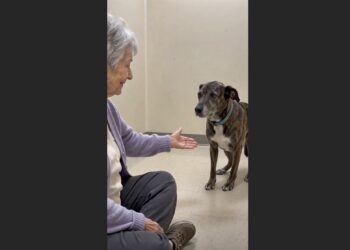
A small dark dog with a white patch on his chest was pressed into the back corner.
His name was Mason.
And while Claire stood in the hallway, he watched her carefully without moving any closer.
Grief Had Made Everything Feel Heavy
Claire’s mother had died in the spring.
Since then, Claire had spent weeks working through the practical tasks that follow a loss.
Some days she managed an entire cabinet.
Other days she opened a drawer, looked at the contents, and closed it again.
Nothing about the process felt efficient.
A sweater could stop her for twenty minutes.
A handwritten grocery list could be harder to throw away than something valuable.
Even the familiar smell of a linen closet could bring back a memory she had not expected.
The towels were different.
They were ordinary, worn, and useful.
Giving them away did not feel like erasing anything.
Instead, bringing them to the shelter felt almost constructive.
For once, an object leaving her mother’s house could still serve a purpose somewhere else.
That mattered more than Claire expected.
She handed over the bag.
Then came the question.
Did she want to see the dogs?
Mason Was in the Last Kennel
Claire followed the worker down the hallway.
Some dogs came immediately toward their kennel doors.
Others barked when people passed.
A few bounced against the gates with the kind of energy that made their whole bodies move.
Mason did none of those things.
He stayed toward the back.
The dog was small, dark-coated, and marked by a white patch on his chest. Above one eye was a healing scar.
He did not growl.
He did not bark.
He simply watched.
The shelter volunteer explained that Mason had arrived without a collar.
No microchip had been found.
There was no easy way to know exactly where he had come from or what his life had looked like before the shelter.
The scar above his eye was healing, but nobody could say for certain how he had gotten it.
That uncertainty mattered.
Fearful behavior does not automatically prove abuse, and shelter staff could not responsibly invent a history for Mason simply because he was cautious around people.
All they knew was what he showed them now.
He preferred distance.
He Wasn’t Difficult
The volunteer was careful when describing him.
Mason was not aggressive.
He was not considered a problem dog.
He was simply wary.
When unfamiliar people stopped near his kennel, he often remained where he was.
Some dogs cope with shelter life by becoming louder.
Others become quieter.
Mason belonged to the second group.
He seemed to make himself small.
Claire recognized something in that.
Not because she believed she understood what Mason had experienced.
She did not.
But she understood the impulse to retreat from a world that suddenly felt too full.
For weeks, people had been asking Claire questions.
How are you doing?
Have you finished the house yet?
Are you keeping the furniture?
What are you going to do next?
Most of them meant well.
Still, there were days when Claire wanted everyone to stop asking.
Mason did not ask anything.
He sat in the corner.
Claire stood in the hallway.
And for some reason, she did not feel ready to leave.
Claire Asked If She Could Sit Nearby
“Could I just sit with him for a little while?”
The volunteer agreed.
Claire did not enter the kennel.
Instead, she sat outside where Mason could see her without having to interact.
At first, nothing happened.
The dog stayed pressed toward the back.
Claire rested her hands in her lap.
She did not call his name repeatedly or reach through the bars.
There was no treat involved.
No attempt to coax him into doing something that would make her feel successful.
She simply sat.
Mason watched.
The shelter continued around them.
Doors opened.
Dogs barked farther down the hallway.
Someone rolled a cart past.
Claire remained where she was.
Eventually, it was time to leave.
Mason had not come closer.
Still, as Claire walked away, she found herself thinking about him.
She Returned With a Book
A few days later, Claire came back.
She told herself she was only checking on Mason.
That explanation was technically true.
Still, she had brought a book with her.
Sitting outside a kennel without speaking had felt awkward the first time. Claire wanted something to do that would not require Mason to respond.
Reading seemed simple enough.
So she returned to the same spot.
Mason was still cautious.
Claire opened the book.
Then she began reading aloud.
Her voice stayed low.
She was not performing for him.
There was no reason to make the story dramatic.
She simply read at the pace she would have used at home.
Mason remained toward the back.
Every so often, Claire glanced up.
He was still watching.
For the first time in weeks, reading did not feel lonely.
The Empty Rooms Had Been Following Her
Since her mother’s death, quiet had taken on a different quality.
Claire’s own house was quiet in the evenings.
Her mother’s house was worse.
There, silence seemed to cling to everything.
No footsteps came from another room.
No television played in the background.
No voice called out from the kitchen.
Sorting through belongings meant spending hours surrounded by evidence that someone had once been there.
Then returning home meant carrying the silence with her.
The shelter was not quiet.
Far from it.
Dogs barked.
People talked.
Metal doors clicked open and shut.
Yet while Claire sat beside Mason’s kennel and read, she felt less alone than she had in a long time.
Mason did not approach.
He did not need to.
His presence was enough.
Claire Came Back Again
There was no formal plan.
Claire simply returned.
Then she returned again.
Each visit followed a similar pattern.
She sat in roughly the same place.
Sometimes she brought a book.
Other times she spoke softly about nothing important.
Mason remained cautious.
Claire never crawled toward him.
She did not put her hands into his safe space or try to force physical contact.
Instead, she let him decide how close he wanted to be.
That meant some visits seemed almost identical to the one before.
Still, small changes began to appear.
Mason stayed visible more often.
His posture seemed less compressed.
Sometimes he watched Claire without appearing ready to retreat farther into the corner.
None of those things looked dramatic.
They did not need to.
For a fearful dog, progress is often measured in inches.
One Day, Mason Took a Treat
After several visits, Claire held out a treat.
Her hand stayed still.
Mason watched it.
For a while, he did nothing.
Then he shifted forward.
Claire did not move the treat closer.
Mason took another small step.
Eventually, he reached her.
He stretched his neck toward her hand, took the treat, and backed away.
Claire smiled.
That was all.
She did not reach for his head.
She did not try to pet him because he had accepted food.
Taking a treat was one decision.
Allowing touch would be another.
Claire respected the difference.
The next time she visited, she sat down as usual.
There was no expectation that Mason now owed her more.
A Few Visits Later, He Stood Up
The changes remained small.
Then one afternoon, Claire entered the shelter hallway.
Mason was lying in his usual area.
When he saw her, he stood.
That was new.
Claire noticed immediately.
Again, she did not make a celebration out of it.
She approached the kennel at the same pace.
Then she sat.
Mason remained standing for a while before settling closer than he had during those first visits.
Claire opened her book.
The routine continued.
By then, shelter workers had noticed the pattern too.
Mason behaved differently when Claire arrived.
He did not suddenly become outgoing with everyone.
Nor did the staff claim that his fear had disappeared.
He was still a cautious dog.
But around one familiar person, his choices were changing.
Claire Was Changing Too
The visits gave Claire something she had not been looking for.
Structure.
There was now a reason to leave the house that had nothing to do with paperwork, donations, or cleaning out another drawer.
Mason did not know about Claire’s mother.
He could not understand why she sometimes paused in the middle of a page.
He had no idea that the book in her hands occasionally blurred because she had remembered something.
That made the arrangement strangely easy.
Claire did not need to explain herself to him.
She did not need to answer whether she was “doing better.”
She could sit.
Read.
Wait.
And leave when it was time.
Mason seemed comfortable with the same terms.
Adoption Was Not an Immediate Decision
People later might have described the situation as though Claire knew from the beginning that Mason would become her dog.
She did not.
When she first saw him, she was still sorting through her mother’s belongings.
Her days already felt unstable.
Bringing home an animal would mean food, veterinary care, training, exercise, time, and responsibility.
A fearful dog could also require more patience than an easygoing one.
Claire considered all of that.
She asked questions.
The shelter staff talked with her about Mason’s behavior.
They discussed the practical side of adoption rather than relying on emotion alone.
Claire went home and thought about it.
Then she came back.
Eventually, she applied.
The Night Before, She Bought a Blue Leash
Even after the shelter told her the adoption was moving forward, Claire had trouble believing it completely.
Maybe that came from the months she had just lived through.
After enough loss, good things can feel temporary before they even arrive.
Still, the night before the adoption was finalized, Claire stopped at a store.
She bought a soft blue leash.
The shelter had plenty of leashes.
Claire knew that.
She bought one anyway.
At home, she placed it inside her purse.
Then she spent the evening trying not to imagine too much.
Mason still had choices to make.
Approval did not mean he would suddenly behave like a confident dog the moment paperwork was signed.
Claire understood that.
She wanted to bring him home.
She did not want to rush him there.
The Staff Offered to Bring Mason Out
On adoption day, the shelter workers were ready to help.
They offered to bring Mason into the lobby.
Claire thought about it.
The lobby was busier.
There would be more movement, more open space, and more unfamiliar activity.
Instead, she asked if she could go to him.
That was the routine Mason knew.
Claire walking toward his kennel.
Claire sitting down.
Claire waiting.
So they agreed.
She entered the kennel quietly.
Then she sat on the floor.
Mason remained toward the back.
Claire held out one hand.
“Hi, Mason,” she said. “It’s just me.”
He Stayed in the Corner
For a moment, Mason did not move.
Claire waited.
The adoption had been approved.
The leash was in her purse.
People outside the kennel knew the plan.
None of that meant Mason had to hurry.
He stood in the corner and watched her.
Claire kept her hand where it was.
No treat.
No coaxing.
No pressure.
Then Mason shifted his weight forward.
One careful step.
He stopped.
Claire did not reach farther.
Another step.
Again, Mason paused.
His movements were slow enough that every one of them looked deliberate.
It was tempting to interpret that as the dog asking permission.
More realistically, he was gathering information and deciding whether to continue.
Claire gave him the time to do that.
There Was No Treat in Her Hand
Eventually, Mason came close enough to sniff Claire’s fingers.
This time, there was no food waiting.
He touched his nose to her hand.
Claire stayed still.
For a second, Mason simply stood there.
Then he moved closer.
The small dog leaned his body against Claire’s knees.
No one in the hallway spoke.
The moment was quiet enough that Claire could feel Mason’s weight against her.
Weeks earlier, he had pressed himself into the back corner when people approached.
Now he had crossed the space voluntarily.
That difference mattered more than anything Claire could have made him do.
She lowered one hand and rested it gently against him.
Mason stayed.
The Hallway Went Quiet
Shelter workers had watched many adoptions.
Some dogs left with tails moving wildly.
Others seemed more interested in the exit door than the person holding the leash.
Every animal handled change differently.
Mason’s moment with Claire was quieter.
There was no burst of excitement.
No jumping.
No frantic celebration.
He simply leaned.
Claire looked down at him.
She knew the dog standing against her knees was still cautious.
Going home would not instantly erase that.
A house would bring unfamiliar rooms, appliances, doors, sounds, and routines.
There might be setbacks.
He might hide.
He might refuse food at first.
He might need days or weeks before sleeping openly in a room.
Claire was prepared to let those things take time.
She had become familiar with slow processes.
Claire Reached Into Her Purse
After a moment, Claire opened her purse.
She pulled out the blue leash.
A shelter worker reminded her that they had one available.
Claire smiled.
“I know.”
She had bought this one herself.
The night before, she had stood in the store looking at several options and chosen the soft blue one without knowing whether Mason would ever walk comfortably beside her.
Now she clipped it to his collar.
Her hands moved carefully.
Mason remained close.
Then Claire stood.
For the first time, they turned toward the hallway together.
Mason Walked Beside Her
Mason did not rush toward the exit.
He walked slowly.
Claire matched his pace.
Down the shelter corridor, his shoulder occasionally brushed against her leg.
The contact was light.
Still, Claire noticed every time.
Weeks earlier, Mason had tried not to be noticed in that same hallway.
Now he was walking through it beside the person who had spent visit after visit waiting for him to make the next move.
Claire did not pull the leash tight.
There was no need.
Mason remained close.
Together they passed the kennels.
Then they reached the lobby.
Then the door.
Outside waited a world Mason did not know yet.
Home Would Be Another Adjustment
Claire understood that getting Mason out of the shelter was not the end of the story.
It was the beginning of another period of waiting.
At home, she would need to give him space.
He would need a quiet place where he could retreat.
Meals would work best on a predictable schedule.
Visitors might need to ignore him rather than reach immediately for his head.
If Mason hid, Claire would not drag him out.
If he approached, she would let him set the pace.
Trust developed in the shelter through repetition.
The same principle would apply at home.
Day after day, Claire would show him what happened next.
Food arrived.
Doors opened and closed.
She left the room and came back.
Nothing frightening followed ordinary household sounds.
Over time, those patterns could become familiar.
Claire Had Learned Something About Going Slowly
Months earlier, Claire might have believed progress should look different.
She had thought clearing her mother’s house would be a task she could finish.
Instead, grief had refused to follow a schedule.
Some days she made progress.
Other days, one object stopped her completely.
Trying to force herself through it never seemed to help.
Mason had his own reasons for being cautious, reasons Claire might never know.
She did not pretend their experiences were the same.
But she understood something about needing time.
That may have been part of why she never demanded quick progress from him.
She knew what it felt like when other people seemed ready for you to move forward before you were.
Mason would not get that pressure from her.
The Blue Leash Became Part of Their New Routine
The leash Claire had bought became one of the first objects that belonged to their life together.
Not her mother’s house.
Not the shelter.
Theirs.
Each time Claire clipped it to Mason’s collar, they practiced another small routine.
The door.
The walk.
The return home.
At first, Mason stayed close.
Unfamiliar noises made him pause.
Claire let him look.
She did not drag him forward unless safety required movement.
Gradually, the outside world became less new.
The same street appeared again.
The same front door opened.
The same person remained at the other end of the leash.
Predictability did what dramatic gestures could not.
It gave Mason information.
Neither of Them Needed to Be Fixed
It would have been easy to turn their story into something simpler than it was.
Claire rescued Mason.
Mason healed Claire.
But relationships do not work that neatly.
Mason could not erase Claire’s grief.
The loss of her mother remained real.
There would still be difficult anniversaries, unexpected memories, and boxes she was not ready to open.
Likewise, Claire could not make Mason’s caution disappear through affection alone.
He would need time, consistency, and perhaps support tailored to whatever behaviors appeared.
What they could give each other was companionship.
Routine.
Presence.
A reason to keep moving through the next part slowly.
That was enough.
The Last Kennel Was Empty
The shelter hallway eventually returned to its normal routine.
People passed through.
Dogs barked.
Leashes clicked onto collars.
Towels were folded and used where they were needed.
At the far end, Mason’s old kennel stood empty.
Claire had entered the building weeks earlier carrying a bag of things from a life she was still trying to let go of.
She had not come looking for anything to take home.
Then she saw a small dog trying to disappear into a corner.
She sat near him.
She came back.
She read.
She waited.
One day, Mason took a treat.
Another day, he stood when she arrived.
Finally, with no treat in her hand and no pressure pulling him forward, Mason crossed the kennel on his own and leaned against her knees.
Claire clipped on the blue leash.
Then they walked out together.
His shoulder brushed her leg all the way down the hallway.
Maybe neither of them had been ready for someone new when they first met.
Fortunately, neither one asked the other to hurry.
Editor’s Note: The characters in this story are fictional. Through these stories, we hope to share the intelligence, loyalty, compassion, and loving nature of dogs with people everywhere.