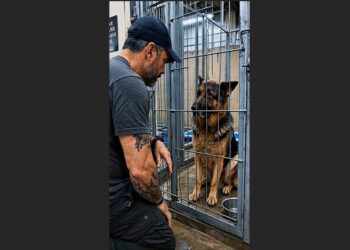
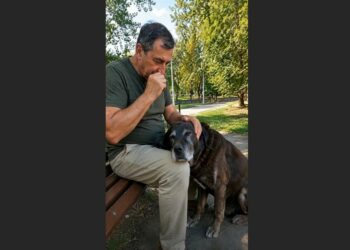
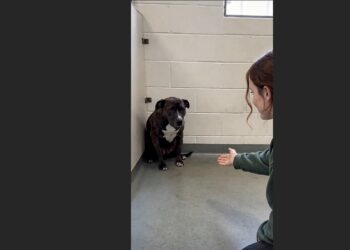
The retired K9 stood quietly in the shelter hallway while a staff member held his leash.
By then, workers knew exactly what to expect from him.
He walked when they asked him to walk. He waited when they stopped. He ate his meals, rested in the place provided for him, and rarely caused any trouble.
Years of training seemed to remain in his body.
Yet something about him had changed.
The German Shepherd followed the shelter’s routines without resisting them, but there was little enthusiasm in the way he moved through his days. Visitors came and went. Doors opened. Footsteps echoed along the hallway.
He noticed people, but seldom showed much interest.
Instead, workers often saw him looking toward the far end of the corridor.
They could not know exactly what he expected to find there.
Then, one afternoon, an older man appeared.
The change in the dog was immediate.
He Still Remembered How to Work
A trained working dog does not simply forget years of repetition because his circumstances change.
The shepherd still responded to handling.
When someone clipped on his leash, he understood how to move beside them. When asked to wait, he waited. He did not drag shelter workers through doorways or become difficult around the kennel area.
In many ways, he was one of the easier dogs to manage.
That made the quieter changes more noticeable.
A working dog often spends years paying close attention to one person. Voice, posture, hand movements, walking pace, equipment, routines, and repeated commands all become part of the partnership.
When that structure disappeared from this dog’s life, the shelter gave him another routine.
It was safe.
It was predictable.
But it was not the same.
He did what people asked.
The energy that workers expected from him rarely followed.
Shelter Life Asked Very Little of Him
His days became simple.
Meals arrived at regular times.
There were walks.
There was cleaning, rest, and interaction with the people caring for him.
Occasionally, visitors stopped to look at him.
The shepherd behaved well through all of it.
He did not seem interested in competing for attention with the dogs who rushed toward their kennel doors. Nor did he bark whenever somebody unfamiliar entered the hallway.
He watched.
Sometimes he walked beside a staff member without much expression, his movements controlled and practiced.
At other times, he settled quietly.
Yet one behavior kept drawing attention.
The dog often looked down the corridor.
Shelter workers began to wonder whether some part of his old routine remained stronger than the new one.
They could only speculate.
Dogs cannot tell people whom they are waiting for or whether they are waiting at all.
Still, everyone could see where his attention repeatedly went.
Toward the hallway.
Toward arriving footsteps.
Toward people who kept turning out to be strangers.
Visitors Came and Went
The shelter did what shelters do.
People arrived hoping to meet dogs.
Some walked slowly along the kennels. Others already knew what size, age, or temperament they wanted.
The retired K9 drew attention because of his appearance and training.
He was composed.
He walked nicely.
He was accustomed to human direction.
However, living with a former working dog involves more than admiring his discipline. His age, history, exercise needs, health, and ability to adjust to civilian life all mattered.
So staff answered questions honestly.
Visitors met him.
Some spent time nearby.
Then they left.
The shepherd returned to his routine.
Nothing dramatic happened when they walked away.
He simply continued through another day.
The Spark Workers Hoped to See Never Quite Appeared
Shelter workers did not expect every dog to greet strangers enthusiastically.
Temperament varies, and a dog entering an unfamiliar environment may need time before showing much of his normal personality.
Still, the shepherd’s emotional flatness was difficult not to notice.
He was cooperative rather than engaged.
He participated rather than sought people out.
If someone asked him to walk, he walked.
If a person stopped, he stopped.
His behavior was almost professional.
Perhaps that made sense for a dog whose life had once depended on structure.
Yet workers kept hoping to see him choose something for himself.
A person.
A toy.
A destination.
Anything that made his body loosen and his attention brighten.
For a long time, very little did.
Then came the afternoon when he was standing in the hallway and looked toward the far end.
An Older Man Entered the Corridor
At first, the scene appeared ordinary.
A shelter worker held the shepherd’s leash.
Someone had entered the hallway.
There was enough distance between them that the man was still several moments away.
Then the dog’s ears lifted.
His posture changed.
The difference was so quick that the person holding the leash noticed immediately.
The shepherd had spent weeks watching people move through this same space without much reaction.
This time, his entire body seemed to become alert.
His head came up.
His focus narrowed.
A moment later, he began moving forward.
The leash tightened.
His Attention Stayed on One Person
Curiosity usually allows room for distraction.
A dog may investigate a sound, glance toward another person, or stop to smell something nearby.
The shepherd did none of that.
His attention remained fixed on the man approaching from the other end of the hallway.
The staff member holding his leash moved with him, trying to keep the approach controlled.
The dog increased his pace.
Years of working-dog training had not disappeared. Yet at that moment, the careful, subdued shepherd shelter workers had come to know looked different.
He was pulling.
His ears remained forward.
Every few steps seemed to increase his urgency.
Whatever he had detected about the approaching man mattered more than everything else around him.
Recognition Can Begin Before Contact
Dogs have several ways to identify familiar people.
Scent is especially important. Hearing also matters, as do body movement, posture, visual cues, and learned routines.
Researchers have found that dogs can distinguish familiar human voices and can form strong associations with people who have been part of their daily lives.
For a working dog and handler, those associations may involve thousands of repetitions.
A particular walking rhythm.
A voice giving commands.
The sounds of equipment.
Hours spent in vehicles.
Training fields.
Daily care.
Quiet time after work.
We cannot know which cue reached the shepherd first in that hallway.
Perhaps the man’s appearance was enough at that distance.
Maybe movement or scent contributed as they came closer.
What was clear was the dog’s behavior.
He had not reacted that way to the other visitors.
Now he was straining toward one particular person.
The Leash Went Tight
The shelter worker kept hold of the leash while the shepherd continued forward.
There was no aggression in the movement.
His body showed urgency, but his attention remained focused.
The person handling him did not simply drop the leash and allow a large dog to run uncontrolled through the shelter.
Instead, they moved with him.
The man at the other end continued approaching.
The distance shortened.
For the shepherd, that seemed to make waiting harder.
His pace quickened again.
The dog who had spent so many days moving only when someone directed him was now making his preference unmistakable.
He wanted to reach the man ahead of him.
Then the Man Spoke
Eventually, they were close enough for the older man to speak directly to him.
“Hi, boy,” he said. “It’s me. I missed you so much.”
The shepherd already appeared intensely focused on him, but the familiar voice added another cue.
His excitement increased.
To anyone watching, the encounter did not resemble an introduction.
There was no cautious period in which the dog circled a stranger and gathered information.
He did not hang back.
He did not divide his attention between the staff member and the man.
Instead, he continued trying to close the remaining distance.
For shelter workers accustomed to seeing him quietly follow routine, the difference was unmistakable.
Something familiar had returned.
Years of Training Build More Than Obedience
Working dogs are often discussed in terms of what they can do.
Track a scent.
Search a building.
Find a missing person.
Detect substances.
Follow commands in distracting environments.
Those abilities depend on training, repetition, reinforcement, and the dog’s natural strengths.
Yet the relationship with a handler often extends beyond individual commands.
The same two partners may work together day after day.
The handler learns how the dog signals uncertainty, excitement, fatigue, and focus.
The dog learns countless details about the handler too.
A slight movement can become meaningful.
A shift in voice may predict what comes next.
Even when they are not actively working, the partnership continues through feeding, grooming, transportation, exercise, and rest.
Over years, those repetitions create familiarity that cannot be reduced to a single command.
The Shelter Had Given Him Safety, Not His Old Life
Nothing about the shepherd’s quiet behavior meant the shelter had failed him.
Workers had provided food, handling, exercise, and a stable routine.
Those things mattered.
However, a safe environment cannot recreate every relationship a dog once had.
The shepherd had learned how the shelter worked.
He knew when meals arrived.
He knew the route used for walks.
He recognized staff members.
Still, his previous life contained experiences those routines could not reproduce.
Most importantly, it had contained a person with whom he had spent years working.
When that person appeared again, the difference showed in the dog’s body before anyone needed to explain it.
He Did Not Need to Understand the Circumstances
Dogs do not understand career changes, retirement paperwork, shelter placement, or the complicated human events that sometimes separate them from familiar people.
The shepherd could not know why his old handler had been absent.
He could not know how much time had passed in the way people mark months and years.
Nor could he understand what the man’s appearance might mean for the future.
But none of that was necessary for recognition.
Dogs live through associations and experience.
A familiar scent can remain familiar.
A known voice can still matter.
Repeated interactions can leave strong memories.
Whatever combination of cues the shepherd encountered that day, his response suggested that the man was anything but a stranger.
The Quiet Dog Was Suddenly Animated
Shelter workers had become accustomed to the dog’s restraint.
Now the shepherd was almost unrecognizable.
His movements carried purpose.
Instead of simply accompanying the person holding his leash, he seemed to be leading the way.
The dog was not scanning the room anymore.
He was not looking down the corridor in the vague way workers had noticed before.
His destination was now specific.
One person.
One familiar voice.
One approaching figure.
The change did not require sentimental interpretation.
They could see it.
Reunion Does Not Erase Everything That Came Before
A powerful reunion can make it tempting to imagine that every difficult part of the dog’s shelter experience vanished in a single second.
Real behavior is more complicated.
Even after recognizing a former handler, a dog may still need time to adjust to whatever comes next.
Routines have changed.
The dog is older.
The human may be older too.
Health, housing, mobility, and practical care needs may be different from what they once were.
A retired working dog cannot simply return to an earlier chapter of life exactly as it was.
However, a reunion can restore one thing immediately.
Familiarity.
The man did not need to become a new person in the dog’s world.
He had already been there.
Nobody Needed to Tell the Dog What to Do
For most of his shelter stay, the shepherd had responded when asked.
This time, no command created his reaction.
No one pointed at the man.
Nobody instructed him to become excited.
His response came before anyone around him fully understood what was happening.
That difference was what made the moment powerful.
The shepherd was not performing an exercise from training.
He was responding spontaneously to a familiar person.
His body tightened.
His ears came up.
He pulled forward.
Once the man spoke, the dog’s focus became even clearer.
Whatever explanation people later gave the scene, those behaviors were observable.
They did not need embellishment.
A Bond Built Through Repetition
People sometimes describe a working dog’s loyalty as though it were mysterious.
Usually, the foundation is much more practical.
Time.
Training.
Consistency.
Trust.
Thousands of shared experiences.
A handler repeatedly becomes the person who provides direction, rewards, care, transportation, and security.
The dog repeatedly learns that person’s signals.
Day after day, those associations deepen.
That does not mean a dog can never bond with someone new.
Retired working dogs can adjust to new homes and form strong relationships with other people.
But forming a new bond does not necessarily erase an older one.
Memory is not a limited container.
A dog can learn a new routine while still responding powerfully to someone who once occupied an important place in his life.
The shepherd in the hallway seemed to demonstrate exactly that.
The Corridor Became Something Else
Minutes earlier, it had been an ordinary shelter hallway.
A staff member held a leash.
A dog waited.
Another visitor was arriving.
Then the shepherd saw the older man.
Suddenly, that same hallway contained years of history nobody else could see.
Training sessions.
Commands repeated hundreds of times.
Vehicle rides.
Working days.
Quiet hours afterward.
Whatever experiences the two had once shared remained part of their individual histories, even after circumstances separated them.
Now the physical distance between them was disappearing.
With every step, the dog’s behavior grew more animated.
By the time they were close enough to meet, little doubt remained that the man was familiar to him.
“I Missed You So Much”
The older man’s words were simple.
“Hi, boy. It’s me. I missed you so much.”
There was no long explanation.
The dog did not need one.
Human beings often feel compelled to explain separation when they reunite.
Why something happened.
Why it took so long.
Why life changed.
A dog cannot follow those explanations in the same abstract way.
What matters to him is what is present now.
The familiar voice.
The familiar body.
The familiar scent.
The chance to move closer.
That afternoon, all of those things came together in a shelter hallway.
The Dog Answered With His Body
The shepherd could not say that he remembered.
He could not describe what those years of partnership had meant.
Instead, his response appeared in movement.
The lifted ears.
The sudden tension in his body.
The determined pull against the leash.
The complete loss of interest in everything except the approaching man.
Those signals came before any reunion could be explained by the people watching.
His behavior changed first.
That is often how dogs communicate the things humans later put into words.
What the Shelter Workers Had Been Seeing
Afterward, the staff may have thought differently about all those days the shepherd looked down the corridor.
It would be tempting to say he had spent every afternoon waiting specifically for his former handler.
There is no way to know that.
Perhaps he was watching movement.
Maybe hallway sounds had become part of his routine.
Perhaps certain footsteps repeatedly caught his attention.
Still, the contrast remained striking.
For weeks, he had looked toward arriving people and then returned to the quiet pattern of shelter life.
This time, someone appeared and the pattern broke immediately.
The dog came alive before anyone asked him to.
That was enough.
Loyalty Does Not Need a Myth
There is no need to say the shepherd somehow knew his handler would return.
Nor is there a reason to suggest that working dogs possess a supernatural sense of human relationships.
The reality is more grounded and, in many ways, more meaningful.
Dogs remember.
They learn through repetition.
They form attachments.
They recognize familiar scents, voices, and movements.
A working partnership can provide years of all those things.
Time apart may change routines, but it does not automatically erase what came before.
When the older man appeared in the hallway, the shepherd responded with the tools dogs actually have.
Attention.
Movement.
Scent.
Memory.
Excitement.
Proximity.
The Dog Who Had Been Going Through the Motions
Until that afternoon, the shepherd had been doing what was expected of him.
Eat.
Walk.
Rest.
Follow.
Wait.
The structure remained, even though the old purpose behind it had disappeared.
Then someone from that earlier life entered the building.
For a few seconds, discipline gave way to something much more spontaneous.
The dog pulled.
The leash tightened.
His attention narrowed to one person.
To shelter workers, it was perhaps the first time in a long while that the shepherd looked entirely invested in where he was going.
He was not walking because someone asked.
He was trying to get somewhere because he wanted to.
Some Relationships Survive the Distance
Life changes for people and dogs alike.
Handlers retire.
Dogs retire.
Families move.
Health changes.
Circumstances separate animals from people who once seemed inseparable from their routines.
A dog adapts because dogs often have little choice except to adapt.
He learns the next room.
The next person holding the leash.
The next feeding schedule.
The next place to sleep.
Adaptation, however, does not require forgetting.
The shepherd had learned shelter life.
Then an older man appeared at the far end of the corridor, and something much older came forward.
The dog lifted his ears.
His body tightened.
He began pulling toward him.
Then the voice reached him.
“Hi, boy. It’s me. I missed you so much.”
No speech was needed from the dog.
He answered in the only way available to him.
He kept moving forward.
Editor’s Note: The characters in this story are fictional. Through these stories, we hope to share the intelligence, loyalty, compassion, and loving nature of dogs with people everywhere.