The chain was only six feet long.
I remember that because I measured it twice.
Six feet of rusted metal, fastened to a wooden post in the middle of a backyard that had almost nothing growing in it.
The grass had disappeared years ago. All that remained was a worn circle of dirt, a dented water bowl, and a patch of ground where a dog had apparently spent most of his life sleeping.
At the end of that chain stood a pit bull.
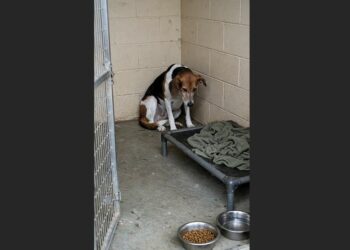
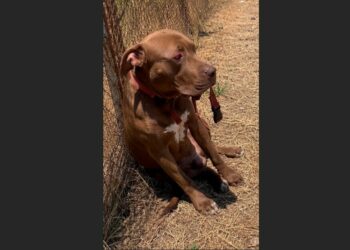
He was thin, but not starving. His coat was dry and rough from years of exposure to the weather. Around his neck, the collar had rubbed away patches of fur, leaving angry, irritated skin underneath.
He watched me approach without barking.
That was what struck me first.
I had worked in animal control for twelve years. I’d met dogs who lunged at strangers, dogs who cowered so badly they couldn’t stand, and dogs who seemed to have forgotten what a human hand was supposed to feel like.
But this one simply looked at me.
Quietly.
As though he’d been waiting so long that he’d forgotten there was anything else to do.
My name is Jordan.
And that morning, at exactly 11:47, I’d received a phone call that would stay with me for the rest of my career.
The woman on the other end sounded frightened.
“There’s a dog chained behind the house next to my apartment,” she said. “He’s been there forever. I think something’s wrong with his neck.”
I asked her how long she’d been seeing him.
There was a pause.
“Almost two years.”
I stopped writing.
“Two years?”
“Yes.”
“Has he been inside during that time?”
“Not that I’ve ever seen.”
She lowered her voice before continuing.
“People say he’s dangerous. And the man who owns him has a temper. I didn’t want trouble.”
I could hear how difficult the call was for her.
“What’s your name?” I asked.
“Naomi.”
“All right, Naomi. I’m going to come take a look.”
She gave me the address.
Before hanging up, she asked one more question.
“Will he know it was me?”
I understood what she meant.
“We’ll handle the complaint through the proper channels,” I told her. “For now, stay inside until we know what’s going on.”
Then I picked up my keys.
I didn’t know it yet, but that call would change three lives.
The dog’s.
Naomi’s.
And mine.
When I arrived, the yard looked worse than I’d imagined.
The house was small, with dark windows and peeling paint along the back steps. An old wooden fence separated the property from Naomi’s apartment building.
There was no doghouse.
No proper shelter from the rain.
Only that wooden post, the six-foot chain, and the bare circle of earth.
The pit bull lifted his head as I approached the fence.
I stopped several feet away.
“Hey there, sweetheart.”
His ears moved.
I could see the muscles in his shoulders tightening, but he didn’t growl.
I spoke softly while assessing the situation and completing the required steps for the inspection.
His water bowl contained murky water.
The ground around the post was damp from the previous night’s rain.
When he shifted his weight, I noticed the raw skin beneath his collar.
I had seen injuries like that before.
They develop when a dog spends too much time restrained, especially when a collar rubs against the same areas day after day.
Some animals pull against the chain until their necks become injured.
Others stop pulling altogether.
This dog barely moved.
I crouched a short distance away.
“Nobody’s asking you to do anything right now.”
He watched my hands.
I let him sniff the back of my fingers before attempting to examine him.
He leaned forward just enough for his nose to touch my skin.
Then he drew back.
Not aggressively.
Cautiously.
As though kindness were something he had no experience accepting.
I looked at the chain.
Then at the worn circle in the ground.
For two years, this had been his entire world.
He could take a few steps toward the house.
A few toward the fence.
He could walk around the post until the chain tightened.
And then he had to stop.
I wondered how many times he’d watched birds land beyond his reach.
How many summer evenings he’d heard other dogs barking somewhere down the street.
How many cold nights he’d curled against that wooden post because there was nowhere else to go.
I couldn’t know the answers.
But I knew he needed help.
The Moment the Chain Fell
After documenting the conditions and proceeding under the authority of the response, I carefully loosened the damaged collar and removed the chain.
The metal dropped into the dirt.
For a moment, nothing happened.
The dog looked down at it.
Then he looked at me.
I waited.
Most people imagine a neglected dog running the instant he’s freed.
Sometimes that happens.
A dog bolts toward the first open space, desperate to put distance between himself and the place where he’s been confined.
But this pit bull didn’t run.
He stood still.
I took a small step backward, giving him room.
“Go ahead,” I whispered.
He moved one paw.
Then another.
He walked forward until he reached me.
And stopped.
I crouched again.
He lowered his head.
Then, with a slow movement that caught me completely off guard, he rested it across my knees.
I sat down in the damp dirt.
I hadn’t intended to.
One moment I was crouching beside him; the next, I was sitting with this enormous, exhausted dog’s head in my lap.
His fur felt rough beneath my fingers.
I could feel his ribs under his coat, but he wasn’t dangerously emaciated.
Someone had kept him alive.
They’d provided enough food for him to survive.
What seemed to have been missing was everything else.
Shelter.
Freedom to move.
Care for his injuries.
And the ordinary, affectionate attention most dogs spend their lives enjoying.
I rested my hand gently between his ears.
He sighed.
It was a long, tired sound.
Then he settled more of his weight against me.
I had to blink several times before I trusted myself to speak.
“There you go, sweetheart.”
He closed his eyes.
For twelve years, I’d worn an animal control uniform. I’d learned to keep my emotions steady because frightened animals need calm people around them.
But sitting there with that dog’s head on my knees, I felt my throat tighten.
He had been given his freedom.
And the first thing he chose to do was come closer to a person.
I called Naomi.
She had been waiting inside, just as I’d asked.
“The dog’s safe with me,” I told her. “Would you like to come outside?”
A few minutes later, she appeared beside the fence.
She was thirty-two, with long hair and the tired expression of someone who had been worrying about something for a very long time.
When she saw the pit bull sitting beside me without his chain, she stopped.
“Oh,” she whispered.
Then she covered her mouth.
I stood, keeping one hand near the dog’s shoulder.
Naomi stepped closer.
“I didn’t know what to do,” she said.
Her voice began shaking.
“I kept seeing him out here. In the summer, when it was so hot. And then in the winter. I thought somebody must be taking care of him.”
She wiped her face with her sleeve.
“People told me not to get involved. They said he was dangerous. And I was afraid of the owner.”
I nodded.
She wasn’t the first person I’d met who had struggled with that decision.
Reporting suspected neglect can feel frightening, especially when the animal’s owner lives nearby.
But Naomi had made the call.
And now the dog was sitting beside me with his head pressed against my leg.
“You did the right thing,” I told her.
She looked down at him.
“He’s not what everybody said.”
“No,” I said quietly. “He doesn’t seem to be.”
Then a door slammed behind us.
The Man at the Back Door
The owner stepped out of the house.
He was a broad-shouldered man in his fifties, and his expression changed the moment he saw the chain lying on the ground.
“Who are you?”
I turned toward him.
“Officer Jordan, animal control.”
His eyes moved from my uniform to Naomi, then to the dog.
“What are you doing with my dog?”
“We received a complaint about the conditions in this yard. I’m investigating the animal’s welfare.”
He came down the steps.
“That dog belongs to me. He’s been out here for two years. Never hurt anybody.”
I kept my voice calm.
“Sir, the conditions need to be addressed. His collar has injured his neck, he doesn’t have adequate shelter, and the restraint is severely limiting his movement.”
The man folded his arms.
“I feed him.”
“I can see he’s been fed,” I replied. “But feeding a dog isn’t the only part of caring for one.”
His face hardened.
“Take your hands off him and leave.”
Beside me, the pit bull reacted to the man’s voice.
His shoulders tightened.
The small movement of his tail stopped.
He lowered his head.
It was a change I couldn’t ignore.
A moment earlier, he’d been leaning against me.
Now he seemed to be trying to make himself smaller.
I looked down briefly, then returned my attention to the owner.
“Sir, I’ve documented conditions that support action under the applicable animal welfare rules. I’m removing the dog under the authorized process, and you’ll receive information about what happens next.”
For several seconds, nobody spoke.
Naomi stood near the fence.
The dog remained close to my leg.
The man stared at me.
Then he turned, walked back into the house, and slammed the door.
I waited until I was certain the confrontation was over.
Only then did I let out the breath I’d been holding.
Naomi looked at me.
“Were you scared?”
I gave her a tired smile.
“A little.”
She seemed surprised.
“Really?”
“Of course. I’ve been doing this twelve years. That doesn’t mean I never get scared.”
I looked down at the pit bull.
“It just means I know why I came.”
Getting him into my vehicle took some patience.
He was a heavy dog, and years of limited movement appeared to have left him unsure of his footing.
He watched the open door for a while before allowing me to help him inside.
Once he was settled securely, he leaned his head toward me.
I stayed beside him for a few minutes.
His breathing gradually slowed.
Through the window, I saw Naomi standing near her apartment.
She raised one hand.
I waved back.
Then I drove toward the shelter.
I kept thinking about the sound the chain had made when it hit the dirt.
A small metallic clatter.
Hardly the sort of noise anyone would remember.
But I knew I would.
Learning to Walk Without a Chain
The veterinarian estimated that the pit bull was about four years old.
Four.
He’d spent approximately half his life tied to that wooden post.
The injuries around his neck needed treatment, but the veterinarian expected them to heal with proper care.
His coat was in poor condition, and he needed a gradual program of nutrition, exercise, and rehabilitation.
But what worried me most was the way he behaved when I took him into the shelter’s exercise enclosure.
He wouldn’t wander away from me.
The area was safely fenced and much larger than the circle he’d occupied behind the house.
There was grass.
Space to move.
Room to investigate.
I unclipped his walking lead in the secure enclosure and stepped back.
He stood beside me.
“Go on,” I told him gently.
He took a few steps.
Then stopped.
He looked over his shoulder.
I moved toward a bench and sat down.
He followed.
I walked across the enclosure.
He stayed close.
Even when I tossed a soft toy a short distance away, he showed little interest.
I couldn’t know whether he had forgotten how to play or simply never had much opportunity.
But I had rarely seen a young adult dog so reluctant to explore.
I began spending a few minutes with him whenever my schedule allowed.
We walked slowly.
I let him stop and sniff.
If he seemed uncertain, I waited.
Sometimes he would take a few steps away from me before turning back.
Each time, I’d stay where I was.
Eventually, he began walking a little farther.
One afternoon, he discovered a patch of grass near the far fence.
He lowered his head and investigated it for several minutes.
Then he moved toward another patch.
And another.
I stood watching him, remembering the narrow circle of dirt behind the house.
For two years, a chain had decided how far he could go.
Now he was beginning to make that decision himself.
A few days later, he ran.
Not far.
Just a short, awkward burst across the grass.
But his tail rose, and for a moment, he looked like any other four-year-old dog enjoying an afternoon outside.
I took a photograph.
I didn’t know then how important that picture would become.
Three Weeks Later
While the pit bull recovered at the shelter, I prepared the case against his former owner.
I gathered the photographs from the yard.
The measurements of the chain.
The veterinary report.
Naomi’s statement.
And my own observations from the day of the rescue.
Animal cruelty charges were filed.
The hearing was scheduled for three weeks later.
I had been through court proceedings before, but I still disliked them.
Not because I doubted the importance of the work.
Because everything that mattered about an animal’s experience had to be translated into evidence.
Measurements.
Medical findings.
Photographs.
Descriptions of conditions.
You couldn’t ask a dog to explain what two years at the end of a chain felt like.
You had to show the court what could be documented.
The former owner arrived with an attorney.
He argued that the dog had been fed and had never seriously injured anyone.
He questioned whether the restraint had really caused harm.
When it was my turn, I described the yard.
The worn circle of dirt.
The lack of adequate shelter.
The injured skin beneath the collar.
And the dog’s difficulty moving confidently beyond the short distance he’d known for so long.
Then I presented the photograph from the shelter.
The pit bull was running across the exercise enclosure.
His ears were raised.
His tail was high.
And for that brief moment, the old chain no longer seemed to be part of his world.
The judge studied the evidence.
After considering the case, the court found the owner guilty of the cruelty charges.
He was ordered to pay a fine and prohibited from owning animals for five years.
I remember looking down at my notes when the ruling was announced.
For a moment, I couldn’t move.
I’d spent weeks preparing the case, worrying about the outcome and replaying that confrontation in the backyard.
Now it was over.
The man left without looking back.
I walked outside and sat on the courthouse steps.
The afternoon sun was low.
Cars passed along the street.
People hurried to their appointments, carrying papers and talking on their phones.
Life continued around me as though nothing unusual had happened.
And perhaps, to most of the world, nothing had.
But one dog would never have to go back to that yard.
And one person had finally been held accountable for the conditions in which he’d been kept.
I didn’t feel like celebrating.
No court decision could give that animal back the two years he’d lost.
But it could help protect what remained of his life.
For that afternoon, it was enough.
The Couple Who Chose Him
A few weeks later, a young couple came to the shelter.
They had recently lost their previous dog to old age.
They weren’t looking for a puppy.
They wanted a companion who might enjoy a quieter home and the ordinary comforts of family life.
I introduced them to the pit bull.
He had improved considerably by then.
His neck was healing.
His coat was beginning to look healthier.
And he’d learned that a leash could mean a walk instead of confinement.
Still, he was cautious with unfamiliar people.
When the couple entered, he looked toward me.
Then back at them.
The woman crouched a short distance away.
She didn’t reach over his head or call him repeatedly.
She simply waited.
The dog approached slowly.
Sniffed her hand.
Then sat beside her.
After a moment, he rested his head against her knees.
The woman began to cry.
Her husband smiled and crouched beside them.
“Well,” he said, “I think we’ve found our dog.”
I looked at the pit bull.
He was leaning comfortably against someone he’d only just met.
I thought about the day he’d rested his head on my knees in that backyard.
And how little he’d asked of me.
Not food.
Not a toy.
Just a moment of gentleness.
The couple completed the adoption process.
They told me they wanted to give him a new name.
“Joy,” the woman said.
I smiled.
For a dog whose life had been so restricted, I couldn’t imagine a better one.
A House Without a Chain
Today, Joy lives in a home with a large fenced yard.
There is no wooden post in the middle of it.
No six-foot chain.
No circle of bare dirt marking the limits of his world.
He sleeps on the couch.
He has a stuffed toy that he carries from room to room.
And when his family opens the back door, he can wander outside, explore the grass, and return when he’s ready.
His neck has healed.
His coat has grown back.
He has become stronger and more confident.
There are still things that frighten him.
Loud noises can make him startle.
Occasionally, he wakes during the night and checks where his people are.
His family understands.
They don’t expect him to forget his past simply because he’s now safe.
They give him time.
And according to the updates they’ve shared with me, he keeps making progress.
One photograph showed him asleep on the couch with his stuffed toy tucked beneath his chin.
Another showed him standing in the yard, watching a bird on the fence.
My favorite was a simple picture of him lying beside his new owners’ feet.
His body was relaxed.
His eyes were closed.
There was nothing extraordinary happening.
And that was exactly why I loved it.
For the first time in his life, Joy had ordinary days.
Breakfast.
Walks.
Naps.
Someone calling his name from the kitchen.
The little things most loved dogs take for granted.
Naomi still lives in the same apartment.
One afternoon, she called me after Joy’s new family sent her a photograph.
She sounded happier than I’d ever heard her.
“They told me he sleeps on their couch,” she said.
“He does.”
“And he has toys?”
“He has a favorite one.”
She laughed softly.
Then her voice changed.
“I keep thinking about that morning.”
“So do I.”
“I almost didn’t call, Jordan.”
I listened.
“I was so afraid of getting involved. I kept telling myself somebody else would do something.”
She was quiet for a moment.
“Then I looked out the window and saw him lying there again. It had rained all night.”
I could hear her taking a breath.
“I realized I couldn’t keep watching.”
“You made a difference,” I told her.
“I know that now.”
She paused.
“I think I needed to learn that.”
After we hung up, I sat at my desk looking at the photograph of Joy on the couch.
Naomi hadn’t been the person who cut the chain.
She hadn’t carried the dog to safety or testified as an animal control officer.
But none of those things might have happened without her phone call.
She had been frightened.
She had called anyway.
And because she did, Joy was sleeping in a warm house instead of on wet dirt.
The Things We Cannot Give Back
I’ve worked in animal control for twelve years.
I’ve seen enough neglect to know that not every rescue ends happily.
Some animals arrive too sick to recover.
Some cases take months to resolve.
And sometimes, despite everyone’s efforts, finding the right home is terribly difficult.
I wish I could say that every dog I meet eventually gets a comfortable couch and a family who loves him.
That isn’t the world I work in.
But Joy reminds me why I keep doing this job.
Not because his rescue was dramatic.
It wasn’t.
There were no flashing lights or crowds of people cheering.
There was a frightened woman making a phone call.
A tired dog sitting beside a post.
A rusted chain falling into the dirt.
And a moment when that dog, free to move wherever he wished, chose to rest his head on my knees.
I think about that moment often.
Especially on difficult days.
When paperwork piles up.
When someone tells me animal welfare isn’t worth the trouble.
When I go home exhausted and wonder whether my work changes anything.
I remember Joy.
I remember his neck healing.
The first time he ran across the shelter enclosure.
The photograph from court.
And the young couple who gave him a name that belonged to the life ahead of him instead of the one he’d left behind.
I don’t know what Joy understood that morning in the backyard.
Perhaps he was simply relieved to have the pressure of the chain removed.
Perhaps he was exhausted and wanted somewhere to rest.
Perhaps my voice sounded different from the voices he’d grown used to hearing.
I can’t put human thoughts into his head.
But I know what he did.
When I removed the chain, he didn’t run.
He came toward me.
And laid his head in my lap.
I sat with him for as long as I could.
The ground was damp.
My uniform got dirty.
And for several minutes, the only thing I could hear was the slow, steady sound of a dog breathing beside me.
He was four years old.
He had spent two of those years chained to a post.
Half his life.
Yet when someone finally offered him a gentle hand, he still had the courage to come closer.
Last week, his new family sent another photograph.
Joy was standing in their garden with his stuffed toy in his mouth.
Behind him, the grass stretched all the way to the fence.
There was room to run.
Room to stop.
Room to choose where he wanted to be.
I studied the picture for a moment before putting it on my desk.
Then I noticed something.
Joy wasn’t standing at the edge of the yard.
He wasn’t looking for a way out.
He was walking toward the back door.
Toward the house.
Toward the people waiting inside.
I smiled.
Two years earlier, someone had tied him to a post and decided that six feet of dirt was enough.
Now he had an entire yard.
And a family who called him inside because they wanted him near them.
People sometimes ask me what the best part of rescuing animals is.
They expect me to say it’s the moment we remove the chain.
Or when we win a case in court.
Those moments matter.
Of course they do.
But they aren’t my favorite.
My favorite part is what comes afterward.
When a dog who once had nowhere to go discovers that he can walk into the house whenever he wants.
When a frightened animal falls asleep beside someone and doesn’t wake at every sound.
When a dog who spent years surviving finally begins enjoying the simple business of being alive.
That’s what I see when I look at Joy.
Not the chain.
Not the courtroom.
Not even that first morning when he rested his head on my knees.
I see a dog carrying a stuffed toy toward the back door of a house where somebody is waiting for him.
And I think about the name his family gave him.
Joy.
Such a small word for such an enormous change.
At 11:47 that morning, I answered a call about a dog who had spent two years chained to a post. When I cut him free, he didn’t run away.
He came to me.
Now, when his family opens the door, he walks inside because he knows he belongs there.
And after everything he endured, that ordinary little moment is the ending I would have wished for him.
Editor’s Note: This is a fictionalized narrative adaptation of the French story provided, written in American English from Officer Jordan’s perspective. It preserves the 11:47 a.m. report, Naomi’s role, the pit bull’s two years on a six-foot chain, his response when freed, the confrontation with his owner, the veterinary examination, the court ruling and five-year ownership ban, and his adoption under the name Joy. Additional scenes, dialogue, and reflections have been developed for literary storytelling. The original account and legal proceedings have not been independently verified; the story should be read as a dramatized narrative rather than a documented animal cruelty case.