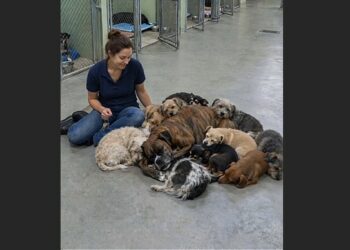
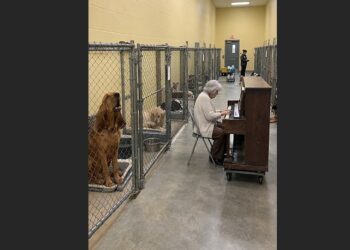
The fourth time Max was brought back to our animal shelter, he didn’t bark.
He didn’t pull against his leash or try to follow the family who had returned him.
He simply walked into kennel twelve, turned toward the back wall, and lay down.
I remember standing outside his gate, holding the paperwork that explained why another adoption had failed.
Too energetic.
Difficult to manage.
Needs more exercise than we can provide.
Different words, but the same message I’d seen in his file before.
Max was too much.
Too active. Too demanding. Too interested in everything around him.
He was a seven-year-old English Foxhound with long ears, a handsome face, and the kind of energy that made people forget he was no longer a young dog.
He loved running. He loved following scents. He loved being outside.
And apparently, none of the families who’d taken him home had been prepared for just how much he loved those things.
This time, something about his return felt different.
He didn’t come to the front of his kennel when I approached.
He didn’t lift his head when I said his name.
He stayed in the corner, staring at the floor.
My name is Clara, and I work at an animal shelter. I’ve seen dogs returned for all kinds of reasons. Some are legitimate, some are heartbreaking, and some could have been avoided if people had understood what they were adopting.
But Max was one of the dogs I worried about most.
Not because he was dangerous.
He wasn’t.
Not because he couldn’t learn.
He could.
I worried because he was a good dog whose needs kept being mistaken for character flaws.
And with every return, it seemed to become harder for him to trust that his next home would last.
That evening, after the other employees had gone, I sat outside his kennel with my back against the wall.
“Hey, Max.”
His ears moved.
I held out a treat.
He looked at it but didn’t come closer.
“You know,” I told him, “I think people have been asking you to be somebody you’re not.”
He lowered his head again.
I sat there for another twenty minutes.
Then I went to the office and asked for his adoption file.
I had a house, a fenced backyard, and a ten-year-old son named Leo who had more energy than most adults could manage.
I also knew exactly what kind of dog Max was.
Maybe that was what he’d been missing all along.
Someone who knew what they were getting into.
Someone who didn’t expect him to become quiet simply because he’d reached seven years old.
Two days later, I signed the papers myself.
And Max came home with me.
Our first night together wasn’t what I’d imagined.
I’d prepared a comfortable bed in the living room, with a thick cushion and a blanket I’d washed that morning.
Leo had selected a stuffed toy and placed it beside the bed.
He was so excited that I had to remind him three times to give Max space.
“He’s had a rough week, honey. Let him settle.”
Leo nodded solemnly.
Then whispered to Max that he could have the toy whenever he wanted.
But Max showed no interest.
He walked around the living room, sniffed the furniture, and eventually settled on the bare floor beside the front door.
His head rested between his paws.
His eyes stayed open.
Whenever a car passed outside, he lifted his ears.
When someone walked along the sidewalk, he raised his head.
He seemed determined to keep the entrance in sight.
I couldn’t help wondering whether he’d learned to associate new houses with another journey back to the shelter.
Maybe he expected someone to come for him.
Maybe the doorway simply felt like the safest place to watch an unfamiliar home.
Whatever the reason, he wasn’t ready to move away from it.
So I brought a blanket into the hallway and lay down a few feet from him.
I didn’t touch him.
I didn’t try to persuade him to use the dog bed.
I just stayed nearby.
The floor was harder than I remembered. After twenty minutes, my hip began to ache.
I shifted onto my side and looked at him.
“Well, Max, this isn’t exactly how I planned to spend my evening.”
One ear twitched.
I smiled.
“But I guess we’ve both had stranger nights.”
Sometime after midnight, I felt something warm touch my fingers.
I opened my eyes.
Max had moved closer.
Only a few inches.
But the tip of his nose was resting against my hand.
I didn’t move.
After a little while, his eyes closed.
And for the first time since I’d brought him home, he seemed willing to sleep without watching the door.
The Dog Who Needed Room to Run
Max didn’t settle into our household overnight.
There were chewed toys and overturned water bowls.
He discovered that kitchen counters sometimes held interesting smells, and that laundry baskets were apparently worth investigating.
He also had an impressive ability to become distracted by the smallest scent during our walks.
If a rabbit had crossed a trail three hours earlier, Max believed investigating that fact was more important than getting home for breakfast.
But he was affectionate.
He loved being near us.
And once he began to feel comfortable, his curiosity returned.
Every morning, before sunrise, I’d take him out for exercise.
On quiet trails near the edge of the neighborhood, he moved with an enthusiasm I hadn’t seen at the shelter.
His nose worked constantly.
His tail stayed high.
He seemed to notice every bird, every patch of damp earth, every movement in the grass.
Eventually, in a suitable open area where it was safe and permitted, I let him run freely under close supervision.
I’ll never forget the first time.
He stood still for a second, looking across the field.
Then he took off.
He ran through the tall grass as though he’d been waiting all his life for someone to tell him he could.
His ears bounced with every stride.
He leaped over a shallow stream, circled back, and went charging after something that turned out to be a butterfly.
I laughed until my sides hurt.
There was nothing wrong with that dog.
He was doing exactly what an English Foxhound was bred to do.
Move.
Explore.
Follow the world with his nose.
Of course, he needed training, boundaries, and enough exercise to keep him healthy and manageable.
But he wasn’t trying to make anyone miserable.
He was simply a spirited dog who needed a life that suited him.
When Max came racing back toward me, I crouched and opened my arms.
He slowed just enough to avoid knocking me over, then pressed his nose against my shoulder.
“You’re not too much,” I told him.
“You’re just Max.”
Leo fell in love with him almost immediately.
My son was ten, with scraped knees, a bicycle that never seemed to stay clean, and an endless supply of questions.
He and Max were well matched.
They both woke up ready to move.
They both loved being outdoors.
And neither of them understood why anyone would willingly spend a beautiful afternoon sitting inside.
On weekends, we’d walk the trails outside town.
Leo rode his bicycle while Max and I followed along the wider paths.
The two of them turned every outing into a competition.
Leo would pedal ahead, then look back over his shoulder.
“Mom! Max is winning!”
“He’s not racing you, honey.”
“Yes, he is!”
Max would trot beside the trail, tail moving, apparently delighted to be included.
For the first time in months, our house felt wonderfully busy.
I no longer came home to an empty living room.
Max waited near the door when I finished work.
Leo had someone eager to accompany him into the backyard.
And each evening, after enough exercise, our supposedly unmanageable dog stretched out on the rug and fell asleep before I finished putting away the dishes.
He wasn’t a perfect dog.
But he was ours.
I thought that was the happy ending to his story.
I had no idea what was coming.
The Sunday Everything Went Wrong
It happened on a bright Sunday morning.
The weather was beautiful, the kind of day that makes you decide breakfast dishes can wait until later.
Leo wanted to ride his bike along the dirt paths through the hills.
Max was already standing near the door, excited by the sight of his walking gear.
I packed some water and a few snacks.
Then we left.
It was a familiar route, with open fields on either side and a winding trail that rose toward a low ridge.
Leo rode ahead while Max and I followed.
I remember the sound of my son’s laughter.
He was shouting something about being faster than Max.
The dog looked toward him, then back at me, as though waiting for permission to join the game.
“Not today, buddy,” I told him, keeping him under control beside me.
We reached a small hill.
Leo pedaled to the top and turned around.
“Mom! Watch this!”
I looked up.
“Leo, slow down!”
But he’d already started downhill.
For a moment, everything looked normal.
Then his front wheel struck a large rock embedded in the dirt.
The bicycle stopped.
Leo didn’t.
He flew over the handlebars and landed several feet away in the dry grass.
The sound of the impact was awful.
Then he screamed.
I dropped what I was carrying and ran.
“Leo!”
He was lying on his side, his face pale and twisted with pain.
I knelt beside him.
“Don’t move, sweetheart. Just stay still.”
He was crying.
“Mom, my leg!”
I looked down.
His leg was bent at an angle no leg should ever make.
I felt the blood drain from my face.
I knew enough to understand that moving him carelessly could make the injury worse.
I tried to keep my voice calm.
“Look at me, Leo. You’re going to be okay. I’m right here.”
But my hands were shaking.
I reached into my pocket for my phone.
Nothing.
I checked the other pocket.
Then my bag.
And suddenly remembered.
My phone was sitting on the kitchen table.
I’d left it beside my coffee when we hurried out.
I looked around.
There was nobody on the trail.
No houses nearby.
No cars.
Just open fields, trees, and the long dirt path leading back toward the neighborhood.
I called for help.
Once.
Then again, louder.
No answer.
Leo was crying harder now, and I could see how frightened he was.
I wanted to pick him up.
Carry him.
Do something.
But I was afraid of hurting him further.
I sat beside him, trying to think.
And for the first time since becoming a mother, I felt completely helpless.
Then Max moved.
He’d been standing several feet away, watching us.
Now he came closer.
He lowered his nose toward Leo’s shoulder and made a soft whining sound.
Leo reached toward him.
“Max.”
The dog looked at my son.
Then toward the path we’d come from.
I was trying to keep Leo calm when Max suddenly turned and ran.
“Max!”
He didn’t stop.
I called again.
He disappeared down the trail.
For one terrible moment, I thought I’d lost him too.
I watched the last glimpse of his tail vanish beyond the bend.
Then I turned back to Leo.
“We’re going to get help, honey.”
I had no idea how.
But somewhere down that trail, Max was running.
And what he did next would become the story our family would tell for the rest of his life.
The Dog at Mrs. Gable’s Gate
Our neighbor, Mrs. Gable, lived near the beginning of the trail.
She was the kind of woman who always knew when someone in the neighborhood was sick and never arrived at a gathering without something she’d baked.
She also knew Max.
He’d greeted her on enough walks that she could recognize his bark from across the street.
That morning, she was at home when she heard frantic barking outside.
At first, she thought a dog was chasing something.
Then the barking continued.
Louder.
More insistent.
She went to the window.
Max was standing at her gate.
He was barking, scratching at the lower part of the fence, and moving back and forth toward the trail.
When she stepped outside, he ran several yards away.
Then stopped and looked back.
“Max? What’s the matter?”
He barked again.
Mrs. Gable glanced down the path.
She knew we had gone walking that morning.
And Max was alone.
That was enough to worry her.
She grabbed her phone and followed him.
He ran ahead, then slowed when she fell behind.
Several times, he stopped and looked back.
Mrs. Gable later told me she could barely keep up.
“I’m not twenty anymore,” she said. “But that dog made it very clear he wanted me to hurry.”
I can only imagine what it looked like.
A seventy-something woman hurrying along a dirt trail with her phone in one hand while a large Foxhound repeatedly ran ahead and came back to check on her.
But Max kept leading her.
And eventually, she heard my voice.
“Help!”
She rounded the bend.
And there we were.
Leo on the ground.
Me kneeling beside him.
And Max running straight toward us.
“Oh, Clara!”
I’ve never been so relieved to see another human being.
“Call an ambulance,” I said. “Please. Leo’s hurt.”
Mrs. Gable was already reaching for her phone.
She called emergency services and explained where we were.
Then she stayed with us while we waited.
Max settled near Leo’s feet.
For once, he wasn’t interested in running.
He simply stayed close.
The paramedics arrived and assessed Leo’s injury.
They stabilized his leg and carefully prepared him for transport.
I stayed beside him, holding his hand and answering questions while trying to keep my voice steady.
Leo was frightened, but he was conscious and talking.
That was something I held onto.
When the ambulance was ready, I arranged for Mrs. Gable to take Max home while I accompanied my son.
I crouched beside the dog.
His ears were raised, and he looked from me to Leo.
I rested a hand against his chest.
“Good boy, Max.”
He leaned toward me.
I had to swallow before I could say anything else.
“Such a good boy.”
Mrs. Gable placed a hand on my shoulder.
“Go with your son,” she told me. “I’ll take care of him.”
I hugged Max once more.
Then climbed into the ambulance beside Leo.
For the first time since the accident, I allowed myself to believe we were going to be all right.
The Dog Everyone Called Too Difficult
Leo’s recovery took weeks.
His leg needed treatment, follow-up appointments, and plenty of rest.
For a ten-year-old boy who loved his bicycle, staying still was almost as difficult as the injury itself.
There were frustrating days.
Days when he wanted to run outside with Max but couldn’t.
Days when he was tired of being careful.
And days when I had to remind him that healing took time.
Max seemed puzzled by our new routine.
He still needed his exercise, and I made sure he got it.
But when he was home, he spent a surprising amount of time near Leo.
He’d settle beside the couch while my son watched television.
Sometimes Leo would rest a hand on his back.
Other times, Max would fall asleep with his head near the edge of the rug.
One afternoon, Leo looked at me and said, “Mom, they sent Max back because he ran too much, right?”
I nodded.
“That was one of the reasons.”
He looked toward the dog.
“But he ran to get help.”
“Yes, sweetheart.”
Leo thought about that for a moment.
“Then I’m glad he’s fast.”
I smiled.
“So am I.”
But later that evening, after Leo had gone to bed, I sat in the living room thinking about those words.
I’m glad he’s fast.
Four times, Max had been returned to the shelter.
Four times, people had decided his energy was more than they could handle.
I understood why an active hound might not be right for every family.
Dogs like Max need exercise, training, and people who can meet their needs.
But I couldn’t stop thinking about the way we’d described him.
Too much.
Too active.
Too difficult.
Those words had followed him from home to home.
And on that Sunday morning, the very qualities that had frustrated his previous families had helped him cover the distance to Mrs. Gable’s house.
His speed.
His stamina.
His determination.
All the things people had wished he would somehow lose.
I looked across the room.
Max was asleep on his bed, one ear folded beneath his head.
He had no idea how much he’d changed our lives.
He was simply tired after another long day.
I went over and sat beside him.
“You know something, Max?”
He opened one eye.
“I think we were the lucky ones.”
His tail thumped twice against the floor.
Then he went back to sleep.
The Day Leo Walked Again
The day Leo was finally able to walk comfortably again, he insisted that Max should be the first one to see.
We were in the living room.
Leo stood carefully, took a few steps, then turned toward the dog.
“Look, Max!”
Max lifted his head.
His tail began moving.
Leo crossed the room slowly and sat beside him.
He put both hands around Max’s face.
“You’re our hero,” he said.
Max responded by licking his cheek.
Leo burst out laughing.
“Mom! He knows!”
I laughed too.
Maybe Max understood the excitement in Leo’s voice.
Maybe he was simply pleased to have his favorite young person sitting beside him again.
Either way, he looked delighted.
We celebrated with a quiet family dinner.
Mrs. Gable came over, and Leo insisted on telling the entire story from the beginning.
He described the hill.
The rock.
The terrible moment his bicycle flipped.
Then he got to the part where Max ran for help.
Mrs. Gable interrupted him.
“Your dog nearly wore me out.”
Leo grinned.
“But you followed him.”
“Well, he wasn’t going to let me do otherwise.”
We all laughed.
Max lay beneath the table, hoping someone would drop a piece of chicken.
For a moment, I looked around the room.
My son was recovering.
Our neighbor was laughing.
And the old shelter dog everybody had considered too difficult was sleeping peacefully beneath our feet.
I thought about the night I’d first brought him home.
The way he’d lain beside the front door, unsure whether he belonged.
And the little touch of his nose against my hand in the middle of the night.
He didn’t sleep beside the door anymore.
He had a favorite place near the couch.
He had toys scattered through the living room.
And he had a boy who called him his hero.
Max still runs every morning.
He’s seven years old, but you wouldn’t always know it by watching him.
He still follows scents with complete dedication.
Still becomes excited when I pick up his walking gear.
And still seems convinced that every patch of grass holds something worth investigating.
Some mornings, when I watch him moving through an open field, I think about the families who brought him back.
I don’t hate them.
Not every dog is right for every household, and admitting that can sometimes be the responsible thing to do.
But I wish someone had understood him sooner.
I wish they’d seen that he wasn’t trying to be difficult.
He was an energetic hound who needed a family willing to make room for the dog he actually was.
Not the quieter dog they hoped he might become.
I know now that adopting Max wasn’t simply about giving him another chance.
It was about recognizing what he needed and accepting the responsibility that came with it.
He needed structure.
Exercise.
Patient training.
And the reassurance that a difficult day wouldn’t mean another trip back to the shelter.
In return, he gave us something I never could have expected.
He became part of our family.
And one Sunday morning, when my son needed help, he ran toward the only person he seemed to know could bring it.
I can’t say Max understood the full seriousness of Leo’s injury.
I can’t know precisely what prompted him to run to Mrs. Gable.
But I know what happened.
He left us on the trail.
He appeared at our neighbor’s gate, barking and repeatedly moving toward the path.
She followed him.
And he led her straight to us.
Without him, I don’t know how long Leo and I might have waited before someone came along.
That is something I will never forget.
Neither will Leo.
Sometimes, in the evenings, I catch Max standing beside the front window.
He watches the neighborhood for a few minutes.
Then he turns, finds me sitting on the couch, and comes over.
He rests his head on my knee.
I scratch behind his ears.
And eventually, he settles at my feet.
It’s such an ordinary moment.
But when I remember how I first found him—curled in the corner of his kennel, refusing to look at anyone—it means more than I can explain.
The fourth time Max was returned, I wondered whether he’d ever trust another family.
Now he follows Leo through the house.
He greets Mrs. Gable as though she’s his oldest friend.
And every morning, he waits beside the door because he knows we’re going somewhere together.
There’s no fear in that waiting anymore.
He’s not watching for someone to take him away.
He’s waiting for the next walk.
The next adventure.
Another morning in the fields.
And I intend to give him as many of those mornings as I can.
My name is Clara.
I work at an animal shelter, and I’ve met more dogs than I could ever count.
But Max taught me something I’ll carry into every adoption conversation for the rest of my career.
A dog’s energy, curiosity, or need for activity isn’t automatically a flaw.
Sometimes it’s simply a sign that the dog hasn’t found the right home.
Four families gave Max back because he was too active. Then my ten-year-old son was badly injured, and that same unstoppable energy helped bring someone to our rescue.
Today, Leo is walking again.
Max is still running.
And the dog who once sat in a shelter kennel with his head lowered now falls asleep every night knowing exactly where he belongs.
Right here.
With us.
Editor’s Note: This is a fictionalized literary adaptation of the French story provided, written in American English from Clara’s perspective. It preserves Max’s age and breed, his four returns to the shelter, Clara’s adoption, Leo’s bicycle accident, Max’s journey to alert Mrs. Gable, the emergency response, and Leo’s recovery. Dialogue, household memories, and transitions have been creatively developed while retaining the original ending. The account has not been independently verified.