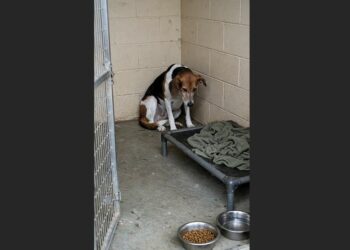
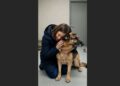
The first time Rex saw a dog bed, he stood in front of it for several minutes without moving.
It was nothing special. Just a large, round bed with thick cushioning, a soft fleece blanket, and a stuffed lamb I’d bought the day before.
But to Rex, it might as well have been something from another world.
He was a twelve-year-old pit bull, or close to it, according to the veterinarians.
His body was large and muscular beneath a coat that had grown thin and dull. His ribs showed far too clearly, and the skin around his neck bore the marks of years spent restrained.
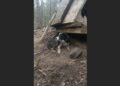
For ten years, Rex had lived at the end of a six-foot chain.
Ten years in a neglected yard, with bare dirt beneath his feet and a filthy bowl nearby.
He had no comfortable place to sleep. No grass to run through. No freedom to walk beyond the small circle his chain allowed.
Then his owners moved away.
They packed their belongings, loaded their vehicles, and left.
Rex was still chained in the yard.
The neighbors eventually called for help.
When rescuers arrived, they found him lying on the ground, too weak to stand.
That’s how he came into my life.
My name is Emma, and I foster dogs who need a little more time and care than most.
I’ve taken in frightened dogs, elderly dogs, and animals recovering from neglect. I know that bringing a rescued dog home isn’t always the joyful moment people imagine.
Some dogs come through the door wagging their tails.
Others need days before they’ll approach you.
But I’d never met a dog quite like Rex.
When he first stepped into my living room, he stopped just inside the doorway.
His head was low.
His legs were stiff.
He looked around as though he expected someone to tell him he’d made a mistake.
“Come on, sweetheart,” I said gently. “You can come in.”
He didn’t move.
I knelt a few feet away and held out my open hand.
I didn’t try to touch him.
I just waited.
A minute passed.
Then another.
Finally, Rex lifted one paw and took a cautious step.
It was such a small movement.
But after ten years at the end of a chain, watching him choose to move forward felt like a beginning.
A Bed of His Own
I showed Rex around the house slowly.
There was the kitchen, where fresh water would always be available.
The hallway, where afternoon sunlight spilled across the floor.
And the back door, which opened into a small fenced garden.
Actual grass.
Not a worn circle of dirt.
I let him look around without rushing him.
He followed cautiously, stopping whenever something unfamiliar caught his attention.
Then we reached the room where I’d prepared his bed.
I’d placed it in a quiet corner away from the busiest part of the house.
The fleece blanket was folded neatly inside, and the stuffed lamb rested against the cushion.
I pointed toward it.
“This is yours, Rex.”
He stared at the bed.
Then he looked at me.
I knelt beside it and pressed my hand into the cushion.
“Go ahead. It’s for you.”
He lowered his head and sniffed the edge.
For a moment, I thought he might turn away.
Instead, he lifted one paw.
He held it above the cushion, hesitating.
Then he carefully placed it on the bed.
Nothing happened.
Nobody shouted.
Nobody pulled him away.
He looked at me again.
“That’s right,” I whispered.
He placed his second paw on the cushion.
Then, with an effort that seemed almost heartbreaking, he stepped all the way inside.
He stood there, his paws sinking into the soft padding.
His body trembled slightly.
Then he began lowering himself.
Slowly, as though he wasn’t quite certain the bed would support him.
At last, he settled onto the blanket and rested his head between his paws.
I sat on the floor nearby.
For a long time, neither of us moved.
I’d bought that bed the previous afternoon without giving it much thought.
Now I was watching a dog experience a kind of comfort he may never have known.
“That’s yours,” I told him again.
“And it’ll still be yours tomorrow.”
That first night, Rex barely changed position.
When I checked on him the following morning, he was still curled in the same place.
I crouched beside the bed.
“Good morning, handsome.”
He opened his eyes and watched me.
There was no wagging tail.
No excited greeting.
But he didn’t shrink away.
And when I stood up to prepare breakfast, he lifted his head to see where I was going.
For Rex, that was enough progress for one morning.
The first few days were difficult.
He wasn’t used to living in a house.
The sound of a cabinet closing could make him flinch.
He hesitated at doorways.
And sometimes, when I moved too quickly, he’d lower his head and become perfectly still.
I learned to slow down.
I spoke before approaching him.
I gave him room to move away.
And I tried to make each day as predictable as possible.
Meals came at regular times.
Water was always available.
Nobody took his food away while he was eating.
At first, Rex stood over his bowl as though he expected someone to interfere.
He ate quickly, then looked around.
But after several days, his movements began to relax.
By the end of the second week, he no longer hovered anxiously over every meal.
He’d learned that breakfast would come tomorrow.
And the day after that.
And the day after that.
It sounds like such an ordinary thing.
But for Rex, being able to depend on something was new.
The Invisible Chain
The hardest part was teaching Rex that he could move freely.
One morning, I opened the back door and invited him into the garden.
He stepped onto the grass.
Then stopped.
He stood there, staring across the yard.
The fence was several yards away, but he made no effort to explore.
I walked a little farther into the garden.
“Come on, Rex.”
He looked at me.
Then down at his paws.
He took one step.
Stopped.
Took another.
And stopped again.
At first, I wondered whether his joints were bothering him.
He was an older dog, and years of neglect had taken a toll on his body.
But there was something else about the way he moved.
He seemed reluctant to venture beyond a small area.
For ten years, a six-foot chain had determined how far he could go.
Now the chain was gone.
But he didn’t seem to understand that the boundary had disappeared.
I brought a wooden chair into the garden and sat down.
I didn’t call him repeatedly.
I simply waited.
Birds moved through the trees.
A breeze stirred the grass.
Rex stood near the door, watching me.
Eventually, he took another step.
Then another.
He moved beyond the distance his old chain would have allowed.
A few minutes later, he reached my chair.
And sat down beside my feet.
I laughed.
I couldn’t help it.
“Well, look at you.”
Rex tilted his head.
I reached down and let him sniff my fingers.
Then, when he seemed comfortable, I gently touched his shoulder.
He stayed.
For the first time, he’d crossed that invisible boundary and chosen to sit near me.
Not because I was holding a leash.
Not because he had nowhere else to go.
Because he wanted to.
That afternoon, I sat in the garden longer than I’d planned.
Rex remained beside me.
And every now and then, he lifted his nose toward the breeze.
The Third Week
By the end of the first week, Rex had learned our morning routine.
He knew when the back door would open.
He knew where his water bowl was.
And he had begun taking short walks around the neighborhood.
He was cautious at first.
Other dogs barking behind fences made him uneasy, and unfamiliar sounds could stop him in his tracks.
But with time, he began showing interest in the world around him.
He sniffed trees.
Watched birds.
And occasionally paused to investigate something in the grass.
I bought him a soft rubber ball.
He looked at it without enthusiasm.
I rolled it across the living room.
He watched it go.
Then looked back at me.
I tried again.
Nothing.
“All right,” I told him. “Maybe you’re not a ball person.”
I left it near his bed.
He ignored it for another week.
Then, one evening during his third week with me, I was sitting on the couch reading when I heard his nails against the floor.
Rex had left his bed.
He walked into the living room and stopped in front of me.
“Hello, sweetheart.”
He looked at the couch.
Then at me.
I moved my book aside.
“Would you like to come up?”
He placed his front paws on the cushion.
Hesitated.
Then carefully climbed beside me.
His whole body seemed tense, as though he expected to be ordered down.
I remained still.
After a moment, he lowered himself onto the couch.
Then he rested his head in my lap.
I stared at him.
Three weeks earlier, he’d been afraid to step through my front door.
Now this enormous, scarred dog was lying beside me with his head on my knees.
I gently rested my hand on his neck.
His breathing slowed.
A few minutes later, he fell asleep.
My book stayed open on the same page for the rest of the evening.
I didn’t want to move.
The Morning I Found Him Upside Down
A few days later, I walked into the room and stopped in the doorway.
Rex was asleep in his bed.
On his back.
All four paws were sticking into the air, his head was turned awkwardly to one side, and he was snoring.
Loudly.
I had to cover my mouth to keep from laughing.
The dog who’d been too frightened to move beyond a small patch of grass was now sprawled across his cushion, belly exposed, completely unaware that I was watching.
I knew better than to assume one sleeping position meant every fear had disappeared.
But it was a wonderful sight.
He looked comfortable.
Ridiculously comfortable.
I took a photograph.
Then I quietly left him to enjoy his nap.
There were still difficult nights.
Sometimes Rex woke suddenly, breathing fast and looking around the room.
I never knew what had startled him.
Maybe a sound outside.
Maybe discomfort.
Maybe something about the unfamiliar experience of sleeping indoors.
Whatever the reason, I learned not to rush toward him.
I’d sit on the floor nearby.
Sometimes I’d speak softly.
Other times, I simply stayed where he could see me.
If he wanted contact, he’d come closer.
If he needed space, I gave it to him.
Some nights, he’d settle within minutes.
Others took longer.
Recovery wasn’t a straight line.
I was learning that patience didn’t mean every day would be easier than the last.
It meant being willing to show up on the difficult days too.
A month after Rex arrived, something happened that made me feel like celebrating.
I was in the kitchen when I heard a soft thump behind me.
I turned.
There was Rex.
Standing in the doorway.
Holding the rubber ball in his mouth.
For a moment, I couldn’t believe it.
He walked toward me and dropped it near my feet.
I picked it up.
“Are you asking me to play?”
His tail moved.
Just a little.
I rolled the ball down the hallway.
Rex followed it.
Picked it up.
And brought it back.
I laughed so hard that he stopped and stared at me.
“You’re doing it, buddy!”
I rolled it again.
He went after it with an eagerness I hadn’t seen before.
We played for only a few minutes.
Then he returned to his bed and lay down, apparently satisfied with his accomplishments.
But I was delighted.
I called a friend and told her Rex had played fetch.
She was happy for us, though I doubt she fully understood why I sounded as though he’d just won a championship.
To someone else, it was a dog retrieving a ball.
To me, it was Rex discovering something that had been missing from his life for ten years.
The simple pleasure of playing.
When Temporary Became Forever
By the second month, Rex had become part of nearly everything I did.
He waited near the door when I came home.
He followed me into the kitchen while I prepared dinner.
He slept in his own bed beside mine, close enough that I could hear his slow breathing in the dark.
The frightened dog I’d brought home had gradually become a companion.
I’d originally agreed to foster him until he was healthy and comfortable enough for adoption.
That had been the plan.
But plans sometimes change.
Especially when you begin arranging your day around someone else’s habits without noticing.
I knew which part of the garden Rex preferred in the afternoon.
I knew how he liked his blanket folded.
And I knew that when he wanted attention, he’d come over and rest his chin against my knee.
One evening, I sat outside with him as the sun went down.
The sky was turning pink above the fence, and Rex lay in the grass with his front paws stretched ahead of him.
I watched him for a while.
Then I said his name.
He lifted his head.
“I think we need to talk.”
He gave me that serious, slightly puzzled expression I’d grown to love.
“You were supposed to stay here until we found you a home.”
His ears moved.
I smiled.
“But I think you already found one.”
He stood and walked over.
Then sat beside my chair, leaning his shoulder against my leg.
I rested my hand on his back.
“You’re staying, Rex.”
I paused.
“For good.”
Of course, he didn’t understand the paperwork that made the adoption permanent.
He didn’t know what a foster failure was.
He only knew the routines we’d built together.
But I knew.
And I wanted the promise to mean something.
He would have a warm place to sleep.
Food.
Care.
A garden.
And someone who would stay with him for the rest of his life.
The Woman on Our Morning Walk
A few days ago, Rex and I were out for our usual walk when a young couple stopped to admire him.
The woman noticed his gray muzzle and the scars on his body.
“He’s beautiful,” she said. “How old is he?”
“About twelve.”
She looked surprised.
“He’s doing well for twelve.”
I smiled.
“He had a rough start.”
She asked what had happened.
I told her a little about his past.
Not every detail.
Just enough for her to understand that Rex had spent ten years chained outside before being rescued.
Her expression changed.
She crouched a few feet away and looked toward him.
“You’re a brave boy,” she said gently.
Rex watched her.
A few months earlier, he’d probably moved behind my legs.
Now he stepped forward.
He sniffed her hand.
Then gave her fingers a small lick.
The woman began to cry.
Her husband put a hand on her shoulder.
I stood there holding Rex’s leash, feeling my own eyes grow warm.
The woman hadn’t known Rex during those first days in my house.
She hadn’t seen how difficult it was for him to walk beyond the invisible circle left by his chain.
She hadn’t watched him hesitate before stepping into a soft bed.
But she could see the dog standing in front of her now.
An older pit bull with a gray muzzle and gentle eyes.
A dog who had every reason to be cautious, yet had decided he could approach a stranger.
I was proud of him.
Not because he’d suddenly become fearless.
But because he was learning that the world contained people worth trusting.
And that he was allowed to decide when he felt ready.
Last night, I sat in the garden with Rex after dinner.
The air was cool, and the first stars were appearing overhead.
Rex lay beside my chair, his head resting on his paws.
For a while, I watched him.
I thought about the first day I’d seen him.
The thin coat.
The visible ribs.
The marks around his neck.
And the way he’d stood inside my front door, afraid to take another step.
I thought about how little he’d known of the world beyond that chain.
Six feet of dirt.
A food bowl.
The same patch of ground through every season.
Then I looked at the dog lying beside me.
His coat had grown healthier.
His eyes were brighter.
He had discovered toys, soft blankets, and afternoon naps on the couch.
He loved short walks.
He liked following me around the house.
And he snored loudly enough that I sometimes had to turn up the television.
Every now and then, something still frightened him.
A sudden noise.
A door slamming.
A stranger moving too quickly.
I didn’t pretend those moments would disappear completely.
Ten years of neglect had shaped his life.
But they no longer controlled every moment of it.
Rex lifted his head and looked toward me.
I reached down and stroked his back.
“Do you remember that first night?” I asked.
He blinked.
“That big bed you didn’t know what to do with?”
His tail moved slowly against the grass.
I smiled.
“I told you it was yours.”
He shifted closer, resting his shoulder against my leg.
“And I meant it.”
We stayed outside a little longer.
The stars grew brighter.
A breeze moved through the trees.
Rex eventually stood and walked toward the back door, ready for bed.
I followed him inside.
He went straight to his soft cushion, turned in a slow circle, and settled down with his old stuffed lamb beside him.
I watched him for a moment before turning off the light.
For ten years, someone had decided how far Rex was allowed to move.
Where he could sleep.
When he could eat.
And whether anyone would bother to care for him.
Now the choices were different.
He could sleep on his bed or beside me on the couch.
He could wander through the garden.
He could carry his stuffed lamb into whichever room he pleased.
And when he wanted affection, he could come and ask for it.
Sometimes he did.
Sometimes he preferred to be left alone.
Both were perfectly fine.
I used to think rescuing a dog meant bringing him somewhere safe and showing him how much better life could be.
Rex taught me there was more to it than that.
It meant keeping the same promises on the days when progress seemed slow.
It meant understanding that trust couldn’t be hurried.
And it meant celebrating the things most people never think twice about.
A dog eating without fear.
Sleeping comfortably.
Walking beyond the place where a chain once stopped him.
Or simply choosing to rest his head in someone’s lap.
This morning, Rex woke before I did.
I heard him stretch in his bed, followed by a long, satisfied sigh.
When I opened my eyes, he was standing beside me.
His tail moved.
I reached down and scratched his ears.
“Morning, handsome.”
He leaned into my hand.
Then headed toward the kitchen, clearly expecting breakfast.
I got up and followed him.
Outside, the sun was beginning to rise.
Another ordinary day.
Another walk.
Another chance for Rex to enjoy the life he should have had all along.
For ten years, his world ended where a six-foot chain ran out. Now he walks beside me with nothing pulling him back.
And every night, when he curls up in that soft bed with his stuffed lamb, I remember the promise I made the first time he placed one uncertain paw on the cushion.
It’s yours, Rex.
The bed.
The house.
The garden.
And all the good days we still have ahead of us.
For as long as you’re here, this is your home.
Editor’s Note: This is a fictionalized narrative adaptation of the French story provided, written in American English from Emma’s perspective. It preserves Rex’s estimated age, his ten years on a six-foot chain, his abandonment and rescue, his gradual adjustment to indoor life, his first soft bed, growing confidence, permanent adoption, and the final promise of a loving home. Dialogue, reflections, and everyday scenes have been creatively developed for literary storytelling. The underlying account has not been independently verified.