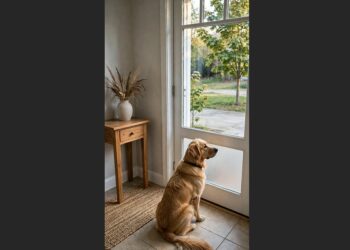
Every evening, Buddy walks onto the porch and chooses the same spot.
He does not wander around looking for somewhere comfortable.
He does not circle three times and settle wherever the last patch of sunlight happens to fall.
Buddy has a place.
From there, he can see the driveway.
He can hear vehicles slowing on the road.
He can watch the gate.
So that is where he sits.
Night after night.
The light fades.
Cars pass.
Doors close at neighboring houses.
Eventually, the street becomes quiet.
Buddy keeps watching.
Nobody has explained to him why the person he once expected to see there no longer arrives.
And tonight, once again, nobody came.
The Routine Begins Before Sunset
Buddy seems to know when evening is getting close.
Long before the porch light comes on, his attention shifts toward the front of the house.
He may be resting somewhere else.
Then a sound outside catches him.
His head lifts.
A few minutes later, he gets up.
He walks toward the door.
When someone lets him onto the porch, Buddy heads directly to his usual place.
Then he faces the driveway.
There is nothing frantic about it.
No barking.
No pacing.
He simply watches.
That quietness is what makes the sight difficult for the people who love him.
Once, That Driveway Meant Someone Was Coming Home
Dogs build much of their lives around repetition.
A certain sound can mean breakfast.
A particular pair of shoes can mean a walk.
Keys can signal that someone is leaving.
The sound of a familiar vehicle entering the driveway can mean something even more important.
Someone is back.
For Buddy, evenings once included that expectation.
He learned the pattern because it happened often enough to become ordinary.
A vehicle.
A gate.
Footsteps.
A familiar person entering the house.
Perhaps Buddy did not think about it in any complicated way.
He did not need to.
The routine simply belonged to his world.
Then it stopped.
The Porch Stayed the Same
That may be part of what makes the behavior persist.
The house did not disappear.
Neither did the driveway.
The gate remained where it had always been.
Even the sounds of the neighborhood continued.
Cars still came around the corner.
People still walked past.
Engines still slowed near the property.
Every one of those sounds could resemble the beginning of an old routine.
Buddy notices.
His ears move.
Sometimes he lifts his head higher.
Then the vehicle continues down the road.
He settles again.
Nobody Can Tell Buddy What Has Changed
Humans can explain absence to one another.
Even when the explanation is painful, words give us a framework.
We can understand that someone has moved away.
That circumstances have changed.
That a separation may be permanent.
Dogs do not receive explanations in the same way.
Buddy cannot be sat down and told why one familiar person is no longer appearing at the end of the driveway.
He can only notice what is missing.
The scent.
The footsteps.
The voice.
The arrival that once happened and now does not.
That Does Not Mean Buddy Understands a “Promise”
People watching him are tempted to say he is keeping faith with someone who promised to return.
It is a beautiful thought.
But dogs do not need a human idea of promises for their waiting to matter.
Buddy understands routines.
Attachment.
Familiarity.
Expectation.
He knows how the house used to feel when that person was part of it.
He knows where arrivals happened.
So he returns to the place where that familiar sequence once began.
That is enough.
Sometimes a Car Makes Him Stand
Those moments are the hardest.
Buddy can sit for a long time without moving.
Then tires crunch somewhere nearby.
His body changes immediately.
Head up.
Ears forward.
Sometimes he rises.
For a few seconds, he looks almost certain that something is about to happen.
Then the vehicle passes.
No one comes through the gate.
Buddy remains standing for another moment.
Afterward, he lowers himself back onto the porch.
The waiting begins again.
His Family Does Not Drag Him Inside
At first, someone tried calling him earlier.
“Buddy, come on.”
He would look back.
Sometimes he came.
Other times he stayed where he was.
Eventually, the family stopped treating the porch as a bad habit that needed correcting.
Buddy was not hurting himself.
He was not refusing food or spending every hour outside.
He still participated in the rest of the household.
So if sitting on the porch for a while seemed important to him, they allowed it.
Someone often stayed nearby.
Not to distract him.
Just so he was not alone.
Waiting Is Only One Part of His Day
That matters too.
Buddy still eats.
He still sleeps.
He still notices when someone opens a snack bag.
He still has moments when a toy is more interesting than anything happening outside.
On walks, he stops to investigate familiar smells.
Sometimes his tail moves when a neighbor greets him.
Those ordinary behaviors help his family remember that he is not living every minute in despair.
Dogs can miss someone and still remain interested in other parts of life.
Both things can be true.
Evening Is Different
As the day winds down, Buddy becomes quieter.
That is when the old routine seems to return most strongly.
Perhaps the timing itself has become a cue.
The changing light.
The sounds from the street.
People returning home around the neighborhood.
Whatever combination of signals triggers it, Buddy eventually makes his way to the porch.
Then he watches.
It happens so consistently that the family no longer needs to check the clock.
Buddy is their clock.
When he takes his place, evening has arrived.
The Empty Driveway Means Something to the People Watching Too
Sometimes a family member sits just inside the door.
They can see Buddy’s back.
His head occasionally turning.
The driveway beyond him.
For people, the scene carries meanings Buddy cannot know.
They remember conversations.
Specific days.
The sound of laughter.
Arguments that now seem unimportant.
Meals.
Birthdays.
Ordinary moments that seemed too ordinary to remember at the time.
Buddy does not share those memories in words.
But he shares the absence.
That can make his waiting unexpectedly painful to witness.
People Often Say Dogs “Never Forget”
Reality is more complicated.
Dogs have strong associative memory.
They can remember familiar people after long separations, particularly through scent, voice, and learned routines.
But saying that every dog remembers every person forever goes beyond what anyone can know.
Buddy does not need that claim attached to him.
His behavior tells us something much more immediate.
Right now, this place still matters.
Right now, certain sounds still make him look.
Right now, the old routine has not completely faded.
There Is No Need to Turn Him Into a Human
Buddy is not sitting on the porch composing thoughts about loyalty.
He is not calculating how long someone has been gone.
He is not measuring disappointment in the way a person might.
His experience is canine.
Sensory.
Pattern-based.
Emotional.
That does not make it less real.
In some ways, the simplicity makes it harder to watch.
He knows someone used to be there.
Now they are not.
And the porch remains.
The Family Has Started Keeping the Evening Calm
They do not crowd him when he goes outside.
No one repeatedly calls his name.
If he comes back in, they welcome him.
If he stays a little longer, someone checks on him.
His meals remain on schedule.
Walks still happen.
His bed stays where it has always been.
Maintaining those routines gives Buddy something predictable while one part of his world has changed.
Consistency cannot restore the person he misses.
It can help the rest of life feel stable.
Some Nights He Comes Inside Earlier
Those nights are encouraging.
Maybe the weather is colder.
Maybe someone calls from the kitchen.
Perhaps he hears the sound of his food being prepared.
Whatever the reason, Buddy sometimes rises before the street goes completely dark.
He turns away from the driveway.
Walks through the door.
Then settles somewhere near the family.
Nobody celebrates too loudly.
They do not want every small shift turned into an event.
They simply let him choose a new place to rest.
Other Nights He Stays Longer
Adjustment is not linear.
One quiet evening does not mean the waiting is finished.
The next night, Buddy may return to the porch and remain there well after the light has changed.
A vehicle might slow near the gate.
His head lifts.
For a moment, everyone watching him feels the same ache again.
Then the vehicle moves on.
Buddy settles.
The family waits with him.
Dogs Can Show Loss in Different Ways
Some search rooms.
Some become clingier.
Others lose interest in food or play.
A dog may sleep more.
Another may pace.
Some appear to show very little change at all.
There is no single pattern that proves what a dog is feeling.
That is why families need to look at the whole animal.
Buddy’s porch routine is only one behavior.
His appetite, sleep, energy, mobility, and general engagement still matter.
If those changed significantly or remained abnormal, veterinary advice would be important.
Grief-like behavior should never become an excuse to overlook illness.
Buddy Still Has People Around Him
That may become increasingly important with time.
Someone fills his bowl.
Someone opens the door.
Someone walks beside him.
Someone scratches the place behind his ears that makes his eyes close.
The person he waits for is absent.
The rest of the household is still present.
Dogs learn from repetition.
Day after day, the people who remain continue doing what familiar people do.
They return.
They care for him.
They stay.
Over time, those patterns may help Buddy build a different routine.
Nobody Knows When the Porch Habit Will End
Maybe it will fade.
One evening, perhaps Buddy will choose the living room instead.
Then he may do it again the following night.
Weeks later, someone might suddenly realize they cannot remember the last time he sat watching the driveway.
Or perhaps Buddy will always check.
Not for hours.
Just a glance toward the gate.
A moment of listening.
Old habits can persist even after their original purpose changes.
There would be nothing strange about that.
For Now, His Family Lets Him Have the Porch
There is no need to rush him.
The porch is familiar.
The driveway is familiar.
The waiting may be part habit, part expectation, and part attachment to a routine built around someone important.
So Buddy sits.
Sometimes a family member brings a blanket.
Sometimes they sit beside him.
Nobody tells him he needs to stop.
Eventually, he gets up on his own.
That choice matters.
Tonight, the Porch Light Came On
Buddy was already outside.
He had taken his usual place before anyone switched on the light.
The driveway was empty.
A car passed at the far end of the street.
Buddy watched it.
Another followed ten minutes later.
His ears lifted.
Then lowered again.
The temperature dropped.
Someone opened the front door and stood there.
“Come inside when you’re ready, buddy.”
He turned his head.
Then looked back toward the driveway once more.
Nobody Came
That was the reality of the evening.
No familiar footsteps.
No gate opening.
No person walking toward him.
After a while, Buddy lowered his body onto the porch.
His head rested on his front paws.
He stayed there for several minutes.
Then, eventually, he stood.
He turned away from the road.
Walked through the open door.
And followed the family into the house.
Tomorrow, He May Wait Again
That does not mean he is trapped forever in the past.
It means the old routine still has a hold on him.
Time may loosen it.
New routines may grow around it.
Buddy may learn that evenings contain other things now.
Dinner.
A walk.
Someone sitting beside him.
A warm place indoors.
Perhaps eventually the sound of a passing car will become just another sound.
For now, it still makes him look.
The Hardest Part Is That Love Leaves Routines Behind
A person can disappear from a dog’s daily life while the structure built around that person remains.
The door.
The driveway.
The hour they used to arrive.
The place where the dog used to wait.
Those things become reminders even if the dog does not experience memory exactly as humans do.
Buddy’s family cannot explain away that gap.
They can only help him live around it.
Gently.
Consistently.
Without forcing him to stop looking before he is ready.
Every Evening, Buddy Goes Back to the Same Spot
Same porch.
Same driveway.
Same gate.
For a while, he watches.
Sometimes a sound gives him hope, or at least brings back an old expectation.
Sometimes nothing happens at all.
Tonight, nothing happened.
Nobody arrived.
Buddy waited anyway.
Then, when the street had grown quiet enough, he finally came inside.
Tomorrow evening, he may return to that spot again.
If he does, his family will let him sit there.
And when he is ready to turn away from the driveway, the door behind him will still be open.
Editor’s Note: The characters in this story are fictional. Through these stories, we hope to share the intelligence, loyalty, compassion, and loving nature of dogs with people everywhere.