Two weeks ago, this Golden Retriever lost the person who had been at the center of his daily life.
He did not lose his home.
His family is still around him.
His bowl is filled every day. His bed is warm. Familiar hands still stroke his head, open the back door for him, and clip on his leash for walks.
By every practical measure, he is cared for.
But the family noticed almost immediately that something had changed.
He began eating less.
He slept more.
The dog who once moved eagerly from room to room became unusually quiet.
Then he started doing something that was much harder for the family to watch.
He went looking for the person who was no longer there.
At First, Everyone Thought He Was Simply Tired
The first few days after the loss were confusing for everyone in the house.
There were phone calls.
Visitors.
Quiet conversations.
People moving through rooms with the distracted movements that often follow a death.
The Golden Retriever noticed all of it.
Dogs are sensitive to changes in routine, tone of voice, activity, and the emotional behavior of the people around them.
Still, nobody knew exactly what he understood.
He could not know what death meant in the human sense.
He did not understand memorial plans, condolences, or why certain relatives suddenly began appearing at the house.
He knew something simpler.
One familiar person was missing.
The Empty Room Drew Him Back
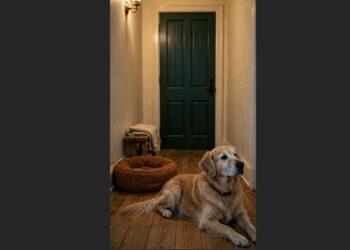
That person had once spent much of the day in one particular room.
The dog knew it well.
He knew the scent.
The furniture.
The place where his person usually sat.
The familiar sounds that came from inside.
After the death, the room remained.
The person did not.
The family first noticed the dog walking in there a few days later.
He stepped through the doorway slowly.
Then he stopped.
His nose moved.
He looked toward the usual places.
For a while, he stood there quietly.
Then he left.
A few hours later, he returned.
He Repeated the Search
It was not frantic.
That somehow made it more painful to watch.
He did not tear through the house or bark continuously.
Instead, he moved from one familiar place to another.
The chair.
The side of the bed.
The doorway.
The hall.
Sometimes he sniffed.
Sometimes he simply stood.
Then, when he did not find the person he expected, he moved on.
The family could not know what he was thinking.
Still, the pattern was difficult to misunderstand as behavior.
He was checking places connected to someone who had disappeared from his routine.
His Appetite Changed Too
The Golden Retriever had always enjoyed meals.
Like many dogs of his breed, he rarely needed encouragement when food appeared.
After the loss, that changed.
He still ate.
But less.
Some meals sat untouched for a while.
Other times, he ate only part of what was offered and walked away.
His family kept a close eye on him because appetite loss can have many causes, including medical ones.
Grief or stress may affect a dog’s eating habits, but behavior should never be the only explanation assumed when an animal stops eating.
They continued offering meals on schedule and watched for other signs that might require veterinary attention.
For now, he remained physically stable.
Emotionally, he seemed different.
The Afternoon Routine Was the Hardest Part
Before the loss, afternoons had carried a familiar rhythm.
At a certain point in the day, the dog expected something.
A sound in the driveway.
Movement outside.
The arrival of the person he loved.
That expectation did not disappear simply because the family understood that the person had died.
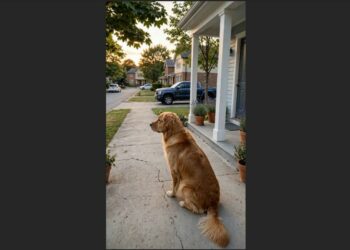
Almost every afternoon, the Golden Retriever began walking toward the front door.
Then he sat beside the glass.
And watched.
He Looked Toward the Driveway
Cars passed.
Neighbors walked by.
Occasionally, a vehicle slowed.
Each sound made his ears move.
Sometimes he lifted his head.
Other times, he stood for a moment and looked more intently through the glass.
Then the sound faded.
No familiar person appeared.
Eventually, the dog’s body relaxed again.
He lowered himself beside the entrance.
And waited there.
The family began recognizing the routine.
Around the same time each day, he returned to the door.
Nobody Tried to Pull Him Away
At first, someone would call his name.
“Come here, buddy.”
He might turn his head.
Sometimes he came.
Other times, he stayed.
The family soon stopped treating the behavior as something that needed to be corrected.
The door was not dangerous.
He was not hurting himself.
So they allowed him to sit.
A blanket was placed nearby.
Someone often joined him for a few minutes.
They did not know whether he found comfort in the company.
Still, they did not want him spending every difficult moment alone.
Dogs Do Not Understand Death the Way People Do
It is tempting to imagine that a grieving dog understands exactly what has happened.
We cannot know that.
Dogs do not appear to conceptualize death with the same abstract understanding humans use.
They cannot be told that someone has died and will never return in a way that makes the future immediately clear.
What they can understand is absence.
They notice when a person is no longer present.
They notice when footsteps disappear.
When a chair remains empty.
When the morning routine changes.
When a familiar scent slowly fades.
That change can affect them deeply.
Grief in Dogs Often Appears Through Behavior
There is no single way a dog responds to loss.
Some become more attached to the people who remain.
Others withdraw.
A normally active dog may sleep more.
Another may become restless.
Some lose interest in play.
Appetite may change.
Certain dogs search rooms or wait near doors associated with the missing person.
Others seem outwardly unchanged.
The Golden Retriever’s response was not proof that he understood death.
It was evidence that a major relationship and routine had disappeared.
His family could see that absence reflected in what he did every day.
They Tried to Keep the Rest of His Life Predictable
The family could not bring back the person he was waiting for.
They could make the rest of his world feel stable.
Breakfast still happened at the usual time.
Walks continued.
His bed remained in the same place.
The people he knew kept coming home.
That consistency mattered.
When one part of an animal’s environment changes dramatically, familiar routines can reduce the amount of uncertainty surrounding everything else.
So they did not redesign his entire day.
They kept as much of it ordinary as they could.
Walks Became More Important
At first, he moved slowly.
The family did not force long outings.
They simply got him outside.
Fresh air.
Familiar streets.
Different smells.
A chance to move.
Some days, he showed more interest.
He stopped at a tree.
Investigated another dog’s scent.
Watched a squirrel cross a yard.
Those moments were encouraging because they showed he was still engaging with the world around him.
Then they came home.
By afternoon, he often returned to the front door.
Progress and grief could exist in the same day.
The Family Was Grieving Too
That complicated everything.
The people caring for the dog had also lost someone they loved.
They were trying to manage their own emotions while watching his behavior change.
Sometimes seeing him wait by the door made their own loss harder.
The empty driveway already meant something to them.
Now there was a Golden Retriever sitting in front of it.
On certain afternoons, someone sat down beside him and cried.
The dog sometimes leaned closer.
Other times, he simply remained facing the glass.
There was no need to make either response symbolic.
They were sharing the same changed house.
Each in a different way.
His Favorite Person Was Still Everywhere
Not physically.
But in the structure of the home.
A familiar chair remained.
Certain belongings still carried scent.
There were places where the dog had once slept at that person’s feet.
Routes through the house that had become habits.
Those things did not disappear after two weeks.
That is part of why adjustment can take time.
A dog may continue encountering cues associated with someone who is suddenly absent.
Each cue can trigger familiar expectations.
A sound at the door.
A particular hour.
A car in the driveway.
A room.
Then nothing follows.
The Family Did Not Rush to Remove Everything
They also did not try to preserve every object forever because they believed the dog needed it.
Instead, changes happened gradually.
The room stayed largely as it was for the moment.
The dog could enter.
He could sniff.
He could leave.
Nobody shut him out simply because watching him search was painful.
At the same time, they encouraged him to spend time with the people who remained.
Short walks.
Quiet companionship.
Meals offered without pressure.
Gentle play when he showed interest.
The goal was not to distract him from the loss.
It was to help him continue living inside a changed routine.
One Evening, He Brought Over a Toy
It had been several days since anyone had seen him do that.
The toy was an old soft one he had carried around for years.
He picked it up and walked into the living room.
Then he stood near a family member.
The person reached for it.
The dog held on for a second.
Then released it.
A small game followed.
Not for long.
A few minutes at most.
Still, everyone noticed.
The dog who had spent much of the week lying quietly had asked for interaction.
That did not mean his grief was over.
It meant he still had moments of interest and connection.
Those moments mattered.
The Next Afternoon, He Waited at the Door Again
That was important too.
Recovery from loss does not follow a neat sequence.
One playful evening does not erase the next difficult afternoon.
The Golden Retriever returned to the glass.
He watched the driveway.
After some time, he lowered himself onto the floor.
His head rested between his paws.
Someone brought the blanket closer.
Then sat nearby.
Eventually, he fell asleep.
There was no attempt to declare that he had “accepted” anything.
Dogs do not need human labels placed on each stage of their behavior.
He was adjusting at his own pace.
His Family Learned to Watch Without Panicking
They continued monitoring his appetite.
His energy.
His sleep.
His willingness to engage.
Grief-like behavior can be understandable after a loss, but prolonged refusal to eat, severe lethargy, vomiting, diarrhea, pain, breathing changes, or other concerning symptoms still require veterinary attention.
Loss does not protect a dog from becoming physically ill.
So the family remained observant.
They wanted to respect his emotional adjustment without assuming every change came from grief.
That balance mattered.
Little Signs Began Appearing
He started finishing more of his breakfast.
One morning, his tail moved when someone reached for the leash.
Another day, he chose to lie in the kitchen while dinner was prepared rather than staying in the empty room.
He still checked that room later.
But he did not remain as long.
His behavior was shifting gradually.
Not toward forgetting.
Toward participating more fully in the life still happening around him.
The Front Door Remained Part of His Afternoon
Two weeks is not very long.
The family understood that.
They did not expect years of routine and attachment to disappear in fourteen days.
So when the dog returned to the front door, nobody treated it as failure.
Some afternoons he stayed there longer.
On others, a sound elsewhere in the house drew him away.
One day, he left the door when someone opened a bag of treats.
The family laughed for the first time in a while.
The dog looked at them, then at the treats.
His priorities had briefly reorganized themselves.
That was okay.
Grieving Dogs Still Need Ordinary Dog Things
They need meals.
Walks.
Sleep.
Opportunities to sniff.
Predictable routines.
Gentle attention.
Some may want more closeness than before.
Others may need quiet.
What helps one dog may not suit another.
The important part is noticing changes without forcing a particular emotional story onto them.
This Golden Retriever did not need anyone telling him he should be “over it.”
He also did not need every quiet moment interpreted as permanent despair.
He needed time.
His Person Was Gone, but His Family Was Not
That difference slowly became part of his new routine.
Someone still opened the door in the morning.
Someone filled his bowl.
Someone sat near him when the house became quiet.
Someone clipped on his leash.
Someone came home.
Those repeated experiences mattered because dogs learn through patterns.
The person he had lost would not return.
But other people did.
Again and again.
The house still contained relationships he could rely on.
There May Never Be One Clear Moment When He Stops Waiting
Perhaps one afternoon, the family will realize he has not gone to the door in several days.
Maybe the behavior will fade gradually.
Maybe he will always check the driveway around that familiar time.
Either outcome can exist without requiring a dramatic explanation.
Habits linked to important people can last.
So can attachment.
The goal is not to erase those things.
It is to help the dog remain comfortable, healthy, and connected as life takes on a different shape.
The Empty Place Is Still There
Everyone in the house feels it.
For the family, it appears in memories.
For the dog, it may appear as a missing scent, a silent room, or the absence of footsteps that used to arrive at a predictable time.
Humans can explain the loss to one another.
The Golden Retriever cannot ask where his person went.
He can only respond to what has changed.
That is why the family pays attention when he walks into the old room.
And why they let him sit by the door.
Love After Loss Looks Different
It does not mean replacing the person who died.
It does not mean making the dog forget.
It means keeping his remaining world dependable.
Offering food even when his appetite is reduced.
Taking the walk even when he moves slowly.
Sitting nearby without demanding play.
Noticing when interest returns.
Giving him room to search if he needs to search.
And knowing when a change in behavior is significant enough to discuss with a veterinarian.
None of that is dramatic.
Most care is not.
For Now, He Still Goes to the Door
Almost every afternoon, he walks across the house and sits beside the glass.
He looks toward the driveway.
He listens.
Sometimes his ears lift when a vehicle passes.
Then the sound disappears.
After a while, he lowers himself onto the floor.
The family no longer calls him away immediately.
Someone may sit beside him.
A hand may rest on his shoulder.
Eventually, he gets up.
He eats.
He walks.
Sometimes he plays.
Then another day begins.
He Does Not Need to Understand Death to Feel an Absence
That may be the hardest part for the people watching him.
They can understand why the person is not coming home.
The dog cannot receive that explanation in the same way.
He simply knows that someone who belonged to every ordinary day is no longer part of it.
Two weeks later, his behavior still reflects that change.
Yet his life is not empty.
There are people who love him.
A warm place to sleep.
Meals.
Walks.
Familiar voices.
Hands that reach down gently when he comes close.
Over time, those things may help a new routine take shape around the space that remains.
He may stop waiting at the door.
Or he may keep checking it for a while.
Either way, nobody needs to hurry him.
For now, when he settles beside the glass and looks toward the driveway, his family lets him stay.
Then, when he is ready, he gets up and joins them again.
Editor’s Note: The characters in this story are fictional. Through these stories, we hope to share the intelligence, loyalty, compassion, and loving nature of dogs with people everywhere.