Duke Had Spent Most of His Life Working Beside Him
At 10:45 every morning, David opened the back door of his Phoenix home and prepared for the most important part of Duke’s day.
By then, the old German shepherd could no longer rise without help.
His hind legs had weakened with age, and his hips had become stiff enough that even a short trip across the house required assistance. Still, Duke remained alert when sunlight reached the kitchen floor or when David moved toward the back door.
David was forty-two, a retired K9 instructor who had spent eighteen years with the Phoenix police. His own body carried reminders of that career. Chronic injuries in his back and shoulder had eventually forced him away from active service.
Duke had served too.
The black German shepherd had once been David’s working partner, trained through countless hours of repetition, obedience work, conditioning, and handler communication.
During one dangerous incident, Duke had been shot while working with David.
He survived.
Years later, when David retired, there was never much question about where Duke would spend the rest of his life.
He came home with him.
Retirement Changed Their Schedule, Not Their Bond
Police work had once organized their days.
Training sessions began at specific times. Equipment was checked. Commands were practiced. Duke learned to respond not only to David’s words but also to patterns of movement and routine.
Retirement was quieter.
At first, Duke adjusted easily.
He still expected activity in the morning. He followed David through the house, watched the backyard, and remained interested in every sound near the gate.
For several years, they settled into a slower version of the partnership they had known on duty.
Duke no longer had assignments.
David no longer wore a uniform to work.
Instead, they took walks when David’s injuries allowed. Duke rested nearby while his former handler worked around the house. Evenings often ended with the dog stretched on the floor close enough to know where David was.
Then age began changing the arrangement.
The signs were small at first.
Duke took longer to stand after sleeping.
His rear legs occasionally slipped on smooth flooring.
Walks became shorter.
Later, stairs became difficult.
Eventually, his hips weakened enough that he could no longer get outside by himself.
David Began Carrying Him to the Yard
Aging did not erase Duke’s interest in being outdoors.
He still lifted his head when David opened the door. Warm air, neighborhood sounds, and familiar smells seemed to hold his attention even when walking had become difficult.
So David created a new routine.
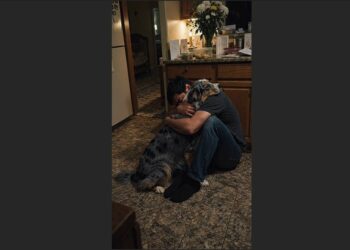
Each morning, at 10:45, he carefully lifted the German shepherd.
It was not an easy task.
Duke was a large dog, and David’s old back and shoulder injuries had never disappeared. He had to move slowly, position himself carefully, and avoid sudden turns.
Still, he carried Duke through the back door and down the yard steps.
Then he settled him on the ground beneath the tree where the old dog liked to rest.
There, sunlight filtered through the branches.
Some mornings were bright and warm. On cooler days, Duke simply lay quietly, taking in the smells carried across the yard.
David usually sat beside him.
He scratched behind one ear and repeated the same words.
“I’ve got you, partner.”
It became their morning ritual.
Margaret Started Noticing From Next Door
Margaret lived in the neighboring house.
At seventy-one, she had developed her own dependable morning habits. She made coffee, opened the curtains, and spent part of the morning in her kitchen.
From one window, she could see into part of David’s backyard.
At first, she noticed the dog only occasionally.
Then she realized the same scene happened every day.
At 10:45, David appeared carrying Duke.
He would take the steps carefully, lower the shepherd onto the grass, and stay beside him.
Sometimes David sat in a chair.
At other times, he lowered himself onto the lawn despite the discomfort that getting back up would cause.
Duke rarely did anything dramatic.
That was part of what held Margaret’s attention.
The old dog simply rested.
David stayed with him.
After enough mornings, Margaret began checking the clock.
10:45.
There they were again.
The Routine Lasted Month After Month
Margaret did not know their history.
She knew David had worked in law enforcement, but she did not know much about his years as a K9 instructor. She also did not know that Duke had once worked beside him.
From her kitchen, she saw only the present.
A middle-aged man with a careful gait.
An old black German shepherd who needed help getting outside.
A patch of sun beneath a backyard tree.
The same quiet exchange every morning.
For ten months, the ritual continued.
Even as Duke lost strength, David preserved that part of his day.
Aging animals often benefit from predictable routines, particularly when mobility, hearing, sight, or stamina begin to decline. Familiar places and repeated patterns can reduce unnecessary stress.
David did not expect the sunshine to cure Duke’s failing body.
He knew better.
Age remained age.
The hips would not become young again.
Still, Duke could enjoy warmth.
He could smell the yard.
He could hear birds, traffic, and distant neighborhood activity.
Most of all, he could spend time beside the person whose routine had been intertwined with his own for years.
Margaret Finally Recorded What She Saw
One morning, Margaret picked up her phone.
She did not film a rescue or a dramatic reunion.
Instead, she recorded the same quiet moment she had watched for months.
David emerged through the back door with Duke supported in his arms.
He moved carefully down the steps.
Once beneath the tree, he lowered the dog onto the grass and adjusted his position until Duke appeared comfortable.
Then David sat beside him.
His hand moved slowly behind the shepherd’s ear.
The clip was short.
Nothing extraordinary happened.
Yet when Margaret eventually shared it, people responded strongly to the simplicity of what they saw.
An aging working dog could no longer reach his favorite place alone.
His former handler made sure he still got there.
The video began circulating far beyond the neighborhood.
Thousands of strangers watched the same scene Margaret had quietly observed from her kitchen.
People Wanted to Know Why David Did It Every Day
Attention made David uncomfortable.
He had never intended the morning routine to become public.
To him, carrying Duke outside was not a performance of loyalty. It was simply a task that needed doing.
When people learned that David also lived with chronic pain, they became even more curious.
Why continue lifting such a large dog when his own back and shoulder already hurt?
David’s answer was brief.
“He helped me through my worst moments,” he said. “It’s my turn.”
He did not elaborate much further.
The sentence was enough.
Their working years had required trust, but not the sentimental kind often assigned to police dogs in popular stories.
K9 partnerships depend on training.
A handler learns a dog’s behavior, strengths, limitations, and signals. The dog learns commands and routines through repetition and reinforcement.
Over years, that working relationship can also create a powerful attachment.
Duke had spent a large part of his life beside David.
Now David organized his own mornings around Duke.
Duke’s World Became Smaller
As the months passed, Duke’s physical range continued to shrink.
There had once been patrol vehicles, training fields, unfamiliar buildings, commands, and long periods of activity.
Now his world consisted mostly of the house and yard.
Getting up required help.
Long walks were no longer realistic.
On difficult days, even adjusting position took effort.
David adapted the home as best he could.
He paid attention to where Duke rested and made sure the old dog did not have to struggle unnecessarily. Smooth surfaces were harder on weak hind legs, so stable footing mattered. Rest mattered more too.
Veterinary care could help manage comfort, but it could not reverse advanced aging.
David understood that.
He did not measure Duke’s quality of life by whether he could still behave like the younger working dog he remembered.
Instead, he watched for smaller things.
Did he still eat?
Could he rest comfortably?
Did he respond to familiar voices?
Did he appear interested when the back door opened?
For many months, the answer to that last question remained yes.
The Tree Became Their Place
By then, the tree in the backyard had become as much a part of the routine as the time on the clock.
At 10:45, David carried Duke out.
He lowered him carefully.
Then they stayed.
Some mornings David talked.
Other days he said very little.
Duke did not need conversation.
He rested with his head raised for a while, then lowered it to the grass.
On warm mornings, patches of sunlight moved across his dark coat.
Occasionally he watched something beyond the fence.
Sometimes he slept.
David remained nearby.
There was no need to claim Duke understood that his handler was repaying some old debt.
Dogs do not think about loyalty in those abstract human terms.
What Duke could understand was familiarity.
A known voice.
A known touch.
The smell of his own yard.
A person who had been beside him for years.
And every morning, the same trip to the same place.
February Brought a Gentle Morning
After ten months of the routine, a February morning arrived clear and mild.
David opened the back door at the usual time.
Duke was weaker by then.
Still, David carried him outside.
The morning light fell through the branches as he settled the shepherd into his familiar spot.
David sat with him.
He scratched the old dog near the ear.
“I’ve got you, partner.”
Nothing about the morning announced that it would be different.
That is often how the final day with an elderly animal begins.
Families may know that time is becoming limited. They may recognize worsening mobility, reduced stamina, or other signs of decline.
Still, nobody can turn the passing hours into something predictable simply by loving an animal enough.
David only knew that Duke was comfortable beside him.
So he stayed.
Duke Died Beside the Person He Knew Best
That morning, Duke died while resting near David beneath the tree.
There was no sudden recovery before it happened.
No final burst of youthful strength.
The old German shepherd remained what he had become: a very elderly dog whose body had reached the end of what it could do.
David stayed beside him on the grass.
For months, he had known this day would eventually come.
Knowing did not make it easy.
The backyard seemed different almost immediately.
For ten months, 10:45 had meant lifting Duke.
Opening the door.
Taking the steps.
Finding the right place beneath the branches.
Now there was no dog to carry.
David sat beside him for a long time.
Grief did not arrive as one clean emotion.
There was pain.
There was also gratitude.
Duke had survived his working years, survived the shooting that once injured him, and lived long enough to become an old dog whose greatest daily outing was a few minutes in the sun.
For David, those ordinary months mattered.
The Next Morning Still Came at 10:45
Habits formed over years do not disappear because the reason for them is gone.
The following mornings felt strange.
David would notice the time.
His body still seemed to expect the sequence.
At 10:45, there should have been movement toward the back door.
There should have been Duke.
Instead, the house stayed quiet.
A photograph of the old shepherd remained near the window.
David did not need the picture to remember him.
Memories were everywhere.
The back door.
The yard steps.
The patch beneath the tree.
Even certain aches in his own shoulder reminded him of the careful way he had learned to lift Duke.
For a while, David allowed life to become quieter.
He did not try to replace the dog.
A new animal could not recreate eighteen years of service, injury, retirement, and aging.
Duke’s life had been his own.
So would any future dog’s.
David Eventually Began Volunteering at a Shelter
Later, David started spending time at an animal shelter.
He knew dogs.
More importantly, years of working with them had taught him that patience often accomplished more than pressure.
Not every shelter dog approached strangers willingly.
Some barked.
Some hid.
Others remained very still.
One young German shepherd caught David’s attention.
His name was Ronnie.
Ronnie was fearful and cautious around unfamiliar people. He did not become confident simply because David had experience with K9s.
Instead, David gave him time.
He avoided forcing contact.
He allowed Ronnie to maintain distance.
Repeated visits created predictability.
At first, progress was barely noticeable.
Later, Ronnie stayed closer.
Eventually, he approached on his own.
Trust developed in small increments rather than one dramatic breakthrough.
That mattered to David.
He had spent years teaching dogs to work through repetition.
With Ronnie, repetition served a different purpose.
It taught the young shepherd that David could be predictable.
Ronnie Was Not Duke
As their relationship grew, David remained aware of one important fact.
Ronnie was not Duke.
He had not shared David’s police career.
He had not worked beside him.
He had not been present during the difficult years of service or the injuries that followed.
Ronnie came with his own history and temperament.
David did not expect him to fill an empty place in exactly the same shape.
Instead, he allowed a different relationship to develop.
The young shepherd needed confidence.
He needed routine.
He needed someone willing to let progress happen gradually.
David could offer that.
In return, Ronnie brought movement back into the house.
There were footsteps again.
A dog waited near doors.
Food disappeared from bowls.
Toys appeared in inconvenient places.
The quiet that had followed Duke’s death changed little by little.
Not because grief had vanished.
Because life had begun making room beside it.
A New 10:45 Routine Took Shape
Eventually, the old time on the clock acquired another meaning.
At 10:45, David still opened the back door.
Now he did not need to lift a heavy, aging shepherd.
Ronnie ran through it himself.
The young dog crossed the yard and headed toward the familiar tree.
There, he found a patch of warmth and stretched out.
David sometimes stood in the doorway and watched.
Other mornings, he walked outside and sat nearby.
A photograph of Duke remained near the window.
The two dogs belonged to different chapters of David’s life.
One had grown old beside him after years of service.
The other had entered his life after loss, carrying fears of his own and requiring a different kind of patience.
David never needed to confuse those stories to value both.
Margaret Still Noticed the Backyard at 10:45
From next door, Margaret could still see part of the yard.
The scene had changed.
There was no longer an old German shepherd being carried carefully down the steps.
Instead, Ronnie came running.
His body moved easily in ways Duke’s no longer could during those final months.
Yet the time remained almost the same.
So did the open door.
So did David.
Margaret had once watched the morning ritual without knowing its history.
Later, she understood more.
The scene had never really been about a viral video.
It had not been about creating a perfect story of sacrifice either.
It was about daily care.
An old dog needed help reaching a place he enjoyed.
His person provided that help.
Again.
And again.
And again.
For ten months.
The Door Still Opens
Today, 10:45 still arrives every morning.
David opens the back door.
Ronnie races outside and makes his way toward the tree.
Sometimes he lies in the same patch of sun where Duke once rested.
The similarity is visible.
The meaning is different.
Duke’s final months were about comfort, physical support, and allowing an old working dog to continue enjoying a small part of his familiar world.
Ronnie’s days are about building confidence and learning that routines can be safe.
Near the window, Duke’s photograph remains.
David still sees it when he crosses the room.
He does not need to believe loyalty survives in some supernatural form to know that Duke changed his life.
Years of working together shaped the man David became.
Ten months of carrying an elderly dog outside shaped him too.
Now another shepherd benefits from some of what David learned.
At 10:45, the door opens.
Ronnie runs toward the sunlight.
David follows at his own pace.
And the old photograph stays by the window, a reminder of the partner who once needed to be carried to the exact same place.
Editor’s Note: The characters in this story are fictional. Through these stories, we hope to share the intelligence, loyalty, compassion, and loving nature of dogs with people everywhere.