Most days, he barely acknowledged my presence.
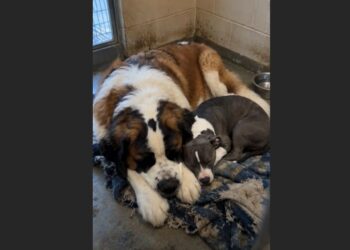
He lay curled in the darkest corner, his muzzle resting on his front paws, his tired eyes facing the concrete wall.
His body was weakened by age and arthritis. His appetite had nearly disappeared, and the shelter’s veterinary staff were becoming increasingly concerned about his condition.
Max had lost Arthur, the person who had been the center of his life, in a single night. After that sudden separation, he seemed to have lost interest in almost everything around him.
The staff were doing what they could, but he remained withdrawn.
I was a physician with twenty-three years of experience, accustomed to difficult situations and long hours in the emergency department.
Yet I had never felt quite so helpless as I did sitting outside that kennel, trying to reach a dog who wouldn’t even turn toward my voice.
For four mornings, nothing seemed to change.
On the fifth, Max moved one ear.
On the sixth, he finally looked at me.
And on the seventh, something happened that would change both our lives.
The German Shepherd Who Had Lost Arthur
I knew very little about Arthur.
I knew his name, and I knew he had been deeply important to Max. Their separation had happened suddenly, leaving the old German Shepherd in the unfamiliar surroundings of a municipal shelter.
Max had spent a long time with that familiar person, and the change appeared to have affected him profoundly.
He was already an elderly dog, with arthritis that made movement difficult. His eyes were clouded by cataracts, and he no longer had the strength or mobility of a younger German Shepherd.
Even getting to his feet required effort.
The shelter staff had noticed how withdrawn he had become.
He spent much of his time lying in the corner of his kennel, showing little interest in food or in the people who approached him.
His physical condition was a concern, and his reluctance to eat was making matters worse.
I had seen patients become withdrawn after sudden losses and major changes in their lives. But I knew that I couldn’t simply apply my understanding of human grief to a dog.
I didn’t know exactly what Max remembered or how he understood Arthur’s absence.
What I could see was an elderly animal whose familiar world had changed abruptly and who was struggling to adjust.
And I couldn’t bring myself to walk away from him.
A Folding Chair Outside His Kennel
I began visiting Max every morning before work.
My routine became remarkably simple.
I arrived at the municipal shelter carrying a small folding chair, placed it just outside his kennel, and sat down.
I didn’t try to force him to approach.
I didn’t insist that he look at me or accept affection.
I simply stayed.
At first, some members of the shelter staff watched me with curiosity.
I understood their skepticism.
They had already spent time caring for Max and had seen how little he responded to attention.
He was old, physically uncomfortable, and deeply withdrawn.
There was no reason to assume that a stranger sitting outside his kennel would make any difference.
But I had spent twenty-three years working in medicine, and one thing I had learned was that meaningful progress didn’t always announce itself dramatically.
Sometimes it appeared in the smallest changes.
A patient taking an interest in an ordinary conversation.
Someone managing a task that had been too difficult the day before.
A moment of comfort after days of distress.
I wasn’t expecting Max to become an energetic young dog again.
I just wanted to give him an opportunity to become familiar with someone who would return.
So I kept bringing my chair.
The Things I Told Him Before Work
I talked to Max during those visits.
Sometimes I told him about the hospital.
I spoke about the long night shifts, the exhaustion that came with emergency medicine, and the difficult decisions that sometimes stayed with me after I left work.
There were days when I felt physically worn down.
There were also days when I carried home the emotional weight of things I couldn’t change.
I told Max about those moments.
And I told him about the smaller victories, too.
The patients who improved.
The emergencies that ended well.
The quiet satisfaction of knowing that someone was going home because the medical team had been able to help.
Max couldn’t understand the details of those experiences, of course.
But I found something unexpectedly comforting about speaking without expecting a response.
I also told him about Sarah.
I described our home, our familiar routines, and the warmth of the rooms where we spent our evenings.
I spoke about the possibility of bringing him there someday.
I didn’t know whether that would ever happen.
At that point, Max wouldn’t even lift his head to look at me.
But I was beginning to think seriously about what life might be like if Sarah and I could give him a home.
For now, I kept those thoughts as hopes rather than plans.
There were more immediate concerns.
Max was barely eating.
Four Days Without a Response
The first four days were difficult.
Max remained in the darkest corner of his kennel, his muzzle resting on his front paws.
When I spoke, he usually continued facing the wall.
Sometimes I wondered whether my presence was making any difference at all.
His food remained untouched, and the shelter staff were increasingly worried about his declining strength.
For an elderly dog already weakened by arthritis, going without adequate food was a serious concern.
The shelter’s veterinary team was monitoring him and had begun discussing whether emergency intravenous fluids might be needed.
I couldn’t ignore the medical implications of his condition.
Whatever emotional distress he was experiencing, his physical needs still required proper veterinary attention.
I continued visiting, but I never considered my presence a substitute for treatment.
I could offer familiarity and companionship.
The veterinary staff had to address his health.
By the fourth morning, I was discouraged.
I sat in the cold shelter, watching Max remain motionless in his corner.
I thought about the possibility that he might not become comfortable enough to approach anyone.
Perhaps his age and physical condition would make the adjustment especially difficult.
Perhaps he would continue withdrawing despite our efforts.
I didn’t have an answer.
So I stayed until it was time to leave for the hospital.
And the following morning, I returned.
The Fifth Morning: One Ear Turned Toward Me
On the fifth day, I arrived with my folding chair and settled into the familiar spot.
Max was lying in his usual corner.
I began talking to him about a young patient whose condition had improved the previous day.
It had been one of those encouraging outcomes that made the difficult hours of emergency medicine worthwhile.
I was partway through recounting the experience when I noticed movement.
Max had turned one ear toward me.
His body remained where it was.
His muzzle still rested on his paws.
He didn’t look up or attempt to approach.
But his ear had shifted in the direction of my voice.
I stopped speaking for a moment.
After four days of almost no visible response, that tiny movement caught my attention.
It didn’t prove that Max was becoming emotionally attached to me, and it certainly didn’t mean that his physical difficulties had improved.
But he was responding to something in his surroundings.
He appeared to be listening.
I resumed speaking softly.
I didn’t move closer or try to turn the moment into a larger interaction.
I wanted him to have the freedom to remain where he felt comfortable.
That morning, I left the shelter feeling a little more hopeful.
Max had finally acknowledged my presence in a way I could see.
The Sixth Morning: He Looked at Me
The following day brought another change.
When I arrived, Max was still resting in his kennel.
I unfolded my chair and began speaking as usual.
After a while, he turned his head.
For the first time, he looked directly toward me.
His dark eyes were clouded by cataracts and fatigue, but his attention was unmistakably directed at where I was sitting.
I remember how long that moment seemed to last.
I had spent almost a week speaking to a dog who rarely looked away from the wall.
Now he was watching me.
I resisted the urge to reach toward him.
We were still separated by the kennel, and Max hadn’t shown that he wanted physical contact.
I simply remained seated and continued talking.
I thought about how easily I might have missed that moment if I had expected progress to look more dramatic.
Max hadn’t stood up.
He hadn’t wagged his tail.
He hadn’t approached the kennel door.
But he had turned toward me voluntarily.
The change gave me a reason to keep hoping that he might eventually become more comfortable with my presence.
And on the seventh day, he did something I hadn’t dared to expect so soon.
The Seventh Day: One Meter Between Us
On the seventh morning, I asked the shelter staff for permission to enter Max’s kennel.
I wanted to see whether he might feel comfortable with me sitting nearby rather than outside the enclosure.
After receiving permission, I went inside and sat directly on the cold floor.
I positioned myself about a meter away from him.
I didn’t move closer.
Max was elderly, physically uncomfortable, and still recovering from a period of withdrawal and poor appetite.
I wanted him to have enough space to decide whether he wished to approach.
I spoke gently.
I told him that if he chose to come closer, I would be there.
I also told him about the home I hoped to offer him someday, where he would have somewhere warm to rest and people willing to care for him.
I knew he couldn’t understand that promise in the human sense.
But saying it aloud made me realize how serious I had become about helping him.
For a while, Max remained where he was.
Then he began to move.
He carefully raised himself from the floor.
The effort was visible in his aging body.
His legs were stiff, and standing wasn’t easy.
I stayed still.
Max took a hesitant step.
Then another.
Slowly, he moved across the small distance between us.
When he reached me, he lowered his muzzle onto my knees.
And he let out a long sigh.
The Weight of His Head on My Knees
I can still remember how it felt when Max rested his head against me.
He was an elderly German Shepherd, tired and physically uncomfortable, and the movement across the kennel had taken effort.
I hadn’t asked him to come.
He had made that choice himself.
For several moments, I remained completely still.
I didn’t want to startle him or overwhelm him with attention.
Then I gently rested a hand against him.
I thought about the first morning, when he had remained in the corner without responding to my voice.
I thought about the untouched food and the concern among the veterinary staff.
And I remembered the tiny movement of his ear two days earlier.
Now the same dog was resting his muzzle on my knees.
I didn’t imagine that a single moment of affection had resolved all his difficulties.
He was still old.
He still had arthritis.
He still needed veterinary care and time to adjust.
But he had voluntarily approached another person.
That mattered.
I stayed on the floor beside him, allowing the moment to unfold without asking for anything more.
By the time I left for the hospital, I knew I wanted to discuss bringing Max home with Sarah.
Sarah Meets the Dog I’d Been Talking About
When I told Sarah everything that had happened, she didn’t hesitate.
She had heard me talk about Max during the previous week.
She knew I’d been visiting him every morning and that I had become increasingly concerned about his condition.
Now I told her about the moment he’d finally approached me.
I described the slow steps across the kennel and the way he’d rested his muzzle on my knees.
I also explained that caring for him would involve real responsibilities.
Max wasn’t a young dog who would adapt instantly to a new household.
He was elderly, had arthritis, and would need medical attention and a predictable routine.
Sarah understood.
The following weekend, she accompanied me to the shelter.
I watched closely as she approached Max.
She was calm and gentle, allowing him time to become familiar with her presence.
When she extended her hand with her palm open, Max moved toward her.
Then he gently touched her fingers with his tongue.
Sarah smiled.
There was no dramatic celebration.
We simply stood together with Max, allowing him to become comfortable with her.
For me, it was another encouraging moment.
He was beginning to respond positively to someone beyond the person who had spent the previous week sitting outside his kennel.
And Sarah was becoming attached to him too.
A Month Before He Could Come Home
We continued visiting Max.
The process of bringing him home wasn’t completed immediately.
His health and care needs remained important, and the adoption required the appropriate arrangements and paperwork.
Over the course of a month, we maintained our visits and worked toward making his adoption possible.
I wanted to approach the decision responsibly.
Max’s arthritis wouldn’t disappear simply because he moved into a loving home.
He would still need supportive care, attention to his mobility, and a routine that allowed him to rest when necessary.
Sarah and I were prepared for those responsibilities.
We also understood that Max might need time to become comfortable in a completely new environment.
After the month of visits and administrative arrangements, the adoption was finally completed.
I remember feeling relieved.
Not because I believed Max’s difficulties were over, but because we could begin providing him with a stable home.
For weeks, I had been carrying a folding chair into the shelter and sitting beside him before work.
Now I could bring him into our everyday lives.
And for the first time, Sarah and I were taking Max home together.
The First Day in Our House
When Max entered our home, he began investigating his new surroundings.
He moved carefully through the rooms, sniffing the wooden furniture, the living room rugs, and the air near the kitchen.
I watched him explore without hurrying him.
He had lived through a sudden change in his familiar environment, followed by a month at the shelter.
I didn’t expect him to feel settled immediately.
Every room contained unfamiliar scents and objects.
He needed time to learn where things were and discover which places felt comfortable.
Sarah and I let him investigate at his own pace.
His movements were still affected by age and arthritis, but he showed interest in the house.
That alone was encouraging.
Then he found the large, soft cushion we had placed near the fireplace.
He examined the area and settled down.
Over time, it became his favorite place to rest.
I enjoyed seeing him there, especially after remembering the cold shelter floor where I had first sat beside him.
The cushion offered him somewhere comfortable, and the warmth of the room made the space particularly inviting.
It was the beginning of a new routine.
Three O’Clock in the Morning
During Max’s first night at home, I woke at around three in the morning.
I had heard a slight noise.
When I opened my eyes, Max was standing beside the bed.
He was close enough for me to recognize his familiar outline in the dim room.
For a moment, I watched him.
I didn’t know whether he’d been disturbed by an unfamiliar sound, wanted reassurance, or had simply come looking for me.
I spoke softly.
I told him he could rest.
After hearing my voice, Max lowered himself onto the floor beside the bed.
I stayed awake for a little while, listening as the house became quiet again.
The moment reminded me of how much had changed in a relatively short time.
Only weeks earlier, Max had spent his days withdrawn in a shelter kennel.
I had sat outside talking to him, hoping that eventually he might turn toward me.
Now he had followed me into the bedroom and chosen to settle nearby.
I didn’t assume that he felt completely secure after one night.
But he was beginning to form familiar routines in our home.
And I was grateful to have him there.
A Call That Took Us Back to the Hospital
A few weeks after Max came home, I had to make an urgent trip to the hospital to collect an important medical file.
On that occasion, I took Max with me.
As we crossed the main lobby, he walked beside me on his leash.
His movements were slow and measured, as usual.
I was focused on the reason for my visit when I noticed a young girl sitting in a wheelchair.
She was eight years old.
She appeared uncomfortable, and her expression was subdued.
Then she saw Max.
She straightened slightly in her chair.
Her attention shifted toward the old German Shepherd.
I watched her expression change as she looked at him.
There was a clear interest that hadn’t been visible a moment earlier.
Max was calm beside me.
As the girl continued watching him, he slowly approached.
He moved carefully, as he usually did, and when he reached her, he gently rested his head on her lap.
She began petting him.
I stood beside them, watching the interaction.
It was an ordinary gesture from a dog who had become comfortable seeking affection.
But for the girl and her mother, the moment carried far more meaning.
The Little Girl Who Smiled Again
The girl’s mother began crying.
She told us that her daughter hadn’t smiled since being hospitalized.
Now, with Max resting his head on her lap, the child was smiling as she stroked his fur.
I looked at the two of them.
Max remained calm, accepting the gentle attention.
The girl continued petting him.
Her mother watched with an expression I recognized from years of working in medicine.
It was the relief of seeing a loved one experience a moment of comfort during a difficult period.
I didn’t know the details of the child’s condition, and I had no reason to believe that one interaction with a dog could resolve the medical or emotional challenges she faced.
But I could see that meeting Max had made a difference in that moment.
The girl had become interested in something around her.
She was engaging with the dog.
And her mother was moved by the response.
I thought about the elderly German Shepherd I had first met at the shelter.
For days, he had barely looked at anyone.
Now he was standing beside a child who was taking obvious pleasure in his presence.
I hadn’t expected that when we adopted him.
And I began wondering whether Max might be able to offer similar comfort to others.
An Unexpected Role at the Hospital
The encounter in the lobby led to a conversation with the hospital’s medical leadership.
With their approval, Max began making regular visits.
His role was informal, centered on offering calm companionship to people who welcomed his presence.
Twice a week, he came to the hospital.
He spent time with anxious children, patients facing long recoveries, and members of the healthcare staff who were often exhausted by demanding shifts.
He wasn’t a medical treatment, and we didn’t expect him to replace any part of the care patients were receiving.
His contribution was simpler.
He offered a quiet presence.
Some people enjoyed petting him.
Others seemed content to sit beside him for a while.
For staff members who spent long hours caring for people in distress, the opportunity to spend a few peaceful moments with an affectionate old dog could be welcome.
Max continued moving at his own comfortable pace.
His age and arthritis remained important considerations.
He wasn’t expected to hurry through corridors or stand for extended periods.
We made room for his limitations.
And in return, he brought something special into those encounters.
The same dog who had once struggled to respond to the people around him was now comfortable spending time with unfamiliar people in a carefully managed setting.
The Hospital Staff Came to Know Max
Over time, Max became a familiar presence during his twice-weekly visits.
The staff learned that he was an elderly German Shepherd who moved slowly and appreciated gentle attention.
They also learned that he had once spent weeks withdrawn in a shelter after losing the person he knew best.
I found myself watching him interact with people and remembering our first days together.
At the shelter, I had spoken to him about my work in emergency medicine.
I had told him about the exhaustion of night shifts and the small victories that made the difficult days worthwhile.
Now he was part of my hospital life in a way I could never have anticipated.
I was still a physician.
The patients still needed medical care, and the demanding nature of the work hadn’t changed.
But Max’s visits reminded me that the experience of being in a hospital extends beyond treatment alone.
Patients and families spend time waiting, worrying, recovering, and adjusting to difficult circumstances.
Healthcare workers carry the responsibilities of those situations through their long shifts.
A gentle interaction with an animal doesn’t remove those challenges.
But it can offer a welcome moment of ordinary companionship.
I had seen that in the little girl who smiled while petting Max.
And I continued seeing the value of quiet, respectful interactions during his visits.
Twenty-Three Years in Medicine Had Changed Me
Before meeting Max, I had spent twenty-three years building my career as a physician.
Those years taught me how to work under pressure.
They taught me to concentrate when decisions mattered and to remain composed during emergencies.
I learned to separate my personal feelings from the immediate demands of patient care when necessary.
That ability had helped me through many difficult shifts.
But I also recognized that years of practicing medicine had made me more guarded.
There were experiences I carried privately.
There were difficult outcomes I rarely discussed.
And there were times when I returned home so tired that I had little energy left to think about anything beyond the next day’s responsibilities.
When I first sat outside Max’s kennel, I hadn’t intended to examine those parts of my own life.
I was there because an elderly dog had lost his familiar companion and seemed to be struggling.
But as the days passed, something unexpected happened.
I began speaking about things I usually kept to myself.
I told Max about my doubts, my exhaustion, and the emotional weight of my work.
He couldn’t offer advice.
He couldn’t respond with words or understand the clinical details I described.
But sitting beside him gave me space to reflect.
And watching him gradually become more comfortable reminded me of the importance of patience in situations where progress couldn’t be forced.
The Man Named Arthur
Sometimes, when Max is resting at home, I think about Arthur.
I know little more about him than his name.
I don’t know all the details of his relationship with Max or what their everyday life looked like.
I do know that Max had been deeply attached to him.
The sudden loss of that familiar companionship had been followed by an exceptionally difficult period for the dog.
At the shelter, he had spent days lying in a corner, showing little interest in his surroundings.
He had once waited behind a glass door for the person he knew.
I often thought about that image during our visits.
Max couldn’t explain what he was experiencing.
He couldn’t tell us which sounds or routines he missed.
We could only observe how he responded to his new circumstances and try to provide the support he needed.
I sometimes wonder what Arthur would think if he could see Max now.
He would see an aging German Shepherd who still has arthritis and needs appropriate care.
He would also see a dog who rests comfortably at home, enjoys gentle attention, and has become a welcome visitor at a hospital.
I can’t know what Arthur would make of those changes.
But I hope he would be glad that Max has found people willing to care for him in his later years.
The Old Dog Beside the Fireplace
Most evenings, Max returns to his favorite cushion near the fireplace.
His muzzle is older and grayer than it was when he first came into our lives.
He still moves carefully.
He still needs time to stand and settle, and there are days when his arthritis makes certain activities more difficult.
Sarah and I pay attention to those needs.
We don’t expect him to move like a young dog.
We want him to be comfortable, to enjoy the activities he can manage, and to have opportunities for rest and affection.
Sometimes, when I sit near the fireplace, Max moves closer and settles with his muzzle resting on my feet.
I look down at him and remember the cold floor of the municipal shelter.
I remember my little folding chair.
The four mornings when he barely acknowledged me.
The fifth morning when one ear turned toward my voice.
The sixth when he finally looked at me.
And the seventh when he walked slowly across the kennel and rested his head on my knees.
I had gone to the shelter because I couldn’t bear to leave an elderly dog alone in such a difficult condition.
I hadn’t expected him to become part of my family.
And I certainly hadn’t imagined that he would one day accompany me to the hospital and offer comfort to the people I spent my working life caring for.
The Chair I No Longer Need
I still think about those early mornings.
For days, I sat outside Max’s kennel, wondering whether I was accomplishing anything.
He barely moved.
He wasn’t eating properly.
The veterinary staff were concerned, and I knew his age and physical condition made the situation serious.
There was no guarantee that he would respond to my visits.
But I returned each morning.
Eventually, he began turning toward my voice.
Then he approached.
And after a month of visits and the necessary arrangements, Sarah and I were able to bring him home.
That decision changed the rhythm of our household.
It also changed something in me.
I had spent so many years concentrating on the urgent demands of medicine that I sometimes overlooked the value of simply being present without expecting an immediate result.
Max reminded me of that.
He didn’t need me to deliver a speech about hope or promise that everything would become easy.
He needed appropriate care, time, patience, and a familiar presence he could approach when he was ready.
I learned to appreciate those things in a different way because of him.
And I carried that appreciation back into my work.
When the Hospital Day Is Over
These days, I still come home from demanding shifts.
There are evenings when I feel the same exhaustion I described to Max while sitting outside his shelter kennel.
The work hasn’t become easier simply because he is part of my life.
But coming home is different.
Sarah is there, and Max has usually settled into one of his familiar resting places.
Sometimes he’s asleep on his cushion beside the fireplace.
Other times, when he hears me nearby, he lifts his head and watches me approach.
If he feels like getting up, he does so slowly.
If he prefers to remain where he is, I go to him.
I stroke his gray muzzle and spend a few quiet moments beside him.
There are no dramatic gestures.
No need to explain everything I’ve experienced during the day.
Just an elderly dog resting comfortably in the home we share.
Max is still the same German Shepherd who once lay motionless in a shelter kennel, struggling with the sudden disappearance of the person he knew.
His arthritis hasn’t vanished.
His eyes are still affected by cataracts.
And he continues to need care suited to his age.
But he eats, rests, seeks affection, and enjoys the familiar routines of our home.
Twice a week, when appropriate, he also accompanies me to the hospital, where his calm presence offers comfort to people who appreciate spending time with him.
Sometimes I think back to the day he first rested his head on my knees.
I was sitting on the cold floor of his kennel, hoping he might come a little closer.
I could never have imagined how much that small movement would mean in the years of my life that followed.
Tonight, Max is asleep beside the fireplace.
His muzzle rests across my feet, and the room is quiet.
I stay where I am for a while, letting him sleep.
Tomorrow, I’ll return to the hospital, where another demanding day may be waiting.
But I won’t need to carry a folding chair to the shelter before my shift.
Max is already home.
Editor’s Note: The characters in this story are fictional. Through these stories, we hope to share the intelligence, loyalty, compassion, and loving nature of dogs with people everywhere.