For six years, Rex had known a life no dog should ever have to endure.
He was a Pit Bull who had survived illegal dogfighting.
His body carried scars from those years, and his behavior showed how difficult it was for him to feel comfortable around people or other animals.
When I brought him home, I thought a quiet house, regular meals, and gentle care would help him begin a new life.
But Rex didn’t seem interested in any of those things.
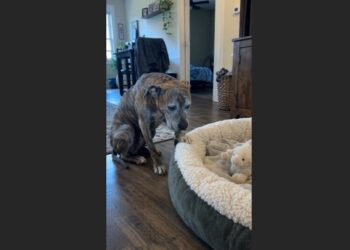
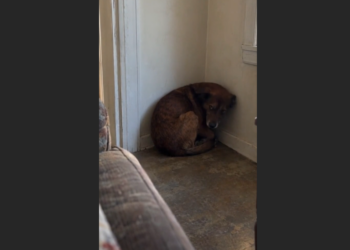
He spent most of his time in the corner of my living room.
His body was tense.
His head remained low.
And whenever someone moved too quickly, he flinched.
I tried sitting near him.
I spoke softly.
I made sure he had somewhere comfortable to rest.
But he rarely approached me.
I began wondering whether he would ever feel safe enough to relax.
Then my neighbor brought her Golden Retriever over for a visit.
The first meeting didn’t give me much reason to hope. The retriever was lively, and Rex remained withdrawn.
But the following day, my neighbor called.
After our conversation, I asked her to bring her dog back.
This time, the Golden Retriever behaved differently.
He walked into my living room without rushing toward Rex.
He stopped about six feet away.
Then he quietly lay down on the floor.
He didn’t bark.
He didn’t attempt to play.
He simply rested there, allowing Rex to watch him.
For a long time, nothing happened.
Then Rex slowly lifted his head.
And for the first time since he’d arrived, he seemed more interested in another living creature than in finding somewhere to hide.
I didn’t know it then, but that quiet afternoon would become the beginning of a friendship that changed both dogs’ lives.
The Dog I Brought Home
I’d known that adopting Rex would require patience.
A dog who has survived years of cruelty cannot be expected to become comfortable in a new environment overnight.
His body had scars.
But there were things about his behavior that concerned me even more.
He seemed constantly alert.
Ordinary household sounds could make him tense.
When I entered the room, he sometimes lowered his head or shifted farther away.
I never knew exactly what he had experienced during those six years.
I knew he had been involved in illegal dogfighting, but I couldn’t reconstruct every event or identify everything that frightened him.
I only knew that his past had been difficult.
And now he needed an environment where he could receive appropriate care without being pressured into unfamiliar interactions.
I prepared a quiet place for him.
He had regular food and water.
I tried to keep our routine predictable.
And I made an effort to let him decide when he was comfortable approaching.
But Rex remained withdrawn.
Sometimes I’d sit in my chair and watch him resting in the corner.
He was finally living somewhere he wasn’t being forced to fight.
Yet he still appeared to be waiting for something frightening to happen.
The Corner of the Living Room
Rex chose a particular corner almost immediately.
It was away from the busiest part of the room.
He could rest there while still watching what happened around him.
At first, I hoped he’d gradually become interested in exploring the house.
I placed his belongings nearby and gave him time.
But he continued returning to the same place.
Sometimes he raised his head when I spoke.
Other times, he barely moved.
I learned not to approach him suddenly.
I didn’t reach for him when he showed signs of discomfort.
And I avoided trying to encourage contact simply because I wanted to reassure him.
I was beginning to understand how much work it would take to help him adjust.
Some days, I thought he seemed a little more relaxed.
Then a noise or unfamiliar movement would make him tense again.
I reminded myself that progress didn’t have to happen quickly.
But I was worried.
Rex was living in a safe home.
He had people willing to care for him.
Yet he seemed unable to enjoy much of the ordinary life around him.
I wanted to help him find a way forward.
I just didn’t know how.
My Neighbor’s Golden Retriever
My neighbor had a Golden Retriever.
He was friendly, active, and accustomed to spending time around people.
His behavior was very different from Rex’s.
Where Rex preferred to remain in a corner, the retriever was usually interested in what was happening around him.
He moved comfortably through familiar places.
He enjoyed attention.
And he seemed much more relaxed during ordinary interactions.
My neighbor knew about Rex.
She understood that he had survived years in illegal dogfighting and that he was having difficulty adjusting to my home.
Eventually, we arranged for the dogs to meet.
I hoped the retriever’s presence might help.
But I knew I had to be cautious.
Rex had a difficult history with other dogs.
That didn’t mean he was incapable of forming a peaceful relationship.
It did mean any interaction needed close observation and careful management.
During the initial visit, the retriever was more energetic than I had hoped.
Rex remained withdrawn.
I didn’t see the change I’d been wishing for.
Afterward, I began wondering whether introducing another dog had been a mistake.
Then my neighbor called the following day.
The Phone Call That Made Me Reconsider
I remember standing with the phone against my ear.
My neighbor was speaking about her Golden Retriever.
As I listened, I looked across the living room toward Rex.
He was in his usual corner.
Quiet.
Still.
Keeping his distance.
The conversation made me reconsider what had happened during the dogs’ first meeting.
Perhaps the retriever’s presence hadn’t been as unimportant to Rex as I’d assumed.
Perhaps we’d simply expected too much from the first interaction.
I couldn’t know.
But I wanted to see whether a calmer, more carefully managed meeting might be different.
So I asked my neighbor to bring her dog back.
We agreed to take things slowly and pay close attention to both animals.
I didn’t want Rex to feel trapped.
And I didn’t want the retriever placed in an uncomfortable or unsafe situation.
When my neighbor arrived, I watched both dogs closely.
Rex became tense as the door opened.
He looked toward the entrance.
Then the Golden Retriever stepped inside.
And almost immediately, I noticed something different.
Six Feet Away
The retriever didn’t rush across the room.
He didn’t bounce toward Rex or try to engage him in play.
Instead, he walked slowly.
Then he stopped about six feet from the corner.
He lowered himself onto the floor and rested his head on his front paws.
I watched carefully.
His body appeared relaxed.
He wasn’t staring at Rex or attempting to move into his space.
Rex remained in the corner.
At first, his muscles tightened.
I expected him to retreat farther.
But he didn’t.
He watched the retriever.
After a while, Rex lifted his head slightly.
I felt a cautious sense of relief.
Nothing dramatic had happened.
The retriever had simply chosen a place to rest.
But Rex was observing another dog without immediately withdrawing.
That was more than I’d expected.
I stayed in my chair.
I didn’t want to interrupt the calm atmosphere.
My neighbor and I continued monitoring them, ready to give either dog more space if needed.
For the first time, I allowed myself to hope that Rex might eventually become comfortable with a canine companion.
An Afternoon Without Demands
The afternoon passed quietly.
The Golden Retriever rested on the floor.
Sometimes he shifted position.
Other times, he simply remained where he was.
Rex watched him from his corner.
He didn’t approach.
But he also didn’t appear to be trying to get farther away.
I had spent so much time looking for ways to encourage Rex to engage with me.
I offered affection.
I spoke gently.
I tried to make the house as comfortable as possible.
Yet I couldn’t persuade him to relax simply by wanting him to.
Now another dog was resting in the same room, without asking anything from him.
I couldn’t know whether the retriever was deliberately trying to reassure Rex.
He might simply have been comfortable resting in a quiet place.
But the lack of pressure seemed to suit the situation.
Rex had time to observe.
He could remain where he felt comfortable.
And he wasn’t being asked to respond before he was ready.
I began thinking that perhaps this was something he’d needed all along.
Not another attempt to draw him out.
Just the chance to share space peacefully.
The Evening Meal
That evening, I prepared food for both dogs.
I made sure each had an appropriate place to eat without being crowded or disturbed.
I expected the retriever to approach his own bowl.
Instead, he moved toward the area near Rex’s food and sat down.
He didn’t begin eating.
He simply remained nearby.
I watched to make sure neither dog showed signs of tension around the food.
Then Rex moved.
He lifted his head.
Slowly, he came out of his corner.
I barely dared to breathe.
He approached his bowl.
Stopped.
Looked toward the Golden Retriever.
The retriever remained calm.
His tail moved gently.
Then Rex lowered his head.
And began eating.
I sat still in my chair.
For the first time since bringing him home, I was watching Rex eat comfortably while I remained in the room.
It was an ordinary activity.
But after days of seeing him struggle to relax, it felt enormous.
I didn’t know whether the retriever had influenced his decision to eat.
Still, the timing was encouraging.
And I hoped we were beginning to find a routine that worked for him.
The Second Morning
My neighbor brought the Golden Retriever back early the following morning.
By then, we had seen that the dogs could share space calmly under close supervision.
I wanted to observe whether Rex would respond similarly during another visit.
The retriever entered quietly.
This time, he settled closer to Rex.
Rex watched.
I expected him to become tense.
But he remained where he was.
As the morning passed, both dogs rested.
Occasionally, one shifted position.
Sometimes Rex lifted his head to look around.
But he didn’t immediately retreat when the retriever moved nearby.
I began noticing changes in his posture.
His body didn’t seem quite as rigid.
His breathing appeared steadier while he rested.
I tried not to draw conclusions too quickly.
A fearful dog can seem comfortable in one situation and struggle in another.
But the repeated calm interactions were encouraging.
We continued giving the dogs space and supervising their time together.
Then, later that evening, Rex did something that surprised me even more than his willingness to eat.
The First Time Rex Chose to Lie Beside Him
The light outside was beginning to fade.
I was sitting in my chair.
The Golden Retriever was lying on the floor.
Rex had been resting nearby.
Then he stood.
He looked toward the retriever.
And slowly began walking in his direction.
I watched without moving.
Rex stopped a short distance away.
He seemed uncertain.
But the retriever remained relaxed.
After a moment, Rex stepped closer.
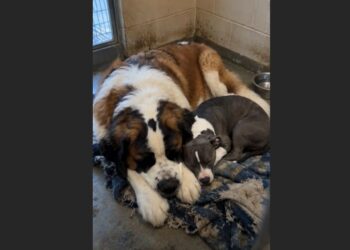
Then he lowered himself onto the floor beside him.
Their bodies touched.
Rex moved his muzzle toward the Golden Retriever’s golden fur and rested against him.
The older dog remained quiet.
For a while, I watched them settle.
Then Rex released a long breath.
His body seemed to relax.
And his eyes closed.
I had seen him rest before.
But I hadn’t seen him choose such close contact with another dog.
Given what he had survived, the moment was deeply moving.
I sat there with tears running down my cheeks.
I didn’t want to interrupt them.
I simply watched two dogs sleeping peacefully beside each other.
The Night I Saw Him Relax
For a long time, I remained in my chair.
The room was quiet.
Both dogs were resting.
Rex’s breathing had become slow and regular.
He wasn’t trembling.
He wasn’t watching the doorway.
And he wasn’t pressed into his familiar corner.
He was lying beside another dog.
I thought about the six years he’d spent in illegal dogfighting.
He had been exposed to circumstances in which encounters with other dogs could involve violence.
Now he was sharing a quiet room with a Golden Retriever who wasn’t challenging him.
The contrast was difficult to ignore.
I couldn’t say that Rex had suddenly forgotten his past.
And I knew one peaceful evening couldn’t guarantee he’d never experience fear again.
But I had seen something important.
Rex could rest comfortably near another dog under the right circumstances.
He had approached voluntarily.
He had chosen where to lie down.
And he remained there.
That night, I felt more hopeful than I had since bringing him home.
The Days That Followed
Over the following days, the changes continued.
Rex began leaving his corner more often.
At first, he ventured only a short distance.
He might walk across the living room, then return to the place where he usually rested.
But gradually, he became more interested in other parts of the house.
Sometimes he followed the Golden Retriever’s movements.
Other times, he simply watched.
He began investigating objects he’d previously ignored.
I noticed him pausing near doorways.
Looking into unfamiliar rooms.
And taking cautious steps into areas he’d avoided before.
I tried to let him explore without making a fuss.
I knew how easily an anxious animal could become overwhelmed.
I wanted him to associate his surroundings with predictable, ordinary experiences.
The Golden Retriever continued visiting.
Their interactions remained calm and carefully observed.
And Rex appeared increasingly comfortable with his presence.
It was the beginning of a different daily routine.
Not one free from every difficulty.
But one in which Rex was showing interest in the world beyond his corner.
Learning to Approach Me
As Rex became more comfortable moving through the house, I began noticing changes in the way he responded to me.
For a long time, he’d avoided coming close.
He watched my movements carefully.
He rarely approached unless he needed something.
Now, sometimes when I spoke, he’d lift his head and look toward me.
Occasionally, he’d come closer.
He began sniffing my hand when I offered it appropriately.
I remained careful not to push him.
I didn’t want to interpret one successful interaction as permission to touch him whenever I wanted.
But Rex was becoming more willing to investigate.
And I could see that the familiar routines we’d developed were helping.
The Golden Retriever was often nearby during these moments.
Rex could observe him receiving gentle attention.
He could see that familiar human contact didn’t always involve something frightening.
That may have been useful to him.
But I also knew Rex’s increasing comfort came through repeated positive experiences and consistent care.
He needed time to learn what to expect from me.
And I was learning how to recognize when he was ready.
The First Tail Wag
One afternoon, I returned home from work.
I entered the house expecting the ordinary quiet routine I’d become accustomed to.
Then I saw Rex.
He was standing in the living room.
Not hiding in his corner.
Not pressed against the wall.
He looked toward me.
And his tail began to move.
I stopped.
The movement was small at first.
Then it became more noticeable.
I smiled.
“Hey, Rex.”
He remained where he was for a moment.
Then he approached.
I lowered my hand and allowed him to sniff it.
He seemed comfortable.
I gently stroked his head.
The change affected me more than I’d expected.
When Rex first arrived, I had worried that he would never feel comfortable around me.
Now he was greeting me when I came home.
I knew a wagging tail could mean different things depending on a dog’s entire body language.
But Rex’s increasingly relaxed posture and willingness to approach were encouraging.
He was becoming familiar with me.
And our house was beginning to feel less frightening to him.
Two Dogs in the Backyard
As Rex gained confidence, we began spending more time outdoors.
The backyard provided room for the dogs to move in a controlled, safe environment.
At first, Rex explored cautiously.
He didn’t seem certain what to make of all the available space.
But the Golden Retriever was comfortable in the yard.
He moved around investigating the grass and familiar surroundings.
Rex sometimes followed him.
Gradually, he began moving more freely.
Then one day, I saw them playing.
It wasn’t rough or uncontrolled.
They moved around the yard together, changing direction and following each other across the grass.
Rex began showing a liveliness I hadn’t seen before.
He moved more confidently.
His tail was active.
And he seemed increasingly interested in participating.
I watched carefully to make sure both dogs remained comfortable.
Given Rex’s history, I wanted to be attentive to how their interactions developed.
But the play continued calmly.
And I found myself smiling as I watched them.
For years, Rex had lived in circumstances where interactions with other dogs had been associated with fighting.
Now he was learning that being near another dog could involve ordinary companionship and play.
The Afternoon I Came Home Early
One afternoon, I finished work earlier than expected.
When I reached the property, I noticed movement in the backyard.
I stopped near the entrance.
Rex and the Golden Retriever were outside together.
They were moving through the grass.
The retriever changed direction.
Rex followed.
Then Rex moved ahead, and the Golden Retriever came after him.
For a moment, they looked like two ordinary dogs enjoying an afternoon in the yard.
I stood watching.
I remembered the frightened Pit Bull I’d brought home.
The dog who barely left the corner of my living room.
Whose body was marked by scars.
And who sometimes seemed afraid to move.
Now he was exploring the backyard, participating in play, and returning to the house to rest comfortably.
I felt a mixture of relief and gratitude.
I knew his recovery wasn’t complete.
There might still be situations he struggled with.
But he’d made real progress.
And the friendship he’d developed with the Golden Retriever had become an important part of his daily life.
What Another Dog Could Offer
I’d tried so hard to help Rex.
I gave him a home.
Regular care.
A quiet environment.
And the time and space he needed to adjust.
Those things mattered.
But I couldn’t provide every experience another dog could offer.
When the Golden Retriever began spending time with him, Rex encountered a different kind of companionship.
He could observe another dog resting calmly.
Eating.
Moving through the house.
And interacting comfortably with familiar people.
Over time, Rex began participating in more of those ordinary activities himself.
I couldn’t say the Golden Retriever had somehow cured him.
I didn’t believe his past had simply disappeared.
And I knew not every dog with a history of fighting would be safe or comfortable living with another animal.
Compatibility requires careful assessment, and introductions must be managed appropriately.
But for Rex, this particular relationship appeared to be beneficial.
The retriever was calm around him.
Rex gradually became comfortable with his presence.
And together, they developed a familiar routine.
I had been trying to help Rex find his place in a new life.
Another dog had become part of that process.
My Neighbor’s Decision
As the weeks passed, my neighbor noticed how close the dogs had become.
She saw them resting together.
She watched their interactions in the yard.
And she knew how much Rex’s behavior had changed since meeting her Golden Retriever.
The situation was becoming more complicated.
The retriever was still her dog.
He had his own home and routine.
But he had also developed a close relationship with Rex.
We talked about what would be best for both animals.
I didn’t want my neighbor to feel pressured into giving up a dog she loved.
And I didn’t want to assume that two dogs should live together simply because they’d become friends.
But she had been watching their relationship closely.
She understood what his presence seemed to mean for Rex.
Eventually, she made a decision that surprised me.
She wanted the Golden Retriever to remain with me permanently.
She believed the dogs would benefit from continuing to live together.
We discussed the practical responsibilities.
Caring for two dogs required more time, resources, and planning than caring for one.
And I needed to be certain I could meet both animals’ needs.
Once we had worked through those considerations, I agreed.
Rex’s friend was staying.
A Home for Two
Having two dogs changed my daily routine.
There were two bowls to prepare.
Two animals to consider when planning walks.
And two different sets of needs to manage.
But there was also something wonderful about seeing Rex and the Golden Retriever together.
They had familiar resting places.
They moved through the house comfortably.
And when the day grew quiet, they often chose to settle near each other.
Rex continued making progress.
He became more willing to explore.
He approached me for attention.
And he began enjoying the ordinary parts of life that had once seemed overwhelming.
His scars remained.
They were part of his history.
But they no longer defined every interaction he had.
I was glad he had someone familiar beside him.
The Golden Retriever hadn’t replaced the need for patient care.
He hadn’t erased Rex’s past.
But their companionship had become a source of stability in our home.
And watching them together made me grateful for the unexpected decision my neighbor had made.
The Fear That Didn’t Disappear Completely
Even after Rex became more comfortable, he still had difficult moments.
An unexpected loud noise could make him startle.
Sometimes he paused when something unfamiliar happened.
Occasionally, I saw the same guarded posture he’d shown during his first days.
I tried not to become discouraged.
His progress didn’t mean he would never feel frightened again.
And I didn’t expect him to forget years of frightening experiences.
When Rex became uncomfortable, I gave him space.
I paid attention to the situation.
And I tried to help him settle without forcing contact.
Sometimes the Golden Retriever remained nearby.
Other times, Rex preferred to move away and rest quietly.
Both responses were acceptable.
The goal wasn’t to make him behave like a dog who had never experienced hardship.
It was to help him enjoy a safe, stable life while respecting the needs he still had.
And that was happening.
He was eating regularly.
Playing.
Exploring the yard.
And approaching familiar people with increasing confidence.
Those changes mattered.
The Scars on Rex’s Body
Sometimes when I stroke Rex’s fur, I notice the scars he still carries.
They remind me of the years before we met.
Six years spent in illegal dogfighting.
Six years when encounters with other dogs were associated with circumstances no animal should be forced to endure.
I can’t change any of that.
And I can’t know every frightening experience Rex had.
But I can see the life he has now.
He has a safe place to rest.
Regular meals.
The opportunity to move freely.
And a companion he often chooses to stay near.
He no longer has to fight.
He doesn’t have to spend his days confined to a place where he cannot escape danger.
And he has people responsible for providing appropriate care.
I know a scar doesn’t tell me everything about an animal’s emotional state.
But when I see those marks, I remember why patience remains important.
Rex’s past is real.
Yet the dog in front of me is also learning new routines, enjoying ordinary activities, and forming relationships.
He deserves to be known for more than what happened to him.
The Dog Who Finally Came Out of the Corner
When I think about Rex’s progress, I often return to the first afternoon the Golden Retriever lay down in my living room.
The older dog was about six feet away.
Rex stayed in the corner.
At first, nothing happened.
Then he lifted his head.
He watched.
And he didn’t retreat.
I remember feeling cautiously hopeful.
It seemed like such a small change.
But at the time, Rex rarely showed interest in anything beyond what he needed to monitor for safety.
Now he was observing another dog.
The retriever didn’t attempt to pull him into play.
He didn’t demand contact.
He simply remained nearby.
Then came the evening meal.
Rex approached his bowl and ate while I watched.
The next day, the dogs rested closer together.
And that evening, Rex chose to lie against the Golden Retriever’s fur.
I remember his body becoming more relaxed.
His eyes closing.
And the quiet sound of both dogs breathing as they rested.
I didn’t know what would happen afterward.
But that was the first time I believed Rex might eventually enjoy the life I’d been hoping to give him.
The Friendship I Hadn’t Planned For
I hadn’t planned to adopt two dogs.
When Rex came home, my only intention was to help him recover from years of cruel treatment.
I expected the process to be difficult.
I knew it might take months or longer.
But I didn’t anticipate how much another dog would become part of that journey.
My neighbor’s Golden Retriever arrived as a visitor.
Then he became a familiar presence.
Eventually, he became Rex’s companion.
And when my neighbor decided to let him stay permanently, our household changed.
Now I have two dogs who often choose to rest beside each other.
They enjoy time outdoors.
They have their own personalities and needs.
And they both receive the care and attention they require.
Sometimes I watch them and think about how unlikely their friendship once seemed.
A Pit Bull with a history of illegal dogfighting.
And a friendly Golden Retriever who had been accustomed to a very different life.
Their relationship didn’t develop because either dog understood the other’s history.
It developed through calm, repeated interactions in which both appeared comfortable.
That was enough.
The Dog Who Greets Me Now
Today, when I return home from work, Rex often comes to greet me.
Sometimes his tail is already moving when I enter.
He approaches with a relaxed expression.
And he seems pleased to receive gentle attention.
I remember the dog who used to remain in the corner when I came home.
The dog who barely lifted his head.
And who sometimes seemed too frightened to cross the living room.
Now he moves comfortably through the house.
He investigates what I’m doing.
And when the Golden Retriever is nearby, the two sometimes follow each other into the yard.
Rex has become stronger and more confident.
His life is filled with ordinary activities that once seemed beyond his reach.
I don’t take those changes for granted.
He still needs patience.
He still deserves respect for his boundaries.
But he no longer seems overwhelmed by every unfamiliar moment.
And I find enormous comfort in seeing him enjoy the familiar routines we’ve built together.
The Two Dogs in the Garden
Some of my favorite moments happen in the backyard.
I might be sitting outside while Rex and the Golden Retriever explore.
Sometimes they move around together.
Other times, each finds something interesting to investigate.
Then, when they’ve had enough activity, they settle nearby.
Rex occasionally rests close enough for his body to touch the retriever’s.
I watch them and remember the first night they slept beside each other.
Back then, I barely dared to move.
I was afraid the moment would end if I disturbed them.
Now their companionship is simply part of daily life.
They no longer need an audience.
There is nothing extraordinary about two dogs choosing to rest together in a sunny yard.
But for me, the sight carries memories of how difficult Rex’s first days were.
And how much his behavior has changed.
I don’t know exactly what Rex feels when he settles beside his friend.
But I know he chooses that place.
And I know he appears comfortable there.
What Rex Taught Me About Patience
Before meeting Rex, I thought patience meant waiting calmly for improvement.
I believed that if I provided a safe home and treated him gently, he would gradually understand that everything was different.
But caring for him taught me something more complicated.
Patience also means accepting that progress may not look the way we expect.
It means allowing an animal to retreat when he feels uncomfortable.
Recognizing small improvements.
And understanding that setbacks don’t necessarily erase what has already been achieved.
For Rex, companionship with another dog became part of his adjustment.
But it wasn’t the only thing he needed.
He also benefited from predictable routines.
Appropriate care.
Quiet places to rest.
And interactions that respected his comfort.
I had to learn to stop measuring success by how quickly he became affectionate.
Some days, success was simply seeing him eat comfortably.
Other days, it was watching him walk across the room without hesitation.
And sometimes, it was finding him asleep beside the Golden Retriever.
Those small moments added up.
The Six Years I Couldn’t Give Back
I sometimes wish I could have met Rex before those six years began.
Before he was forced into fighting.
Before his body carried so many scars.
Before he learned to respond to unfamiliar situations with such intense fear.
But I can’t change his past.
I can’t make those years disappear.
What I can do is provide the kind of life he should have had all along.
A dependable home.
Regular care.
Safe opportunities to exercise and play.
And companionship that suits his individual needs.
I can also continue learning.
Rex has shown me that no single approach works for every frightened animal.
Some dogs benefit from quiet spaces.
Some need structured training or specialized behavioral support.
And some may become more comfortable when introduced appropriately to a compatible companion.
For Rex, my neighbor’s Golden Retriever became an important part of his new life.
Not because the retriever possessed some mysterious ability to understand trauma.
But because the dogs gradually developed a calm, familiar relationship.
And that relationship helped Rex become more comfortable.
The Moment Everything Began to Change
When I think about the turning point, I don’t remember a dramatic rescue or a sudden transformation.
I remember a quiet living room.
A frightened Pit Bull in the corner.
And a Golden Retriever lying on the floor about six feet away.
The retriever didn’t rush toward him.
He didn’t try to make Rex play.
He simply rested.
Rex watched.
Then, over time, he began responding.
First by lifting his head.
Then by eating while the other dog remained nearby.
Then by approaching him.
And finally by lying down against his golden fur.
Those moments became the beginning of many ordinary changes.
Rex explored the house.
He greeted me after work.
He played in the backyard.
And he developed a comfortable relationship with a dog who eventually became a permanent member of our family.
The scars from his earlier life remain visible.
But they are no longer the only things I notice when I look at him.
I see the way his tail moves when I come home.
The way he enjoys the grass.
And the way he returns to his friend when the day grows quiet.
The Life They Share Today
Tonight, after our walk, Rex and the Golden Retriever will probably settle somewhere near each other.
Rex may choose his own resting place.
Or he may move closer until their bodies touch.
The Golden Retriever will likely rest quietly, as he often does.
And I’ll sit nearby, grateful for the ordinary peace of our home.
It’s difficult to believe this is the same dog who once spent nearly all his time hiding in the corner of my living room.
The same dog whose body carried scars from six years of illegal dogfighting.
Who flinched at sudden movements.
And who seemed unable to feel comfortable even after he’d reached a safe home.
I thought I would have to teach Rex everything about life outside fear.
I expected his progress to depend entirely on what I could provide.
Then another dog walked into our living room.
He settled on the floor.
And gave Rex the opportunity to observe him without pressure.
I can’t know whether the Golden Retriever understood how much that mattered.
But I know Rex began changing.
He ate more comfortably.
He explored.
He played.
And eventually, he developed a friendship strong enough that my neighbor decided the two dogs should remain together.
Now they share a home.
Rex still has moments when an unexpected sound startles him.
I still give him the time and space he needs.
But he is no longer spending his days withdrawn in a corner.
He has a routine he recognizes.
People he knows.
A yard he enjoys exploring.
And a Golden Retriever who often rests beside him.
When I look at them together, I don’t see a dog who has been magically cured of his past.
I see an animal who has been given the opportunity to experience something different.
Safety.
Consistency.
Gentle companionship.
And the freedom to decide when he’s ready to approach.
For six years, Rex was forced into a life of fighting.
Today, he can lie peacefully beside another dog without having to defend himself.
Sometimes I find them resting together and remember the first afternoon the retriever came back.
Six feet apart.
Neither moving.
Rex watching cautiously from the corner.
And the Golden Retriever resting quietly on the floor.
I had no idea how much that moment would come to mean.
But now, when Rex settles against his friend’s golden coat and closes his eyes, I understand something I couldn’t see during those first difficult days.
Rex didn’t need to become fearless to enjoy a good life.
He needed care, patience, and the opportunity to build trust at his own pace.
And in our home, he found an unexpected companion who helped make that possible.
Editor’s Note: The characters in this story are fictional. Through these stories, we hope to share the intelligence, loyalty, compassion, and loving nature of dogs with people everywhere.