The growl moved through the shelter hallway like distant thunder.
It was not loud.
It was not frantic.
Still, several adults nearby stopped what they were doing.
A volunteer holding a clipboard stepped back. Another tightened her grip on a leash. Farther down the corridor, nervous dogs began barking harder in response to the tension around them.
Nineteen-year-old Ava Carter tilted her head toward the sound.
Tap.
Tap.
Tap.
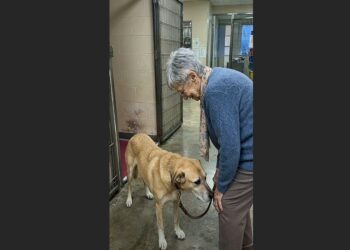
The tip of her white cane touched the concrete floor in front of her shoes as she stood beside her mother.
Ava could not see the warning sign attached to the last kennel.
She could not see the worried expressions passing between shelter employees.
But she could hear the dog breathing behind the gate.
And when the low growl came again, she listened carefully.
“He sounds scared,” Ava said.
Her mother touched her arm.
“Ava, let’s keep looking.”
But Ava remained facing the final kennel.
“Who is he?”
Ava Had Come Looking for a Working Partner
The shelter had been crowded that afternoon.
Dogs barked from both sides of the hallway. Volunteers moved between kennels carrying bowls, towels, paperwork, and leashes. Families stopped to ask questions about dogs they had seen online.
Ava had spent much of the afternoon sitting beside her mother on an old wooden bench while shelter staff introduced several dogs.
She was not simply looking for a pet.
Ava had lost her vision at sixteen after a degenerative condition progressed over time.
First, details became harder to see.
Then larger shapes disappeared.
Eventually, she could no longer rely on vision for independent travel.
The transition had been difficult.
She had to learn new ways to move through the world, use a cane confidently, navigate unfamiliar buildings, and trust skills that had once been unnecessary.
Her other senses had not magically become stronger because she was blind.
What changed was how much attention she learned to give them.
Footsteps told her who was approaching.
A shift in breathing could reveal whether someone was nervous.
Echoes helped her understand the size of a hallway.
The vibration of traffic through pavement mattered at intersections.
Now, as she prepared for college, Ava was exploring whether a trained guide or service dog might eventually become part of her independence.
That was why she and her mother had come.
Every Dog They Met Was Friendly
The first dog greeted Ava with a wet nose against her hand.
Another settled against her knees almost immediately.
One young Labrador wagged so enthusiastically that his tail repeatedly struck a metal chair.
Ava laughed.
Every dog seemed kind.
Several might have made wonderful pets.
But a working assistance dog needed far more than friendliness.
The dog would eventually need stable nerves, excellent health, reliable obedience, confidence in crowds, and extensive professional training.
Shelter staff understood that finding such a dog was not simply a matter of choosing the sweetest one.
Ava understood it too.
She enjoyed meeting each dog.
Still, nothing about the afternoon felt settled.
Then the growl came from the end of the hallway.
“That’s Duke”
Ava lifted her head toward the sound.
“Who is that?”
Her mother answered first.
“Not one we’re meeting.”
A volunteer named Karen hesitated.
“That’s Duke.”
Another low growl came from the final kennel.
Karen explained that Duke was an older German Shepherd and a retired police K9.
His history was complicated.
Years earlier, he had worked with a handler named Officer Ray Lawson. Their partnership included search work, tracking assignments, and other police duties appropriate to Duke’s training.
Then a warehouse emergency ended that career.
Officer Lawson died during the incident.
In the confusion afterward, Duke became highly defensive around his handler’s location and reacted aggressively when emergency personnel attempted to approach.
The behavior was serious.
No one at the shelter romanticized it.
Duke had been removed from active duty and later placed under experienced supervision.
Eventually, after several transitions, he arrived at the shelter.
The Sign Said Not to Enter
Duke’s kennel was managed differently from the others.
Staff did not allow casual visitors inside.
Only designated workers handled him.
His meals could be delivered without someone entering his space, and contact was kept structured.
The large warning sign on the gate was there for a reason.
Duke had not bitten everyone he met.
He had not become uncontrollably aggressive.
But his history meant nobody could assume he was safe simply because he seemed calm at a particular moment.
He had experienced a major loss and a chaotic event.
Since then, unfamiliar people approaching too quickly could trigger defensive behavior.
Over time, he had become increasingly withdrawn.
Sometimes he stayed near the back of the kennel.
Other times, he watched the hallway.
When people lingered too close, he often growled.
Most visitors kept walking.
Ava Asked to Sit Nearby
“I want to hear him closer,” Ava said.
Her mother immediately objected.
“No.”
Karen agreed that entering the kennel was not an option.
Ava nodded.
“I didn’t ask to go inside.”
That distinction mattered.
After some discussion, Karen allowed Ava to sit at a safe distance outside the kennel while staff remained nearby.
No hands would go through the bars.
No gate would open.
There would be no attempt to touch Duke.
Ava walked carefully toward the end of the hallway.
Her cane moved ahead of her.
Duke heard her coming.
The growl deepened.
Ava stopped.
Then, instead of continuing forward, she lowered herself onto the floor several feet from the gate.
She Did Not Challenge the Growl
Many people hear a growl and interpret it as a threat that should be corrected.
Experienced handlers know something else.
A growl is communication.
It can mean fear.
Discomfort.
Uncertainty.
A request for distance.
Punishing that warning can make a situation more dangerous because the dog may learn to skip the warning next time.
Ava did not understand all of Duke’s behavior from one sound.
But she understood enough not to push closer.
She sat sideways rather than facing the kennel directly.
Her hands stayed in her lap.
Duke growled again.
Ava stayed where she was.
“You don’t have to come over,” she said quietly.
The dog remained in the back.
That was the entire first meeting.
There Was No Miracle at the Gate
Duke did not walk forward and place his head in Ava’s hand.
No one would have allowed that.
His behavioral history made direct contact inappropriate without careful assessment.
Instead, something smaller happened.
After several minutes, the growling stopped.
Duke remained where he was.
His breathing gradually slowed.
Ava spoke occasionally.
Nothing dramatic.
She told him her name.
She mentioned college.
At one point she laughed about how many dogs had already put their noses into her hands that day.
Duke listened from the back of the kennel.
When Ava stood to leave, he did not follow.
Still, Karen noticed something.
For the final few minutes, he had been quiet.
Ava Came Back
Two days later, Ava returned.
She asked for the same arrangement.
Same distance.
Same side-facing posture.
No reaching.
No forced interaction.
Karen agreed.
Duke growled when Ava first settled outside the kennel.
Then he stopped.
On the third visit, he remained quiet from the beginning.
Ava began bringing headphones and listening to audiobooks while she sat there.
Sometimes she repeated parts aloud.
Other times, she simply talked.
She told Duke about orientation at college.
She described how frustrating it had been to relearn routes she used to navigate visually.
She talked about using a cane in public and how strangers sometimes tried to grab her arm without asking.
Duke did not understand the stories.
That was not the point.
He heard a familiar voice that arrived repeatedly and never pushed into his space.
Duke Started Staying Visible
During Ava’s earliest visits, Duke often remained partly hidden.
After several weeks, that changed.
He began lying where he could observe her more easily.
Sometimes he moved closer to the front after she had been sitting there for a while.
Ava could hear when his paws shifted on the kennel floor.
Karen quietly described his position when useful.
“He’s about halfway up now.”
Another day:
“He’s lying near the gate.”
Ava smiled but did not turn every improvement into a celebration.
Duke did not need cheering.
He needed predictability.
So the visits stayed ordinary.
Ava arrived.
She sat.
Duke chose where to be.
Then she left.
Professional Assessment Came Before Contact
As Duke became more relaxed around Ava, the shelter consulted people experienced with working dogs and behavior cases.
His history could not be ignored.
Before anyone considered adoption, they needed a clearer picture of his current behavior.
Could he tolerate handling?
How did he respond to unfamiliar environments?
What happened around men, women, dogs, sudden movement, loud noises, and confinement?
Were his reactions specific to particular triggers, or was he broadly unsafe?
The process took time.
There were no guarantees.
A dog can form a connection with one person and still be unsuitable for public-access work.
That was especially important in Ava’s case.
A guide or service dog must be extraordinarily stable in environments filled with unpredictable people.
The shelter would not turn Duke into a service dog simply because his relationship with Ava appeared meaningful.
First, they had to determine whether adoption itself was responsible.
The First Open-Gate Meeting Was Controlled
Weeks passed before Duke and Ava met without kennel bars between them.
The session happened in a controlled area.
An experienced handler brought Duke out first.
Ava waited in a chair.
Her mother stood nearby.
Karen remained present.
Duke entered on leash.
At first, he stayed close to the handler.
Ava did not call him.
She waited.
After several minutes, Duke began investigating the room.
His paws moved slowly across the floor.
Then he approached Ava.
He sniffed near her shoes.
Ava kept her hands still.
Duke moved along her side.
After another moment, his shoulder touched her knee.
Only then did Ava lower her hand where he could investigate it.
Duke sniffed her fingers.
He stayed.
That was enough for one day.
Trust Did Not Erase His History
As their meetings continued, Duke became more comfortable around Ava.
He sometimes settled near her feet.
Eventually, he accepted touch.
But the people involved remained cautious about interpreting progress.
Duke had not forgotten everything that had happened.
Nor had Ava somehow repaired him through kindness.
He was still a dog with a serious behavioral history.
That meant management mattered.
Professional evaluation mattered.
Training mattered.
Ava’s affection could support the relationship, but affection alone could not make Duke safe in every environment.
A month after their first meeting, the shelter approved Ava as Duke’s adopter under a structured transition plan.
Nobody called him her service dog.
Not yet.
At that point, Duke had only one job.
Learn what home with Ava was like.
Home Came Before Work
Ava’s home was prepared carefully.
Duke had a quiet place where nobody would bother him.
Visitors were limited.
His meals followed a predictable schedule.
Walks took place on low-traffic routes at first.
Ava learned how to handle the leash while using her cane, though family members and trainers helped during the early transition.
Most importantly, Duke was given time to decompress.
He did not immediately begin guiding Ava through crowded sidewalks.
That would have been unsafe for both of them.
Instead, the first weeks were about routine.
Breakfast.
Walk.
Rest.
Training.
Dinner.
Sleep.
Repeat.
Duke gradually learned that Ava’s home was not another temporary placement.
Ava Had Her Own Adjustment to Make
Living with Duke required patience from her too.
His size mattered.
His history mattered.
His needs did not disappear because Ava cared about him.
There were days when training went well.
Other days, Duke became distracted or tense.
Ava had to learn his physical signals in ways that did not depend on sight.
Trainers helped her recognize changes through the leash.
A sudden shift in tension.
A stop.
A turn.
A change in Duke’s breathing.
Over time, the pair developed their own communication.
It was not mystical.
It was practiced.
Duke Needed New Skills
Months after the adoption, trainers began evaluating Duke for more advanced work.
His previous police training gave him a strong foundation in obedience and responsiveness, but police work and assistance work are not interchangeable.
Some skills had to be unlearned.
Others had to be built from the beginning.
Guiding a blind handler requires specialized training.
A dog must learn to stop at curbs, avoid obstacles, navigate around pedestrians, ignore distractions, and sometimes disobey a command when following it would be unsafe.
Not every dog can do that work.
Even a highly trained police K9 may not have the right temperament.
Duke’s progress was assessed gradually.
Only as he demonstrated stability did training continue.
The Relationship Changed His Routine
What shelter workers noticed first was not some extraordinary working ability.
It was Duke’s daily behavior.
He slept more deeply.
He spent less time monitoring doors.
He engaged willingly in training.
He began choosing to rest near Ava.
Sometimes, while she studied, Duke stretched across the floor beside her desk.
Other times, he lay near the balcony door listening to city sounds.
Ava gave him predictability.
Duke gave Ava companionship.
Neither erased the other’s past.
That distinction mattered.
Ava Did Not Need to Be “Fixed”
People sometimes spoke about Ava as though blindness had broken her life.
She disliked that.
Losing her vision at sixteen had been devastating.
There had been anger.
Fear.
Grief.
Learning new skills had taken enormous effort.
But blindness had become part of how she moved through the world.
It was not evidence that she was damaged.
Likewise, Duke’s difficult behavior after losing his handler did not make him a ruined dog.
He had struggled.
He had needed management and professional help.
Those facts were real.
But neither Ava nor Duke needed a sentimental story about two broken beings repairing each other.
They needed skills.
Support.
Time.
And a workable partnership.
Public Work Had to Be Earned
Duke’s transition into assistance work took many months.
Training happened in stages.
Quiet streets came before busy ones.
Simple indoor routes came before crowded public buildings.
Ava continued using her cane.
She did not throw it away because Duke was learning.
The cane remained an important mobility tool and backup.
Eventually, Duke began helping with selected routes under professional supervision.
He learned to stop before curbs.
He practiced navigating around obstacles.
Staircases became part of training.
Crowds were introduced gradually.
If he showed stress, the difficulty decreased.
The goal was never to prove something about his past.
The goal was to determine whether the work suited the dog he was now.
Duke Also Learned How to Respond to Ava
Ava sometimes experienced intense anxiety in crowded or unpredictable environments.
Duke was not expected to magically detect an “attack” before Ava herself knew it was happening.
Instead, trainers worked with behaviors he could learn.
Ava had recognizable signs of rising distress.
Changes in breathing.
Changes in posture.
A particular movement of her hands.
Duke was trained to respond to specific cues.
Sometimes that meant moving closer.
Sometimes it meant applying steady contact.
Sometimes it meant helping Ava create space while she used coping strategies she already knew.
The work was practical.
That made it more reliable.
Their Bond Was Built Outside the Dramatic Moments
People who met Duke later often wanted to hear about the shelter.
They liked the story of the growl.
The dangerous dog.
The blind young woman.
The first connection.
But Ava remembered quieter things.
The first time Duke slept through an entire afternoon.
The first time he voluntarily brought her a toy.
The sound of him stretching beside her bed in the morning.
The slight pull in the leash when he noticed something interesting and then redirected his attention.
Those moments mattered more than the dramatic version.
Relationships are built through repetition.
Duke knew Ava because he had spent hundreds of ordinary hours with her.
Ava knew Duke for the same reason.
College Became Their Shared Routine
By the time Ava’s college life became busier, Duke had completed extensive training appropriate to the work he was doing.
Campus introduced new challenges.
Doors opening unexpectedly.
Groups of students stopping in the middle of walkways.
Food on the ground.
Skateboards.
Stairs.
Elevators.
Crowded hallways between classes.
Ava and Duke practiced routes until they became familiar.
When something changed, Ava relied on the combination of her own orientation skills, her cane when needed, and Duke’s trained responses.
He was part of her independence.
Not the source of it.
That distinction mattered to Ava.
Two Years Later
Two years after their first meeting, Ava prepared for graduation.
Duke was older now.
A little more gray showed around his muzzle.
On graduation day, he wore a dark blue working vest and rested quietly near the designated seating area.
The ceremony was loud.
Names echoed through speakers.
Families cheered.
People moved constantly.
Years earlier, an environment that unpredictable might have been inappropriate for Duke.
Now, after extensive work and gradual exposure, he remained settled.
When Ava’s name was announced, applause rose from the audience.
Duke did not understand graduation.
He did not know what a degree represented.
But he knew Ava’s voice.
He knew her movement.
And when she returned to him, his attention shifted immediately toward her.
Nobody Had Been Saved by a Miracle
Later that evening, Ava sat on the apartment balcony with Duke beside her.
The graduation clothes had been put away.
The city sounded softer from several floors up.
Ava rested one hand along Duke’s shoulder.
She thought about the first day at the shelter.
Everyone had heard the same growl.
The difference was not that Ava possessed some special ability to understand dogs.
She had simply been willing to sit at a safe distance and let the dog communicate discomfort without challenging him.
That first choice had led to another.
Then another.
Professionals had done the difficult work of evaluating Duke.
Trainers had helped both of them build the skills needed for daily life.
Her mother had supported the transition.
Shelter workers had refused to give up while also refusing to ignore the risks.
Duke’s progress belonged to all of that.
They Were Never “Broken”
Ava ran her hand slowly through the fur near Duke’s neck.
“You know,” she said, “people thought we were both broken.”
Duke leaned against her.
Ava smiled.
The word had always bothered her.
Blindness did not make her broken.
Fear did not make Duke broken either.
They had each experienced difficult changes.
They had each needed support.
And both had learned how to live differently afterward.
Duke had not cured Ava’s anxiety or replaced her mobility skills.
Ava had not erased Duke’s past.
What they had built was more ordinary than that.
Trust.
Training.
Routine.
Work.
Home.
Two years earlier, Ava had sat outside a kennel while a retired police dog growled from the back.
She had not reached through the bars.
She had not asked him to stop being afraid.
She had simply stayed long enough for him to learn that her presence did not require anything from him.
Everything else came slowly.
That was why it lasted.
Editor’s Note: The characters in this story are fictional. Through these stories, we hope to share the intelligence, loyalty, compassion, and loving nature of dogs with people everywhere.