When the upstairs neighbor moved out, most of what remained behind was ordinary.
A quiet apartment.
An empty doorway.
The sounds of furniture and footsteps gone from the floor above.
But one thing had not left with him.
His dog.
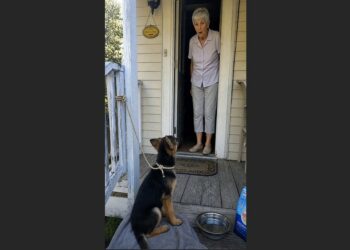
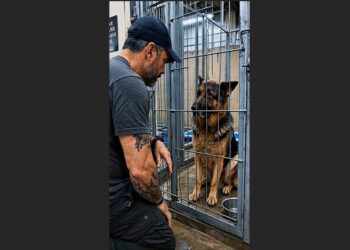
The German Shepherd sat in the hallway outside the apartment, waiting beside a door that was no longer going to open for him.
At first, the neighbor downstairs assumed someone would return.
A friend, perhaps.
A relative.
Maybe the dog’s owner had only left temporarily and planned to come back once the move was finished.
So he waited too.
Then the hours passed.
Nobody came.
And the dog began to cry.
The Sound Continued Through the Night
It was not constant barking.
That might have been easier to dismiss as frustration or excitement.
Instead, the German Shepherd made a lower, unsettled sound that carried through the hallway.
Sometimes he whined.
Sometimes there was a drawn-out cry.
Then silence.
A few minutes later, it started again.
The dog remained outside the same door.
He did not wander far.
He appeared to be waiting for the person who had lived behind it.
By evening, the downstairs neighbor had heard enough to become worried.
Still, he hesitated.
Taking responsibility for someone else’s large dog was not a small decision.
Perhaps the owner really was coming back.
Perhaps someone else had arrangements for him.
Yet night arrived, and nothing changed.
The hallway lights stayed on.
The apartment remained empty.
The German Shepherd stayed beside the door.
By Morning, Nobody Had Returned
The next day made the situation harder to explain away.
The dog was still there.
No food bowl had appeared.
No leash had been picked up.
No familiar person came through the building looking for him.
The neighbor could hear the shepherd from inside his own apartment.
Eventually, ignoring the sound no longer felt possible.
He opened his door.
The dog looked toward him.
For a moment, neither moved.
The German Shepherd seemed exhausted.
His posture was low.
The alert confidence often associated with the breed was nowhere to be seen.
Instead, he watched with tired eyes and remained close to the apartment he had apparently been expecting to reopen.
The man approached carefully.
No sudden reaching.
No attempt to grab his collar.
He spoke softly and allowed the dog to watch him come closer.
The shepherd did not move away.
He Finally Brought Him Inside
The man had no plan beyond getting the dog out of the hallway.
He opened his apartment door and encouraged him inside.
The shepherd followed reluctantly.
That seemed promising at first.
At least he was somewhere warm and quiet.
At least there was water.
At least somebody knew where he was.
Then the man offered food.
The dog turned away.
He tried again later.
Same response.
He spoke gently, hoping the shepherd might relax enough to eat once the building became quiet.
Nothing changed.
Instead, the dog found a corner of the room.
There was an old yellow pillow on the floor nearby.
The shepherd moved against it and stayed there.
The Yellow Pillow Became His Place
For much of the next day, the dog barely changed position.
He pressed himself close to the yellow pillow.
Sometimes his eyes closed halfway.
But he did not appear deeply asleep.
Every so often, he lifted his head toward a noise in the hallway.
Then he settled again.
Food remained untouched.
The man tried sitting nearby.
The shepherd tolerated his presence but did not seek him out.
If spoken to, he might glance over.
Otherwise, he seemed withdrawn from everything happening around him.
There was no aggression.
No barking.
No attempt to challenge the stranger now sharing the room with him.
That worried the man more.
The dog looked depleted.
Not just hungry.
Not just tired.
Something about his behavior suggested that the abrupt change in his life had overwhelmed him.
Three Days Passed Without a Real Meal
By the third day, concern had turned into fear.
A large dog refusing food for that long needed attention.
The man made a veterinary appointment and took the shepherd in.
He explained what had happened.
The owner had moved.
The dog had apparently been left behind.
He had spent roughly a day and night outside the empty apartment.
Since coming downstairs, he had barely eaten.
The veterinarian examined him.
There were no obvious findings that fully explained the refusal to eat.
That did not mean the dog was medically fine in every sense.
Prolonged appetite loss can become dangerous, and many physical conditions can contribute to it.
Still, the circumstances made severe stress an important concern.
The dog’s entire routine and attachment figure had disappeared at once.
The Veterinarian Was Concerned About Stress
The veterinarian explained that dogs can experience significant behavioral changes after losing a familiar person or environment.
They may become withdrawn.
Some stop playing.
Others sleep differently, become unusually quiet, or temporarily lose interest in food.
No one could know exactly what the shepherd understood about his owner’s disappearance.
He did not understand moving trucks, leases, or abandonment in the abstract human sense.
What he did know was that the person, place, and routine he recognized had suddenly changed.
The veterinarian treated the appetite problem seriously.
Supportive care was discussed.
Medication intended to encourage eating was tried.
The man went home hoping that would be enough.
It wasn’t.
The Medicine Did Not Solve Everything
Back in the apartment, the shepherd returned to the yellow pillow.
Food remained difficult.
Treats that most dogs would have taken immediately did little to interest him.
Medication alone could not rebuild appetite if stress was a major part of the problem.
The man tried different soft foods.
He offered very small portions.
He made sure fresh water stayed close.
When necessary, he followed veterinary guidance about helping the dog maintain hydration and nutrition without forcing large amounts at once.
Nothing about those days felt dramatic.
Mostly, they were repetitive.
Offer food.
Wait.
Watch.
Try again later.
Sit nearby.
Listen to the dog breathe.
Hope the next attempt would be different.
The Dog Grew Weak
As the week continued, the shepherd lost strength.
When he stood, his legs sometimes trembled.
He moved less.
The man returned to the veterinarian.
There was no satisfying answer.
Severe stress and inadequate intake can weaken a dog quickly, especially when appetite has already been poor for days.
The veterinarian emphasized that the dog’s condition needed close monitoring.
The man heard another message beneath the medical explanation.
There were no guarantees.
The dog might improve.
He might not.
The next several days mattered.
That was when the man made his own decision.
He was not going to disappear too.
“I’m Not Leaving”
He took time away from work.
There was no heroic plan.
No special training method.
Mostly, he stayed home.
He did not sit directly over the dog.
He did not continually touch him or try to force affection.
Instead, he stayed nearby.
Sometimes he spoke.
Other times, he read or worked quietly from a chair a few feet away.
The German Shepherd could retreat if he wanted.
The yellow pillow remained his place.
Food appeared at predictable times.
Water stayed close.
Nothing was demanded.
The man wanted the dog to learn one thing through repetition.
This person enters the room.
This person leaves briefly.
This person comes back.
The First Days Looked Almost the Same
There was no sudden breakthrough.
On the first full day at home together, the shepherd remained withdrawn.
The second was not much different.
He still did not behave like a dog ready to play, explore, or seek affection.
The man began to understand how difficult it was to measure improvement when the changes were so small.
Did the dog hold his head up a little longer?
Was he watching more closely?
Had he shifted closer because he wanted proximity, or because the floor happened to be cooler there?
It was impossible to know.
So the man stopped trying to interpret every movement.
He kept the routine steady.
That seemed more useful.
Then the Dog Watched Him Cross the Room
One afternoon, the man stood and walked toward the kitchen.
Halfway there, he glanced back.
The shepherd’s eyes were following him.
That had not happened much before.
The dog did not stand.
He did not wag his tail.
But his attention had changed.
The man continued into the kitchen rather than rushing back to reward the moment with affection.
When he returned, the dog’s eyes tracked him again.
It was a tiny change.
Still, after days of almost complete withdrawal, it felt significant.
The shepherd was beginning to engage with what happened around him.
The Next Morning, He Lifted His Head
The following day, the man spoke softly from across the room.
The shepherd raised his head.
Only a little.
But he looked toward the voice.
Again, the man resisted the urge to move quickly.
He stayed where he was.
“Hey, buddy.”
The dog’s head remained up for several seconds.
Then it lowered again.
That was all.
No miracle.
No instant recovery.
Yet the man found himself thinking about the difference between a dog who ignored almost everything and one who had begun watching.
Something was changing.
Slowly.
The Yellow Pillow Stayed With Him
By then, the old pillow had become a familiar object.
The shepherd returned to it repeatedly.
The man considered moving it or replacing it with a proper dog bed.
Instead, he left it alone.
There was no reason to remove one of the few things the dog had chosen for himself.
The yellow fabric became part of the daily routine.
The shepherd lay beside it when the apartment was quiet.
The man often sat several feet away.
Sometimes they stayed like that for an hour without interacting.
Then, on the fourth day of that calmer routine, the dog shifted.
He moved his head away from the pillow.
Slowly, he leaned toward the man’s hand.
He Rested His Head Against the Hand
The man kept his fingers relaxed.
He did not stroke the dog immediately.
The shepherd moved closer on his own.
Then his head came to rest against the hand.
The contact lasted only a short time.
Still, it was the first voluntary physical closeness the dog had initiated.
The man felt his throat tighten.
For days, nearly every interaction had depended on him.
He brought water.
He offered food.
He arranged veterinary care.
The dog tolerated all of it.
This was different.
The shepherd had chosen the contact.
The man allowed his hand to remain still until the dog pulled away.
Eating Came Later
Two days after that, the shepherd showed another change.
The man offered a small piece of food from his fingers.
Normally, the dog turned his head.
This time, he sniffed.
He hesitated.
Then he took a bite.
One small bite.
The man sat completely still.
The shepherd chewed.
A few moments later, he accepted another.
That was when the man began crying.
The amount of food itself was not large enough to mean the dog had recovered.
He still required monitoring.
His appetite needed to become reliable.
His strength had to return gradually.
But he had chosen to eat.
After so many failed attempts, that mattered.
Recovery Did Not Happen Overnight
The days that followed were better, but not perfect.
Some meals went well.
Others required patience.
The shepherd still slept more than a relaxed, healthy dog normally might.
He remained sensitive to sounds in the hallway.
Sometimes a door closing upstairs caused him to lift his head suddenly.
Old expectations do not disappear immediately simply because circumstances change.
The man did not expect them to.
He kept life predictable.
Meals arrived at similar times.
Walks, once the dog was strong enough, stayed short and calm.
Visitors were limited.
The shepherd was given room to retreat.
Slowly, his physical condition improved.
Two Weeks Later, He Began Eating on His Own
A little more than two weeks after being brought inside, the shepherd no longer needed to be persuaded through every meal.
He began walking toward the bowl.
He ate independently.
His legs looked steadier.
Instead of spending nearly every hour beside the yellow pillow, he started following the man occasionally from room to room.
The first time it happened, the man almost missed it.
He walked into the kitchen.
A few seconds later, he heard nails lightly against the floor.
The shepherd was standing in the doorway.
No one called him.
He had simply followed.
That became another small routine.
Nighttime Changed Too
During the first days, the shepherd had stayed in his corner.
Eventually, he began settling closer to where the man slept.
At first, that meant the floor several feet away.
Later, he chose a spot nearer the bed.
One night, the man woke and found the dog curled beside him, head resting close.
The shepherd did not appear frightened.
He was simply sleeping.
That mattered.
Deep rest can be difficult for dogs who feel unsafe because sleeping requires letting go of vigilance.
The man watched him for a moment.
Then he turned off the light again.
The dog remained where he was.
The Veterinarian Noticed the Difference
At a follow-up appointment, the dog looked stronger.
His appetite had improved.
His weight and hydration could be monitored more reliably.
The veterinarian was encouraged by the change.
Still, nobody treated affection as the cure.
The dog’s improvement had involved veterinary care, nutrition, hydration, rest, time, and a more predictable environment.
Human presence was part of that.
But it was not magic.
The man understood that.
He had not loved the dog back to health through willpower.
He had simply provided consistent care while the shepherd’s body and behavior gradually began responding.
He Needed a Name
The former owner had left behind very little useful information.
As the weeks passed, the man found himself referring to the dog as “buddy” or “boy.”
Eventually, that stopped feeling sufficient.
The shepherd was no longer just somebody else’s abandoned dog.
He had become part of the apartment downstairs.
Part of the morning routine.
Part of the walks.
Part of the quiet evenings.
The man chose the name Phoenix.
It was not because he believed the dog had been completely remade.
Phoenix still startled sometimes.
Certain hallway sounds still drew his attention.
He still had difficult moments.
But the name marked a beginning.
The Former Owner Stopped Mattering to the Daily Routine
At first, the man had been angry.
He wondered where the upstairs neighbor had gone.
How could someone move out and leave a dog behind?
Shouldn’t there have been an explanation?
Eventually, those questions became less important to daily life.
Phoenix needed breakfast regardless of where the former owner was.
He needed walks.
Veterinary follow-ups.
Rest.
A secure collar.
Regular meals.
None of those tasks became easier through anger.
So the man focused on what was in front of him.
The dog had been left.
Now he was here.
Phoenix Was Not Suddenly Fearless
Stories like this can become too tidy if recovery is described only by the happy moments.
Phoenix still had behaviors shaped by what had happened.
If footsteps stopped outside the apartment, his head came up quickly.
When someone unfamiliar entered, he sometimes moved farther away.
The man did not force greetings.
He let Phoenix watch.
Over time, many of those reactions softened.
Some might remain.
That was acceptable.
A successful recovery did not require Phoenix to behave as though nothing difficult had ever happened.
It meant he could eat.
Rest.
Move through the home.
Seek closeness when he wanted it.
And continue building confidence.
The Yellow Pillow Remained
The man eventually bought Phoenix a proper dog bed.
It was larger.
Softer.
Much more suitable for a German Shepherd.
Phoenix used it.
But the old yellow pillow never disappeared completely.
For a while, it stayed beside the new bed.
Sometimes Phoenix rested his head on it.
The man could not know whether the pillow had any emotional meaning to the dog.
Perhaps it was simply familiar.
Perhaps he liked the texture.
Either way, there was no reason to throw it out.
So it remained.
An ordinary object from the first difficult days.
The Apartment No Longer Felt Temporary
Something had changed for the man too.
At first, he had brought the shepherd inside because leaving him in the hallway felt impossible.
There had been no plan beyond that.
Now food bowls sat in the kitchen.
A leash hung near the door.
Veterinary records had begun accumulating.
The yellow pillow and dog bed occupied part of the room.
Phoenix had become part of the space.
The decision had happened gradually.
Not on the first day.
Not at the veterinary clinic.
Not even when the dog first rested his head against the man’s hand.
It happened through repetition.
One meal.
One walk.
One night.
Then another.
Trust Was Not One Bite of Food
The man later remembered the first bite Phoenix took from his fingers as a turning point.
Still, he knew it did not prove that trust had suddenly returned.
Trust is larger than one interaction.
It develops through patterns.
A hand offers food and does not hurt.
A person leaves the room and comes back.
A door closes but opens again.
A bowl appears every day.
A sleeping dog is allowed to remain asleep.
Nobody forces affection.
Those repeated experiences mattered more than a single emotional moment.
Phoenix needed evidence.
The man kept giving it.
Staying Was the Real Promise
The man never knew what Phoenix understood about any of this.
Dogs do not think about abandonment, loyalty, or promises exactly as people do.
Phoenix could not know that his new person had consciously decided, “I won’t leave you.”
He could only experience the result.
Morning came.
The man was there.
Evening came.
He was still there.
A week passed.
Then two.
The apartment did not suddenly empty.
The food kept coming.
The walks continued.
At night, the same person remained nearby.
That was how Phoenix learned what the words could never explain.
A Different Dog, Slowly
A little more than two weeks after the hallway, Phoenix looked different.
Not entirely.
There were still traces of caution.
But his body had more strength.
His eyes followed movement with interest rather than exhaustion.
He ate without being coaxed.
Sometimes he came close because he wanted contact.
At night, he settled nearby.
The man noticed something else too.
Phoenix had begun sleeping with less tension in his body.
His breathing became slower.
His legs sometimes stretched out rather than staying tucked tightly underneath him.
The dog who once spent hours pressed against the yellow pillow was gradually learning that rest did not have to mean waiting for someone to disappear.
The Hallway Was Quiet Again
Eventually, the upstairs apartment had a new tenant.
Different footsteps replaced the old ones.
The hallway returned to being an ordinary hallway.
Phoenix still passed the old door occasionally.
Sometimes he glanced toward it.
The man never knew whether the location remained meaningful to him.
He did not try to interpret every look.
Instead, he kept walking.
Phoenix followed.
Down the stairs.
Outside.
Then home again.
Not upstairs.
Downstairs.
To the apartment where his bowl was waiting.
Where the yellow pillow remained beside his bed.
Where someone opened the door for him every time they came back.
One Person Stayed
The first night, the man had heard a dog crying outside an empty apartment and hoped somebody else would solve the problem.
Nobody did.
So he opened his door.
Everything after that had been slower and more complicated than a simple rescue story.
Phoenix needed medical attention.
He needed nutritional support.
He needed time.
He needed space.
Most of all, he needed consistency.
There was no single moment when everything became fine.
Instead, there were small moments.
Eyes following someone across a room.
A head lifting at a voice.
A muzzle resting against a hand.
One bite of food.
Then another.
A dog walking into the kitchen on his own.
A quiet body sleeping nearby at night.
The man had not erased what happened in the hallway.
He could not.
But he had changed what came afterward.
Phoenix had once sat outside a locked apartment waiting for a familiar person who never returned.
Now, when he fell asleep beside someone, morning brought something different.
The person was still there.
Editor’s Note: The characters in this story are fictional. Through these stories, we hope to share the intelligence, loyalty, compassion, and loving nature of dogs with people everywhere.