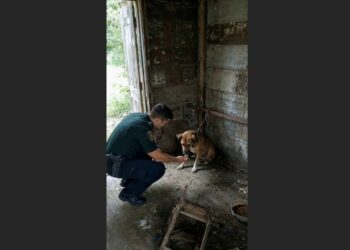
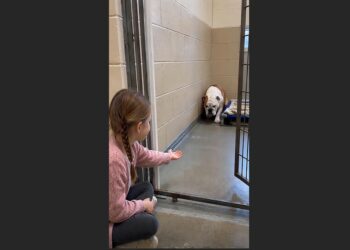
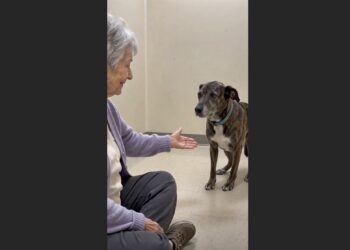
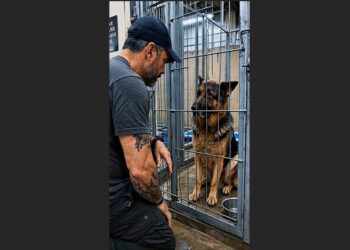
For 126 days, Ben lived in the same shelter kennel and watched other dogs leave.
Families moved slowly along the row of gates, stopping whenever a dog caught their attention. Some dogs hurried forward. Others barked, bounced, or pressed themselves against the bars.
Ben did none of those things.
He usually stayed near the back.
If somebody reached toward him, he lowered his head and moved away. He never growled or showed his teeth. He simply created more distance.
To many visitors, the message seemed obvious.
Ben did not want them.
After a few moments, they moved on.
Then Susan came through the shelter one quiet afternoon.
She had not planned to adopt a dog that day.
In fact, she was not entirely sure she was ready for one at all.
But when she reached Ben’s kennel, she stopped.
The House Had Been Quiet for Almost Two Years
Susan’s husband had died nearly two years earlier.
For a long time afterward, her days were filled with practical things.
Calls.
Paperwork.
Appointments.
Possessions that suddenly had to be sorted.
Friends checking in.
Family members asking what she needed.
Eventually, much of that activity faded.
What remained was the house.
It was the same home Susan had shared with her husband, but it no longer sounded the same.
There was no second cup being placed on the kitchen table.
No television playing because someone else had turned it on.
No familiar movement from another room.
Over time, the silence stopped feeling temporary.
It became part of the routine.
Friends Had Suggested a Dog
People who cared about Susan had noticed how quiet her life had become.
More than once, someone suggested getting a dog.
The idea made practical sense.
A dog could provide companionship and routine. There would be walks, meals, veterinary appointments, and another living presence in the house.
Susan understood all of that.
Still, the thought was harder than people seemed to realize.
Opening her home to a dog meant changing the life she had slowly learned to manage after her husband’s death.
It also meant becoming responsible for someone again.
Food.
Exercise.
Training.
Medical care.
Daily attention.
And eventually, another attachment that could also end in loss.
So Susan did not rush.
When she finally visited the shelter, she told herself she was only looking.
Ben Didn’t Try to Get Her Attention
Several dogs noticed Susan immediately.
Ben seemed to notice her too.
He just did not come forward.
The shelter worker explained that he had been there for 126 days.
He was not considered aggressive.
He followed routines reasonably well and allowed staff to care for him, but unfamiliar people made him uneasy.
His earlier home had involved rough handling and long periods alone. By the time he arrived at the shelter, Ben had learned to be cautious about human contact.
Susan listened.
She watched as Ben kept himself near the back wall.
Then she did something different from many visitors.
She did not reach for him.
Instead, she asked if she could sit outside the kennel.
The First Visit Lasted Only a Few Minutes
Susan lowered herself carefully beside the gate.
Ben watched.
She kept her hands near her lap.
There was no treat held out to lure him forward.
No repeated calling of his name.
No attempt to convince him that she was safe.
She simply spoke quietly.
Susan told him he was a handsome dog.
She mentioned the rain outside.
At one point, she laughed softly at herself for talking to a dog who remained several feet away.
Ben did not approach.
That was fine.
After a few minutes, Susan stood.
She left before he became overwhelmed.
As she walked toward the exit, Ben remained in the kennel.
Still, Susan thought about him all the way home.
She Came Back
Several days later, Susan returned.
Ben was still near the back.
Again, she sat outside the kennel.
Again, she avoided reaching through the bars.
The visit was not dramatically different from the first.
But Susan came back after that.
Then she returned again.
A pattern formed.
For Ben, Susan became one of the few visitors who did not arrive expecting immediate physical contact.
She sat.
She talked.
She waited.
When the visit ended, she left.
Then, after a few days, she appeared again.
Ben Began Staying Closer
The changes were easy to miss at first.
During the earliest visits, Ben stayed deep in the kennel.
Later, he remained visible near the middle.
Eventually, he began staying closer to the front even while Susan sat nearby.
She noticed but did not make a fuss.
Ben did not need applause for standing three feet closer.
He needed the experience to remain calm.
So Susan kept her movements predictable.
If she offered a treat, she held it where Ben could choose whether to approach.
If he stayed back, she did not follow him.
Over time, the distance changed because Ben changed it himself.
One Day, He Took a Treat
Susan held a treat on her open palm.
Ben watched.
She waited.
Several seconds passed.
Then he stepped closer.
Susan kept her hand still.
Ben moved again.
Eventually, his nose reached her fingers.
He took the treat and retreated a short distance.
Susan smiled.
She did not immediately try to pet him.
Accepting food did not mean Ben was ready for touch.
It meant he had been willing to come close enough to take food.
That was enough progress for one afternoon.
Then He Started Recognizing Her Arrival
A few visits later, Susan entered the shelter hallway and noticed Ben standing.
That was new.
Normally, he waited until visitors were near his kennel before reacting.
This time, his head lifted as Susan’s voice carried down the corridor.
He remained inside the kennel, but his posture changed.
Susan approached.
Ben stayed where he was instead of retreating.
She sat in the familiar place.
The shelter worker noticed too.
Ben had begun responding differently to Susan.
That did not mean his fear around people had vanished.
He remained wary of strangers.
But one person had become familiar.
Susan Still Wasn’t Sure
As Ben became more comfortable with her, another question became harder to avoid.
Was Susan actually going to adopt him?
The answer was not immediately yes.
That surprised her.
She cared about Ben.
She looked forward to seeing him.
Yet bringing him home felt much bigger than sitting beside his kennel for an afternoon.
Susan had built a quiet, predictable life after her husband’s death.
It was not the life she would have chosen, but she knew how it worked.
Adopting Ben would disrupt that routine.
There would be dog food in the kitchen.
A leash by the door.
Walks regardless of weather.
Veterinary appointments.
Possibly accidents.
Possibly fear-related behaviors they had not yet seen.
Susan worried that she was not ready.
Waiting for Complete Certainty Wasn’t Helping
For several days, Susan tried to imagine the moment when she would feel completely certain.
It never came.
Instead, she found herself thinking about the same question.
If not now, when?
Grief had already taught Susan something uncomfortable about waiting.
There was rarely a perfect moment to begin living differently.
Sometimes a person simply had to decide whether the next step was manageable.
Susan did not need Ben to fix her loneliness.
And Ben did not need her to magically erase his fear.
What they might be able to offer each other was much simpler.
A stable home.
A predictable routine.
Company.
Time.
That felt possible.
So Susan applied to adopt him.
The Shelter Didn’t Treat Emotion as Enough
The staff knew Susan had developed a bond with Ben.
Still, they talked through the practical parts of adoption.
Ben’s history meant he would likely need a quiet transition.
Visitors should be limited at first.
His safe spaces needed to be respected.
Forced affection would be especially unhelpful.
They discussed feeding, exercise, veterinary care, and what to do if Ben hid after arriving home.
Susan listened carefully.
She also considered her own limitations.
Could she manage him physically?
Could she afford his care?
Was the garden secure?
Would the house give him enough quiet places to retreat?
The answers were encouraging.
The adoption was approved.
Then Susan began preparing.
A Bed Went Beside the Couch
Susan bought a soft dog bed.
She placed it beside the couch rather than in the middle of the room.
Ben would have somewhere close to her without being trapped in a high-traffic area.
Then she looked at the kitchen floor.
The smooth surface might be difficult if Ben moved nervously or quickly.
Susan added rubber-backed mats to provide better traction.
Food and water bowls went into a quiet corner.
She walked through the garden and checked the gate.
Then she checked it again.
Anything fragile within easy reach was moved.
Susan was not trying to create a perfect house.
She was trying to create one where Ben would not immediately have to navigate unnecessary stress.
She Cleared Her Calendar
Susan also made a decision about the first few days.
There would be no parade of visitors.
Friends were curious about Ben.
Some wanted to stop by as soon as he arrived.
Susan asked them to wait.
Ben had spent months learning one person.
Moving into a new home would already introduce enough unfamiliar information.
New rooms.
New smells.
A different door.
Different outside sounds.
A new sleeping place.
There was no reason to add several strangers on the first evening.
So Susan cleared her schedule.
For the first days, the house would belong to the two of them.
The Brown Leash
On adoption day, Susan arrived carrying a plain brown leash.
There was nothing special about it.
She had chosen something simple and sturdy.
The shelter had its own equipment, but Susan wanted the leash Ben would use at home to begin with him there.
A worker walked with her toward the kennel.
Ben saw Susan approaching.
His head came up.
Susan smiled.
“Hi, Ben.”
This time, the kennel door would open for a different reason.
The paperwork was finished.
A house was waiting.
Yet Ben did not know any of that.
To him, the day still began with a familiar person standing outside his kennel.
The Door Opened
The shelter worker opened the gate.
Ben stayed where he was.
Nobody pulled him into the hallway.
Susan did not wave the leash or repeatedly call him forward.
Instead, she lowered herself.
At her age, getting close to the floor required care.
She kept one hand on her knee for support.
The other rested where Ben could see it.
Then Susan spoke.
“Finally… you’re coming home.”
The words mattered to Susan.
Ben could not understand the larger meaning behind them.
He had no concept of adoption approval or the preparations waiting at her house.
What he did understand was familiarity.
Susan was there.
Her voice was familiar.
Her posture was familiar.
And, as on every previous visit, she was not forcing him to come closer.
One Step Into the Hallway
Ben shifted.
Then he took one step.
His body remained uncertain.
He paused.
Susan did not move toward him.
A second step followed.
Then another.
Slowly, Ben entered the hallway.
There was nothing dramatic about the movement.
No running.
No jumping.
No sudden transformation from fearful dog to confident companion.
He was still Ben.
Still cautious.
Still gathering information.
Susan waited.
Eventually, he came close enough to smell her fingers.
Then Ben Stayed
Ben sniffed Susan’s hand.
For a moment, he simply stood there.
Then he moved closer.
His head came against her shoulder.
Susan froze briefly, afraid that moving too quickly might startle him.
Ben remained there.
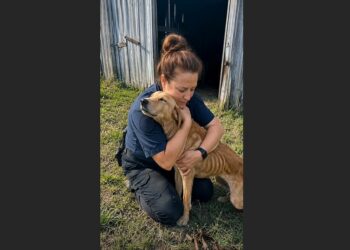
Only then did she bring her arms around him.
The embrace stayed loose.
If Ben wanted to move away, he could.
He did not.
The brown leash remained looped in Susan’s hand.
For weeks, she had sat outside a metal gate waiting for Ben to decide how much distance he needed.
Now he was pressed against her shoulder.
Nobody in the hallway needed to say anything.
One Hug Did Not Erase His Fear
Susan understood something important before they left the building.
Ben leaning against her did not mean every problem was solved.
A dog may trust one person and remain fearful in other situations.
New sounds could frighten him.
A visitor reaching unexpectedly might cause him to retreat.
The first night in a strange house could be difficult.
He might refuse food.
He might hide.
He might sleep lightly and wake whenever Susan moved.
Nothing about the adoption required Ben to become a different dog by bedtime.
Susan’s responsibility was not to make him fearless.
It was to give him an environment where fear no longer had to control every choice.
The Leash Finally Had a Purpose
After a while, Susan attached the brown leash.
Ben stood.
She gave him time to notice the change.
Then they began walking.
The shelter hallway was the same one Ben had seen for 126 days.
This time, he was moving toward the exit.
Susan did not know whether he understood that he would not be returning to the same kennel that evening.
Probably not.
Dogs learn a new home through experience, not paperwork.
Ben would need repeated evidence.
This door leads outside.
This car ride ends somewhere safe.
This bowl belongs to me.
This person comes back.
This bed remains here tomorrow.
Trust would continue being built through ordinary repetition.
The House Was Ready
When Susan opened her front door, Ben hesitated.
She expected that.
He smelled the threshold.
Then he stepped inside.
The rubber mats were already in place.
The food bowls waited in their quiet corner.
Near the couch sat the soft bed Susan had chosen.
Ben did not immediately climb into it.
Instead, he explored carefully.
Susan followed at a distance.
She resisted the urge to show him every room.
He would find them when he was ready.
For the rest of the afternoon, she kept the house calm.
No television turned up loudly.
No visitors.
No excitement about the fact that she had finally brought a dog home.
Just time.
The Quiet Changed First
Susan had expected the biggest change to be noise.
Perhaps barking.
Tags jingling.
Paws crossing the floor.
Instead, what she noticed first was presence.
Ben was somewhere in the house.
Sometimes she could see him.
Sometimes she could not.
But another living creature occupied the space.
When Susan moved into the kitchen, she became aware of whether Ben stayed behind or followed.
When she sat on the couch, she noticed him watching from several feet away.
The silence itself had changed.
It was no longer the silence of an empty house.
Ben Needed a Routine
During the first days, Susan kept things simple.
Meals came at predictable times.
Walks followed the same route when possible.
She avoided crowding him while he ate.
The bed beside the couch remained available whether Ben used it or not.
If he wanted distance, Susan allowed it.
When he approached, she responded calmly.
Sometimes Ben followed her into another room.
Other times, he remained where he was.
Susan learned not to treat every movement as a test of affection.
A fearful dog does not need to prove trust every hour.
He needs enough stable experiences for trust to become ordinary.
Susan Needed Time Too
Ben was not the only one adjusting.
For almost two years, Susan had made decisions only for herself.
Now she checked the time because Ben needed dinner.
She remembered to bring the leash before opening the door.
Shopping lists included dog food.
Walks appeared on days when Susan might otherwise have stayed home.
Sometimes those changes felt comforting.
Other times, they felt tiring.
That did not mean the adoption was wrong.
It meant Susan had taken responsibility for another living creature.
Love and inconvenience can occupy the same house.
So can grief and new attachment.
Susan did not need to pretend otherwise.
Ben Wasn’t There to Replace Anyone
There were evenings when Susan sat on the couch and missed her husband just as deeply as before Ben arrived.
The dog did not erase those moments.
Nor did Susan expect him to.
A relationship with a dog cannot replace a marriage.
Ben offered something different.
He gave Susan another rhythm to her day.
He gave her a reason to step into the garden in the morning.
He gave her company during evenings that had once stretched quietly toward bedtime.
Sometimes he slept nearby.
Sometimes he simply watched her.
That was enough.
Trust Appeared in Small Places
As the weeks passed, Ben’s progress showed up in ordinary behavior.
He stopped retreating every time Susan crossed the room.
He rested more openly.
Instead of always choosing the farthest corner, he sometimes settled on the bed beside the couch.
When Susan picked up the brown leash, he began standing rather than backing away.
He learned the household sounds.
Cupboard doors.
The kettle.
The garden gate.
Susan’s footsteps.
None of those changes made dramatic photographs.
They were more important than that.
They meant Ben was beginning to understand how his new life worked.
The Bed Beside the Couch
One evening, Susan was reading when she heard Ben shift.
The dog had been resting several feet away.
Without being called, he stood and walked toward the couch.
Susan kept reading.
Ben stopped near the bed she had bought before bringing him home.
For weeks, he had used it only occasionally.
This time, he circled once.
Then he lay down.
Susan lowered the book.
Ben rested with his body turned partly toward her.
She smiled and returned to the page.
No celebration.
No reaching down to interrupt him.
The bed was simply being used for what it had always been intended to become.
A safe place near her.
The Brown Leash Stayed by the Door
Over time, the leash found a permanent place near the entrance.
Each morning, Susan saw it there.
A year earlier, nothing had hung on that hook.
Now the sight meant Ben needed a walk.
It meant she needed shoes.
It meant the day had a reason to begin moving.
The house was still the home Susan had shared with her husband.
His absence had not become smaller simply because Ben lived there.
But absence was no longer the only thing the rooms contained.
There was a dog bed beside the couch.
Food bowls in the quiet corner.
Rubber mats across part of the kitchen.
And a brown leash by the door.
Neither of Them Had Needed Certainty
Susan sometimes thought about the weeks before she applied to adopt Ben.
She had waited for certainty.
It never arrived.
Ben had done something similar in his own way.
He had spent months at the back of a kennel unwilling to assume that an approaching hand was safe.
Neither one changed through a single dramatic moment.
They gathered evidence.
Susan saw Ben come forward.
Ben saw Susan return.
She learned she could make room for another relationship.
He learned that her hands did not force him closer.
Eventually, each took a step.
Then another.
The House Waiting for Them Wasn’t Empty Anymore
On adoption day, when Ben pressed his head against Susan’s shoulder, the brown leash had remained unused in her hand for a few extra moments.
Susan had spent weeks preparing for that day.
She had arranged the bed.
Covered the slippery floor.
Checked the gate twice.
Cleared her calendar.
Still, the most important preparation had happened before any of those things.
She had learned to wait.
Ben had spent 126 days watching people approach and leave.
Susan became different because she returned without demanding anything from him.
By the time she finally told him, “You’re coming home,” Ben did not understand the future hidden inside those words.
He only knew the person saying them.
Then he stepped into the hallway.
He smelled her fingers.
He leaned against her shoulder.
And Susan held him gently while the brown leash remained looped in one hand.
For almost two years, she had believed the quiet house waiting at the end of the day was simply something she would have to get used to.
That afternoon, it was still quiet.
But it was no longer empty.
Editor’s Note: The characters in this story are fictional. Through these stories, we hope to share the intelligence, loyalty, compassion, and loving nature of dogs with people everywhere.