Molly Was Only Supposed to Visit
Molly was not supposed to be the person who reached Daisy that afternoon.
Her mother had brought her to the shelter for a short visit. The plan was simple: walk through the kennels, meet a few dogs, and head home a little while later.
Nothing about the day was meant to become important.
Shelters can be overwhelming places, especially for children. Dogs bark from behind gates. Metal latches click. Volunteers move between kennels carrying bowls, blankets, and leashes. Some animals rush forward when visitors appear, while others retreat from the noise.
Molly looked at all of them.
Then she reached one of the quieter kennel rows.
Near the end stood a large bulldog named Daisy.
From a distance, Daisy looked physically strong. She had a broad chest, a heavy head, and the solid build people often associate with confidence.
Up close, however, her body told a very different story.
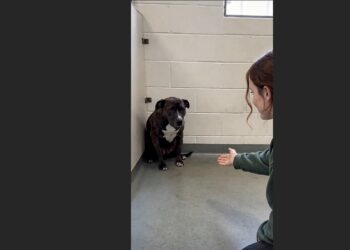
Daisy was pressed into the back corner.
She was trying to make herself small.
Daisy Rarely Came to the Front
A raised dog bed stood along one side of the enclosure.
Daisy did not use it.
Instead, she kept her paws planted on the floor near the rear wall. Her head stayed low, and her eyes remained fixed toward the entrance.
She did not bark at Molly.
She did not growl.
She made no attempt to rush forward.
In some ways, that kind of fear can be easy for visitors to miss.
People often recognize a frightened dog when the animal trembles, cries, or tries to escape. A dog who becomes extremely still can look calm to someone unfamiliar with canine stress.
Daisy was not calm.
Her posture was rigid.
Her weight remained shifted away from the doorway.
Every part of her seemed prepared to stay exactly where she was until the people outside moved along.
Shelter staff had seen the same behavior since her arrival.
She was not behaving aggressively.
She was overwhelmed.
Nobody Knew Exactly What Had Made Her So Afraid
There is a temptation to look at a frightened shelter dog and write an entire history for her.
Someone must have hurt her.
Someone must have abandoned her.
Someone must have taught her that people were dangerous.
Perhaps something painful had happened in Daisy’s past.
Perhaps several things had.
But without reliable information, no one could know.
Fear can develop for many reasons. A dog may arrive at a shelter after losing a familiar home, becoming separated from known people, experiencing inconsistent handling, or simply being overwhelmed by a loud and unfamiliar environment.
For Daisy, the cause was less important than what she was showing in the present.
She was uncomfortable with people approaching.
She did not yet feel confident enough to move toward strangers.
So staff gave her space.
Many visitors did the same, although often for another reason.
They simply kept walking.
Other Dogs Made Easier First Impressions
A shelter visitor has only a few seconds to form an impression.
Dogs who approach the front of their kennels often attract attention first.
They wag.
They lean against the gate.
They accept treats.
They make it easy for a person to imagine taking them home.
Daisy offered none of those things.
Someone would slow down, look toward the back of the kennel, and wait.
When Daisy remained in the corner, the visitor usually moved on.
It was understandable.
Not every family has the experience, time, or environment needed to help a highly fearful dog adjust. Responsible adoption requires more than feeling sorry for an animal.
Still, repeated passersby meant Daisy had few chances to show anything beyond her fear.
Molly stopped anyway.
She looked at the bulldog in the corner.
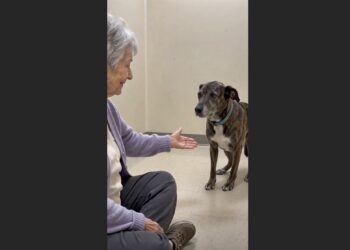
Then she lowered herself to the floor.
Molly Did Not Try to Pull Daisy Out
Her pink cardigan bunched around her elbows as she settled near the kennel entrance.
She did not call loudly.
She did not slap her hands against her legs or make the high, excited noises people often use when trying to persuade a dog to approach.
Most importantly, she did not move toward Daisy.
She stayed where she was.
That gave the dog distance.
For a fearful animal, distance can be valuable. It provides an option that people sometimes forget to offer: the ability to say no simply by staying away.
Molly had no treat in her hand.
There was no squeaky toy.
She was not trying to lure Daisy into doing something before she was ready.
Instead, she stretched one arm forward slowly.
Her palm faced upward.
Then she waited.
“Come on,” she said softly. “It’s okay.”
Daisy did not move.
Nothing Happened for a While
Adults often become uncomfortable when an interaction fails to progress.
They repeat themselves.
They move closer.
They reach farther.
Sometimes they decide the animal is not interested and leave.
Molly did none of those things.
She remained on the floor.
Daisy remained in the corner.
For several seconds, the scene looked exactly as it had before Molly sat down.
The bulldog’s eyes stayed on the child.
Her face remained tense.
Molly kept her arm where it was.
She spoke again, barely above a whisper.
There was no demand in her voice.
No celebration waiting to explode the moment Daisy moved.
That quiet mattered.
A fearful dog does not need an emotional performance from a stranger. Often, she needs the opposite: predictable movement, low pressure, and enough time to gather information.
Daisy watched.
Molly waited.
Then one of Daisy’s paws moved.
One Step Did Not Mean the Fear Was Gone
The movement was small.
Daisy shifted her weight forward.
One paw left the place where it had been planted.
Then she stopped.
Her body remained low.
Her eyes never left Molly.
It would have been easy to interpret that first step as trust.
More accurately, it was investigation.
Daisy had not suddenly decided that people were safe.
She was testing the situation.
The child had stayed still.
Nothing unpleasant had happened.
The hand remained available but did not chase her.
So Daisy gathered more information.
She took another step.
Then she paused again.
Molly smiled, but she did not rush forward to close the remaining distance.
“Come on,” she repeated quietly.
Daisy’s nose moved.
Another step followed.
The Distance Slowly Disappeared
What happened next took patience rather than courage.
Daisy moved a little farther from the wall.
Her muscles still looked tight.
The raised bed remained unused beside her.
Yet for the first time during the visit, she had voluntarily left the corner.
Molly stayed low.
That likely made her less imposing than an adult standing over the dog.
Her voice remained soft.
Daisy stopped again.
The little girl waited again.
Then the bulldog continued.
One step.
A pause.
Another.
Eventually, her nose came close enough to Molly’s hand.
Molly did not immediately grab her.
For a moment, Daisy simply smelled the offered palm.
That small interaction was more significant than it might appear.
The dog had been given the opportunity to approach on her own.
And she had chosen to do it.
Molly Let Daisy Make the Last Part of the Decision
Daisy remained close.
Molly leaned forward carefully.
The interaction had changed.
A few minutes earlier, the bulldog had been pressed against a wall, keeping as much distance as possible between herself and the people outside.
Now she was within reach.
Molly put her arms around Daisy’s neck.
It was a brief, gentle embrace rather than a struggle to restrain her.
Daisy did not pull away.
Instead, she remained beside the child, her heavy body close to Molly’s small frame.
For anyone watching, the contrast was striking.
The dog had not become a different animal.
Her history had not disappeared.
Whatever stress had caused her to retreat into the back of the enclosure was still part of the situation.
Yet Daisy had made one new choice.
She had approached.
A Hug Was Not a Cure
Moments like that are often described as breakthroughs.
Sometimes they are.
However, a breakthrough should not be confused with complete recovery.
A fearful dog may accept contact from one person and remain frightened of another.
She may approach willingly one afternoon and retreat the next morning.
Progress can be uneven.
Daisy would still need people to respect her body language.
She would need predictable routines and opportunities to retreat when overwhelmed.
If she eventually entered a home, the practical work would continue there. New rooms, new sounds, visitors, feeding schedules, walks, and unfamiliar expectations could all require adjustment.
One quiet encounter with Molly could not erase fear.
What it could do was reveal something important.
Daisy was still capable of curiosity.
She could still make a choice to move toward someone.
That was worth noticing.
Molly Had Not Tried to “Fix” Her
Perhaps the most useful part of the encounter was what Molly did not do.
She did not insist that Daisy be affectionate.
She did not crawl into the corner after her.
She did not pull the dog toward the kennel entrance.
She did not interpret hesitation as disobedience.
Instead, Molly made herself available.
Then she waited.
Adults who work with fearful animals often spend considerable time learning precisely that skill.
Sit sideways.
Lower the pressure.
Avoid staring.
Let the dog gather scent and visual information.
Allow retreat.
Reward voluntary approach rather than forcing contact.
Molly may not have been thinking in behavioral terms.
She was simply being gentle with an animal who appeared unsure.
Still, the result looked very similar.
Daisy Had Been Watching Her the Entire Time
Fearful dogs notice far more than people sometimes realize.
Even while Daisy remained at the back of the enclosure, she had been watching.
Molly’s movements mattered.
Her distance mattered.
Her voice mattered.
The fact that the child did not advance when Daisy stayed put mattered too.
Every quiet second gave Daisy additional information.
Nothing bad followed the outstretched hand.
Nobody cornered her.
Nobody forced her onto the unused bed.
The little girl remained where she was.
Eventually, Daisy became curious enough to reduce the distance herself.
That distinction is important.
Trust is difficult to create through force because forced contact removes choice.
Daisy’s approach meant something precisely because she could have remained where she was.
She did not.
The Room Felt Different Afterward
Shelter kennels can make emotional moments look larger than they are.
Metal walls amplify sounds.
A frightened dog leaving a corner can feel dramatic when everyone has grown accustomed to seeing her stay there.
Yet nobody needed to turn Daisy’s movement into a miracle.
She had taken several steps.
She had smelled a child’s hand.
She had allowed brief physical contact.
Those were observable facts.
They were enough.
For Molly, the moment seemed simple.
She had seen a dog who looked lonely and sat down.
For Daisy, the calculation was likely more complicated.
She had to decide whether approaching an unfamiliar person felt safe enough to try.
Whatever information she gathered from Molly’s quiet posture and voice, it led her forward.
The fear did not vanish.
It loosened its grip for a moment.
The Raised Bed Was Still Waiting
Afterward, Daisy was still Daisy.
The raised bed remained against the side of the enclosure.
The shelter routine continued around her.
Dogs barked.
Doors opened.
Staff moved through the kennel row.
Nothing about the building had changed simply because one little girl had sat on the floor.
That is often the reality of animal rescue.
Progress happens inside an environment that keeps moving.
There are meals to distribute, kennels to clean, veterinary needs to address, and new animals arriving.
For a frightened dog, however, one calm interaction can become part of a larger pattern.
A person approaches and does not force contact.
Another person provides food.
Someone cleans the enclosure without cornering her.
A familiar voice returns the following day.
Over time, enough predictable experiences can begin to compete with fear.
Daisy’s encounter with Molly was one of those experiences.
Visitors Usually Look for What a Dog Can Give Them
People often enter shelters imagining the dog they hope to find.
They picture a wagging tail.
A face pressed against the kennel gate.
Immediate affection.
Perhaps a dog who seems to choose them at first sight.
There is nothing wrong with wanting a companion who feels comfortable around people.
But some dogs cannot make that kind of first impression.
Fear gets there first.
Daisy could not greet strangers with enthusiasm simply because enthusiasm would make her easier to adopt.
At that point, staying back was how she managed uncertainty.
Molly seemed less concerned with what Daisy could offer.
She did not appear disappointed when the dog failed to approach immediately.
Instead, she responded to the animal in front of her.
That made space for a different kind of interaction.
One in which Daisy did not have to perform.
Trust Often Looks Smaller Than People Expect
We tend to recognize dramatic change more easily than subtle change.
A dog racing across a yard is obvious.
A dog taking one cautious step is easy to miss.
Yet for a highly fearful animal, the smaller movement may represent the more difficult decision.
Daisy’s progress that afternoon could be measured in feet.
From the back wall to the middle of the kennel.
From the middle to Molly’s fingertips.
Then the final distance between a dog who had been avoiding people and a child sitting quietly on the floor.
Nothing about that distance looked impressive on paper.
To anyone who had watched Daisy remain in the corner, it mattered.
Recovery for fearful dogs is often built exactly that way.
Not through one enormous act of bravery.
Through choices that become slightly easier with repetition.
Daisy Was Not “Broken”
People sometimes use that word when describing dogs who have withdrawn.
Broken.
It sounds compassionate, but it is rarely useful.
Daisy was frightened.
She was highly stressed.
She was uncertain about human contact.
Those conditions could affect her behavior without defining everything she was capable of becoming.
Calling a dog broken can also create the expectation that someone else must repair her.
That is not how trust works.
People can create safer conditions.
They can use predictable routines.
They can provide appropriate veterinary and behavioral support.
They can respect distance and reward voluntary engagement.
The dog remains an active participant.
Daisy demonstrated that clearly.
Molly did not move her out of the corner.
Daisy walked out herself.
The Fear Was Still There When Molly Held Her
That may be the most important part of the scene.
When Daisy finally stood beside Molly, she did not suddenly become a carefree dog.
Her body still carried caution.
The shelter was still unfamiliar.
The experiences that had shaped her responses did not disappear.
Yet fear was no longer the only thing determining her behavior.
Curiosity had appeared.
Then proximity.
Then contact.
Molly’s arms went around her, and Daisy remained there.
For a few moments, the big bulldog who had spent so much time trying to disappear into the back of the kennel allowed herself to be close to someone.
There was no need to say she understood that Molly wanted to help her.
There was no need to imagine that she had suddenly decided all people could be trusted.
The simpler explanation was enough.
One person had given Daisy time.
Daisy had responded.
Sometimes the First Gift Is Space
People talk about rescuing dogs in terms of what humans provide.
Food.
Shelter.
Medical treatment.
A home.
Those things matter enormously.
Yet frightened dogs often need something less visible as well.
Choice.
The choice to stay back.
The choice to approach.
The choice to end an interaction.
Molly gave Daisy that without making a speech about it.
She sat outside the kennel.
She extended a hand.
Then she waited.
Daisy did the rest.
That afternoon did not complete Daisy’s story, and it would be unfair to invent what happened after. A dog with her level of fear would likely need more time, more careful interactions, and a home suited to her needs if adoption eventually became possible.
But for one quiet stretch of time, something changed.
The bulldog who had been pressed against the back wall decided to take a step.
Then another.
By the time Molly’s arms rested around her neck, Daisy’s fear had not disappeared.
She simply was not facing the moment from the far corner anymore.
Editor’s Note: The characters in this story are fictional. Through these stories, we hope to share the intelligence, loyalty, compassion, and loving nature of dogs with people everywhere.