Pip Had Barely Moved Since He Arrived
The security camera at Harborlight Animal Rescue showed nothing dramatic at first.
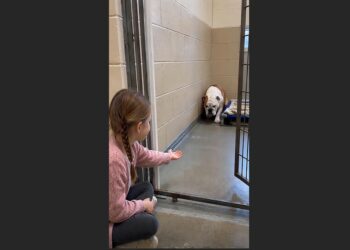
It was late at night, and most of the shelter had gone quiet. In one kennel, a small mixed-breed dog named Pip remained curled tightly in the corner.
He was two years old, although his thin body made him look younger.
Pip had been found alone in an empty lot. By the time he reached the shelter, he was severely underweight and frightened by almost everything around him.
Older marks on his body suggested that life had not always been easy. However, shelter workers had no reliable history explaining what caused them.
They refused to invent one.
What they could observe was Pip’s behavior in the present.
He trembled for long stretches.
Food remained untouched.
When staff members entered, he pressed himself farther into the corner rather than approaching.
He was not aggressive.
He was overwhelmed.
For his first hours at Harborlight, even resting seemed difficult.
Then, at 11:22 that night, another dog entered the kennel.
His name was Wellington.
Wellington Was Nearly Seven Times Pip’s Size
Wellington was impossible to overlook.
The thirteen-year-old Saint Bernard had the massive frame of his breed, though age had softened him considerably. Gray spread across his face, and his movements had become slow and deliberate.
Getting up took longer than it once had.
Walks were shorter.
On some mornings, his joints needed a little time before he moved comfortably.
He had lived at the shelter for five years.
According to the history staff had been given, Wellington once belonged to someone who eventually moved into assisted care and could no longer keep such a large dog.
After that, he became a shelter resident.
Potential adopters noticed him.
Some even spent time with him.
Yet his age and size repeatedly worked against him.
A senior Saint Bernard brings practical responsibilities. Food costs are substantial. Veterinary care for an aging giant-breed dog can be expensive. Mobility may decline, and helping such a heavy animal can become physically demanding.
Families often chose younger or smaller dogs.
So Wellington stayed.
Over time, however, staff began noticing that he had developed an unusual role of his own.
He Watched New Dogs From a Distance
It did not happen with every animal.
However, shelter workers noticed a pattern when certain fearful dogs arrived.
Wellington would watch them.
He did not rush into their space.
He did not bounce around inviting play.
Usually, he simply observed.
If circumstances allowed and staff believed the dogs could be introduced safely, Wellington sometimes moved closer.
Then he did something remarkably consistent.
He lay down.
Often, he positioned himself directly beside the frightened dog.
Sometimes their bodies touched along the shoulder or back. On other occasions, Wellington rested his large head close enough that the other dog could move away if desired.
No one had trained him to do it.
The shelter did not claim he understood another dog’s history.
Still, staff could see that his presence often coincided with a change.
A dog who had been pacing might eventually lie down.
Rapid breathing sometimes slowed.
Trembling occasionally became less intense.
The shelter team began paying attention.
Staff Had Seen the Pattern Many Times
By the night Pip arrived, employees believed they had observed similar interactions involving Wellington at least sixteen times.
The details differed.
Some dogs relaxed quickly.
Others needed much longer.
A few remained cautious even after Wellington settled nearby.
Still, his calm behavior appeared useful enough that the shelter eventually began arranging carefully supervised introductions with particularly frightened newcomers when staff felt the pairing was appropriate.
That did not mean putting two unfamiliar dogs together without assessment.
Size differences mattered.
Body language mattered.
Health, resource guarding, and each dog’s tolerance for proximity mattered too.
Wellington was elderly, and his comfort had to be protected just as much as the younger dog’s.
When an introduction seemed safe, however, staff sometimes let him do what he had repeatedly chosen to do on his own.
He would enter.
Look around.
Then settle.
Shelter director Frances had watched the pattern often enough that she joked about his success rate.
Every pairing seemed to leave the frightened dog at least somewhat calmer.
She did not pretend to understand exactly why.
Calm Can Be Contagious Without Being Mysterious
Dogs pay close attention to other dogs.
They notice posture, movement, breathing, vocalizations, and reactions to the environment.
A calm companion can sometimes provide useful social information.
If one dog hears a noise and remains relaxed, another may gradually learn that the sound does not always predict danger.
Likewise, lying near another animal can provide warmth and familiar physical contact if both dogs are comfortable with it.
None of that requires supernatural empathy.
Wellington did not need to understand that Pip had been found underweight in an empty lot.
He did not need to know what had happened before the shelter.
All he needed to respond to was the dog in front of him.
Pip was tense.
Wellington was not.
For staff watching from outside, that contrast had become familiar.
So late that night, they allowed Wellington to spend time with him.
Then the camera recorded what happened next.
At 11:22, Wellington Lay Down Beside Him
Pip remained pressed against the kennel wall.
When Wellington entered, the smaller dog did not immediately approach.
He watched.
The Saint Bernard moved slowly, as older dogs often do.
There was no rush toward Pip.
No attempt to force an interaction.
Wellington turned, lowered his huge body to the bedding, and settled beside him.
Close.
Very close.
His body touched Pip’s side.
Then he stayed there.
At first, Pip continued trembling.
That part mattered.
Wellington’s arrival did not produce an instant transformation.
For several minutes, the younger dog’s body remained tense.
He was still in an unfamiliar shelter surrounded by unfamiliar smells and sounds.
One calm dog could not erase all of that.
But nothing unpleasant happened.
Wellington did not crowd him further.
He did not paw at him or demand play.
He simply rested.
Four Minutes Later, Pip Looked Different
By approximately 11:26, staff reviewing the footage noticed that Pip’s trembling had begun to ease.
Not disappear completely.
Ease.
His body remained curled, but the constant shaking became less pronounced.
Wellington stayed where he was.
The Saint Bernard’s breathing looked slow and regular. Every so often, he adjusted slightly before settling again.
Pip did not retreat.
Given his earlier behavior around people, that was notable.
The small dog had spent much of his first day trying to increase distance between himself and everything unfamiliar.
With Wellington, he allowed contact.
Minutes passed.
Then more.
Eventually, Pip’s position changed.
His body loosened enough that he rested more of his weight against the bedding.
Later, he shifted toward the older dog.
The camera kept recording.
By morning, the distance between them was gone.
Pip Fell Asleep Against Wellington’s Side
When shelter staff returned, Pip was asleep.
He had curled himself against Wellington’s enormous body.
For the people who had watched him struggle through his first day, the sight was significant.
Sleep in a shelter can be difficult for an anxious dog.
The environment is unfamiliar.
Doors open and close.
Other dogs vocalize.
People move through hallways.
Cleaning equipment, food carts, and ventilation systems produce sounds a newcomer has not yet learned to ignore.
Pip had spent hours monitoring everything around him.
That morning, he was finally resting deeply enough that his body no longer looked prepared to react to every movement.
Wellington remained beside him.
The old Saint Bernard appeared to have done little beyond sleeping too.
Yet his presence had given Pip something different from an empty kennel.
A warm, calm body was there.
For one night, that seemed to help.
Then Pip Ate
Later that morning, staff brought Pip food again.
Until then, he had shown almost no interest.
Fear and stress can suppress appetite, especially in a newly admitted shelter dog. That does not mean refusing food is purely emotional; medical problems must also be considered, particularly in an underweight animal.
Pip was being monitored carefully.
This time, however, something changed.
He ate.
It was his first real meal since arriving.
No one could prove that Wellington caused it.
Perhaps Pip had simply reached the point where hunger overcame hesitation.
Maybe a night of actual rest reduced enough stress for appetite to return.
More likely, several factors were working together.
What staff knew was that Pip had slept beside Wellington.
Then, the next morning, he ate.
For a shelter team worried about a frightened, underweight dog, that was meaningful progress.
Wellington Had Done This Before
The scene felt extraordinary to people seeing it for the first time.
For Frances and her staff, however, it was another version of something they already knew.
Wellington seemed unusually comfortable around nervous dogs.
He did not behave like an energetic playmate.
At thirteen, he rarely had the interest or stamina for that.
Instead, he offered stillness.
That quality was easy to underestimate.
Shelters are full of motion.
Dogs arrive.
Dogs leave.
Bowls move.
Doors close.
Volunteers change shifts.
Veterinary examinations happen.
Potential adopters walk through.
For a frightened dog, almost everything is new.
Wellington represented the opposite.
He was slow.
Predictable.
Unhurried.
If another dog needed space, he was content to remain still.
That may have been part of why his presence seemed to help.
Staff did not call him a therapist.
He was simply Wellington.
Five Years Had Made the Shelter His Familiar World
No one originally planned for Wellington to live at Harborlight for so long.
When he arrived, adoption remained the goal.
Year after year, however, families chose other dogs.
Five years is a large portion of any dog’s life.
For a Saint Bernard already entering his senior years, it was especially significant.
By thirteen, Wellington knew the shelter routine extremely well.
He knew feeding times.
He recognized staff members.
He knew which doors opened toward the outdoor area.
He seemed able to rest through many of the ordinary noises that disturbed newcomers.
That familiarity may also explain part of what younger or frightened dogs responded to.
Wellington did not react as though every sound required attention.
A food cart in the hallway was only a food cart.
A kennel door opening did not necessarily mean danger.
Footsteps came and went.
Life continued.
For Pip, those things were still uncertain.
Beside Wellington, he could experience them next to a dog who treated them as ordinary.
Frances Worried About Wellington Too
There was another side to the story.
Wellington was thirteen.
His age could not be ignored simply because he had developed a meaningful role in the shelter.
He required rest.
His joints needed consideration.
Staff watched his mobility and general health closely.
They also made sure interactions with other dogs did not exhaust or overwhelm him.
Helping frightened newcomers could never become an obligation he was forced to perform.
If Wellington did not want contact, that had to be respected.
Some mornings, he preferred his own bed.
On those days, nobody asked more of him.
A senior dog’s value should not depend on what he can provide to others.
Wellington deserved comfort even if he never calmed another frightened animal again.
Still, whenever he voluntarily chose to approach one, staff noticed the same quiet pattern.
Watch.
Walk over.
Lie down.
Wait.
Pip’s Recovery Would Take More Than One Night
By breakfast, Pip had made progress.
He was still not recovered.
His low body weight required attention.
The old injuries needed veterinary assessment.
His fear around people would require patience rather than forced affection.
Staff members continued approaching him quietly.
They gave him opportunities to retreat.
Nobody assumed that sleeping beside Wellington meant Pip would suddenly greet strangers at the kennel door.
He had to learn safety through repetition.
Meals arriving regularly.
Hands that did not grab.
Voices that remained calm.
A predictable place to sleep.
People leaving and returning without harming him.
Wellington could help make some moments easier.
He could not do the entire job.
In the days ahead, progress would likely be measured in ordinary behaviors.
Eating consistently.
Standing when a familiar person entered.
Taking a treat.
Resting without shaking.
Exploring.
Approaching voluntarily.
Those small changes would matter more than any dramatic claim about instant healing.
Nobody Needed to Call Pip “Broken”
Frances sometimes heard that word used for dogs like Pip.
Broken.
She disliked it.
Pip was frightened.
He was underweight.
He carried old physical marks and showed signs of severe stress.
None of that meant something essential inside him had been destroyed.
The camera footage itself suggested otherwise.
Even after whatever experiences had shaped his fear, Pip remained capable of responding to safety.
He could choose proximity.
He could rest.
He could eat.
Those abilities were still there.
Wellington did not repair him.
The Saint Bernard simply provided one environment in which Pip appeared able to relax enough for those behaviors to surface.
That distinction mattered.
Recovery belonged to Pip too.
Wellington Was Still Waiting for a Home
There was a difficult irony in all of this.
Wellington had helped other shelter dogs become more comfortable.
Some of those dogs would eventually leave.
He remained.
His age continued to make adoption less likely.
His size continued to make some families hesitate.
None of those concerns were unreasonable. Anyone adopting a thirteen-year-old Saint Bernard would need to prepare for the realities of senior care.
There could be mobility problems.
Veterinary costs might increase.
Time together could be short.
Adoption would need to focus on giving Wellington comfort and stability, not pretending old age could somehow be reversed.
Frances understood why people hesitated.
Still, watching him settle beside another terrified dog made the years he had spent there feel different.
The shelter was not the permanent home anyone had originally wanted for him.
Yet within that environment, Wellington had formed relationships and routines that mattered.
Sixteen Frightened Dogs Had Rested Beside Him
Staff counted at least sixteen dogs who had shown some version of the same response.
They arrived frightened or overwhelmed.
Wellington came near.
Then he settled.
Again, the shelter could not scientifically prove cause and effect from those observations alone.
Nor did Frances believe Wellington possessed some mysterious ability to diagnose trauma.
She saw something more grounded.
He was an unusually calm old dog.
He appeared comfortable with physical closeness.
Many frightened dogs seemed to respond well to that.
For an animal entering an unfamiliar kennel, that could be enough to make the first night easier.
Perhaps Wellington had become skilled at reading canine body language through years of living around other dogs.
Perhaps his age simply made him less threatening.
Maybe warmth, scent, and steady breathing helped.
There might never be one explanation.
The effect staff observed was real enough for them to respect it without turning it into magic.
In the Morning, Wellington Returned to His Routine
After Pip ate, the shelter day began.
Bowls were washed.
Kennels were cleaned.
Dogs went outside.
Phones rang.
Wellington rose slowly.
Standing took effort at his age.
Once upright, he walked toward his food and ate without urgency.
That was another thing about him.
Wellington did almost everything slowly now.
After breakfast, he usually found a comfortable place and watched.
Staff members sometimes joked that he appeared to be inspecting the morning arrivals.
Most days, nothing required his involvement.
He slept.
He went outside.
He accepted attention from familiar people.
He lived the ordinary life of an elderly shelter dog.
Then, occasionally, a new animal arrived carrying more fear than it knew what to do with.
Wellington noticed.
If the introduction was safe and he chose to participate, the old pattern sometimes began again.
He watched.
He stood.
He walked over.
Then he lay down.
That Night Was Only the Beginning for Pip
The video ended without a dramatic conclusion.
Pip did not wake the next morning transformed into a confident dog.
Wellington did not receive an adoption application because thousands of people suddenly understood his worth.
At least, nothing in the story established those outcomes.
So the important part remained smaller.
At 11:22, a frightened dog was trembling in a kennel.
An old Saint Bernard lay beside him.
Four minutes later, the trembling had begun to ease.
By morning, Pip was sleeping against Wellington’s side.
Then he ate.
For one frightened dog, that was enough progress for a single night.
For Wellington, it was another quiet morning after doing something shelter workers had seen him do many times before.
He ate breakfast.
He rested.
Then he watched the kennels around him.
At thirteen, his world had become slower and his future uncertain.
But when another dog struggled to settle, Wellington still sometimes had something useful to offer.
Not a cure.
Not a miracle.
Just warmth, calm, and the willingness to stay close until the other dog no longer felt quite so alone.
Editor’s Note: The characters in this story are fictional. Through these stories, we hope to share the intelligence, loyalty, compassion, and loving nature of dogs with people everywhere.