For 126 days, Ben watched people come and go.
Families walked through the animal shelter, stopping at kennels where dogs barked, wagged their tails, and pressed excitedly against the gates.
Some dogs were adopted within days.
Others waited a little longer.
But Ben remained.
He wasn’t aggressive.
He wasn’t difficult.
And the shelter workers had never considered him a bad dog.
He was simply frightened of people.
Whenever someone reached toward him, Ben lowered his head and backed away.
Most visitors interpreted that as rejection.
They wanted a dog who seemed happy to meet them.
Someone who would walk forward, accept a scratch behind the ears, and make the decision feel easy.
Ben couldn’t do that.
So they moved on.
Day after day, he remained near the back of the same kennel.
Then, one quiet afternoon, a woman named Susan stopped outside his door.
She hadn’t planned to adopt a dog that day.
Her husband had died almost two years earlier, and she was still adjusting to living alone.
Friends had encouraged her to find a companion.
But opening her home and her heart to someone new felt more difficult than she’d expected.
She was only there to look around.
Then she saw Ben.
He was watching her from the back of his kennel.
His body was low.
His head was slightly lowered.
And when she moved closer, he shifted away.
Susan didn’t try to touch him.
She didn’t ask him to come forward.
Instead, she sat down outside the kennel and spoke softly for a few minutes.
Then she left.
But unlike so many visitors before her, Susan came back.
And over the following weeks, something began changing.
Ben started spending more time near the front of his kennel.
He accepted a treat from her hand.
Eventually, he began lifting his head whenever he heard her familiar voice in the hallway.
Then came the day Susan arrived carrying a brown leash.
The shelter worker opened Ben’s kennel.
But he didn’t move.
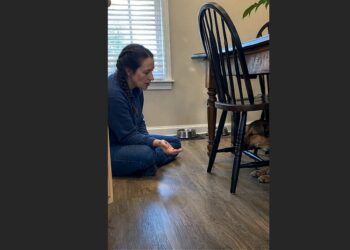
Susan slowly lowered herself to his level, resting one hand against her knee for support.
And she whispered:
“Finally… you’re coming home.”
What happened next was a moment she’d spent weeks hoping for, without ever expecting Ben to give it to her so soon.
The Dog Who Was Easy to Overlook
Ben had learned to keep his distance.
The shelter staff knew his behavior well.
When the hallway was quiet, he rested near the back of his kennel.
When visitors arrived, he watched.
If someone approached too quickly, he moved away.
If a stranger reached through the gate, he lowered his head.
He rarely barked for attention.
He didn’t jump against the kennel door or rush toward unfamiliar people.
In a building filled with dogs hoping to be noticed, those behaviors made him easy to miss.
Visitors often stopped for only a few seconds.
They looked at Ben.
Read the information attached to his kennel.
Sometimes tried calling him closer.
But when he remained near the back wall, they continued down the hallway.
It wasn’t necessarily because they were unkind.
Many people simply hoped to find a dog who was immediately comfortable with them.
Ben needed more time than a brief shelter visit usually allowed.
The workers understood that.
They knew he was capable of being gentle.
But they also knew his fear was preventing people from seeing that side of him.
And as the days accumulated, his chances of being chosen seemed to grow smaller.
Thirty days.
Sixty.
Ninety.
Then more than a hundred.
By the time Susan met him, Ben had spent 126 days waiting for someone willing to look beyond his fear.
What Had Happened Before the Shelter
When Susan asked about Ben, a shelter worker explained his background.
He had previously lived in a home where he experienced rough handling and long periods alone.
Those experiences appeared to have made him cautious around people.
Hands reaching toward him could cause him to retreat.
Unfamiliar attention made him uncomfortable.
And he often preferred to keep as much distance as possible.
The worker didn’t promise that Ben would suddenly become affectionate once he left the shelter.
His adjustment might take time.
He could remain nervous in unfamiliar surroundings.
He might need repeated calm experiences before accepting touch.
And some days would probably be harder than others.
Susan listened.
She looked toward the back of the kennel.
Ben was still watching her.
She couldn’t know precisely what he remembered about his former home.
But she could see how those experiences seemed to have affected his behavior.
He wasn’t trying to impress her.
He wasn’t offering an easy introduction.
He was simply a dog who had learned to be careful.
Susan understood the difference.
And instead of reaching toward him again, she lowered herself into a position where he could observe her without feeling crowded.
The Woman Who Lived in a Quiet House
Almost two years earlier, Susan had lost her husband.
After his death, the house had become painfully quiet.
At first, that silence was simply part of the shock of coming home without him.
Then weeks passed.
Months.
And eventually, the quiet became part of every day.
Susan continued living her life.
There were meals to prepare.
Household tasks to finish.
And friends who cared about her.
But much of the familiar companionship she’d shared with her husband was gone.
There was nobody sitting nearby during the ordinary parts of the day.
No familiar voice coming from another room.
And no one to talk to when something small happened that she would once have mentioned without thinking.
Friends sometimes suggested adopting a dog.
They thought a companion might make the house feel less lonely.
Susan understood their intentions.
But she hesitated.
Caring for another living creature meant changing the routines she’d built since her husband’s death.
It meant taking responsibility.
Making room.
And allowing herself to form another attachment.
She wasn’t sure she was ready.
Still, one afternoon, she decided to visit the shelter.
No commitments.
No adoption plans.
Just a chance to look around.
That was the afternoon she met Ben.
Their First Few Minutes Together
Susan sat outside Ben’s kennel.
She kept her voice low.
She didn’t push her fingers through the bars.
And she didn’t try to persuade him to come forward.
For the first few minutes, Ben remained near the back.
He watched her.
His posture was cautious.
Susan could see that he wasn’t comfortable approaching yet.
So she stayed where she was.
She spoke softly.
Nothing complicated.
Just the kind of quiet conversation someone might offer an animal who was uncertain about a new person.
Ben didn’t move closer.
But Susan hadn’t expected him to.
When she sensed that the visit had gone on long enough, she stood and left.
She didn’t leave with a dog.
She didn’t fill out adoption paperwork.
And she didn’t ask the staff to make Ben behave differently.
Instead, she went home thinking about the quiet animal she’d met.
The dog who had been waiting for 126 days.
The dog who seemed more frightened by attention than comforted by it.
She wondered whether he might respond differently if he saw the same person again.
So she returned.
The Visits Became a Routine
During the first few visits, Ben continued staying near the back of his kennel.
Susan sat outside.
Spoke quietly.
And allowed him to watch.
She didn’t measure their progress by whether he allowed her to touch him.
She didn’t want the experience to become another situation where someone demanded more than he could comfortably give.
Instead, she tried to make the visits predictable.
She arrived calmly.
Stayed for a manageable amount of time.
And left without forcing an interaction.
Ben began recognizing her presence.
At first, the changes were difficult to notice.
He seemed less concerned about her sitting nearby.
He continued watching, but he didn’t always retreat as far.
Later, he remained closer to the front of his kennel.
Susan noticed.
She didn’t celebrate loudly or reach for him.
She simply continued doing what she’d been doing.
The shelter workers saw the difference too.
Ben was still cautious around unfamiliar visitors.
But Susan was becoming familiar.
And that familiarity seemed to matter.
The First Treat From Her Hand
One afternoon, Susan offered Ben a treat.
She held it where he could see it.
Then waited.
He didn’t approach immediately.
His head moved slightly.
He looked toward her hand.
Then paused.
Susan remained still.
She wasn’t going to push the treat toward his face.
If he didn’t want to take it, that was all right.
After a while, Ben came closer.
He investigated the treat.
Then gently accepted it from her hand.
Susan smiled.
It was the first time he’d been comfortable enough to take food directly from her.
She resisted the urge to reach out and pet him.
Ben had made one choice.
That didn’t necessarily mean he wanted more contact.
So she allowed him to step away.
He returned to a comfortable distance.
And Susan remained beside the kennel for a little while longer.
It was a small moment.
But it showed her something important.
Ben wasn’t incapable of trusting people.
He simply needed an opportunity to approach without pressure.
The Sound of Susan’s Voice
As the weeks passed, Susan began noticing another change.
Sometimes, when she entered the shelter hallway and spoke, Ben lifted his head before she reached his kennel.
He seemed to recognize the familiar voice.
The first time she noticed, she stopped walking for a moment.
She looked toward him.
Ben was watching.
He hadn’t run excitedly toward the gate.
He wasn’t wagging his tail wildly.
But he was paying attention to her arrival.
That was enough to make Susan smile.
She continued visiting.
Some afternoons were easier than others.
On one visit, Ben might remain near the front.
On another, he might spend most of the time resting farther back.
Susan tried not to interpret every difference as progress or failure.
She understood that a frightened dog wouldn’t necessarily become comfortable in a straight line.
What mattered was the overall change.
Ben had begun accepting her presence.
He was willing to take a treat.
And he no longer responded to her arrival as though every unfamiliar interaction had to be avoided.
The dog who once moved away from every approaching hand was slowly learning that Susan’s hand didn’t need to frighten him.
The Decision She Was Afraid to Make
Susan began thinking about adoption more seriously.
She could picture Ben in her house.
A soft place beside the couch.
A quiet corner where he could eat.
Rooms where he wouldn’t have to listen to other dogs barking throughout the day.
But imagining it was easier than making the decision.
She’d spent almost two years adjusting to life without her husband.
The house had its routines.
They weren’t always happy routines, but they were familiar.
Adopting Ben would change them.
She would need to plan her days around another living creature.
Make sure he received appropriate care.
And be patient if his first weeks at home were difficult.
There was also the emotional risk.
Susan knew what it meant to love someone and then experience loss.
She hadn’t stopped missing her husband.
And part of her was afraid to become attached again.
That fear surprised her.
She wanted companionship.
She wanted to help Ben.
But when she considered making the adoption permanent, she hesitated.
Then she thought about how long he had already waited.
One hundred twenty-six days before she’d met him.
And several more weeks spent slowly becoming comfortable with her.
She realized that waiting until she felt completely certain might mean never making the decision at all.
So she spoke with the shelter staff.
She wanted to know what Ben would need.
And whether she could provide it.
Making Room for Ben
Once Susan’s adoption was approved, she began preparing the house.
She didn’t expect Ben to arrive and immediately understand that he was home.
The shelter workers had warned her that the transition could be stressful.
He might hide.
He might avoid unfamiliar rooms.
And he might need time before feeling comfortable around the furniture, household sounds, and everyday movement.
Susan wanted to make the environment as manageable as possible.
She placed a soft dog bed beside the couch.
Close enough that Ben could share the living room with her.
But separate enough to give him his own resting place.
She put rubber mats on the kitchen floor to provide better footing.
His food and water bowls went into a quiet corner.
Somewhere he could eat without feeling as though people were constantly walking around him.
Then she checked the garden gate.
Once.
And again.
She wanted to make sure the yard was secure before bringing home a frightened dog who might react unpredictably to unfamiliar sounds.
She moved fragile objects out of reach.
Cleared spaces where he might need to walk.
And made sure there were comfortable areas where he could settle without being disturbed.
It wasn’t elaborate.
No expensive decorations.
No room filled with toys.
Just practical preparations for an animal who needed calm, safety, and time.
A Calendar With Nothing on It
One of Susan’s most important preparations involved her schedule.
She cleared her calendar for Ben’s first days at home.
She didn’t arrange a gathering so friends could meet him.
She didn’t invite neighbors over to celebrate.
And she didn’t plan a busy series of outings.
She wanted the house to be quiet.
Ben would already be dealing with a significant change.
A new person.
A new environment.
Different smells.
Different sounds.
And unfamiliar routines.
Susan didn’t want to add unnecessary excitement.
She knew he might spend much of his first day resting or observing.
He might not use the dog bed she’d prepared.
He might be reluctant to eat with her nearby.
He might need considerable space.
She was ready to accept that.
If he wanted to approach her, she would welcome him.
If he preferred to keep his distance, she would let him.
She was beginning to understand that helping Ben wouldn’t always mean doing more.
Sometimes it would mean giving him the chance to make his own choices.
The Brown Leash
On adoption day, Susan arrived at the shelter carrying a simple brown leash.
She’d spent time preparing the house.
She had thought carefully about the responsibility.
And now, the day had finally come.
Ben was going home with her.
But when the shelter worker opened his kennel, Ben remained where he was.
He didn’t run toward the hallway.
He didn’t rush into Susan’s arms.
He watched.
The familiar person was there.
But something about the situation was different.
The kennel door was open.
There was movement around him.
And the routine he’d come to recognize was changing.
Susan could see his uncertainty.
She didn’t try to hurry him out.
She knew he’d spent months in that enclosure.
For all its noise and limitations, it was now a familiar environment.
Leaving could be difficult even though the new home would provide better care and comfort.
She waited.
Then slowly lowered herself to his level.
“Finally… You’re Coming Home.”
Getting down wasn’t quite as effortless for Susan as it once had been.
She placed one hand against her knee for support.
Then lowered herself carefully.
The brown leash remained looped in her hand.
She held her other hand where Ben could see it.
She didn’t reach abruptly toward his collar.
She didn’t pull him forward.
She simply made herself available.
Ben watched her.
Susan looked at the dog she’d spent weeks visiting.
She remembered the first afternoon.
How far back he’d stayed.
The way he lowered his head when anyone reached toward him.
And the careful distance he’d kept between himself and the unfamiliar people in the shelter.
Now she was kneeling outside his open kennel.
And he was about to begin a different life.
Her voice softened.
“Finally… you’re coming home.”
Ben remained still.
Susan waited.
Then he took one uncertain step toward the hallway.
The First Step Out
Ben moved cautiously.
He stepped beyond the place where he’d spent so many days watching families pass.
Then he stopped.
He looked around.
The hallway was familiar, but he was approaching it differently now.
There wasn’t a gate between him and Susan.
There was room to move.
And there were unfamiliar possibilities beyond the kennel door.
Susan remained low.
She didn’t ask him to come faster.
She didn’t tug on the leash.
Ben looked toward her.
Then moved closer.
He lowered his nose toward her outstretched fingers.
Susan held still.
He sniffed.
For a moment, neither moved.
Then Ben stepped closer again.
And gently pressed his head against her shoulder.
The Hug Susan Hadn’t Expected
Susan hadn’t planned to hug Ben at the kennel door.
She knew he was frightened of unexpected handling.
She knew sudden contact could overwhelm him.
For weeks, she’d avoided reaching toward him before he was ready.
But now Ben had moved toward her on his own.
His head rested against her shoulder.
His body was close.
Susan remained still for a moment.
Then she gently brought her arms around him.
She didn’t pull him tightly.
She simply held him in a way that allowed him to remain comfortable.
Ben stayed against her.
The brown leash was still looped in Susan’s hand.
Unused.
There was no need to hurry toward the exit that second.
For 126 days before Susan appeared, Ben had watched people walk past his kennel.
For several more weeks, he’d watched one particular woman return.
She had never demanded that he approach.
Never forced a hand onto his head.
Never acted disappointed when he needed distance.
And now, with the kennel door open, Ben had chosen to come close enough to rest against her.
Susan felt the weight of his head on her shoulder.
The moment was quiet.
But it affected her more deeply than she’d expected.
The House That Had Been Too Quiet
As Susan held Ben, she thought about home.
The house she’d returned to alone for nearly two years.
The evenings when the rooms felt too quiet.
The ordinary moments when she wished there were someone nearby.
She hadn’t gone to the shelter because she thought a dog could replace her husband.
No one could do that.
Their years together were part of her life.
And she would continue missing him.
But she was beginning to see that making room for a new companion didn’t mean abandoning the memories of someone she’d lost.
There could be room for both.
She could still love her husband.
Still remember him.
And care for a dog who needed a home.
Ben didn’t know anything about her marriage.
He didn’t understand why her house had been quiet.
And Susan couldn’t know exactly what he remembered about the home where he’d once been treated roughly and left alone for long periods.
But she knew what they could offer one another now.
Consistency.
Company.
And time.
What 126 Days Couldn’t Tell Anyone
To most shelter visitors, Ben had looked like a dog who didn’t want attention.
He retreated when they approached.
He lowered his head.
And he rarely showed the excitement people hoped to see.
But those brief encounters didn’t reveal everything about him.
They couldn’t show how he might respond after meeting someone repeatedly.
They couldn’t show what would happen when unfamiliar hands stopped reaching toward him.
And they couldn’t show whether he’d eventually feel comfortable seeking affection himself.
Susan had learned those things slowly.
Not in one afternoon.
Not by demanding that Ben prove he was friendly.
But by visiting again and again.
She’d seen him begin to stay closer to the kennel gate.
Accept a treat.
And respond to her voice.
Then, on adoption day, she’d seen him step forward and rest his head on her shoulder.
Those moments didn’t mean all his fear had disappeared.
He would still need time to adjust to the new house.
He might remain cautious around visitors.
And some situations might continue making him uncomfortable.
But Susan no longer saw only the frightened dog at the back of the kennel.
She knew Ben was capable of connection.
He’d simply needed the chance to develop it.
The Beginning of a Different Routine
The shelter had been part of Ben’s life for months.
He knew the sounds of the hallway.
The movement of staff members.
And the kennel where he usually rested.
Now he would have to learn something new.
A home with Susan.
A quiet corner for his food.
Rubber mats in the kitchen.
A soft bed beside the couch.
And a garden with a gate she’d checked twice.
Susan didn’t expect him to understand everything immediately.
She knew the first night might be difficult.
He might choose a different place to sleep.
He might be nervous about moving between rooms.
And he might need patience before accepting the new routine.
But he wouldn’t have to compete with the barking and activity of a shelter to find a quiet moment.
He would have someone responsible for his care.
Someone who already knew that he preferred a gentle approach.
And someone willing to let him become comfortable at his own pace.
Susan would be learning too.
She hadn’t cared for a dog in the home since making the decision to open her life again.
There would be adjustments.
But this time, she wouldn’t be making them alone.
The Woman Who Came Back
Susan had never promised Ben anything during their early visits.
She hadn’t leaned against his kennel and told him he would definitely be coming home with her.
She hadn’t made a decision before understanding his needs.
She simply returned.
One visit became another.
Then another.
Ben began recognizing her voice.
He accepted a treat from her hand.
And gradually, the distance between them became smaller.
Those visits helped Susan too.
They gave her a reason to leave the house.
Something to look forward to.
And a relationship that developed without pressure to feel happy or confident before she was ready.
She’d been afraid to make a commitment.
But she’d also discovered that she cared about Ben.
Not because he’d offered her immediate affection.
Not because he’d behaved like an easy, outgoing dog.
But because she’d come to know him.
She had seen his caution.
Respected it.
And watched him begin to trust her presence.
By adoption day, she understood that she wasn’t choosing an imaginary version of Ben.
She was choosing the dog in front of her.
Fearful moments included.
The Door That Finally Opened
For months, Ben had lived behind the same kennel door.
People stopped outside.
Some spoke to him.
Others tried to reach through the bars.
Most eventually walked away.
He remained near the back.
Then Susan appeared.
And instead of trying to make him greet her, she sat down.
She spoke softly.
She left before he became overwhelmed.
And she returned.
Weeks passed.
Ben gradually moved closer.
Then one afternoon, Susan arrived with the brown leash.
The shelter worker opened the kennel.
Ben didn’t rush out.
He hesitated.
But Susan understood.
She lowered herself carefully.
Held her hand where he could see it.
And waited.
“Finally… you’re coming home.”
He stepped into the hallway.
Stopped.
Then approached her.
He sniffed her fingers.
And rested his head against her shoulder.
Susan gently held him.
For a moment, the leash remained unused.
And the woman who had spent almost two years living in a painfully quiet house found herself thinking about what was waiting for them.
A dog bed beside her couch.
Food bowls in the kitchen.
A secure garden.
And days she’d deliberately left free so Ben could settle without being overwhelmed.
The house wouldn’t suddenly be filled with noise or excitement.
Ben wasn’t that kind of dog.
Susan didn’t need him to be.
She had grown comfortable with his quiet ways.
His careful movements.
And the small gestures that meant he was beginning to trust.
Two Lives With Room for Something New
There was no dramatic transformation at the shelter that afternoon.
Ben didn’t suddenly become a confident dog who loved everyone.
Susan didn’t stop missing her husband.
The past wasn’t erased for either of them.
But something had changed.
Ben was leaving the kennel where he’d spent 126 days being overlooked.
Susan was preparing to return to a house that had felt empty for almost two years.
And neither was facing the next part of life quite the same way.
Ben had a person who understood that affection couldn’t be forced.
Susan had a companion whose trust had grown slowly enough that she knew how much the small gestures mattered.
The first days at home would still require patience.
There would be new routines to learn.
Unexpected sounds.
Perhaps moments when Ben retreated and needed space.
But Susan had already shown she was willing to give him that space.
And Ben had shown that, when he felt comfortable, he could move toward her.
That was a beginning worth protecting.
Finally, Home
Susan had entered the animal shelter on a quiet afternoon with no intention of adopting a dog.
She’d only wanted to look around.
Almost two years had passed since her husband died.
And she was still unsure whether she could open her heart to another companion.
Then she stopped outside Ben’s kennel.
He’d been there for 126 days.
A frightened dog who lowered his head when people reached for him.
Who remained near the back while other dogs greeted families.
Who had learned to be cautious after rough handling and long hours alone in his former home.
Susan didn’t ask him to change that afternoon.
She sat down.
Spoke softly.
And left him alone when he’d had enough.
Then she came back.
Again and again.
Until he recognized her voice.
Until he accepted a treat.
Until he was comfortable enough to remain near her.
And finally, until she was ready to take him home.
On adoption day, the shelter worker opened the kennel.
Ben stayed still.
Susan slowly lowered herself, supporting her weight with one hand against her knee.
She held her other hand where he could see it.
“Finally… you’re coming home.”
Ben stepped forward.
Paused.
Then moved closer.
He sniffed her fingers.
And gently pressed his head against her shoulder.
Susan wrapped her arms around him.
Carefully.
Without pulling him closer than he wanted to be.
The brown leash remained looped in her hand.
And Ben stayed beside her.
For a few moments, there was no need to complete another task or hurry toward the door.
They could simply remain together.
One woman who had spent two years learning to live with loss.
One dog who had spent 126 days waiting for a family.
And a quiet moment of trust that neither had tried to rush.
Susan knew she couldn’t give Ben back the time he’d lost.
She couldn’t undo the experiences that had made him frightened.
But she could give him a home where he would be treated gently.
And Ben couldn’t fill the place her husband had left behind.
That wasn’t what Susan wanted.
She simply wanted to share her days with another living creature again.
As Ben rested against her shoulder, she thought of the dog bed waiting beside her couch.
The quiet kitchen.
The garden she’d made sure was secure.
And the empty spaces in her calendar, ready for however long he needed to settle.
For the first time in a long while, Susan wasn’t thinking only about how quiet the house would be when she returned.
She was thinking about bringing Ben through the door.
And giving him all the time he needed to understand that he was finally home.
Editor’s Note: The characters in this story are fictional. Through these stories, we hope to share the intelligence, loyalty, compassion, and loving nature of dogs with people everywhere.