The Answer Had Been “Not Yet” for Two Weeks
Every time the veterinarian called, Mike asked the same question.
“When can Bruno come home?”
For fourteen days, the answer changed slightly but meant the same thing.
Not yet.
Bruno was still healing.
Still being monitored.
Still not ready to leave the veterinary hospital.
Two weeks earlier, the black Labrador had been injured during a house fire. He had made it out with the crew, but one of his front legs was badly hurt, and the rest of his injuries turned out to be more complicated than anyone first realized.
Mike went with him to the emergency veterinary hospital that night.
He stayed through the first examinations.
Through the cleaning of wounds.
Through the discussion about imaging, medication, and what the next several hours might look like.
Eventually, staff convinced him to go home.
Mike agreed.
Sleeping was another matter.
Bruno Had Been His Partner for Years
That was the word everyone used.
Partner.
Technically, it was correct.
Mike and Bruno worked together.
They trained together.
They responded to calls together.
They returned to the station together.
But after enough years, “partner” had started feeling too small.
Bruno knew Mike’s routines almost as well as Mike did.
He knew when work clothes meant they were leaving.
He knew where to settle at the station.
He recognized the sounds that mattered.
He also possessed an almost supernatural-looking ability to appear whenever food entered the room, though no one at the station considered that part of his professional skill set.
If Mike sat down after a difficult call, Bruno was usually nearby.
Sometimes touching his boot.
Sometimes asleep a few feet away.
Sometimes staring at him until Mike finally reached down and scratched behind his ears.
Their working relationship had been built through repetition.
The personal one had grown around it.
The Fire Station Felt Wrong Without Him
Nobody said much about Bruno’s bed.
They simply left it where it was.
His bowl remained in its normal place.
An old tennis ball stayed near the lockers.
No one put it away.
Mike never asked them not to.
He did not have to.
Every firefighter in the building noticed the empty spaces Bruno normally occupied.
The bed was the hardest.
Mike walked past it constantly.
Some mornings, habit made him glance toward it before he remembered.
Bruno was not there.
The station still functioned.
Calls came in.
Equipment checks happened.
Meals were cooked.
People joked.
Engines left the bay and returned.
But a familiar part of the place was missing.
Anyone who had spent enough time around Bruno could feel it.
Mike Visited Whenever the Veterinarian Allowed
Those visits were not always comforting.
Some days Bruno looked noticeably stronger.
He was more alert.
He ate well.
His tail moved when Mike came into view.
On those days, Mike left the clinic thinking they had turned a corner.
Other days were harder.
The thick bandage around Bruno’s front leg made the injury impossible to ignore.
Walking required effort.
He tired quickly.
Additional wounds still needed attention.
For a dog who had always been eager to move, slowing down did not come naturally.
Still, Mike never encouraged him to do more than the veterinary staff wanted.
Recovery could not be rushed because Mike missed him.
Working dogs do not heal faster because people need them back.
Bones, muscle, skin, and soft tissue all follow biological timelines.
So Mike sat with him.
Talked to him.
Then went back to the station without him.
Bruno Didn’t Understand Why He Had to Stay
There was no way to explain hospitalization to a dog.
Bruno knew familiar people appeared and disappeared.
He knew unfamiliar staff handled his injuries.
He knew parts of his body hurt.
He knew Mike’s voice and scent when he visited.
Beyond that, human explanations would have been projection.
Mike never pretended otherwise.
He talked to Bruno anyway.
He told him the station was waiting.
He told him the guys had not touched his bed.
He complained about terrible coffee.
He mentioned the tennis ball still beside the lockers.
Not because Bruno could follow the story.
Because familiar sound mattered.
And because Mike needed something to say while sitting beside the dog he wanted to bring home.
The Second Week Finally Sounded Different
Around the start of the second week, the veterinarian’s updates became more encouraging.
Bruno was eating consistently.
His wounds were healing.
He had begun using the injured leg more carefully.
His pain seemed better controlled.
There was still work ahead, but the conversations no longer centered on immediate concerns.
They centered on recovery.
That was when Mike became relentless.
“So when can I get him?”
The veterinarian avoided giving a precise answer.
Maybe soon.
They wanted to see how Bruno progressed.
Mike asked again the next day.
Still no date.
He assumed the uncertainty was medical.
Part of it was.
The rest was deliberate.
Several firefighters had started planning something without telling him.
The Crew Wanted Bruno to Come Back to the Station First
A couple of Mike’s coworkers had spoken with the veterinary team.
They knew how hard the previous two weeks had been.
They had seen Mike walk past Bruno’s untouched bed.
They had heard the phone calls.
They had watched him leave for clinic visits and return without his dog.
So when the veterinarian believed Bruno was finally ready to leave the hospital, the firefighters asked whether they could help arrange his return.
They wanted Mike to see Bruno arrive at the station.
Not hear about it beforehand.
Not drive to the clinic and bring him home himself.
The plan was simple.
Choose the afternoon.
Make sure Mike was outside.
Keep him from asking too many questions.
Then let Bruno do the rest.
Mike knew nothing.
He Was Sitting Outside the Bay When He Saw the Veterinarian
The afternoon was quiet.
Mike sat on a bench near the station bay.
Someone inside had managed to keep him there under a flimsy excuse.
He happened to turn his head.
At first, he noticed the veterinarian.
That alone confused him.
Then he looked lower.
Beside her was a black Labrador.
Mike stopped moving.
Bruno stopped too.
They were still separated by a stretch of concrete.
For a second, neither did much.
Then Bruno’s tail began moving.
Slowly at first.
Then faster.
Mike stood.
“Bruno…”
His voice changed on the dog’s name.
“I missed you so much.”
Bruno Wanted to Move Faster Than His Body Could
The excitement was obvious.
The ability was limited.
A thick white bandage still wrapped the injured front leg.
Another bandaged area covered part of his body.
Bruno shifted forward.
He favored the leg.
The veterinarian kept the leash loose and allowed him to choose his pace.
Mike watched him take several careful steps.
That was enough.
There was no chance he was going to make Bruno cross the entire distance.
“Easy,” Mike said.
“I’m coming.”
Then he stepped away from the bench.
The veterinarian released the tension on the leash while staying ready if Bruno needed support.
Dog and handler moved toward each other.
Bruno walked as quickly as his healing body comfortably allowed.
Mike covered most of the ground.
A Few Feet Away, Mike Dropped to His Knees
He opened his arms.
Bruno continued straight toward him.
There was no leap.
No dramatic collision.
He was too injured for that.
Instead, Bruno stepped into the space between Mike’s arms and pressed his head against Mike’s chest.
Mike wrapped his arms carefully around Bruno’s neck and shoulders, avoiding the bandaged areas.
The dog’s tail kept moving.
Mike lowered his face into the fur at the top of Bruno’s head.
For a moment, he said nothing.
The firefighters standing nearby stayed quiet too.
One of them had been recording.
Even he kept his distance.
The moment did not need direction.
It did not need commentary.
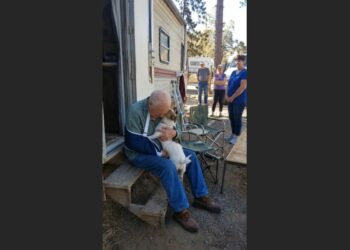
After fourteen days, Mike finally had Bruno in front of him again.
“You’re Finally Back”
The words came quietly.
Mike kept one hand against Bruno’s shoulder.
Bruno leaned into him.
No one could know exactly what Bruno understood about the separation.
Dogs can recognize familiar people after time apart through scent, voice, appearance, and movement.
His response made the recognition obvious.
What the reunion meant in human terms belonged to Mike.
Fourteen days of waiting.
Fourteen days of asking.
Fourteen days of seeing the dog bed empty.
Now Bruno was physically there.
Still hurt.
Still recovering.
But there.
Eventually, Mike leaned back enough to look at him.
He held Bruno’s face gently between both hands.
“I’ve been waiting for you.”
Bruno moved forward again.
Mike laughed through tears.
Nobody at the Station Pretended the Story Was Finished
Coming back was not the same as being healed.
Bruno’s front leg still needed time.
More veterinary appointments were scheduled.
Bandage changes remained part of the routine.
His activity had to stay restricted.
There would be no running beside equipment.
No demanding training.
No return to working duty simply because the reunion looked good on video.
His body would determine the schedule.
That was understood immediately.
The firefighters did not need their old Bruno back overnight.
They needed the Bruno in front of them to recover properly.
For now, his job was remarkably simple.
Eat.
Rest.
Take medication.
Move only as advised.
Get stronger.
Everything else could wait.
Returning to the Station Was Its Own Adjustment
Mike brought Bruno inside later that afternoon.
The Labrador walked slowly.
The familiar building smelled the same.
The same people were there.
The same equipment.
The same noises.
Bruno paused several times.
Then continued.
When they reached the area near the lockers, his bed was still in the old place.
Nobody had moved it.
The bowl remained nearby.
So did the tennis ball.
Bruno went toward the bed.
He circled slowly.
Then lowered himself.
Mike sat down beside him.
Someone joked that Bruno had reclaimed his station.
Mike smiled.
But no one pushed the dog to interact more.
He had already done enough.
The Tennis Ball Stayed Where It Was
That detail mattered.
Before the fire, Bruno would have noticed it immediately.
A ball near the lockers usually meant opportunity.
Now he glanced at it and rested.
Nobody rolled it toward him.
Nobody tried to excite him into showing everyone that he was “still himself.”
He was still himself.
He was also injured.
Respecting that difference was part of caring for him.
The ball could wait.
So could work.
Mike seemed to understand that better than anyone.
He sat near Bruno’s bed without asking for anything.
Every so often, he reached over and touched the dog’s shoulder.
Bruno closed his eyes.
For the first time since the fire, the station’s quiet did not feel empty.
The Fire Had Changed Both Their Routines
Before the injury, Mike rarely had to think about whether Bruno could follow him somewhere.
Bruno simply did.
Afterward, every movement required planning.
Could he manage that distance?
Was the floor slippery?
Was he tired?
Did the leg look more uncomfortable today?
Was swelling increasing?
Senior dogs and injured dogs often teach people to notice small physical details they previously took for granted.
Bruno was not old, but recovery temporarily made those details important.
Rugs were placed where traction might be an issue.
Rest areas were kept clear.
People learned not to crowd him.
Mike became protective without becoming impatient.
Healing was not something he could command.
The Crew Had Missed Bruno in Different Ways
One firefighter missed having him under the table during meals.
Another admitted the station seemed too quiet after midnight.
Someone else had become accustomed to Bruno appearing whenever locker doors opened.
Nobody had realized how many routines included the dog until he disappeared from them.
His return made those absences visible.
Still, the crew did not turn Bruno into a mascot who existed for their morale.
He was an injured working dog first.
His welfare came before anyone’s desire to celebrate.
Visitors were limited.
Excitement was kept under control.
Rest remained the priority.
The people who had waited fourteen days for him now had to learn another kind of patience.
Mike Stopped Asking When Bruno Could Come Home
The question changed.
Now it was:
“When can he do more?”
The veterinarian’s answer remained familiar.
Not yet.
Mike laughed the first time he heard it.
He had apparently exchanged one version of waiting for another.
But this time Bruno was beside him.
That made patience easier.
The leg gradually improved.
Follow-up examinations tracked healing.
Activity increased in small stages.
A little more walking.
A little more weight through the limb.
More comfortable movement.
There were good days and slower ones.
Nobody treated a difficult morning as failure.
Bodies recover unevenly.
Being Home Did More for Mike Than It Did for Bruno’s Leg
That distinction mattered.
Bruno’s medical recovery came from veterinary treatment, rest, pain control, proper nutrition, and time.
Being with Mike did not magically repair injured tissue.
But companionship changed the emotional atmosphere around the recovery.
Bruno could rest near familiar people.
Mike no longer had to leave the veterinary hospital without him.
The station had its familiar dog sounds again.
Water bowl.
Nails on the floor.
A deep sigh from the bed.
Mike stopped staring at an empty corner.
Sometimes emotional relief is not a cure.
It is simply being able to care for someone where you can see them.
Bruno’s Old Routine Returned in Pieces
He did not resume everything at once.
Morning arrival.
Rest.
Short controlled walks.
Back to bed.
Meals.
Medication.
More sleep.
The old tennis ball stayed mostly untouched.
Eventually, Bruno showed interest in it again.
He looked toward it.
Then toward Mike.
Mike smiled.
“Not yet.”
Bruno stared a moment longer.
Then settled.
For once, the human was better at patience.
The crew laughed.
That small interaction reassured them more than an energetic display would have.
Interest was returning.
His body would catch up as much as it was able.
No One Knew Whether Bruno Would Work Again
That question could wait.
Sometimes working dogs return after injuries.
Sometimes retirement becomes the safer outcome.
The decision depends on healing, function, pain, veterinary guidance, and the demands of the job.
Mike refused to speculate early.
If Bruno could return safely, they would discuss it.
If he could not, then his working career would end.
That would be difficult.
It would not diminish what he had already done.
There is a tendency to measure working dogs by usefulness.
How many searches.
How many calls.
How many years of service.
Mike had long stopped thinking of Bruno that way.
If Bruno never performed another task, he would still be Bruno.
That was enough.
The Empty Bed Had Been Harder Than Mike Admitted
After the reunion, one firefighter finally asked him about those two weeks.
Mike shrugged at first.
Then admitted that coming into the station had been the worst part.
At home, he could tell himself Bruno was where he needed to be.
At the station, evidence of his absence was everywhere.
The bed.
Bowl.
Ball.
The places Bruno normally rested.
No one had removed them because no one wanted the space to become permanent.
Every day, Mike saw them.
Every day, he called or waited for an update.
“When can Bruno come home?”
Now the dog occupied the bed again.
The question had finally been answered.
The Reunion Wasn’t Powerful Because Bruno Ran
He couldn’t run.
That was precisely what made the moment feel so honest.
Bruno wanted to get to Mike.
His body required him to move carefully.
Mike saw that and went to him.
There was no need to make the injured dog prove anything by crossing the whole distance.
No dramatic sprint.
No leap into waiting arms.
Just a Labrador taking guarded steps on a bandaged leg while one man hurried forward to meet him.
That was enough.
Perhaps more than enough.
Love for an injured animal is not measured by how excited the reunion looks.
Sometimes it is measured by who closes the distance.
That Evening, Bruno Fell Asleep in His Old Spot
The station returned to its usual rhythm.
Someone started dinner.
A radio sounded.
People moved through the bay.
Bruno remained on the bed.
Mike sat nearby.
The black Lab’s breathing gradually slowed.
His injured leg was positioned carefully.
The tennis ball remained by the lockers.
Nothing important had changed in the room during those fourteen days.
That had been deliberate.
The station had kept Bruno’s place.
Now he was back in it.
Not ready for work.
Not fully healed.
Not the same dog physically that he had been before the fire.
But home.
Mike Didn’t Need to Hold Back the Tears
Someone later asked whether he had been embarrassed to cry in front of the crew.
He laughed.
After two weeks of hospital visits and uncertain updates, embarrassment had not occurred to him.
He had watched Bruno walk toward him.
Bandaged.
Tired.
Alive.
Then the dog had pressed his head against Mike’s chest.
That was all it took.
There are moments when composure serves no useful purpose.
This was one of them.
Bruno did not care whether Mike cried.
He knew only the familiar person crouched in front of him.
The hands around his shoulders.
The voice he recognized.
The place he knew.
For Now, Nobody Is Asking Bruno for Anything
He does not need to prove that he remembers his training.
He does not need to return to duty.
He does not need to chase the old tennis ball.
He does not need to make anyone feel better.
His only responsibility is recovery.
Mike has learned to accept that.
Some mornings Bruno moves a little more easily.
Other days remind everyone that two weeks in a hospital does not erase a serious injury.
The veterinary appointments continue.
So does the healing.
And most evenings, Bruno ends up where he did before the fire.
Near Mike.
Sometimes awake.
Usually sleeping.
The Station Feels Normal Again, but Not Because Everything Is Back to Normal
Bruno’s bandages make that impossible to pretend.
His slower movement does too.
What returned was not the old routine in full.
It was presence.
The dog bed was occupied.
Mike no longer glanced toward it and saw only an empty space.
When food appeared, Bruno once again became interested, though he was not always allowed to investigate as enthusiastically as before.
When Mike sat down, the Labrador usually settled somewhere nearby.
That was the part everyone had missed most.
Fourteen days after the fire, Mike watched Bruno walk carefully across the concrete toward him.
He could have stayed on the bench and waited.
Instead, he stood.
Then dropped to his knees.
“Easy, Bruno. I’m coming.”
Maybe that is the detail that says the most about them.
For years, Bruno had followed Mike wherever the work required.
This time, when Bruno could not cover the distance easily, Mike went to meet him.
And that evening, when the black Labrador finally lowered himself onto the bed everyone had left untouched, Mike sat down beside him.
For the first time since the fire, neither of them had to wait for the other to come home.
Editor’s Note: The characters in this story are fictional. Through these stories, we hope to share the intelligence, loyalty, compassion, and loving nature of dogs with people everywhere.