By Late Afternoon, Kennel 27 Had Already Been Cleared
On September 21, 2024, an elderly Labrador mix had been moved away from the adoption floor at a county shelter outside Missoula, Montana.
For nineteen days, his kennel card had identified him only by a number.
Kennel 27.
Staff estimated he was about twelve years old.
His chocolate coat had faded with age, especially around his face and shoulders. His muzzle was nearly white. Arthritis made his rear legs stiff when he first stood, and one cloudy eye showed the effects of an old injury.
Several worn teeth caused the tip of his tongue to slip slightly from one side of his mouth when he relaxed.
He was not in acute medical distress.
He was simply old.
And in an overcrowded shelter, age had become the hardest thing about him to overcome.
That afternoon, staff had already begun preparing him to leave the building.
Not for another rescue.
For a veterinary appointment from which he was not expected to return.
He Had Been Given More Time Than Anyone Expected
The shelter had been operating beyond comfortable capacity.
Dogs were arriving faster than they were leaving.
Available kennels mattered.
So did emergency spaces for animals brought in by law enforcement or animal control.
Staff had postponed Kennel 27’s placement on the euthanasia schedule several times.
Once, a rescue organization transferred another dog and freed space.
Another day, several puppies were adopted together.
Later, an emergency holding kennel unexpectedly became available.
Each time, the old Labrador remained.
Nobody considered that a permanent solution.
It was another day.
Then another.
By the nineteenth day, there was nowhere left to move the decision.
Staff knew exactly what his age did to his chances.
Senior dogs can be wonderful companions.
They can also bring arthritis, medication, mobility changes, dental care, and the possibility that the relationship may last only a few years.
Many families understandably chose younger animals.
Kennel 27 watched them go.
He Never Learned to Advertise Himself
The puppies understood attention in the simplest possible way.
Visitors arrived.
Puppies rushed forward.
Tails moved.
Bodies bounced against fencing.
People laughed.
Kennel 27 rarely did anything like that.
If someone stopped in front of him, he stood carefully.
One slow wag.
Sometimes two.
Then he waited.
If they continued toward another kennel, he lowered himself onto his bed again.
Volunteers occasionally planned to photograph him for social media.
Then another dog would do something easier to capture.
A puppy tilted its head.
A young shepherd pressed against the gate.
A hound rolled onto its back.
The old Labrador remained still.
Eventually, staff began joking sadly that he was the easiest dog in the building to overlook.
He did not demand to be chosen.
He simply waited to see whether anyone would stop.
His Behavior Suggested He Had Once Lived in a Home
Nobody knew his complete history.
No owner came looking.
No reliable identification led back to a family.
Still, the dog knew things.
Ask him to sit and he usually did.
Attach a leash and he walked without dragging anyone.
At feeding time, he often waited near his bowl until a staff member stepped back or gestured toward it.
When volunteers brushed his coat, his eyes slowly closed.
He leaned into the brush.
Those behaviors did not reveal exactly where he had lived or who had trained him.
But they suggested familiarity with people and household routines.
Someone had once taught him something.
Someone had probably called him by a name other than a kennel number.
Whatever that name had been was gone with the rest of his history.
By Saturday afternoon, the shelter was preparing to say goodbye to a dog nobody had reclaimed.
At 4:37, a Technician Clipped On His Lead
The young animal-care technician moved quietly.
She had been avoiding the task for as long as she reasonably could.
Kennel 27 stood when she entered.
His back legs needed a moment.
Then he followed.
No pulling.
No resistance.
She walked him past the adoption rooms and through a rear hallway.
The holding room near the exit was simple.
Concrete floor.
A water bowl.
A folded blanket.
This was not the room where end-of-life procedures took place.
Animals waited there for transport.
The technician spread the blanket.
The Labrador circled once and lowered himself.
Later, she would say his calmness had been the hardest part.
It was tempting to imagine he knew what was happening.
He did not.
Dogs do not understand shelter scheduling or euthanasia appointments.
He was simply an old dog being moved to another unfamiliar room.
Still, watching him settle there quietly affected everyone who knew why he had been moved.
Eight Minutes Later, Margaret Ellis Walked In
She was seventy-one and soaked from the afternoon rain.
A canvas tote hung from one shoulder.
Her rain jacket dripped onto the shelter floor.
Margaret had retired the previous year after nearly four decades as an elementary school teacher.
She lived almost two hours away in a small ranching community.
The shelter had not been part of her plans.
She had been driving to visit her sister when heavy rain made the highway unpleasant enough that she pulled off to wait.
That was when she noticed a handmade sign pointing toward the county animal shelter.
She had time.
So she turned.
At the front desk, Margaret apologized.
“I only have a few minutes.”
Then she said something the volunteer had not heard often.
“I’d like to meet your oldest dog.”
Most People Asked for Something Very Different
The volunteer paused.
“Your oldest?”
Margaret nodded.
“They’re usually the ones who’ve been waiting.”
She said it without drama.
No speech about saving a life.
No suggestion that choosing a puppy was wrong.
She simply knew what suited her.
Margaret was retired.
Her household was quiet.
She was not looking for a dog that needed miles of running or months of puppy training.
A senior animal made sense.
The volunteer walked her along the adoption row.
Young dogs barked.
Several rushed forward.
Margaret stopped and smiled at them.
She scratched one through the kennel gate.
Another puppy made her laugh.
Still, she kept asking.
“Any older?”
Eventually, they reached the far end of the row.
One kennel was empty.
The bedding remained.
The card was gone.
Margaret stopped.
“Who was in there?”
The Volunteer Hesitated Before Answering
“He was moved to the back.”
“When?”
“About ten minutes ago.”
Margaret looked toward the closed hallway door.
“Can I meet him?”
The volunteer did not answer immediately.
Paperwork had already begun.
The transport plan had already been made.
Still, nothing had happened that prevented an adoption if the shelter manager approved it.
The volunteer excused herself.
Margaret waited.
A few minutes later, someone opened the rear hallway.
They led her toward the holding room.
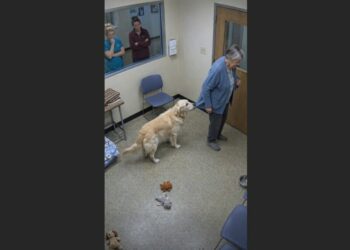
The old Labrador was lying on the blanket.
When the door opened, he lifted his head.
He did not stand immediately.
Margaret did not approach him quickly.
Instead, she entered and lowered herself carefully onto the concrete.
“Hello, handsome,” she said.
Then she waited.
He Came Toward Her Slowly
The Labrador pushed himself upright.
His rear legs were stiff.
He took several steps.
Stopped.
Then continued.
Margaret remained kneeling.
She held one hand low, allowing him to approach rather than reaching directly over his head.
The dog smelled her fingers.
Then her sleeve.
Finally, he moved close enough that his shoulder touched her.
Margaret stroked his neck.
The Labrador shifted forward.
His heavy head came to rest against her shoulder.
Then he exhaled.
Long.
Deep.
One of the staff members standing nearby looked away.
People later described the sound as relief.
No one could know that.
A dog may sigh because he is settling physically, releasing tension, or simply changing his breathing.
What staff could see was enough.
He had approached Margaret voluntarily.
He had chosen contact.
And she was in no hurry to end it.
Margaret Didn’t Ask Whether He Was “Good With Everything”
She asked practical questions.
How far could he comfortably walk?
What did the veterinarian think about the arthritis?
Would he need pain medication?
Could he manage a few steps?
How was his appetite?
Did he tolerate brushing and nail care?
How had he behaved around other dogs?
The shelter manager answered as carefully as possible.
They did not know everything.
Older dogs often arrive with incomplete histories.
They could describe only what they had observed and what the medical examination suggested.
His arthritis would require management.
Future dental work might become necessary.
The cloudy eye should continue to be monitored.
His age meant regular veterinary care mattered.
Nobody could promise how long he had left.
Margaret nodded.
She understood.
Then the manager told her about the appointment scheduled across town.
Staff Did Not Want Her Adopting Out of Guilt
That part mattered.
Once Margaret understood how little time had remained, emotion flooded the room.
The shelter manager deliberately slowed the conversation.
A senior dog should not be adopted simply because someone feels unable to walk away.
Margaret needed to know what she was accepting.
Large senior dogs can become difficult to lift if mobility declines.
Arthritis may progress.
Medication can become more expensive.
Rugs may be needed over slippery floors.
Ramps can become useful around vehicles or steps.
End-of-life decisions may arrive sooner than an adopter hopes.
Margaret listened to all of it.
The manager even reminded her that several younger dogs would likely have fewer immediate medical needs.
Margaret glanced toward the old Labrador.
He had lowered himself beside her feet.
“I didn’t come here looking for the most years,” she said.
She rubbed one hand over his gray muzzle.
“I came looking for the right dog for the years we have.”
At 4:52 P.M., She Said She Wanted Him
The shelter began the adoption process.
They checked her identification.
Discussed her home.
Asked about other pets.
Reviewed veterinary expectations.
Margaret lived in a one-story house.
There were only two shallow steps at the entrance.
Her sister lived close enough to help when needed.
Margaret had owned dogs before and already knew which veterinary clinic she would call Monday morning.
A senior-dog sponsorship program covered his adoption fee.
Margaret made a donation anyway.
She also asked for a copy of every medical note the shelter had.
The old Labrador remained beside her.
During the paperwork, someone brought him water.
He drank.
Then returned to Margaret’s chair.
The transport plan across town was canceled.
The blanket in the holding room was folded and returned to storage.
Kennel 27 was no longer a number on a list.
Margaret Named Him Chance
She chose the name before they left.
A volunteer assumed she meant that Margaret had given him a second chance.
She shook her head.
“No.”
The old dog had already survived several extensions at the shelter before she arrived.
Space had opened.
Transfers had happened.
Schedules had changed.
Chance felt appropriate because so much of his immediate future had depended on small changes he could never understand.
Still, Margaret did not spend long philosophizing.
She had practical work to do.
The dog needed a harness.
A comfortable bed.
Food appropriate for his age and condition.
She needed rugs before his stiff legs met the polished floor at home.
The shelter helped load supplies into her aging Subaru.
Then they walked outside.
Chance stopped beside the passenger door.
He Needed Less Help Into the Car Than Anyone Expected
Margaret prepared to support his rear end.
Chance surprised her.
He placed his front paws inside.
Paused.
Then managed to climb onto the seat.
The movement was not graceful.
It was enough.
A blanket covered the passenger side.
Chance turned once before settling.
Before Margaret closed the door, he looked toward the shelter building.
Some of the staff later described it as a final goodbye.
Margaret was more careful.
“He was looking around,” she said.
“That was enough.”
Dogs do not need to understand that they are leaving somewhere forever for the moment to matter to us.
Chance looked.
Then Margaret closed the door.
At 5:15, instead of arriving at the veterinary office for the appointment the shelter had scheduled, the old Labrador was traveling toward a quiet house almost two hours away.
His First Days Were Mostly About Rest
Chance did not become energetic after adoption.
He was twelve.
That did not change because someone loved him.
The first night, he ate part of his meal and slept for hours.
Margaret had placed an orthopedic bed near the stone fireplace.
He used it immediately.
She also put runners across the slippery sections of flooring.
Chance moved cautiously through the house.
He investigated the kitchen.
Living room.
Bedroom doorway.
Back door.
Then he returned to the fireplace.
The following morning, Margaret called her veterinarian.
His arthritis treatment was reviewed.
They discussed body weight, joint support, gentle exercise and signs of discomfort.
The goal was not to make Chance young.
It was to help an elderly dog remain comfortable in the body he had.
Walks Became Short and Slow
Margaret liked mornings.
Chance seemed to as well.
They began with brief trips outside.
At first, they walked only to the edge of the yard.
Then a little farther.
Chance sniffed more than he walked.
Margaret did not mind.
She had spent decades moving according to school bells.
Retirement had taught her that ten minutes no longer needed to be efficient.
If Chance wanted to investigate one bush for several minutes, she waited.
When he tired, they went home.
Some days his hips were noticeably stiffer.
Cold weather made the first few steps difficult.
On those mornings, Margaret shortened the walk.
Good senior care meant responding to the dog in front of her rather than forcing yesterday’s routine onto today’s body.
Chance seemed satisfied with that arrangement.
His Personality Appeared in Small Pieces
At the shelter, Chance had seemed almost entirely quiet.
At home, other habits emerged.
He snored.
Loudly.
Margaret claimed the sound could compete with farm equipment.
He preferred the warmest place in any room.
He developed a suspiciously accurate understanding of when Margaret opened cheese.
He liked having his shoulders brushed.
If she stopped too soon, he leaned backward against her leg.
His worn teeth made hard treats difficult, but softer ones became extremely important to him.
Most afternoons, Chance slept while Margaret worked in the garden.
Or, more accurately, while Margaret tried to work.
Chance preferred monitoring her from a place near the front window.
When she disappeared from view, he often stood.
When she returned, he settled again.
Margaret Never Called That “Protecting” Her
She thought the explanation was simpler.
Chance had recently undergone a series of abrupt changes.
A shelter.
Different handlers.
Different rooms.
Then a new house.
It made sense that he paid attention to where she went.
So Margaret made her departures predictable.
She walked outside.
She returned.
She went to collect the mail.
She came back.
If she visited her sister, Chance stayed with someone he already knew.
Over time, his monitoring became less intense.
He no longer stood every time Margaret disappeared from sight.
Sometimes he slept through her entire trip to the garden.
But in the evenings, he still liked the window.
He seemed to know approximately when she normally came inside.
Routine had begun doing what reassurance alone could not.
It made the new home understandable.
Winter Arrived in Montana
Snow covered the fields around Margaret’s house.
Chance discovered that he liked watching it more than walking through it.
Cold worsened the stiffness in his hips.
So outdoor trips became shorter.
Inside, the stone fireplace became his territory.
Margaret placed his bed close enough for warmth without putting him too near the heat.
A few months after the adoption, she took a photograph.
Chance was asleep there.
His gray muzzle rested across her slippers.
One ear folded awkwardly beneath his head.
Outside the window, snow was falling.
Nothing about the photograph was dramatic.
That was exactly why Margaret loved it.
The old dog who had been scheduled to leave the shelter permanently was doing nothing more remarkable than sleeping beside a fireplace.
Ordinary life had become the point.
The Shelter Received Margaret’s Letter Months Later
There was no claim of miraculous recovery.
Chance still walked slowly.
His arthritis had not disappeared.
His cloudy eye remained cloudy.
The damaged teeth did not grow back.
His age continued moving forward.
Margaret wrote that he snored louder than anyone she had ever known.
She described how he waited near the window when she watered the garden.
If she took too long, he stood.
When she came inside, he usually returned to his bed.
“People tell me I rescued an old dog,” she wrote.
“I think we happened to meet on an afternoon when both of us had room for company.”
Staff passed the photograph around.
Several people recognized the blanket.
Few would have recognized the dog from his expression alone.
He was sleeping deeply.
Nobody Pretended His Future Was Guaranteed
Senior adoption stories are sometimes told as though reaching a home erases age.
It does not.
Chance would need continued veterinary monitoring.
His mobility might decline.
There could be difficult decisions later.
Margaret understood that before signing the paperwork.
For her, the possibility of grief was not a reason to avoid the relationship.
Nor was it something she romanticized.
She had not adopted Chance because losing an old dog quickly would somehow be noble.
She adopted him because his needs matched what she could provide.
A quiet house.
Slow walks.
Time.
Money for medical care.
Warm places to sleep.
Company.
That practical compatibility mattered as much as what happened in the holding room.
The Puppies Had Not Done Anything Wrong by Being Young
Margaret occasionally corrected people who framed the story as though everyone else at the shelter had made the wrong choice.
Families who adopted puppies had chosen animals appropriate for their lives.
A household with children might want years of activity.
Someone interested in hiking might need a younger companion.
Another person might not have been physically or financially able to care for a large arthritic senior.
Those were reasonable considerations.
Chance did not need everyone to choose him.
He needed one home that fit.
At 4:45 on a rainy afternoon, Margaret happened to walk through the door looking specifically for a dog like him.
The timing was extraordinary.
The compatibility was what made the adoption work.
Chance Had Never Needed to Act Younger
He did not jump against kennel fencing.
He did not perform for visitors.
He did not learn to behave like a puppy to become adoptable.
At twelve, his appeal was quieter.
A polite leash.
A slow tail wag.
A body comfortable resting beside someone.
The willingness to lean into a brush.
Those things had been easy to overlook in a shelter full of younger dogs demanding attention.
Margaret noticed because she was not seeking energy.
She was seeking presence.
Chance had plenty of that left to give.
The Number on His Kennel Disappeared
There is something unsettling about how quickly animals can become paperwork in crowded shelters.
Intake number.
Kennel number.
Medical number.
Transport list.
Those systems are necessary.
They help staff manage large numbers of living animals responsibly.
But sometimes a person walks through the door and the number becomes a name again.
Kennel 27 became Chance.
The holding-room blanket returned to storage.
His empty kennel was cleaned for another dog.
Life at the shelter moved forward.
At Margaret’s house, a different routine began.
Morning medication.
Slow walk.
Breakfast.
Nap.
Garden.
Fireplace.
Evening.
Nothing extraordinary.
Just days.
For Chance, That Was Enough
He had spent nineteen days waiting inside a place where every visitor represented possibility.
Then one afternoon, the possibility nearly ran out.
At 4:37, he left the adoption floor.
At 4:45, Margaret entered the building.
At 4:52, she decided that his gray muzzle, stiff legs, cloudy eye, and uncertain number of remaining years were not reasons to walk away.
Months later, Chance slept beside a fireplace while snow fell outside.
His head rested on Margaret’s slippers.
The image did not prove he understood what had almost happened that September afternoon.
He did not need to.
He had a soft bed.
A person whose routines he had learned.
A window where he could watch her garden.
And enough ordinary mornings ahead that nobody needed to count them before they happened.
Chance had not become younger.
He had not become healthier than age allowed.
He had simply become someone’s dog again.
And on the afternoon when everyone else had already gone home with younger animals, that was all he needed.
Editor’s Note: The characters in this story are fictional. Through these stories, we hope to share the intelligence, loyalty, compassion, and loving nature of dogs with people everywhere.