At First, Everyone Assumed Someone Was Coming Back
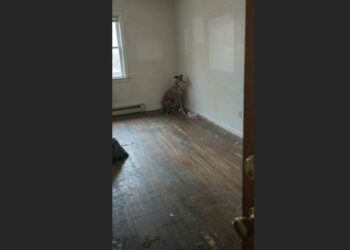
Almost a week passed after the apartment across from mine was emptied before any of us understood what had happened.
The moving vans arrived over the weekend.
Furniture disappeared first. Then boxes. By Sunday evening, the windows were dark, and the building manager assumed the residents had moved out when their lease ended.
Nothing unusual about that.
Except for the little dog.
Around dusk each evening, a white-and-tan Jack Russell Terrier appeared outside their old apartment and settled on the faded mat beside the door.
He stayed there for hours.
Whenever the elevator opened, his head came up.
His tail gave a quick, hopeful flick.
Then a stranger stepped into the hallway, and the tail stopped.
He lowered his head again.
Most of us assumed his family would eventually return for him.
They never did.
By the Fifth Day, His Bark Had Changed
During the first couple of days, the dog occasionally barked when he heard movement.
It was sharp and alert.
The kind of sound you might expect from a small terrier guarding the place he knew.
By the fifth day, it sounded different.
Softer.
Less frequent.
Almost worn out.
I do not pretend he was consciously calling for his family in the human sense. Dogs cannot understand rental agreements, moving vans, or the decision to relocate without them.
But dogs do recognize people, footsteps, routines, doors, and the places where familiar people normally appear.
This dog kept returning to the same entrance.
He listened whenever the elevator arrived.
He watched every person coming down the hallway.
Whatever he expected, it was connected to that door.
And each evening, the person he was waiting for failed to appear.
I Started Looking for Him Every Morning
I could not stop thinking about him.
When I left for work, he was often curled against the wall.
When I came home, he was still there.
Sometimes another neighbor had left food.
Someone placed water nearby.
The dog took enough to keep going, but he seemed reluctant to move far from the apartment.
Eventually, I asked maintenance whether anyone had actually contacted the former residents.
That was when the truth became clear.
They were gone.
No forwarding address.
No emergency contact.
No arrangement for the dog.
Nothing.
The little terrier had not slipped out accidentally while they were moving.
As far as anyone could determine, they had left without him.
That night, I carried a clean bowl of water into the hallway.
He watched me approach.
He did not come toward me.
Even Water Couldn’t Pull Him Far From the Door
I placed the bowl several feet away.
The dog looked at it.
Then back at the apartment entrance.
His priorities seemed fixed.
So I stopped trying to persuade him.
I spread a blanket nearby and sat down at a distance.
The hallway was quiet.
Every few minutes, the elevator hummed somewhere below us.
The terrier lifted his head each time.
Nearly an hour passed before he finally stood.
He approached the water slowly.
Took several small drinks.
Then immediately returned to the mat by the door.
That told me more than any dramatic reaction could have.
Even after days of uncertainty, thirst and disrupted routine, he still preferred staying near that familiar entrance.
I went back to my apartment feeling helpless.
The following morning, the weather made the decision for me.
Rain Blew Across the Walkway
The building had an exposed section near the apartments.
When the storm arrived, wind pushed rain sideways through it.
By morning, the dog’s sleeping place was soaked.
The blanket was wet.
So was he.
His fur clung to his small body.
I stood there for several minutes watching him shiver.
Then I decided he was not spending another day outside that door.
I approached slowly.
He did not run.
When I lifted him, he offered almost no resistance.
That frightened me.
Jack Russells are compact dogs, but he felt far too light.
I carried him across the hallway into my apartment.
For the first time in days, the door he had been watching disappeared from view.
He did not settle.
He immediately began searching.
He Checked Every Room
The moment I put him down, the terrier moved from one room to another.
Bedroom.
Kitchen.
Living room.
Bathroom.
He sniffed corners.
Checked doorways.
Then returned toward the entrance.
When he did not find whatever he was searching for, he tucked himself into the corner beside my bookcase.
I made a bed there.
He ignored it.
I bought high-quality dog food that afternoon, convinced hunger would eventually overcome everything else.
It did not.
Treats failed too.
So did toys.
A tennis ball rolled past him without getting so much as a glance.
I could sit only a few feet away and still watch his attention return repeatedly to my front door.
Every sound in the hallway mattered.
Every footstep.
Every elevator bell.
He listened.
Then waited.
The Veterinarian Found Problems, but Not the Whole Explanation
The next day, I took him to a veterinary clinic.
He needed fluids.
He was underweight.
Both ears were infected and uncomfortable.
Those issues were treatable.
Fortunately, the veterinarian found no major physical disease that fully explained why he showed so little interest in food, play, or interaction.
She asked about his history.
I told her what little I knew.
Apartment emptied.
Owners gone.
Five days outside the door.
No one coming back.
She listened.
Then she explained that dogs can become seriously distressed after the abrupt loss of people and routines they are attached to.
Appetite may fall.
Activity can decrease.
Some dogs withdraw.
Others become restless or vocal.
The behavior does not mean a dog understands abandonment the same way a person would.
It means his environment and social world have changed suddenly, and he has not yet adapted.
“We can treat his body,” she said gently.
“The rest may need time.”
She Told Me Not to Expect a Quick Transformation
That advice turned out to be important.
I wanted progress.
Of course I did.
I wanted him to eat a full meal.
I wanted him to chase a ball.
I wanted one of those dramatic moments people describe when a rescued dog suddenly realizes everything is going to be all right.
The veterinarian warned me not to measure recovery that way.
Days might pass with almost no visible change.
Then one small behavior would appear.
Maybe he would explore.
Maybe he would eat while I remained nearby.
Maybe he would choose to rest somewhere other than the corner.
The goal was not to overwhelm him with affection.
It was to make the environment predictable.
Food at regular times.
Water always available.
Quiet movement.
A safe resting place.
No pressure to interact.
So I changed how I behaved around him.
I Stopped Asking Him to Be Happy
That was harder than it sounds.
My instinct was to encourage.
Come here.
Want a treat?
Want to play?
But every invitation was still a demand for a response.
So I stopped.
If I read in the evening, I sat on the floor near his blanket.
If I used my laptop, I worked nearby.
Before bed, I talked quietly about whatever was happening.
Work.
Weather.
Something I needed to buy the next day.
I knew he did not understand the content.
That was not the point.
My voice became another predictable household sound.
I left food available according to the veterinarian’s instructions.
I kept his medication schedule.
I avoided reaching for him unless necessary.
For most of the following week, it felt like nothing was changing.
Then one morning, while I was making breakfast, I looked toward the hallway.
He was standing there.
Watching me.
He Had Left the Corner on His Own
I froze.
Not dramatically.
I simply stopped moving for a second because I did not want to startle him.
He stood halfway down the hallway.
His ears were up.
For the first time since I carried him inside, he seemed interested in something happening away from the front door.
I turned back to breakfast.
A few minutes later, he disappeared.
Still, the moment stayed with me all day.
That afternoon, something else happened.
I moved from the living room toward the bedroom.
Behind me came a light tapping sound.
Toenails.
I looked back.
The terrier had followed.
Only a few steps.
When he realized I was watching, he stopped.
He did not come closer.
He eventually returned to his resting place.
But he had made the decision to follow me.
Nobody had coaxed him.
For a dog who had spent days oriented toward people who were gone, that small choice felt enormous.
The First Bite of Chicken Came the Next Evening
I had stopped offering elaborate treats.
This time, I held out a small piece of plain boiled chicken.
He smelled it.
Usually, that was where things ended.
He would turn his head.
Instead, he remained interested.
His nose moved closer.
Then he took the smallest bite.
I smiled so hard my cheeks hurt.
It was not because one mouthful meant he was recovered.
He was still under veterinary care.
He still needed to gain weight.
His ear infections were still being treated.
But appetite is part of engagement with the world.
That evening, he had chosen food while I was sitting there.
The following day, he ate a little more.
Then more again.
Recovery did not arrive.
It accumulated.
His Real Personality Appeared in Pieces
Over the next several weeks, the quiet little dog began changing.
Not all at once.
Some mornings he still seemed withdrawn.
Certain hallway noises sent him toward the door.
If the elevator opened outside, he occasionally froze and listened.
But new behaviors began taking up more space.
He greeted me when I returned from work.
At first, that meant standing several feet from the entrance.
Then his tail began moving.
Eventually, he came all the way to the door.
The tennis ball suddenly became interesting too.
One evening, I rolled it gently across the room.
He watched.
The second time, he followed it.
By the end of the week, he was chasing it down the hallway with far more enthusiasm than my furniture deserved.
He also discovered the warm patch of sunlight beside the living room window.
Soon it became his favorite place to sleep.
The Sofa Came Later
For weeks, he never climbed onto furniture.
I did not encourage him.
One evening, I was watching television when I felt something warm against my leg.
I looked down.
He had climbed onto the couch without making a sound.
The terrier settled beside me.
Then, very slowly, his head leaned against my thigh.
I stayed still.
There was no reason to turn the moment into a celebration and frighten him away.
After several minutes, his body relaxed.
His eyes closed.
That was different from the dog who had curled beside the bookcase while remaining alert to every sound.
He was sleeping next to me.
Not deeply.
Not yet.
But comfortably enough to let his weight rest against another person.
Trust, I was learning, could look very ordinary.
At the Follow-Up Visit, Even the Veterinarian Smiled
A few weeks later, we returned to the clinic.
He had gained weight.
The ear infections had improved.
Hydration was no longer a concern.
Most noticeably, his behavior in the exam room had changed.
The little terrier walked in under his own power.
He smelled the floor.
Accepted a treat.
Then his tail swept across the tile when the veterinarian approached.
She looked at him and smiled.
“Look at you.”
I laughed.
It was hard to reconcile this curious, alert dog with the one I had carried out of the rain.
Still, I did not want to tell the story as if love alone had transformed him.
He had received veterinary care.
Nutrition.
Medication.
Time.
Routine.
Space.
And hundreds of repetitions in which ordinary life remained safe.
That combination gave him room to change.
I Named Him Chance
Until then, everyone had called him some version of “the little terrier.”
I eventually chose Chance.
The name felt appropriate.
Not because I believed destiny had arranged any of this.
He needed another opportunity at stability.
I had happened to live across the hall.
That was enough.
Still, over time, I realized the name applied to more than him.
My own life had become repetitive in ways I had not noticed.
Work.
Home.
Dinner.
Sleep.
Repeat.
Chance interrupted that.
Now there were walks.
Veterinary appointments.
Tennis balls under furniture.
Dog hair where I never expected it.
A small body asleep in the sunlight.
I had brought him inside because leaving him in the rain was no longer acceptable.
I had not expected him to alter the rhythm of my own home.
He did.
Nearly a Year Later, He Still Checks the Door
That habit never disappeared completely.
Every night, before we settle down, Chance walks to the front entrance.
He stops.
Listens.
Usually for only a few seconds.
I do not know whether those sounds still connect in his mind to the old apartment across the hallway.
I do not know whether he remembers the people who left.
Dogs can retain long-term associations with places, routines, smells, and familiar individuals, but we cannot translate a brief pause at a door into a complete human story.
What I know is what happens next.
Chance turns away.
He walks back into the room.
Then he settles beside me.
He does not spend the night waiting at the entrance.
He does not stare toward the hallway until sleep overtakes him.
The door is simply a door now.
Most nights, anyway.
Home Became Something Predictable Again
I think about the first time I saw him on that faded mat.
Elevator opens.
Head rises.
Tail moves.
Wrong person.
Head lowers.
Again.
Again.
Again.
It would be easy to describe that as loyalty.
Perhaps that word fits from our perspective.
But what affected me most was how completely his life had been organized around a routine that suddenly stopped.
Then, slowly, he built another one.
Morning walk.
Breakfast.
Sunlight near the window.
My keys at the end of the workday.
The sound of my footsteps outside.
Dinner.
Tennis ball.
Sofa.
Bed.
The important part was repetition.
I left for work.
Then I returned.
The food bowl was filled again.
The blanket stayed.
Nothing disappeared while he slept.
No moving van emptied the rooms.
One ordinary day followed another.
Healing Did Not Require Him to Forget
Chance still listens when the elevator opens.
Sometimes he raises his head when voices pass our door.
That does not mean he has failed to recover.
Recovery does not require a dog to erase every association formed during a frightening experience.
It can mean the old response no longer controls the entire day.
Chance has things he enjoys now.
He plays.
He eats eagerly.
He seeks company.
He sleeps deeply in the afternoon sun.
And nearly every evening, he climbs beside me on the sofa as if that piece of furniture has belonged to him all his life.
The dog who once refused expensive food now appears instantly if he hears a chicken container open.
The dog who ignored toys has learned exactly how many times he can push a tennis ball beneath the couch before I become tired of retrieving it.
The dog who would not move away from someone else’s door now waits beside mine for me to come home.
Then he walks away from it with me.
Almost a year ago, Chance spent five days outside an empty apartment listening for footsteps that never returned.
Now he still pauses at the front door before bedtime.
He listens.
Then he turns around.
He comes back to the living room.
He curls against my side.
And he sleeps.
Maybe that is what a second chance looks like for a dog.
Not forgetting the door that once stayed closed.
Just learning that somewhere else, another one keeps opening.
Editor’s Note: The characters in this story are fictional. Through these stories, we hope to share the intelligence, loyalty, compassion, and loving nature of dogs with people everywhere.