Ace Had Been Aaron’s Partner for Nearly a Decade
The video was recorded inside a veterinary hospital in Colorado.
It was never meant to show a heroic police operation, an arrest, or the kind of training exercise that had filled so much of Ace’s working life.
There were no uniforms lined up outside.
No ceremonial procession.
No department photographer.
Only Lieutenant Aaron Briggs, his wife Denise, a veterinarian, and an eleven-year-old Belgian Malinois whose body had finally reached the point where work, training, and determination could no longer carry him forward.
Ace lay across Aaron’s lap in a quiet comfort room.
For nine years, the two had worked beside each other as K9 partners.
Now Aaron was holding him because Ace could barely support himself.
Denise stood several feet away with her phone raised.
Aaron had asked her to record.
He thought he wanted to remember everything.
Within minutes, she would realize that she couldn’t.
Eight Months Earlier, Ace Had Started to Change
The first signs had been subtle.
Ace had been retired from demanding field work as age caught up with him, but he remained alert and interested in his routines.
He still watched Aaron prepare for work.
He still responded to familiar cues.
He still wanted his morning walks.
Then his movement began changing.
Nothing dramatic happened at first.
A little hesitation.
Slight weakness.
An occasional misstep that could easily have been blamed on age.
Veterinary evaluation eventually revealed something more serious.
Ace had developed a neurological illness.
The disease was progressive.
Treatment might help manage symptoms and preserve comfort for a time, but Aaron was told from the beginning that there was no simple path back to the dog Ace had once been.
The veterinarian responsible for the department’s dogs spoke openly with him.
Good days could continue.
So could bad ones.
Eventually, the balance between them would shift.
Aaron Had Spent Years Watching Ace Move With Precision
That made the decline especially difficult.
A Belgian Malinois in police work is an athlete.
Throughout his career, Ace had been trained to move quickly, respond to cues, search methodically, and work through environments that required both physical ability and concentration.
Aaron knew the details of that movement better than anyone.
He knew Ace’s normal stride.
He knew how the dog’s ears changed when something caught his attention.
He knew how Ace positioned himself before beginning certain tasks.
He knew the difference between fatigue and distraction.
So when weakness appeared, Aaron noticed.
Over the following months, it became harder to dismiss.
Ace’s rear legs did not always respond the way they once had.
He sometimes needed longer after resting before he could move comfortably.
The dog who once seemed built entirely from muscle, focus, and forward motion had begun depending more heavily on the people around him.
Aaron adjusted.
Their Life Became Smaller
The changes came one at a time.
Walks became shorter.
Then slower.
Long outings disappeared.
Aaron began choosing flatter routes near home.
On difficult mornings, Ace went only far enough to relieve himself before turning back.
There was no attempt to prove that a retired police dog could still perform like one.
His working years were finished.
The goal was comfort.
For a while, that worked.
Ace still had good mornings.
He still ate.
He still seemed interested when Aaron entered the room.
Sometimes he rested in familiar places around the house and looked almost unchanged until he tried to stand.
Then, roughly a month before the final veterinary appointment, even the shortened morning walks became too much.
Ace would start normally.
Minutes later, he slowed.
Eventually, Aaron stopped asking him to complete them.
Eating Became Difficult Too
Two weeks before the hospital visit, Ace’s appetite became inconsistent.
Some meals disappeared.
Others sat untouched.
Aaron tried different foods.
He talked with the veterinary team.
They monitored Ace closely.
Loss of appetite alone can have many causes, but in a dog already living with advanced neurological disease, it became one more part of a larger pattern.
Ace’s world was narrowing again.
During the final week, he needed assistance simply to get out of bed.
Aaron sometimes supported his body as he stood.
Other times Ace tried, failed, rested, and tried again.
Nothing about those moments resembled the working dog Aaron remembered running beside him.
Yet Aaron did not measure Ace’s worth by what he could still do.
The question had changed.
It was no longer, How much can we treat?
It had become, Is he still comfortable enough for treatment to be fair to him?
The Decision Was Not Made in One Morning
People sometimes imagine end-of-life decisions as a single terrible realization.
For Aaron, it happened gradually.
The conversation had begun months earlier.
Ace’s veterinarian had made sure of that.
They discussed mobility.
Appetite.
Rest.
Pain and distress.
Ability to engage with familiar people.
Whether Ace could still perform basic daily functions without fear or exhaustion.
Aaron did not wait for one catastrophic emergency to begin thinking about those questions.
He still hated the answers when they became clearer.
On Thursday, he arranged an appointment with the veterinary hospital.
There was no expectation that the visit would somehow restore Ace’s strength.
Aaron understood where the disease had taken them.
The appointment was about preventing his partner’s final stage from becoming a crisis.
The following morning, Aaron’s shift commander heard what was happening.
He offered support immediately.
Aaron Did Not Want a Room Full of Officers
The commander asked whether Aaron wanted members of the department there.
Men and women who had known Ace.
Handlers who had trained beside him.
Officers who understood what it meant to spend years depending on a dog during work that could become dangerous without warning.
Aaron appreciated the offer.
He declined.
Ace had spent much of his life surrounded by uniforms, radios, vehicles, training fields, and police facilities.
Aaron did not want the final room to feel like another department event.
He wanted quiet.
There was only one other person he wanted with him.
Denise.
His wife had lived alongside the partnership for years.
She knew the late returns from shifts.
The muddy paws.
The veterinary appointments.
The equipment in the house.
The strange reality of being married to a man whose closest coworker slept on the floor and occasionally tracked dirt through the kitchen.
Denise would go with them.
Aaron Asked Her to Record
The request surprised her.
Aaron rarely wanted photographs during emotional moments.
But this felt different.
Ace had been part of nearly a quarter of Aaron’s life.
Nine working years could not be summarized by a badge, a collar, or a photograph from retirement.
Aaron was afraid that later, memory would change.
Perhaps he would forget exactly how Ace looked.
Perhaps he would forget the sound of his breathing or the way he rested his head against him.
He also did not want Ace’s story to exist only inside his own memory.
So he asked Denise to use her phone.
Not for social media.
Not for the department.
Just to preserve what happened.
She agreed.
Then they drove to the hospital.
Ace barely lifted his head during the trip.
Cornerstone Had a Room for Goodbyes
The veterinary hospital had a comfort room set apart from the busier treatment areas.
The lighting was gentle.
There were no stainless-steel exam tables dominating the center of the room.
A blanket had been spread across the floor.
The space was designed so families could spend quiet time with an animal approaching the end of life.
Aaron lowered himself there with Ace.
The old Malinois stretched across his lap.
His body was lighter than Aaron remembered from his working years, though still substantial.
Ace leaned his head into Aaron’s arm.
His breathing was faint and slow.
The dog who had once been ready to move at the slightest cue now seemed exhausted by simply remaining awake.
Aaron held him carefully.
Denise started recording.
There Was Nothing Left for Ace to Prove
For much of his career, Ace’s life had been built around commands.
Wait.
Search.
Come.
Stay.
Work.
Release.
The exact cues changed according to training, but the principle remained the same.
A working dog learns that behavior has structure.
There is a task.
There is a handler.
There is reinforcement.
There is an end point.
That morning, Aaron gave Ace no work.
There would be no obedience exercise.
No search.
No expectation that he remain alert.
Aaron simply held him.
When Dr. Cho entered, she did so quietly.
She did not begin immediately.
She looked at Ace.
Then at Aaron.
The veterinarian had already discussed the plan with them.
There was no need to fill the room with more words than necessary.
Aaron Started Talking to His Partner
His voice was different from the one he had used during training.
Softer.
He told Ace there was nothing to be afraid of.
He told him he had been a good partner.
Then a better one.
The kind no handler had a right to expect.
Aaron thanked him.
Not because Ace could understand a nine-year career being summarized in human language.
He could not.
But dogs know familiar voices.
They know touch.
They know the scent of a person who has spent thousands of hours beside them.
Aaron’s words were as much for himself as they were for Ace.
He continued speaking.
He told Ace he did not need to keep trying.
He did not need to stand.
He did not need to follow him anywhere.
He could rest.
“You Can Stop Fighting”
Aaron had watched the disease take more from Ace every month.
Movement.
Endurance.
Appetite.
Independence.
Through all of it, Ace had continued responding to familiar people and routines whenever his body allowed him.
Aaron had sometimes described that as Ace “fighting.”
In the comfort room, the word meant something different.
He was not asking a dog to make a conscious decision about death.
Ace could not understand illness in those terms.
Aaron was giving himself permission to stop asking for another day simply because he was afraid of the first one without him.
“You don’t have to fight anymore,” he told him.
Denise kept the phone aimed toward them.
Ace remained almost motionless.
His head rested against Aaron.
Then something changed.
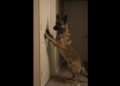
Ace Started Trying to Lift His Front Legs
At first, Aaron thought the movement might be involuntary.
Ace shifted against his lap.
One front leg moved.
Then stopped.
Denise kept recording.
Ace tried again.
The effort was obvious.
For days, he had needed help merely getting upright.
On the drive to the hospital, he had scarcely raised his head.
Now he was trying to bring one paw higher.
Aaron instinctively moved a hand as though to support him.
Then he stopped.
Ace continued.
One front paw rose toward Aaron’s chest.
The second began moving too.
Slowly.
Awkwardly.
With nothing resembling the strength that had once defined him.
Denise’s phone trembled.
Both Paws Reached Aaron’s Shoulders
Ace kept working until one paw rested against Aaron.
Then the other.
Eventually, both front legs were raised enough that his paws rested against Aaron’s shoulders.
He stayed there.
The position looked almost like an embrace.
No one in the room claimed that Ace understood it that way.
Dogs can seek physical contact with familiar people, especially during weakness or distress. Years of learned behavior, body positioning, scent, and attachment may all influence a moment like that.
Nobody could know why Ace moved exactly as he did.
They only knew how difficult the movement had become for him.
Aaron froze.
For nine years, he had read Ace’s movement during searches, training, patrols, and ordinary mornings at home.
This movement required no interpretation.
His dog wanted closer contact.
So Aaron lowered his face.
Ace’s head met him.
Dr. Cho Stepped Back
The veterinarian did not interrupt.
She paused.
Then she moved farther away.
There was nothing medically useful about rushing those seconds.
Aaron’s arms came around Ace.
He held him against his chest.
For a while, the room went almost completely silent.
No dramatic music.
No speeches from fellow officers.
No radio call announcing the end of a K9’s career.
Only Aaron’s breathing.
Denise continued holding the phone.
Her husband still wore the expression of a man trying to remain composed because he believed somebody in the room needed him to.
Ace’s paws remained near his shoulders.
Aaron lowered his forehead against the dog’s head.
Then he stopped talking.
Denise Had Seen Ace Strong
She had known him during years when controlling his energy was more difficult than encouraging movement.
She had seen him return from shifts alert and restless.
She had watched Aaron work through training exercises with him.
She had seen Ace leap into a vehicle without hesitation.
Later, she watched those movements become slower.
During the previous week, the contrast had become painful.
Ace needed help standing.
Sometimes Aaron supported him beneath the body just to get him outside.
There were moments when he seemed to consider getting up and then remained where he was.
So when Denise saw those two paws moving toward Aaron’s shoulders, she understood how much physical effort they represented.
That was what overwhelmed her.
Not a belief that Ace was delivering some final human-style message.
The effort itself.
Aaron Did Not Ask Him to Move
There had been no command.
No hand signal.
No food reward.
Aaron had not lifted Ace’s legs for him.
The old dog initiated the movement.
That distinction was why Denise remembered it so clearly.
For nearly a decade, Aaron and Ace had lived in a partnership filled with cues.
That morning, the most important movement came without one.
Ace shifted closer.
Aaron responded.
That was all.
Sometimes people try to make such moments larger by claiming an animal knew exactly what was about to happen.
There was no need.
Ace did not need to understand a veterinary appointment, prognosis, or final goodbye for the moment to matter.
He knew Aaron.
He knew his voice.
He knew the arms holding him.
That relationship was enough.
The Phone Began Shaking
Denise tried to keep the image steady.
Later, she would remember noticing small details through the screen.
Aaron’s hand against Ace’s back.
The dog’s pale muzzle.
Dr. Cho standing quietly at a distance.
The blanket beneath them.
Ace’s paws near Aaron’s shoulders.
She had agreed to record because Aaron wanted the memory preserved.
Now the phone suddenly felt intrusive.
There are moments people imagine they will want documented until they are actually living inside them.
Denise lowered the phone slightly.
Then raised it again.
She tried to continue.
Aaron had not moved.
Neither had Ace.
Nine Years Had Come Down to One Quiet Room
There had been hundreds of shifts.
Training days in bad weather.
Vehicle rides.
Veterinary examinations.
Ordinary evenings.
Early mornings.
Days when Ace worked and days when he simply slept after working.
A K9 partnership is often remembered through its most visible moments.
Searches.
Apprehensions.
Public demonstrations.
Awards.
But most of nine years is repetition.
Feeding.
Cleaning equipment.
Training the same behavior again.
Driving.
Waiting.
Watching the dog carefully enough to know when something is different.
Aaron had done that so long that reading Ace had become part of his daily life.
Now there was almost nothing left to read.
Ace was exhausted.
Aaron held him.
The dog’s paws remained near his shoulders.
Dr. Cho waited.
Denise Could Hear Aaron Breathing
That was the sound that finally broke her.
Not Ace.
Not the veterinarian.
Aaron.
He was trying to stay quiet, but Denise knew the sound of her husband’s breathing well enough to hear when he was losing control of it.
The phone dipped again.
Ace’s paws were still around him.
Aaron tightened his arms slightly but did not squeeze.
His face remained close to Ace’s head.
Dr. Cho continued giving them space.
Denise had intended to record their final moments because Aaron believed he would someday need them.
She had wanted to give him that.
But standing there, watching a dog who could barely lift his own head use what strength remained to move closer to the man beside whom he had worked for nine years, Denise reached her limit.
She lowered the phone.
She could not keep recording.
Editor’s Note: The characters in this story are fictional. Through these stories, we hope to share the intelligence, loyalty, compassion, and loving nature of dogs with people everywhere.