By the time Oskar reached the rescue center, the three-month-old German Shepherd puppy had already survived more than most dogs would encounter in a lifetime.
A forest fire had torn through the area where he had been found.
His lungs were still irritated from smoke exposure.
His body needed time.
So did his behavior.
Sudden noises sent him scrambling.
A door slamming somewhere in the building could make him flatten himself against the floor.
Rain striking the metal roof was enough to send him searching for somewhere to hide.
The veterinary team could treat inflammation, monitor his breathing, provide nutrition, and give his body the conditions it needed to recover.
The harder part was helping a frightened puppy become comfortable with ordinary life again.
Then Jax entered the room.
She was a nine-year-old Rottweiler with gray beginning around her muzzle, a slower gait, and joints that already required a little extra care.
She had never raised a litter of puppies.
Nobody expected her to become important to Oskar.
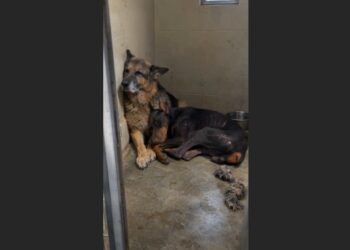
She simply walked toward him, sniffed him carefully, and lay down beside him.
For the first time since arriving, Oskar lowered his head against another dog’s body.
Then he fell asleep.
Jax Did Not “Know” What Had Happened to Him
People at the rescue were tempted to describe the moment in larger terms.
She understood his trauma.
She decided to protect him.
She became his mother.
Those explanations were emotionally satisfying.
They also went beyond what anyone could know.
Jax did not understand a forest fire in the way a person would.
She could not know Oskar’s medical history or what memories might be associated with particular sounds.
What staff could observe was much simpler.
The puppy was frightened.
The older dog remained calm around him.
When Jax lay nearby, Oskar often settled more easily.
That was enough reason to pay attention.
The First Night Changed Their Routine
Oskar had spent much of his early time at the rescue sleeping lightly.
He startled easily.
Even normal shelter noise could wake him.
Jax seemed far less concerned by the ordinary rhythm of doors, footsteps, food bowls, and distant barking.
That difference appeared to matter.
When the older Rottweiler rested, Oskar sometimes rested too.
When she remained relaxed through a sound, he recovered more quickly afterward.
No one claimed Jax was treating trauma.
She wasn’t.
But animals can respond to the presence and behavior of other familiar animals.
A calm companion can sometimes provide predictability in an environment that otherwise feels overwhelming.
For Oskar, Jax became part of that predictability.
His Physical Recovery Was Still Slow
Affection could not repair smoke irritation.
Companionship could not replace veterinary care.
Oskar continued to be monitored.
His lungs needed time to recover.
Exercise had to match what his body could tolerate.
His appetite and hydration mattered.
So did rest.
The staff watched his breathing closely and avoided turning every small improvement into a miracle.
Some days were better than others.
The encouraging part was that his interest in the world gradually increased.
He ate more reliably.
Explored farther.
Spent less time shut down.
And more often than not, Jax was somewhere nearby.
Loud Sounds Were Still Difficult
One afternoon, a heavy door slammed in another part of the rescue.
Oskar startled immediately.
His body dropped.
Jax stood.
She moved between the puppy and the source of the noise before stopping.
People later described her as “shielding” him.
Perhaps that was how it looked.
But staff avoided assigning a heroic motive.
Jax may have been orienting toward the sound herself.
She may have responded to Oskar’s sudden movement.
She may simply have moved into a position that happened to place her between him and the doorway.
What mattered was what followed.
Oskar stayed close to her.
His body gradually relaxed.
Rain Created Another Challenge
The rescue building had sections with a metal roof.
When the first heavy autumn rain arrived, water struck it with enough force to fill the building with a constant drumming sound.
Oskar reacted quickly.
He moved toward Jax.
Then pushed himself beneath the older dog’s body as much as his growing frame allowed.
Jax adjusted her stance.
When she eventually lay down, Oskar pressed close.
No one pulled him out.
No one insisted he needed to “face his fear.”
He had found a place where he felt safer.
That was useful.
Fear is not a character flaw.
And recovery is not measured by how quickly an animal can be forced to tolerate something frightening.
Jax Had Never Raised Puppies
That made their relationship especially interesting to the staff.
There was no need to call it maternal instinct.
Adult dogs can form social relationships with younger dogs without having produced a litter.
Some tolerate puppies poorly.
Others are remarkably patient.
Jax seemed to fall into the second group.
She allowed Oskar to stay close.
She tolerated his increasing curiosity.
When he became too energetic, she sometimes moved away.
That mattered too.
A healthy relationship between dogs includes boundaries.
Jax did not need to accept everything simply because Oskar was young.
Three Weeks Later, Oskar Wanted to Play
The change happened gradually enough that nobody could identify a single moment when the frightened puppy became more playful.
Then one morning, the difference was impossible to miss.
A sharp, excited bark came from the yard.
One of the caretakers looked through the fencing.
Oskar was facing Jax.
His front legs were lowered.
His rear end remained up.
Tail moving.
A classic invitation to play.
He jumped backward.
Then forward again.
Jax watched him.
Oskar darted toward her neck, grabbed briefly at loose fur, then bounced away.
Jax Played at a Much Older Dog’s Pace
She was nine.
Her joints were not those of a puppy.
She did not race across the yard at full speed.
Instead, she turned slowly.
Moved after him for a few steps.
Lowered her head.
Allowed Oskar to circle.
Then shifted away again.
The puppy seemed delighted.
He bounced.
Paused.
Returned.
What the staff saw that morning was not proof that Oskar’s emotional recovery was complete.
It was something more concrete.
A puppy who had once responded to ordinary sounds by hiding was now initiating play.
He had enough physical comfort and environmental confidence to do something puppies are supposed to do.
That mattered.
Play Did Not Erase What Came Before
Oskar still startled.
Rain did not suddenly become meaningless.
His lungs still required monitoring.
Progress did not remove vulnerability.
But his world had become larger.
There were toys.
A yard.
People he recognized.
Food arriving on schedule.
And Jax.
That was a substantial improvement from a puppy whose life had recently been reduced to recovery and fear.
Then another problem began to emerge.
Oskar was getting close to being ready for adoption.
Young German Shepherds Rarely Waited Long
The rescue knew what would happen once Oskar’s profile became public.
He was young.
Handsome.
Increasingly playful.
Families looking for an energetic dog would notice him quickly.
Jax’s situation was different.
At nine, she was a senior Rottweiler.
Gray showed across her muzzle.
Her movement had slowed.
Her joints needed ongoing management.
Future adopters would have to think about veterinary expenses, mobility, shorter exercise, comfortable flooring, and the realities of adopting an older large-breed dog.
Puppies often attracted applications immediately.
Senior dogs could wait.
The Staff Began Discussing Whether the Dogs Should Stay Together
Emotionally, everyone wanted the answer to be yes.
Practically, the question required more thought.
Oskar clearly sought Jax’s company.
Jax appeared comfortable with him.
Separating dogs that have developed a strong attachment can sometimes create distress.
But rescue workers also have to avoid turning every friendship between two dogs into an absolute requirement that they remain together forever.
The team watched them carefully.
How did Oskar behave when Jax was temporarily elsewhere?
Could he settle independently?
Did Jax seek him when separated?
Was each dog capable of interacting confidently without the other?
Those questions mattered.
So did adoption reality.
Finding one appropriate home for a puppy was easy.
Finding one capable of taking a German Shepherd puppy and a senior Rottweiler was much harder.
No One Wanted Oskar’s Confidence to Depend Entirely on Jax
That would not be fair to either dog.
Jax was older.
Oskar needed to develop his own resilience and comfort with people, environments, and routines.
So the staff continued giving him individual experiences.
Short periods without Jax.
Gentle interaction with caregivers.
Exploration.
Age-appropriate training.
The goal was not to separate them emotionally.
It was to make sure Oskar could function as an individual too.
Jax deserved the same consideration.
She was not a treatment plan.
She was an aging dog with needs of her own.
Still, Their Attachment Was Hard to Ignore
When they were together, Oskar often rested against her.
He followed her through the yard.
During unfamiliar sounds, he still oriented toward her.
Jax frequently chose to settle near him even when other resting places were available.
The staff began hoping for something they knew was unlikely.
A family willing to consider both dogs.
Not because a fairy-tale ending demanded it.
Because, after observing them, the rescue believed keeping them together could be a good welfare outcome if the right household appeared.
Then the Miller family visited.
The Millers Initially Came for a Young Dog
There were four of them.
Two parents.
A daughter around twelve.
Her younger brother.
They had a large yard and were looking for an active dog who could become part of family life.
Oskar caught their attention immediately.
By then, he was far removed from the puppy who had first arrived at the center.
He approached.
Tail moving.
Interested in the children.
The younger boy laughed as Oskar moved between family members collecting attention.
From a distance, Jax watched.
The Daughter Noticed Jax
She was quieter than her brother.
More observant.
While everyone else focused on Oskar, she looked toward the older Rottweiler.
Jax was standing behind the barrier.
Not demanding attention.
Not barking.
Simply watching the activity.
“Who’s that?”
The caretaker followed her gaze.
“That’s Jax.”
The girl looked between the two dogs.
“Do they know each other?”
That question opened the conversation everyone at the rescue had been waiting for.
The Caretaker Told Them What the Rescue Actually Knew
Oskar had arrived after surviving a forest fire.
He had needed medical care for smoke-related respiratory problems.
He had been unusually fearful in the shelter environment.
Jax had begun spending time with him.
The puppy settled more easily around her.
Their relationship developed.
Oskar’s behavior gradually changed as his health improved and his world became more predictable.
No claim was made that Jax had medically saved him.
No one said she had cured trauma.
The family did not need embellishment.
The observable story was moving enough.
They Also Heard About Jax’s Needs
Nine years old.
Senior large-breed dog.
Joint discomfort.
Slower movement.
Future medical care likely.
Two dogs meant more food.
More veterinary expenses.
More space in the vehicle.
More planning.
Oskar would need training, exercise, structure, and the ordinary work involved in raising a young German Shepherd.
Jax would need something almost opposite.
Comfort.
Controlled activity.
Rest.
Support as she aged.
Adopting both dogs was not simply doubling the joy.
It was doubling responsibility in different directions.
The Girl Asked the Question Everyone Remembered
She moved closer to Jax’s enclosure and crouched several feet away.
She did not reach through.
“Do they need to be together to be happy?”
The caretaker considered the question.
A simple “yes” would have made the story cleaner.
The more honest answer required nuance.
“We think they’re very attached,” she said. “They do well together. If the right family could take both, we’d be very happy to keep them together.”
The girl looked toward Oskar.
Then back at Jax.
Her parents exchanged a glance.
The Decision Was Not Made in Five Seconds
The family asked questions.
Many of them.
How much medication did Jax need?
What did her joint care involve?
Could she manage stairs?
How much exercise was appropriate?
How did Oskar behave without her?
How large was he expected to become?
Had both dogs been assessed around children?
What about travel?
Food?
Training?
Future veterinary costs?
Those questions reassured the staff.
Impulse adoption often begins with emotion and ends when daily reality arrives.
The Millers were thinking about daily reality before taking anyone home.
The Children Wanted Both Dogs Immediately
Children can afford to be certain.
Parents have to think about budgets.
Schedules.
Vehicles.
Emergency care.
Boarding.
Training.
What happens when a puppy becomes a seventy-pound adolescent.
What happens when a senior dog’s mobility declines.
The Millers went home to discuss it.
That evening, the rescue did not celebrate.
Nothing had been signed.
The staff had learned not to build happy endings before paperwork and planning were complete.
The next day, the family called.
They wanted to continue the process for both.
Monday Became Adoption Day
The paperwork included everything the family needed to understand.
Oskar’s health history.
Follow-up recommendations.
Training needs.
Jax’s age.
Her joint care.
The possibility of increasing medical needs as she grew older.
The family signed.
No one pretended love would make Jax young.
No one promised Oskar would never become frightened again.
They were taking home two real dogs.
One beginning life.
One moving into its later years.
Both deserved a household prepared for those realities.
Getting Them Into the Vehicle Took Time
The Millers had prepared the back with comfortable bedding.
Oskar approached first.
Young dogs often treat new things as invitations to investigate.
Jax was slower.
She reached the vehicle and stopped.
At her age, climbing was physically different from what it was for Oskar.
The family did not pull her up by the collar.
They helped.
That would become part of her life.
Assistance was not failure.
A senior dog should not have to prove independence every time her joints make something difficult.
Before Leaving, Jax Looked Back
The caretaker had spent enough time with dogs not to turn that look into a speech.
Jax did not understand adoption paperwork.
She did not know this was a permanent departure.
She did not know the humans around her were emotional.
She simply paused.
The caretaker crouched beside her and rubbed the side of her neck.
“Take care of yourself, old girl.”
Jax licked her wrist.
Then turned toward the vehicle.
Oskar was already inside.
Jax climbed in with help.
The door closed.
The First Weeks at Home Required Adjustment
A large yard was useful.
It did not replace supervision or routine.
Oskar needed boundaries.
Jax needed places where she could rest without a puppy climbing on her.
The family created separate beds.
Separate feeding spaces.
A quiet area for Jax.
Training sessions for Oskar.
The children learned that the dogs did not have to be together every minute.
That was healthy.
Attachment should not mean constant dependence.
Oskar Grew Quickly
The puppy body began disappearing.
His legs lengthened.
His chest broadened.
Energy increased.
The Miller family worked on leash manners, recall, household routines, and settling.
Oskar still played with Jax.
But as he became bigger and stronger, the family interrupted play when it became too rough.
Jax was allowed to leave.
Oskar learned that her decision to stop mattered.
The relationship remained close because the older dog was not forced to tolerate him endlessly.
Jax Preferred Softer Things
The rescue had warned them.
Hard flooring could be difficult after rest.
So rugs appeared throughout the house.
A thick bed was placed near the fireplace.
Another sat close to the large window overlooking the yard.
Jax used both.
She continued receiving appropriate care for her joints.
Some mornings she moved stiffly.
After warming up, she became more comfortable.
Her walks were shorter than Oskar’s.
That was fine.
The family stopped expecting both dogs to need identical lives simply because they lived in the same house.
Oskar Continued Seeking Her Out
After play, he often rested nearby.
Sometimes touching.
Sometimes not.
During heavy rain, he still occasionally moved closer to Jax.
The behavior became less urgent with time.
The house itself had become familiar.
Storms happened.
Nothing terrible followed.
Doors closed.
People returned.
Food arrived.
Night ended.
Morning came.
Security was no longer located in only one dog.
It existed in the entire routine around him.
That was important.
Jax Was Allowed to Be More Than Oskar’s Protector
This may have mattered most.
At the shelter, people had begun defining her by what she did for the puppy.
At home, the Millers discovered the rest of her.
She liked the fireplace.
She liked slow walks.
She preferred one rug to every expensive dog bed they initially bought.
She enjoyed having her neck rubbed.
She could be stubborn about coming inside when the weather was cool enough to suit her.
She snored.
Loudly.
She had preferences unrelated to Oskar.
She deserved those too.
Oskar Was Allowed to Become More Than the Fire Puppy
The family did not introduce him forever as the puppy who almost died.
His history remained true.
It simply stopped being the main event every day.
He grew.
Learned.
Got into things.
Dragged mud inside.
Went through an adolescent phase in which commands he knew perfectly well occasionally appeared to vanish from memory.
He became athletic.
Curious.
Sometimes ridiculous.
Exactly the kind of life the rescue had hoped he would be able to have.
Their Relationship Changed as Oskar Matured
At three months, he had hidden against Jax.
Later, he invited her to play.
As an adult, he no longer needed to crawl beneath her during every difficult sound.
He still chose her company.
That distinction made the bond healthier, not weaker.
Jax had helped provide stability during an important period.
Oskar had also developed his own confidence.
The older dog could rest without being responsible for managing a frightened puppy every hour.
Photographs Kept Arriving at the Rescue
The Miller family sent updates.
Oskar running across the yard.
Jax asleep near the fire.
Both dogs in the back of the family vehicle.
The children sitting nearby.
Nothing about the pictures was especially dramatic.
That made them valuable.
Rescue workers spend much of their time dealing with crisis.
An ordinary photograph months later can mean the crisis did not remain the animal’s entire life.
One Winter Photograph Became a Favorite
Snow had begun falling outside the large glass door.
Jax was lying near the window.
Oskar rested beside her.
He was much larger now.
Almost unrecognizable compared with the frightened three-month-old puppy who had first arrived.
His head was resting against Jax’s side.
Jax’s eyes were open.
Oskar’s were closed.
People at the rescue immediately returned to the story they loved most.
The old Rottweiler still protecting him.
Perhaps.
Or perhaps two dogs were simply resting together in a warm house while snow fell outside.
That explanation was beautiful enough.
Jax Had Not Saved Oskar Alone
This was important to remember.
Veterinary care treated his physical injuries.
Shelter staff managed his recovery.
Predictable routines reduced stress.
Training and gradual exposure helped him adjust.
The Miller family continued the work.
Oskar himself matured.
Jax contributed companionship.
Calmness.
Familiarity.
Social contact.
Those things mattered enormously without needing to replace everything else.
Healing is often a network of support rather than one heroic act.
Oskar Had Not Given Jax a Purpose Either
That was another tempting version.
The lonely senior dog finally had someone to care for.
But Jax’s life had value before Oskar arrived.
Her worth did not depend on becoming useful to a puppy.
Senior dogs are not meaningful only when they mentor younger animals or inspire humans.
Jax deserved comfort because she was Jax.
What developed with Oskar was a relationship.
Not a job assignment.
Their Age Difference Was Always Going to Matter
Oskar’s strongest years were ahead.
Jax’s were behind her.
The Millers understood from the beginning that this created an eventual difficulty.
The younger dog might one day live without her.
That possibility was not a reason to separate them early.
It was a reason to continue helping Oskar develop independence while giving Jax the best senior life possible.
Good relationships are not made less worthwhile because they cannot last forever.
The Fireplace Became Jax’s Favorite Retirement Post
Most evenings she settled there.
Oskar often chose a nearby spot.
Sometimes he wanted to play.
Jax ignored him.
Sometimes she raised her head and participated briefly.
Then stopped.
The family respected the difference.
Youth had energy.
Age had limits.
Neither needed to apologize.
The Children Learned Something Useful From Both Dogs
Not that love conquers trauma.
Not that every frightened animal needs another dog.
Not that senior pets exist to sacrifice themselves for younger ones.
They learned something quieter.
Care can look different depending on who needs it.
For Oskar, care often meant structure, activity, training, and opportunities to explore.
For Jax, it increasingly meant softer surfaces, shorter walks, help getting into the vehicle, and permission to rest.
Both were care.
The Rescue Staff Stopped Waiting for Updates With Anxiety
At first, every message made them wonder whether something had gone wrong.
Two large dogs.
One young and still developing.
One old and medically more complicated.
There were plenty of ways the placement could have been difficult.
Instead, the updates became reassuringly ordinary.
Oskar had dug something up.
Jax had stolen his bed despite having three of her own.
Oskar wanted to play.
Jax wanted to sleep.
Life had become domestic.
The Story People Preferred Was Simpler
A puppy survived a fire.
An old Rottweiler became his mother.
She saved his spirit.
A family adopted them both.
They lived happily ever after.
Real life was more interesting.
Oskar required veterinary care and time.
Jax provided companionship but also needed boundaries.
The rescue had to consider whether keeping them together was truly beneficial.
The Millers had to think about money, age, training, mobility, and the responsibility of two dogs with very different needs.
Then the relationship continued changing as both animals changed.
That version was less perfect.
It was also more believable.
What Jax Gave Oskar Was Presence
She was there when he was frightened.
She stayed nearby when he slept.
She tolerated his early attempts to play.
She provided another dog’s familiar body language in an environment full of unfamiliar human activity.
Perhaps that was the simplest way to describe her role.
Presence.
Not magic.
Not motherhood in a human sense.
Not therapy.
A steady older dog beside a young one during a difficult period.
Sometimes that is powerful enough.
What the Millers Gave Them Was Room to Remain Themselves
They did not expect Oskar to stay fragile forever.
They did not expect Jax to become young again.
They allowed the dogs’ relationship to change.
That may have been the reason the adoption worked.
The puppy grew.
The senior slowed.
The family adjusted around both.
No one asked Jax to keep protecting Oskar indefinitely.
No one asked Oskar to remain dependent so their story would stay touching.
They simply kept living.
By Winter, the Photograph Told a Different Story
Oskar was no longer small enough to disappear beneath Jax.
He had become a strong young German Shepherd.
Jax looked older.
Gray had spread farther across her muzzle.
The difference between them was more obvious than ever.
Yet there they were.
Side by side near the window.
Snow falling beyond the glass.
Oskar’s head against Jax’s side.
Jax resting on a soft rug.
There was no need to decide whether she was still guarding him.
There was no danger in the room.
No fire.
No crashing door.
No rain hammering a shelter roof.
Only two dogs who had learned one another’s presence well enough that resting together had become ordinary.
That Was the Part Worth Keeping
Jax did not erase Oskar’s frightening beginning.
Oskar did not make Jax young.
The Miller family did not perform a miracle.
They gave both dogs a home capable of meeting very different needs.
The rest happened gradually.
A frightened puppy learned that not every loud sound was followed by danger.
A senior Rottweiler gained warm rugs, medical care, and a family willing to help her age comfortably.
Their attachment remained.
But it did not have to carry the weight of the whole story.
Years from now, perhaps the family will still have that winter photograph.
A young German Shepherd asleep beside an old Rottweiler while snow falls outside.
People may look at it and see a mother and her adopted puppy.
A protector and the dog she saved.
A bond formed from tragedy.
Maybe all of those descriptions capture a piece of what humans feel when they see the image.
But the dogs themselves needed something simpler.
Oskar needed safety, care, and time.
Jax needed the same.
For a while, they also had each other.
And that was enough.
Editor’s Note: The characters in this story are fictional. Through these stories, we hope to share the intelligence, loyalty, compassion, and loving nature of dogs with people everywhere.