Sarah was trying to move forward after a breakup when a familiar face appeared on a Colorado shelter website.
The dog was Banjo.
She had helped raise him, lived with him, and known the small details that turn an animal from somebody’s pet into part of a household.
Yet Banjo was now listed as available for adoption.
Sarah had not received a phone call telling her he was there.
She had not been asked whether she could take him.
Instead, she discovered his surrender almost by accident.
A few days later, she was driving roughly three and a half hours toward Animal Friends Alliance.
By the time she returned home, the trip would total about eight hours.
This time, however, Banjo would be riding back with her.
Banjo Had Been Part of Sarah’s Life Before the Breakup
According to Sarah’s later account, she had helped raise Banjo from the time he was young.
After she and her former partner separated, Banjo remained with him. At the time, that arrangement apparently seemed workable, even though Sarah remained attached to the dog. Parade Pets, which reported on the reunion and Sarah’s follow-up explanation, noted that Banjo had technically belonged to her former partner.
Then his circumstances became less stable.
Sarah said her ex eventually found himself living in a vehicle with Banjo and another dog.
During that period, he also told her that Banjo was having behavioral problems and that he was considering finding him another home or returning him to a shelter.
The exact nature of those behavior concerns was not publicly detailed in the reports.
Still, Sarah understood that Banjo’s living situation might change.
So she made an offer.
Sarah Told Him She Would Take Banjo First
Rather than wait for Banjo to be surrendered, Sarah offered to care for him for a few days.
More importantly, she made it clear that if her former partner could no longer keep him, she wanted the opportunity to take him.
From her perspective, rehoming did not need to mean sending Banjo somewhere unfamiliar.
He already knew her.
She already knew him.
According to Parade’s account of Sarah’s follow-up video, she specifically asked to be contacted if surrender became a real possibility.
Then something happened that made her uneasy.
A Location-Sharing App Gave Her the First Clue
Sarah was removing her former partner from the location-sharing feature on her phone when she noticed where he was.
An animal shelter.
Not just any shelter, according to her account.
It was the organization connected to Banjo’s earlier adoption.
Parade reported that Sarah saw the shelter location while removing her ex from the “Find My Friends” feature. That discovery made her suspect that the conversation about possibly giving Banjo up had already become something more concrete.
She still did not have confirmation.
So Sarah started checking.
Then Banjo’s Photograph Appeared
Over the following days, Sarah watched the shelter’s listings.
Eventually, there he was.
Banjo.
His photograph appeared among the dogs available through the shelter system.
According to Sarah’s telling, he had been surrendered under the name associated with his original adoption, which initially made the situation less obvious.
Once she recognized him, however, there was little uncertainty left.
The dog she had helped raise was back in the shelter system.
Her former partner had not told her.
Other reporting on the case likewise confirms that Sarah learned Banjo had been surrendered only after finding him through the shelter listing rather than through direct communication from her ex.
She Contacted Animal Friends Alliance
Sarah reached out to Animal Friends Alliance in Colorado and explained the situation.
The organization provides adoptions and other pet-support programs in northern Colorado and operates an adoption center in Fort Collins. Its current public information lists the Jason Telleen Adoption Center on North Taft Hill Road among its facilities.
Once staff understood that Sarah already knew Banjo and intended to make the drive, they arranged for him to remain available until she arrived.
Parade reported that the shelter placed a hold on Banjo so he would not be adopted while Sarah traveled to get him.
That solved one immediate problem.
The next challenge was getting there.
An Eight-Hour Round Trip Required Help
Sarah was not living down the street from the shelter.
The drive would take several hours each way.
She also had work.
Her manager supported her taking time away so she could make the trip.
Meanwhile, people close to her helped with the adoption itself. In Sarah’s account, her best friend Ellie and Ellie’s husband offered to cover the adoption fee.
Parade similarly reported that Sarah’s best friend paid the adoption fee so Banjo could return home with her.
That support turned a stressful discovery into a workable plan.
Then Sarah got in the car.
The Drive There Was About Getting Back to a Dog She Already Knew
The trip took approximately three and a half hours.
That left Sarah with plenty of time to think about what she would find.
Banjo had gone through several major changes.
The household he knew had ended.
His living situation had become unstable.
Then he had returned to a shelter.
Nobody could know exactly how he understood those events.
Dogs do not comprehend breakups, surrender paperwork, or disputes between former partners the way people do.
What Banjo could experience were the practical consequences.
Different routines.
Different sleeping places.
Different people.
Then a shelter environment.
Sarah knew only one thing with certainty.
She was going to see him again.
Banjo Entered the Room on a Leash
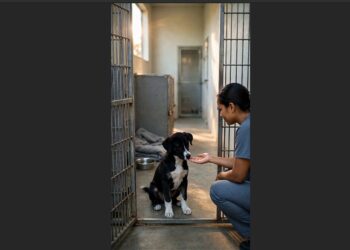
At the shelter, Sarah waited on a bench while an employee went to get him.
The reunion was recorded.
At first, Banjo walked beside the staff member in an ordinary way.
Then he noticed Sarah.
The change was immediate.
His tail began moving.
His body became more animated.
Within seconds, he was jumping toward her, licking her, and pressing close while Sarah wrapped her arms around him.
The video later spread widely online. Parade described Banjo’s reaction as rapid tail wagging, jumping, licking, and full-body excitement after spotting Sarah on the bench.
Another report described the same moment, noting that he twisted and wiggled with excitement while Sarah held him.
Staff Said They Had Not Seen That Side of Him
One line in the reunion video stood out to many viewers.
Shelter staff indicated that they had not seen Banjo behave that way during his stay.
That does not necessarily mean he had been miserable every moment.
Shelter environments can affect dogs differently. Some become loud and restless. Others become quieter or more reserved.
Banjo’s response to Sarah, however, was visibly different from the behavior staff had apparently observed before her arrival.
Multiple reports on the video noted that shelter employees remarked they had not previously seen that side of him.
For Sarah, the explanation did not need to be more complicated.
Banjo had recognized a familiar person.
And he was highly excited to see her.
Recognition Did Not Require a Human Story
It is tempting to watch a reunion like Banjo’s and narrate every movement.
He knew she had come to save him.
He understood she had not abandoned him.
He knew he was going home.
Those ideas may feel satisfying, but they go beyond what anyone can know from the video.
Dogs can remember familiar people through scent, voice, appearance, movement, and prior experience.
Banjo’s reaction showed strong recognition and excitement.
That observable behavior was enough.
He did not need to understand the paperwork behind the moment for the reunion to matter.
Sarah Still Had to Adopt Him Through the Shelter
Knowing Banjo did not automatically place him back in her care.
Sarah completed the required adoption process.
That was important.
Once an animal has been legally surrendered to an organization, shelters generally need to follow their own procedures before transferring custody to a new adopter.
Animal Friends Alliance describes itself as an animal-welfare organization providing adoptions and programs intended to keep cats and dogs with families. Its northern Colorado adoption program handles animals through established shelter processes rather than informal handoffs.
For Sarah, the result was straightforward.
She completed the adoption.
Banjo was leaving with her.
The Drive Home Was Nearly Four Hours
The return trip was longer.
Roughly four hours.
This time, however, Sarah was not traveling alone.
Banjo was with her.
There was no need to make the drive dramatic.
A long car trip with a recently adopted dog is still a long car trip.
Stops may be needed.
The dog may sleep.
Traffic still exists.
Yet the practical details could not change the central fact.
Hours earlier, Sarah had been driving toward a shelter hoping Banjo would still be there.
Now she was bringing him home.
The Reunion Did Not Erase Everything That Had Happened
Banjo still had experienced multiple changes in a relatively short period.
Sarah also had her own life to reorganize.
She had been trying to rebuild after a breakup.
Taking in a dog, especially one reportedly associated with behavioral concerns, meant additional responsibility.
Food.
Veterinary care.
Exercise.
Housing.
Training if needed.
Daily routines.
The adoption solved the immediate question of where Banjo would live.
It did not make every future issue disappear.
That distinction matters in rescue stories.
Love may motivate someone to drive eight hours.
Keeping a dog successfully takes place during all the ordinary days afterward.
Later Videos Showed Banjo Settling In
Sarah continued sharing Banjo online after the reunion.
Later clips showed him playing on her bed, running outside, and spending time with her.
Parade reported that one follow-up video showed Banjo chasing his tail, playing, running outdoors, and enjoying affection after returning home with Sarah.
Those images were far less dramatic than the shelter reunion.
That was part of their value.
The important question after any highly emotional adoption is what everyday life looks like once the cameras are gone.
For Banjo, the later footage showed something simple.
A dog doing ordinary dog things in a home.
His Story Also Shows How Complicated Pets Can Become After a Breakup
When couples separate, decisions about animals can become difficult quickly.
Who legally owns the pet may not be the same person who has done most of the daily caregiving.
Housing can change.
Finances can change.
Work schedules can change.
One person may initially be better positioned to keep the animal, only for circumstances to become different months later.
In Banjo’s case, Sarah had remained willing to take him.
The breakdown happened because she said she was not informed before the surrender.
That communication gap nearly meant Banjo would be adopted into an entirely different household.
The Shelter Was Not the Villain in the Story
That point is also important.
Animal Friends Alliance had received a surrendered dog and was doing what shelters do: caring for him while preparing for an appropriate outcome.
Once Sarah contacted the organization and explained her connection to Banjo, staff helped make the reunion possible.
The shelter did not create the circumstances that separated them.
Instead, it became the place where the situation could finally be corrected.
The organization’s public mission includes both adoptions and programs designed to help animals remain with loving families.
In Banjo’s case, staff also had the unusual experience of watching a dog they already knew react to someone he clearly remembered.
Sarah Had Help From More People Than the Video Shows
The viral clip focuses on two figures.
Sarah.
Banjo.
Yet the full story included others.
A manager willing to accommodate the unexpected trip.
Friends willing to help with the adoption cost.
Shelter employees who listened to Sarah’s explanation.
Staff who placed a hold on Banjo until she could arrive.
The friend who supported her through the upheaval.
Stories about one person “saving” an animal often simplify what actually happened.
Banjo’s return to Sarah worked because several people made small practical decisions that lined up at the right time.
Banjo Had Not Been Waiting for a Stranger
That is what gives the reunion its particular weight.
Many shelter adoptions begin with two lives meeting for the first time.
This one was different.
Sarah was not walking into a kennel hoping to connect with an unfamiliar dog.
Banjo already had a history with her.
He knew her voice.
Her scent.
Her movements.
The routines of living in the same household.
So when the shelter employee brought him into the room, there was no need for a slow introduction.
Banjo supplied the evidence of familiarity himself.
His entire body changed.
The Most Memorable Part Was Not the Eight-Hour Drive
The distance made the story dramatic enough to spread online.
Still, mileage was not really the point.
Sarah could have lived 20 minutes away and the central decision would have been the same.
She found a dog she had helped raise in a shelter.
Then she chose to take responsibility for him.
The long drive simply made the commitment more visible.
Three and a half hours there.
Approximately four hours back.
Between those two stretches of road was a shelter bench, a leash, and a dog who suddenly began wagging the moment he recognized someone familiar.
Moving Forward Now Included Banjo
Before finding his picture, Sarah had been trying to rebuild her own routine.
That is normal after a relationship ends.
People change homes.
Sort belongings.
Separate accounts.
Remove names from phones.
Turn off shared locations.
In Sarah’s case, one of those ordinary digital tasks led directly to Banjo.
She had been removing her former partner from a location-sharing feature.
Instead, she saw the shelter.
Then she found Banjo.
The act that was supposed to close one connection unexpectedly reopened another.
Banjo Did Not Need to Understand Any of That
For him, the change was more immediate.
A familiar person appeared in a shelter room.
He moved toward her.
She held him.
Then they left together.
Days later, he was playing on a bed and running outside.
Dogs live within routines people create around them.
Banjo could not decide where he was legally registered or who signed an adoption form.
This time, Sarah could.
And she did.
The Shelter Listing Had Called Him Available
To someone scrolling through the website, Banjo was another dog looking for a home.
Perhaps they would notice his photograph.
Read his profile.
Wonder whether he might fit their family.
Sarah saw something else.
She saw the dog she had already known.
The one she had helped raise.
The dog whose habits were not theoretical to her.
She had already shared a home with him.
That difference turned a shelter listing into a road trip.
There Was No Need to Portray the Reunion as Fate
The facts were strong enough.
Sarah noticed something unusual on her phone.
She kept checking.
Banjo’s photograph appeared.
She contacted the shelter.
People helped her arrange the trip.
She drove several hours.
Then Banjo saw her.
That sequence is more compelling than any claim that the universe had arranged it.
A few practical actions made the difference.
Checking a website.
Making a phone call.
Taking time off work.
Paying an adoption fee.
Driving.
Showing up.
Showing Up Was the Part Banjo Could Recognize
Whatever happened between the adults belonged to them.
Banjo could not understand the arguments or decisions that put him back in the shelter.
What he could recognize was Sarah.
The reunion video captured that clearly.
One moment, he was walking beside a shelter employee.
The next, his tail was moving and his body was surging toward someone familiar.
Sarah wrapped her arms around him.
Soon afterward, she signed the paperwork that made their next chapter possible.
Then They Drove Home Together
The return trip took hours.
Yet this time, the destination was settled.
Later, Banjo would play across Sarah’s bed.
He would run outside.
He would begin adjusting to a new routine with someone he already knew.
For Sarah, moving forward after the breakup no longer meant leaving every part of the old life behind.
One part came with her.
His name was Banjo.
He had appeared online as a dog waiting for someone to choose him.
Sarah did not see an unfamiliar shelter dog.
She saw the dog she had helped raise.
So she got in the car.
And she came back for him.