Winnie Was Supposed to Be Near the End of His Life
We had not gone to the rescue intending to adopt a dog.
My husband and I were only dropping off blankets, bags of food, and a few supplies we had collected.
Then we saw Winnie.
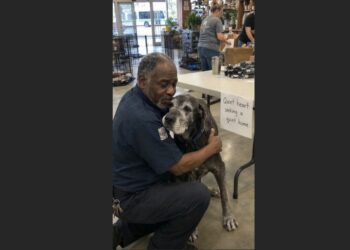
He was an eleven-year-old Bluetick Coonhound with a silver muzzle, a torn ear, and a body marked by small scars.
A rescue volunteer had found him chained near an abandoned hunting cabin in Tennessee.
By the time help reached him, Winnie was dangerously thin. His paws were infected, and one rear leg carried the effects of an old injury that had never healed properly.
The volunteer was honest with us.
“He probably won’t ever run again,” she said. “And he may only have a few months left.”
Winnie did not look toward us when we first stopped at his kennel.
He was curled in the farthest corner with his nose between his paws.
The younger dogs around him barked and jumped.
Winnie stayed still.
He Only Lifted His Head When I Knelt Down
I crouched beside the gate.
For several seconds, nothing happened.
Then Winnie slowly lifted his head.
His eyes met mine.
There was no excited tail.
No paw against the bars.
No attempt to demand attention.
He simply moved closer until his nose touched the metal.
Then he closed his eyes.
That was the moment everything changed.
I looked at my husband.
“We can’t leave him here.”
He glanced at Winnie.
Then at me.
Neither of us had planned for a senior dog with medical needs.
We understood what taking him home might involve.
Medication.
Veterinary costs.
Mobility problems.
Possibly a very short time together.
Still, we kept standing there.
Eventually, my husband nodded.
So Winnie came home with us.
His First Week Was Almost Completely Quiet
Winnie did not behave like a dog excited about a new beginning.
He slept.
A lot.
We placed a thick blanket near the fireplace because warmth seemed to help his stiff body.
He ignored toys.
He did not try to climb the stairs.
Getting up for meals sometimes looked like serious work.
His injured rear leg remained awkward, and we never encouraged him to move more than he comfortably could.
The veterinarian helped us develop a plan around pain control, nutrition, skin care, and gentle activity.
Nobody expected his body to become young again.
Our goal was simpler.
Comfort.
Rest.
Routine.
For the first several days, Winnie seemed almost detached from everything around him.
Then I began noticing how much he listened.
His Ears Moved Before the Rest of Him Did
Whenever a car passed outside, Winnie’s ears lifted.
When one of us entered the room, his eyes followed.
If the heater clicked on, he noticed.
If my husband opened the back door, Winnie turned his head before the sound fully reached me.
A coonhound is built around scent and hearing.
Even an elderly one with a tired body can remain intensely aware of changes in the environment.
Winnie rarely barked.
He did not patrol the house.
He did not act like a guard dog.
But he seemed to monitor what happened around him.
That became part of his routine.
Sleep.
Listen.
Watch.
Sleep again.
Little by little, he also began responding to us.
The First Tail Thump Felt Like Progress
One morning, I found Winnie waiting near the kitchen.
He did not stand directly beside the food bowl.
He simply positioned himself where he could see me prepare breakfast.
A few days later, he followed me onto the porch.
His pace was slow.
The injured leg shortened his stride.
Still, he came.
Then my husband returned from work one evening.
Winnie lifted his head.
His tail hit the floor once.
Then again.
It was not dramatic.
That was what made it important.
He was beginning to include us in his routine.
A dog with an unknown history does not need to become exuberant to show change.
Sometimes trust looks like choosing to remain in the room.
Sometimes it is resting with your back exposed.
Sometimes it is one quiet tail movement when a familiar person comes home.
Winnie gave us those small moments one at a time.
Three Weeks After the Adoption, We Went Out to Dinner
Rain had been falling since the afternoon.
Not a gentle rain.
The kind that comes down hard enough to blur the trees and turn roadside ditches into streams.
We considered staying home.
Eventually, the weather seemed to ease.
The roads looked passable when we left.
Winnie came with us.
He had begun enjoying car rides, mostly because the back seat let him stretch out without putting too much pressure on his leg.
We drove into town, ate dinner, and started home after ten.
Rain was still falling.
The road toward our house climbed through the mountains in long dark bends.
There were few streetlights.
Most of the route depended on headlights.
Winnie was asleep across the back seat.
Then he woke up.
At First, We Thought His Leg Was Hurting
He lifted his head.
Then he whined.
It was unusual enough that I immediately turned around.
“Winnie?”
He shifted.
His ears were up.
My husband slowed slightly.
We assumed the position in the car had aggravated his old injury.
I reached back toward him.
Winnie did not settle.
Instead, he sat up.
The whining became louder as we approached the next curve.
Then he tried to stand.
For a dog who normally moved carefully, the change was striking.
He pushed his head between the front seats.
My husband glanced at him.
“Easy, Winnie.”
The hound barked.
One sharp sound.
Then another.
Winnie Had Almost Never Barked in the House
That made my husband pay attention.
Still, neither of us knew what was wrong.
Winnie pawed toward the front.
Then he shifted his weight against the center console.
My husband corrected the steering.
“Winnie, settle down.”
He did not.
The old hound became more agitated.
Whining.
Barking.
Moving forward despite the discomfort it clearly caused him.
We were approaching a bend in the road.
My husband finally said, “All right.”
Then he hit the brakes.
The car stopped several yards before the curve.
For a second, Winnie remained standing between the seats.
Then his legs began shaking.
He dropped back.
My husband looked at me.
“I’m checking the road.”
He Got Out With a Flashlight
Rain struck the windshield.
My husband pulled on his jacket and stepped into the darkness.
I stayed inside with Winnie.
The headlights illuminated the beginning of the curve, but little beyond it.
My husband walked forward.
Then he stopped.
Completely.
I watched him raise the flashlight.
He took another step.
Then backed up.
Even from inside the car, I could tell something was wrong.
When he returned, his face had changed.
He opened the driver’s door.
For a moment, he said nothing.
Then he looked at me.
“The road is gone.”
I thought I had misunderstood him.
“What?”
“A section washed out.”
He pointed ahead.
“Past the curve.”
The Storm Had Taken Part of the Pavement
The rain had overwhelmed the drainage around the bend.
Water had eaten beneath the road until a section of pavement collapsed into the swollen creek below.
From our position, the damage was almost impossible to see.
The curve blocked the view.
Darkness hid the missing section.
Rain reflected the headlights back toward us.
There were no barricades yet.
No warning lights.
No emergency crew.
The collapse had apparently happened recently enough that nobody had closed the road.
If we had continued at the same speed, my husband believed we would have reached the washout before understanding what we were looking at.
We sat in silence.
Then I turned toward Winnie.
He was lying down again.
Breathing heavily.
His effort had exhausted him.
I pulled him gently toward me.
He rested his head against my chest.
We Couldn’t Know What Winnie Had Detected
Later, people would ask the obvious question.
How did he know?
I still cannot answer that.
Maybe he heard rushing water differently as we approached.
Maybe he detected vibrations, changes in road noise, or scent from mud and disturbed earth.
Dogs can perceive sounds and smells we miss completely.
A hound, even an old one, is particularly sensitive to scent.
But we cannot say Winnie somehow understood that the road had collapsed or consciously calculated that our lives were in danger.
What we know is observable.
He woke.
His behavior changed dramatically as we approached the bend.
He became increasingly agitated.
We stopped because of him.
And when my husband checked the road, a dangerous washout was directly ahead.
That is enough.
We Turned Around and Took the Long Way Home
There was no safe route forward.
My husband carefully reversed until we reached a place wide enough to turn around.
The alternate route home took much longer.
Winnie slept through most of it.
I kept one hand on him.
Every now and then, I could feel his breathing under my fingers.
By the time we reached the house, the rain had weakened.
My husband carried Winnie inside because his leg was too tired after the episode in the car.
We placed him near the fireplace.
He circled once.
Then he lowered himself onto the blanket.
Within minutes, he was asleep.
My husband and I remained awake much longer.
Neither of us could stop thinking about the dark bend.
The County Closed the Road the Next Morning
A road crew arrived early.
Barriers went up.
Workers blocked both directions.
Later that morning, we drove as far as we safely could and spoke with one of the county employees.
We told him where our car had stopped.
He looked toward the curve.
Then toward Winnie, who was sitting in the back seat.
“You wouldn’t have seen the drop until you were right on it,” he said.
That sentence stayed with me.
I looked through the window at the dog everyone had considered a difficult adoption.
Eleven years old.
Limping.
Scarred.
Possibly only months left.
The dog nobody had chosen first.
Three weeks after coming home, something he noticed in the darkness changed what happened to us on that road.
The Rescue Volunteers Could Hardly Believe It
When we called to tell them, the first reaction was silence.
Then questions.
Was Winnie all right?
Had his leg been injured during the excitement?
Were we sure he had reacted before the curve?
We told them everything exactly as it happened.
Nobody wanted to turn him into a supernatural warning system.
The sanctuary knew dogs too well for that.
They also knew how unusual his behavior had been.
Winnie rarely vocalized.
He rarely forced himself upright unless he needed to.
That night, he did both.
One volunteer laughed softly.
“The old man finally found something worth barking about.”
That sounded more like Winnie.
No legend.
No miracle.
Just an old hound who noticed something his people had not.
His Life Didn’t Become Dramatic After That
The following week looked much like the week before.
Winnie slept by the fire.
He limped toward the kitchen in the morning.
He followed me to the porch when the weather was mild.
He waited for my husband after work.
Nothing about the road incident transformed him into a younger dog.
His rear leg remained damaged.
His stamina remained limited.
Some mornings were better than others.
We continued veterinary care.
We adjusted his pain medication when needed.
We added rugs in places where the floor was slippery.
We made sure he did not have to use the stairs.
That was his real life.
Not heroics.
Comfort.
Routine.
And increasingly, belonging.
Six Months Later, Winnie Was Still With Us
The volunteer had warned that we might have only a few months.
We understood why.
Winnie was old and had arrived in poor condition.
But predictions about individual senior dogs are never exact.
Six months passed.
He was still here.
His body remained fragile.
His coat improved with better nutrition.
His paws healed.
The old rear-leg injury would never disappear, but with pain management and appropriate activity, he moved more comfortably.
He did not run.
Nobody asked him to.
A slow trip around the yard was enough.
Some days, even that seemed unnecessary to him.
Winnie preferred the fireplace.
Especially after dinner.
He Still Waited for My Husband
Every evening, around the time my husband usually returned, Winnie moved toward the window.
Not quickly.
Nothing Winnie did was quick anymore.
He stood where he could see the driveway.
Sometimes he waited several minutes.
Then headlights appeared.
The garage door opened.
My husband came inside.
Winnie’s tail began tapping against the floor.
That routine became more important to us than the story about the mountain road.
It was ordinary.
Predictable.
Exactly what Winnie seemed to need.
A person left.
Then came back.
Dinner arrived.
Blankets stayed where he liked them.
Nobody chained him outside.
Nobody disappeared from an abandoned cabin.
Whatever he had known before, his current life became easier to understand.
Rainy Nights Still Changed Him
We noticed that after the incident.
When rain became heavy, Winnie followed us more closely.
If thunder rolled, he sometimes moved from the fireplace into whichever room we occupied.
He listened.
His ears worked constantly.
We did not call it guarding.
There was no way to know whether he associated rain with that night on the mountain road.
Many dogs become more alert during storms because the sound environment changes dramatically.
Still, the pattern became part of our household.
Rain on the roof.
Winnie getting up.
Slow footsteps through the hallway.
Then the old hound settling somewhere near us.
Sometimes I looked down and remembered the back seat.
The bark.
The brake lights reflecting off wet pavement.
People Called Him a Hero
I understood why.
From the human side of the story, it fit.
If Winnie had not become agitated, my husband might not have stopped.
If he had not stopped, we might have reached the missing pavement before we could react.
That possibility still unsettles me.
But Winnie did not need a title.
He did not know people were sharing the story.
He did not understand that the county worker had looked at him differently afterward.
He had no concept of being overlooked at a shelter or proving anyone wrong.
He was simply a dog.
An old one.
A tired one.
One who had learned our routines and become part of our home.
That was enough.
We Had Thought We Were Giving Him a Peaceful Ending
When we signed the adoption papers, that was our assumption.
Winnie probably did not have much time.
We would make him comfortable.
He would have warmth.
Good food.
Veterinary care.
A place beside the fire.
Someone nearby when his body finally became too tired.
We never expected anything from him in return.
That is an important part of adopting a senior dog.
They do not owe anyone a dramatic expression of gratitude.
They do not need to save a life, protect a house, or prove that choosing them was worthwhile.
Winnie would have been worth bringing home if he had done nothing except sleep for six months.
The fact that one rainy night became extraordinary was simply part of his story.
Not the reason his life mattered.
His Scars Became Less Important Once He Was Home
When I first met Winnie, I noticed every one.
The torn ear.
Thin body.
Damaged leg.
Marks under his coat.
At home, those details slowly faded into the background.
I noticed other things instead.
The way he sighed when he finally settled near the fireplace.
How carefully he accepted food from my hand.
The exact sound his tail made against the floor.
The expression he gave my husband if dinner was late.
The way one ear lifted when a truck approached.
Those were the things that came to define him.
Not the abandoned cabin.
Not the chain.
Not even the road.
Home gave him enough ordinary days to become more than the worst things that had happened before we met him.
The Dark Mountain Road Is Still There
The damaged section was eventually repaired.
The road reopened.
We still drive it.
The first time we approached that bend after repairs, I noticed my husband slow down more than necessary.
Neither of us said anything.
Winnie was not with us that day.
He was home asleep.
Still, I could picture exactly where the car had stopped.
I could remember my husband’s flashlight moving through the rain.
I could remember Winnie trembling from the effort of standing between the seats.
The road looked completely ordinary again.
That almost made it stranger.
Places do not always keep visible evidence of the moments that happened there.
People do.
Winnie Was Never “Too Old” to Matter
That is the part I think about most.
At the rescue, his age made people hesitate.
Understandably.
A senior dog with medical problems can require significant time, money, and care.
Not every household is equipped for that.
Winnie also could not offer the promise of a decade together.
He could offer only whatever time remained.
For us, that became six months and counting.
The value of those months has never depended on their number.
They were built from mornings in the kitchen.
Evenings at the window.
Slow steps onto the porch.
Rainy nights.
One frightening drive.
And countless hours asleep beside a fire.
Winnie did not need a long future to become part of our family.
He only needed someone willing to give him a present.
These Days, He Mostly Sleeps
The silver around his face has spread.
His hearing is not quite as sharp as it was when we adopted him.
He needs more time to stand.
Sometimes my husband helps support his rear end for the first few steps.
There are days when Winnie chooses the fireplace over every other activity.
We let him.
A good life for an elderly dog does not have to be busy.
Comfort matters more.
When evening comes, though, Winnie often wakes.
He looks toward the window.
My husband’s truck appears.
Tail against floor.
Once.
Twice.
Then the door opens.
On rainy nights, Winnie may follow us through the house afterward.
Listening.
Watching.
Eventually settling nearby.
We once thought we were bringing home an unwanted old dog so he would not spend his final months alone.
Three weeks later, his behavior stopped us before a washed-out mountain road.
Six months later, the part of the story I treasure most is quieter.
Winnie is still here.
Still limping.
Still gray.
Still choosing the warmest spot in the house.
And every night, when my husband comes home, the old hound who once lay unnoticed in the back of a rescue kennel lifts his head and lets his tail hit the floor.
He does not need to save us again.
He already has a home.
That is enough.
Editor’s Note: The characters in this story are fictional. Through these stories, we hope to share the intelligence, loyalty, compassion, and loving nature of dogs with people everywhere.