Charlie Came Back to the Shelter Twice
By the time Charlie returned to the shelter for the second time, the staff already knew what the paperwork would say.
He followed people everywhere.
He cried when left alone.
Closed doors made him anxious.
A crate did not calm him. It made him more distressed.
Charlie had not bitten anyone.
He had not destroyed a home.
He had not shown aggression toward the families who tried to adopt him.
His problem was simpler and, in some homes, harder to manage.
Charlie wanted to be close to someone almost all the time.
His first adoption lasted only a few days.
His second lasted about a week.
Each family brought him back for nearly the same reason.
Charlie could not relax when the people around him disappeared.
His First Family Felt Overwhelmed
At first, Charlie seemed affectionate.
He followed family members from the living room to the kitchen.
If someone sat down, he settled nearby.
When they stood, he stood too.
That behavior seemed sweet during the first hours.
Then nighttime came.
Charlie had difficulty settling by himself.
When someone left the room, he became restless.
If a bathroom door closed, he waited outside.
When the family tried putting him in a crate, Charlie became increasingly distressed instead of relaxing.
They tried giving him time.
Still, they were not prepared for a dog who seemed to need constant proximity.
Within days, they decided the match was not sustainable.
Charlie returned to the shelter.
No one blamed the family.
A household can care deeply about a dog and still recognize that its needs do not fit their daily life.
The Second Adoption Ended Much the Same Way
Shelter workers tried to explain Charlie more carefully the next time.
He liked physical contact.
He might follow people constantly.
He could struggle when left alone.
The second adopters believed they could manage it.
For the first few days, things looked promising.
Then the same pattern returned.
Charlie leaned against their legs.
He moved from room to room behind them.
If one person sat on the couch, Charlie pressed himself against them.
When they left, even briefly, he became visibly anxious.
He was not trying to control anyone.
He simply had difficulty settling without a familiar person nearby.
After a week, the family brought him back.
Again, there was no dramatic incident.
No damaged furniture.
No growling.
No bite.
Just a dog whose need for closeness exceeded what the household could realistically provide.
Charlie’s Behavior Wasn’t a Moral Failure
People sometimes describe dogs like Charlie as spoiled, manipulative, or badly behaved.
Those labels are not particularly useful.
Separation-related distress can have many causes, and shelter staff could not know exactly why Charlie struggled.
Maybe previous instability contributed.
Perhaps he had simply developed strong dependence on human presence.
Whatever the history, his behavior in the present was clear.
Distance worried him.
Closed doors worried him.
Being left alone was difficult.
The staff worked on predictable routines and calm departures.
They tried not to make every reunion excessively emotional.
They also knew one important thing.
Charlie needed the right home.
Training could help.
Management could help.
But the household itself mattered too.
A dog who wants near-constant companionship may be a poor fit for someone away from home ten hours a day.
In another home, the same dog could be much easier to live with.
Back in His Kennel, Charlie Became Quiet
After the second return, Charlie sat near the front of his kennel.
He no longer jumped excitedly whenever every visitor stopped.
Sometimes he simply watched.
It would be easy to say he believed he had failed two families.
Nobody could know that.
Dogs do not understand adoption contracts or why one household returns them to a shelter.
What Charlie could experience was repeated change.
One environment.
Then another.
People becoming familiar.
Then disappearing.
A return to the sounds and smells of the shelter.
That kind of instability can be difficult for some dogs.
So the staff gave him routine.
Meals arrived at predictable times.
Walks happened regularly.
Volunteers spent time with him.
Still, everyone knew the shelter was not where Charlie would do best.
He needed a person who did not experience his closeness as a burden.
Then Margaret Ellis came through the door.
Margaret Wasn’t Looking for an Independent Dog
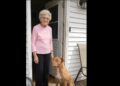
Margaret walked slowly with a walker.
She had been living alone since her husband died.
The house they once shared had changed after his death.
Not physically.
The furniture was still there.
The kitchen was still familiar.
But the rhythm had disappeared.
There was no second voice in the evening.
No one moving through the hallway.
No small conversations about dinner, television, weather, or what needed fixing.
Margaret was not looking for a dog to erase that loss.
No animal could replace her husband.
What she wanted was companionship in the life she had now.
She had thought carefully about what kind of dog would fit.
A high-energy puppy would be difficult.
A dog requiring long runs would not match her mobility.
An animal who preferred to spend most of the day in another room was not what she hoped for either.
Margaret wanted a dog who liked being close.
The shelter staff exchanged looks.
They knew exactly who she should meet.
“There’s One Dog We Should Tell You About”
They were honest with her before bringing Charlie out.
He had already been adopted twice.
He struggled with separation.
He followed people.
He wanted frequent physical contact.
He might become anxious when she left the house.
He would likely require gradual work on alone time rather than simply being expected to tolerate long absences immediately.
Margaret listened.
Instead of looking concerned, she asked a different question.
“How close does he like to be?”
One staff member smiled.
“Very.”
Margaret laughed.
“That might be all right.”
The staff also discussed practical matters.
Could she manage a dog safely with the walker?
Was Charlie calm enough not to knock into her?
Could food, water, bedding, and walking routines be arranged without creating fall risks?
Those questions mattered more than the emotion of the meeting.
The goal was not merely to find Charlie someone who liked clingy dogs.
The home had to work physically too.
Charlie Walked Straight to Her
A staff member brought him into the meeting area.
Charlie saw Margaret sitting in a chair beside her walker.
He approached without hesitation.
No jumping.
No frantic circling.
He came close.
Then he leaned his body gently against her legs.
Margaret lowered one hand.
Charlie smelled it.
A moment later, he gave her fingers one small lick.
She smiled.
When Margaret shifted more comfortably into the chair, Charlie moved with her.
Then he placed his head in her lap.
That was it.
No dramatic reaction.
No instant transformation.
Just a dog resting against a woman who had specifically come hoping to find exactly that kind of companionship.
Margaret ran her fingers carefully along his head.
“This,” she said, “is what I was looking for.”
The Staff Didn’t Rush the Adoption
The match looked promising.
Still, one quiet meeting does not prove what life together will be like.
The shelter wanted Margaret to understand Charlie’s needs outside the meeting room.
They discussed his anxiety again.
She might need help if she had medical appointments or other reasons to leave for several hours.
Gradual alone-time training would still matter.
Charlie should not become unable to function whenever Margaret was out of sight.
Margaret agreed.
She also had people who could help when needed.
The shelter talked about keeping walkways clear so Charlie would not interfere with her walker.
Beds should be placed beside furniture rather than directly in narrow paths.
His leash manners needed to remain gentle.
Everything was considered.
The emotional fit was strong.
The practical fit appeared reasonable too.
The adoption moved forward.
Charlie Followed Her Home and Kept Following
His first days in Margaret’s house looked exactly like the shelter had predicted.
If Margaret went into the kitchen, Charlie came too.
If she moved toward the bedroom, he followed at the pace of her walker.
When she sat down, he chose the nearest comfortable place.
Often that meant leaning against her feet.
Margaret did not find it irritating.
She found it reassuring.
Still, she did not encourage panic.
There was a difference between enjoying a close dog and teaching him that he could never tolerate distance.
So she created small routines.
Sometimes Charlie rested on a bed beside her chair instead of directly touching her.
Sometimes she moved into another room while he remained behind with a chew.
If he chose to follow, that was fine.
If he stayed, that was fine too.
Closeness remained available without becoming the only acceptable state.
Television Became Their Evening Routine
Margaret had always left the television on in the evening after her husband died.
At first, it was mostly to break the silence.
Now Charlie became part of the routine.
Margaret settled into her chair.
Charlie climbed onto the couch or curled beside her feet.
Sometimes he leaned so heavily against her leg that she joked he was trying to become furniture.
Other times he slept through entire programs.
He was not entertaining her every moment.
That was not what she needed.
She wanted another living presence in the room.
The sound of breathing.
A dog shifting position.
Toenails clicking lightly when he got up for water.
Small noises that made the house feel occupied.
Charlie provided those naturally.
For him, Margaret provided something equally valuable.
A person who did not resent being followed.
The Trait That Failed Elsewhere Fit Here
This was what shelter workers found most striking.
In the previous homes, Charlie’s constant proximity had created stress.
With Margaret, it fit the household.
That did not mean the previous adopters had been wrong.
Their schedules, expectations, and living arrangements were different.
A dog can be poorly matched to one home without being a “bad dog.”
Charlie illustrated that perfectly.
He did not suddenly stop following people when he moved in with Margaret.
He followed her.
She simply liked it.
He did not become less interested in physical contact.
He still rested against her whenever possible.
Margaret welcomed that too.
The behavior had not magically disappeared.
The environment around it had changed.
Sometimes good adoption work is not about transforming the dog.
It is about finding a household where the dog’s actual temperament can be managed comfortably and responsibly.
Margaret’s Walker Became Part of the Routine
At first, Charlie watched it carefully.
The wheels.
The metal frame.
The way it moved before Margaret did.
Soon he learned how to position himself around it.
Margaret also learned to give him space.
She did not encourage him to weave between the walker and her legs.
That could have been dangerous for both of them.
Instead, Charlie usually stayed slightly to one side.
When she stopped, he stopped.
When she sat, he settled.
Their walks were short and unhurried.
Margaret did not need Charlie to cover miles.
Charlie did not appear to care.
He seemed happiest when he could smell along the sidewalk and then return home with her.
Their pace matched.
That mattered.
Nights Changed Too
Before Charlie, evenings often ended with Margaret turning off the lights and walking through a silent house alone.
Now she heard paws behind her.
Charlie followed toward the bedroom.
A bed had been placed near the foot of hers.
Most nights, he used it.
Sometimes he slept close enough that one paw touched the frame.
Margaret liked knowing he was there.
Charlie seemed to like the arrangement too.
The house had a new nighttime rhythm.
Lock the door.
Turn off the television.
Check the kitchen.
Walk slowly toward the bedroom.
Settle.
No great emotional breakthrough occurred.
Just repetition.
For an anxious dog, repetition can be powerful.
The same person went to bed every night.
The same person was there in the morning.
Margaret Still Had to Leave Sometimes
Adopting Charlie did not mean she would stay home forever.
There were appointments.
Groceries.
Family visits.
The shelter had been clear that avoiding all separation could make his anxiety harder to manage.
So Margaret worked gradually.
At first, she stepped outside for very short periods.
Then she came back.
Later, she stayed away a little longer.
Charlie had a comfortable resting place.
Sometimes a family member stayed with him.
Other times he was alone briefly.
The goal was never to make him an independent dog who preferred solitude.
That was not Charlie.
The goal was to help him learn that temporary absence did not always mean permanent loss.
Progress took time.
Some departures remained difficult.
Others became easier.
Margaret did not treat setbacks as disobedience.
She adjusted and continued.
He Was Still Charlie
Months into the adoption, Charlie remained affectionate.
If Margaret sat down, he usually appeared within minutes.
If she moved into the kitchen, he often followed.
When visitors came, he preferred staying near her instead of wandering around the house.
That was his temperament.
But there were signs of increased security.
He could rest while Margaret moved around nearby.
He no longer needed to maintain physical contact every second.
He occasionally stayed asleep when she stepped into another room.
Those changes were small but meaningful.
Charlie had not been trained out of wanting companionship.
He had simply learned that closeness was available without needing to chase it constantly.
That made the relationship easier for both of them.
Margaret’s Home Was Still a Place of Grief
Charlie did not erase her husband from the house.
Photographs remained.
His belongings remained in certain drawers.
Some mornings, Margaret still reached automatically for two mugs before remembering.
Certain anniversaries hurt.
Certain songs did too.
Charlie was not a cure for widowhood.
He was a companion living alongside it.
On difficult afternoons, he rested near her.
On ordinary afternoons, he did exactly the same thing.
That was perhaps what Margaret appreciated most.
Charlie did not need to know whether she was remembering her husband or simply watching the weather.
He was there.
Not as therapy.
Not as a replacement.
As a dog who liked being close.
Sometimes that was enough.
The Shelter Staff Kept Thinking About the Two Returns
They had watched Charlie come back twice.
Both times, staff worried that potential adopters would interpret the history as proof something was wrong with him.
Return records can make people nervous.
Why didn’t the previous homes keep him?
What happened?
Was there a problem they were not being told about?
In Charlie’s case, the answer was straightforward.
There had been a mismatch.
He required more proximity and reassurance than those households could provide.
Margaret wanted exactly that kind of dog.
What looked excessive in one setting looked entirely manageable in another.
That did not mean every anxious dog simply needs an owner who is home all the time.
Behavioral treatment still matters.
So does teaching safe independence.
But compatibility matters too.
Charlie finally had both.
The House Is No Longer Silent
Margaret still notices the difference most in the smallest sounds.
Charlie drinking from his water bowl.
His collar moving as he scratches.
The soft tapping of paws behind her.
A sigh from the couch.
Sometimes she stops in the hallway and realizes he is only a few steps away.
That used to be exactly the behavior other people found difficult.
For Margaret, it is comforting.
Charlie has become part of the rhythm of the house.
Breakfast.
Short walk.
Rest.
Television.
Another walk.
Dinner.
Bed.
His world is not large.
Neither is hers.
They fit inside it together.
Charlie Was Never Waiting for Someone to “Fix” Him
There was work to do.
His anxiety needed understanding.
His ability to tolerate short separations needed improvement.
But Charlie’s desire for closeness was not a character defect.
He was not broken.
He was not a failed adoption because two homes had returned him.
He was a dog with needs that had been difficult in those particular circumstances.
Margaret saw the same behavior and asked a different question.
Not, “How do I make him stop following me?”
But, “Can we build a safe life where being together works for both of us?”
The answer turned out to be yes.
Some Dogs Need the Right Kind of Quiet Home
These days, Margaret moves through the house with her walker.
Charlie follows at a comfortable distance.
Not pressed against her legs.
Not frantic.
Just close.
When she sits, he settles nearby.
Sometimes his head ends up in her lap exactly as it did the first afternoon they met.
Other times he chooses the rug.
Both are signs of progress.
Charlie knows closeness is available.
He does not have to demand it every second.
Margaret knows she no longer has to move through every room alone.
Neither one erased what came before.
Charlie still carries some anxiety.
Margaret still carries grief.
Their lives did not become perfect because they found each other.
They simply became more compatible.
And in the house that once felt unbearably silent, the evening now often ends with the same gentle sound.
Margaret’s walker moving toward the bedroom.
Then Charlie’s paws following a few steps behind.
Exactly where both of them are comfortable being.
Editor’s Note: The characters in this story are fictional. Through these stories, we hope to share the intelligence, loyalty, compassion, and loving nature of dogs with people everywhere.