Helen had only intended to spend a few minutes at Maple Ridge Humane Society.
At sixty-eight, the retired schoolteacher had become accustomed to doing most things alone. She’d spent forty-one years teaching third grade, raised a daughter, and built a life filled with familiar routines.
But retirement had been quieter than she expected.
And after losing her older sister the previous autumn, the silence at home had become increasingly difficult.
That Thursday morning, Helen arrived at the shelter carrying a stack of blankets and several unopened bags of dog food.
She wasn’t looking to adopt.
At least, that’s what she told the volunteer who offered to introduce her to some of the dogs.
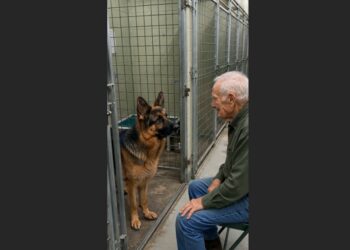
But twenty minutes later, Helen was sitting in a quiet visiting room beside a seven-year-old Border Collie mix named Rosie.
And when she stood to leave, the dog did something nobody expected.
Rosie hurried after her, gently took the sleeve of Helen’s cardigan between her teeth, and stood perfectly still.
She didn’t growl.
She didn’t pull.
She simply held on.
The shelter’s security camera captured the moment.
And for the people who witnessed it, the sight of that quiet little dog asking someone to stay was difficult to forget.
For much of her adult life, Helen had been surrounded by people.
She taught third grade at the same elementary school for forty-one years.
Her days were filled with lesson plans, busy classrooms, parent conferences, school performances, and children who always seemed to have something important to tell her.
Teaching wasn’t simply her profession.
It had shaped the rhythm of her life.
Every weekday began with a purpose. There were students depending on her, lessons to prepare, and dozens of small problems to solve before the final bell rang.
When she retired five years earlier, she’d looked forward to having more time for herself.
She imagined reading all the books she’d been setting aside, spending afternoons in her flower garden, and volunteering at the public library.
For a while, those activities kept her busy.
But she hadn’t realized how different the house would feel when there was no classroom waiting for her each morning.
Then her sister died.
Helen’s older sister had lived only a few blocks away for decades.
Their lives had been closely connected through ordinary things.
Afternoon telephone calls.
Sunday lunches.
The familiar comfort of having someone nearby who understood their family history without needing an explanation.
When her sister died after a brief illness the previous autumn, those routines ended.
Helen still had people who cared about her.
Her neighbors invited her over for dinner. Friends from church checked on her regularly. Her daughter, Emily, remained an important part of her life.
But evenings were different.
Helen would lock the front door, turn off the lights, and make her way through rooms that seemed larger than they once had.
She wasn’t completely alone in the world.
She simply missed having someone beside her during the ordinary parts of the day.
Emily had noticed.
More than once, she’d suggested that her mother consider adopting a rescue dog.
“You’ve always had room in your heart for animals,” she reminded her.
Helen would smile.
“I don’t know if I’m ready for that responsibility again.”
She meant it.
She liked dogs, but caring for one was a commitment, and she wasn’t certain she wanted to make that decision at her age.
Still, the idea stayed somewhere in the back of her mind.
On Thursday morning, Helen loaded several blankets and a few unopened bags of dog food into her car.
They’d belonged to her sister’s old Labrador.
The supplies were no longer needed, and Helen thought the shelter could put them to good use.
That was her reason for visiting Maple Ridge Humane Society.
Nothing more.
A volunteer thanked her warmly when she arrived.
Then, almost as an afterthought, the woman asked whether Helen would like to meet some of the dogs.
“Oh, I probably shouldn’t,” Helen replied with a little laugh. “I’m only here for a few minutes.”
The volunteer smiled.
“We hear that a lot.”
Helen hesitated.
She had nowhere urgent to be.
And since she’d already made the trip, spending a few minutes with the dogs didn’t seem unreasonable.
She agreed to look around.
That was how she met Rosie.
Rosie was a seven-year-old Border Collie mix with black-and-white fur and gray beginning to appear around her muzzle.
One eye had a faint cloudy spot left by an old injury, although it no longer seemed to bother her.
She had a gentle way of wagging her tail, never becoming overly excited.
And when someone spoke quietly, she sometimes tilted her head as though paying close attention.
Rosie had arrived at the shelter almost five months earlier.
Her previous owner had suffered a severe stroke and entered long-term medical care.
Family members had tried to find someone who could take Rosie, but nobody was able to provide the daily exercise and attention she needed.
So the dog had been surrendered.
For Rosie, it meant losing the only home she’d ever known.
The shelter staff said she wasn’t aggressive or especially fearful.
She was simply withdrawn.
Instead of approaching visitors eagerly, she often waited in the corner until they moved on.
She rarely barked.
She didn’t push herself forward when people came looking for a dog.
And because she was quiet, she was easy to overlook.
Her behavior chart contained a brief description:
“Exceptionally loyal. Bonds deeply. Takes time to trust.”
Helen read those words carefully.
Then she asked if she could spend some time sitting with Rosie.
Rather than taking the dog into the play yard, the volunteer opened a quiet visiting room.
Inside were two chairs, a rug, and a basket of toys.
Helen settled into one of the chairs.
Rosie remained several feet away.
She watched the older woman without approaching.
Helen didn’t try to call her over.
She understood that some dogs needed a little time to feel comfortable with strangers.
So she began talking.
She told Rosie about the books she’d been reading.
About the tomatoes growing in her backyard.
And about how strange it felt preparing dinner for one person after so many years of sharing meals with family.
Rosie listened quietly.
Of course, Helen knew the dog couldn’t understand every word.
But speaking aloud felt surprisingly comfortable.
For nearly twenty minutes, she sat in that little room, talking about ordinary things she’d been keeping mostly to herself.
And slowly, Rosie began moving closer.
At first, the dog simply shifted her position on the rug.
Then she moved another little distance.
Eventually, she settled beside Helen’s feet.
Helen looked down and smiled.
She reached out gently and stroked the top of Rosie’s head.
The dog closed her eyes.
There was no sudden burst of excitement.
Rosie didn’t jump into Helen’s lap or begin demanding attention.
She simply accepted the gentle touch and rested near the older woman’s chair.
A volunteer watching through the window noticed how comfortable they appeared together.
Helen, who had spent months adjusting to the quiet of her home, seemed perfectly content sitting beside a dog who didn’t require constant conversation.
And Rosie, who usually kept her distance from visitors, had chosen to come closer.
It was a small moment.
But it meant something to the people who knew how withdrawn Rosie had been.
Eventually, Helen looked at the clock.
She’d stayed much longer than she intended.
“I should probably head home,” she said softly.
She thanked the volunteer for allowing her to spend time with Rosie.
Then she stood, taking care not to disturb the dog resting near her feet.
She walked toward the doorway.
Opened it.
And stepped into the hallway.
She had taken only a couple of steps when she felt something catch her cardigan.
Helen turned.
Rosie had followed her out of the visiting room.
The Border Collie was standing close behind her, holding the sleeve of her sweater gently between her teeth.
She wasn’t tugging hard enough to hurt Helen or damage the fabric.
She simply hadn’t let go.
Several volunteers noticed.
A family waiting near the reception area stopped talking.
Rosie was usually so quiet that she rarely drew attention to herself.
Now she was standing in the hallway, holding on to a woman she’d met less than half an hour earlier.
Helen looked down.
For a moment, neither of them moved.
Then Rosie lifted her eyes toward Helen.
Her ears lowered slightly, and her tail gave one hesitant wag.
Helen’s expression changed.
She carefully freed her sleeve from the dog’s mouth.
Then, despite her aching knees, she lowered herself onto the floor.
She wrapped her arms around Rosie’s neck.
Rosie leaned into her.
Her body relaxed, and she rested her head against Helen’s shoulder.
One of the volunteers later admitted that she’d stepped into another room because the sight had brought her to tears.
Helen stayed on the hallway floor for several minutes, gently scratching behind Rosie’s ears.
The dog remained beside her.
Eventually, a staff member approached.
She quietly asked whether everything was all right.
Helen looked up with tears in her eyes.
“I came to donate blankets,” she said.
Then she glanced at Rosie.
“I think she just found a way to thank me.”
The older woman laughed softly.
“And I don’t believe she’s planning on letting me leave without her.”
It was the first time that morning she’d seriously allowed herself to consider taking a dog home.
But the possibility suddenly felt different.
She wasn’t choosing a puppy because it was adorable.
She wasn’t looking for a dog to fill every empty hour.
She was sitting beside an older rescue who had also experienced the loss of a familiar home and companion.
Rosie needed someone patient.
Someone who wouldn’t expect instant excitement or constant play.
And Helen had a quiet house, a garden, and a routine that might suit a dog who preferred gentle companionship.
She looked at the volunteer.
Then she asked about adopting Rosie.
The paperwork began less than fifteen minutes later.
While the shelter staff prepared everything, Helen called her daughter.
Emily answered expecting an ordinary conversation.
Instead, her mother said, “I hope you don’t mind coming over this evening.”
“Why?”
“Because someone new is coming home with me.”
Emily was surprised, but she didn’t need much explanation.
She’d been suggesting a rescue dog for months.
Now her mother had finally met one she wanted to bring home.
Emily arrived at the shelter before they left.
Rosie was sitting quietly beside Helen near the front entrance.
When Emily saw them together, she smiled and shook her head.
“I had a feeling this would happen eventually.”
Helen smiled back.
She hadn’t expected it herself.
But looking down at Rosie, she was glad she’d agreed to spend those few extra minutes at the shelter.
The first days at home were an adjustment for both of them.
Rosie needed to become familiar with a new environment, and Helen had to get used to organizing her days around another living creature.
But the changes were gentle.
Rosie didn’t demand constant entertainment.
She seemed happiest knowing where Helen was and having a comfortable place nearby.
Every morning, she waited outside the bathroom while Helen got ready.
When Helen went into the garden, Rosie followed.
During the afternoon, she often settled beside the armchair where Helen liked to read.
And whenever Helen prepared dinner, the dog found a quiet place near the kitchen.
If Helen walked into another room, Rosie usually followed a few steps behind.
The older woman had once wondered whether she was ready for the responsibility of caring for a dog again.
Now she was discovering that those responsibilities brought familiar structure back to her days.
There were meals to prepare.
Walks to take.
And a companion who seemed to enjoy the same quiet routines she did.
About a week after the adoption, one of the shelter volunteers called to check on Rosie.
Helen was happy to report that the dog was settling in.
She described how Rosie followed her through the house and rested beside her while she read.
Then she paused.
“For years,” Helen said, “I thought I was the one rescuing a lonely dog.”
She looked down at Rosie, who was resting her head across Helen’s feet.
“But the truth is, she noticed my loneliness long before I admitted it myself.”
Helen knew that Rosie couldn’t have understood her history or the losses she’d experienced.
But there was something comforting about the way they’d met.
Neither had been looking for a dramatic moment.
They’d simply spent time together.
And when Helen tried to leave, Rosie had reached for her sleeve.
The shelter later shared a sentence from Helen’s conversation alongside the security footage:
“Some dogs don’t ask for attention by barking the loudest. Sometimes they simply find the gentlest way to ask you to stay.”
Ten days into their new life together, Helen and Rosie were already developing familiar habits.
The garden had become one of their favorite places.
Helen tended her plants while Rosie kept her company nearby.
In the afternoons, they settled together while Helen read.
And in the evenings, the house no longer felt quite so empty.
Helen still missed her sister.
She still thought about their afternoon phone calls and the Sunday lunches they’d shared for so many years.
Adopting Rosie didn’t take away that grief.
But it gave her someone to care for during the quiet hours.
And Rosie, who’d spent five months waiting at the shelter after losing her previous home, was beginning to enjoy familiar routines again.
I keep thinking about how easily their meeting might never have happened.
Helen had gone to Maple Ridge only to donate blankets and dog food.
She’d intended to leave within a few minutes.
Rosie was a quiet seven-year-old dog who rarely approached visitors.
Neither seemed likely to attract much attention that morning.
But a volunteer invited Helen to stay.
Helen agreed to sit with Rosie.
And for twenty minutes, they shared a peaceful room without expecting anything from each other.
Helen had spent forty-one years teaching children and was still adjusting to retirement and the loss of her sister. Rosie had spent almost five months in a shelter after her owner entered long-term medical care.
They were both learning how to live with a changed routine.
And somehow, that quiet visit became the beginning of a new one.
The part everyone remembers is the moment in the hallway.
Rosie following Helen.
Gently catching her cardigan sleeve.
And standing there without pulling, growling, or making a sound.
But I think the twenty minutes before that moment mattered just as much.
Helen hadn’t tried to make Rosie perform or behave differently.
She’d simply sat in a chair and spoken softly.
Rosie had been allowed to approach when she felt comfortable.
And by the time Helen stood to leave, the dog seemed to want the interaction to continue.
We can’t know exactly what Rosie was thinking.
But her behavior made an impression on everyone who witnessed it.
Especially Helen.
A sixty-eight-year-old retired teacher walked into an animal shelter carrying blankets. She left with a seven-year-old Border Collie mix who had gently caught her sleeve when she tried to say goodbye.
The security camera recorded only a brief moment.
It couldn’t show the years Helen had spent teaching, the grief she’d experienced after losing her sister, or the quiet evenings that followed.
It couldn’t show the five months Rosie had spent waiting after losing her previous home.
But it captured the instant their paths changed.
Today, Rosie has a comfortable place beside Helen’s reading chair.
Helen has someone to accompany her into the garden.
And when the house grows quiet in the evening, neither has to spend it entirely alone.
Sometimes the beginning of a beautiful friendship doesn’t look extraordinary.
Sometimes it’s twenty minutes spent sitting together.
And one gentle tug on the sleeve of a cardigan.
If Helen and Rosie’s story touched your heart, please consider sharing it with someone who loves older rescue dogs. Sometimes the quietest animals have the most wonderful companionship to offer—we just have to give them a little time.