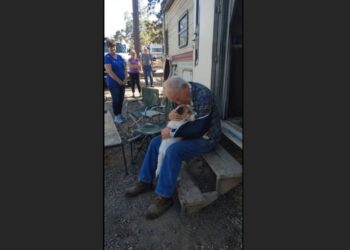
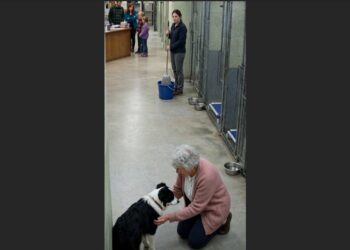
Walter hadn’t gone to the animal shelter looking for another dog.
At seventy-four, he’d already experienced enough loss to know how difficult it could be to love someone and then have to say goodbye.
His wife had died three years earlier.
His Labrador was gone, too.
That afternoon, he simply wanted to donate a few bags of dog food and some old blankets that had belonged to his beloved pet.
Ten minutes, he figured.
Enough time to unload everything, thank the staff, and drive home.
But before he reached the exit, something made him stop.
At the far end of the kennel hallway sat a large German Shepherd.
The dog wasn’t barking or jumping against the gate like some of the others. He wasn’t trying to attract visitors.
He sat in the back corner of kennel number 27, pressed so tightly against the concrete wall that he seemed to be trying to make himself smaller.
His ears were lowered.
His head hung down.
And his entire body appeared tense.
Walter stood watching him for a moment.
Then he pulled a folding chair against the kennel gate and sat down.
He didn’t reach for the dog.
He didn’t offer treats or try to persuade him to come closer.
He simply began talking.
Thirty minutes later, the German Shepherd did something the shelter workers had been hoping to see for almost four months.
He walked out of his corner.
And gently touched his nose to Walter’s fingers.
The dog’s name was Ranger.
He’d arrived at the shelter nearly four months earlier after being rescued from a property where he’d spent years chained outdoors.
He’d had very little opportunity to develop comfortable relationships with people.
By the time he reached the rescue, human attention seemed to frighten him more than reassure him.
Ranger was a big dog, with the imposing appearance of a German Shepherd that might have made an unfamiliar visitor cautious.
But the shelter staff knew he wasn’t aggressive.
He didn’t threaten people or attempt to bite them.
Instead, he withdrew.
When someone approached his kennel, he moved away.
If a staff member entered, he often froze.
And when potential adopters came to meet him, Ranger rarely responded to their attempts at affection.
The visitors would wait for a while, hoping he’d become interested.
Eventually, most would move on.
They wanted a dog who would approach them willingly.
Ranger wasn’t ready to do that.
The shelter volunteers had tried to help him adjust.
They understood that his years of isolation could make ordinary interactions difficult.
A dog who has spent a long time chained outside may need patience, predictable routines, and opportunities to make choices before becoming comfortable with people.
But understanding Ranger’s fear didn’t make finding him a home any easier.
His size could be intimidating.
And his refusal to approach visitors made him appear uninterested in them.
Some people assumed he would never become affectionate.
Others worried they wouldn’t know how to help him.
So Ranger remained in kennel number 27.
Day after day, people walked past.
And day after day, he stayed in the corner.
Walter had been watching the German Shepherd when a volunteer approached.
“He’s been here almost four months,” she explained quietly.
Walter glanced toward the dog.
“Nobody wants him?”
The woman sighed.
“They want to. At least until they meet him.”
She described Ranger’s background and the challenges staff members had faced while trying to earn his trust.
He wasn’t dangerous.
He wasn’t badly behaved.
He simply seemed overwhelmed whenever someone tried to interact with him.
“He just shuts down,” she said. “Like he’s expecting something bad to happen.”
Walter nodded.
He continued looking at the dog.
There was something familiar about the way Ranger had withdrawn into himself.
Not because Walter understood what the dog had experienced.
He didn’t.
But he knew what it was like to reach a point where being alone seemed easier than trying to connect with anyone.
After Walter’s wife died, the house had become unbearably quiet.
For years, they’d shared routines so ordinary that he hadn’t realized how important they were until she was gone.
There had always been someone to talk to in the evening.
Someone to share a meal with.
Someone who knew the little details of his day without needing an explanation.
After her death, those familiar moments disappeared.
Friends called.
Neighbors invited him to gatherings.
Family members checked in.
Walter appreciated their concern, but for a long time, he found it difficult to accept their invitations.
Some days, he preferred staying home.
He could sit quietly, work on a small project, or spend time in the backyard without having to explain how he was feeling.
His Labrador had offered companionship during those difficult years, too.
Now that the dog was gone, the house felt emptier still.
Walter hadn’t come to the shelter hoping to change that.
But standing in front of Ranger’s kennel, he remembered how difficult it had once been to let anyone close.
The volunteer asked whether he’d like to meet some of the other dogs.
Walter shook his head.
“I’m fine right here.”
He took a folding chair from against the wall and placed it outside Ranger’s kennel.
Then he sat down.
The German Shepherd remained pressed against the far wall.
Walter didn’t call his name repeatedly.
He didn’t whistle or try to lure him toward the gate with food.
He simply stayed where he was.
Visitors continued walking through the building.
Dogs barked in nearby kennels.
Shelter workers moved along the hallway, cleaning and caring for the animals.
Walter settled into his chair as though he had nowhere else he needed to be.
After a while, he began talking.
He spoke about the weather.
Then about the old truck he’d been trying to keep running.
He mentioned the tomatoes growing in his backyard.
And eventually, he talked about his wife.
There was no particular order to the conversation.
Walter wasn’t trying to train Ranger or convince him to do anything.
He was simply speaking in the calm, steady voice of someone sharing an afternoon with a companion.
Ranger stayed in his corner.
He didn’t wag his tail or come running toward the gate.
But after nearly twenty minutes, Walter noticed a small movement.
One of the dog’s ears lifted.
Just slightly.
It would have been easy to miss.
Walter noticed.
He kept talking.
Another ten minutes passed.
Then Ranger slowly raised his head.
For the first time since Walter sat down, the German Shepherd looked directly toward him.
Their eyes met.
Walter didn’t move forward.
He didn’t become excited or try to take advantage of the change.
He leaned back in the folding chair.
“You don’t have to come over here,” he said softly. “I just figured neither of us had anywhere else to be today.”
Ranger watched him.
Then the dog stood.
It was a small movement, but the shelter worker observing from down the hallway stopped what she was doing.
For months, Ranger had remained withdrawn around visitors.
Now he was standing and looking toward someone sitting outside his kennel.
Walter waited.
And after another moment, Ranger took a step.
He didn’t walk directly to the gate.
He moved slowly, pausing as he crossed the kennel.
Every few steps, he stopped.
Walter remained seated.
He made no effort to shorten the distance between them.
He wanted Ranger to be free to approach or retreat.
The dog continued forward.
One careful step at a time.
Eventually, he reached the front of the kennel.
His nose hovered near the wire.
Walter slowly lifted his hand and rested it against the gate.
He didn’t push his fingers into Ranger’s space.
He simply kept his hand still.
For several seconds, the German Shepherd watched him.
Then Ranger leaned forward.
His nose touched Walter’s fingers.
The old man smiled.
Ranger didn’t immediately retreat.
He stood quietly at the gate, sniffing Walter’s hand.
The volunteer watching from the hallway felt tears gathering in her eyes.
She’d worked with Ranger regularly during the months he’d spent at the shelter.
She’d seen him freeze when people entered his kennel and withdraw whenever visitors approached.
Now he was standing at the front of his enclosure, investigating a stranger’s hand entirely of his own choice.
It wasn’t a dramatic transformation.
Ranger hadn’t suddenly become a carefree, affectionate dog.
He was still cautious.
But he’d made a decision to approach someone.
For an animal who had spent almost four months avoiding human contact, that was meaningful progress.
And it had happened because Walter had been willing to sit quietly long enough to give him the opportunity.
Walter returned the following afternoon.
He brought himself back to kennel number 27 and sat outside the gate again.
Ranger was still cautious.
But he seemed to recognize the familiar routine.
Walter stayed for a while, speaking quietly and allowing the dog to decide whether to approach.
Then he came back the next day.
And the day after that.
Their visits became a regular part of Walter’s afternoons.
Sometimes he talked about the weather or the things he needed to do at home.
Sometimes he simply sat.
There was no demand that Ranger greet him immediately.
And Walter didn’t treat a hesitant day as a failure.
Over time, the German Shepherd began approaching a little sooner.
The distance between the back corner and the kennel gate became easier for him to cross.
The staff watched the changes with quiet encouragement.
They knew that animals recovering from long periods of isolation rarely become comfortable with people overnight.
Some need extensive time and support.
Progress can be uneven.
And a dog who approaches one familiar person may still be frightened by strangers.
But Walter’s visits were giving Ranger repeated experiences of calm human interaction.
Nobody was forcing him into a situation he couldn’t manage.
He could decide how close to come.
And each time Walter returned, the dog had another chance to become familiar with him.
What had started as a ten-minute donation visit had become something far more important to both of them.
Walter had been spending much of his time alone since losing his wife and Labrador.
Now he had a reason to leave the house each afternoon.
Someone was waiting at the shelter.
Even if that someone still needed time to feel comfortable with him.
Three weeks after their first meeting, Walter walked into the shelter carrying a leash.
He didn’t know exactly how Ranger would respond.
The dog had made progress, but the old man understood that trust couldn’t be rushed.
He’d brought the leash because he hoped Ranger might finally be ready to leave the kennel with him.
A shelter worker approached and opened the gate.
Walter waited.
And this time, Ranger didn’t retreat toward the corner.
He stepped forward.
Then he walked directly to Walter.
No long hesitation.
No anxious pacing.
Just a German Shepherd approaching the elderly man who’d been sitting outside his kennel every afternoon for three weeks.
Walter lowered himself carefully, his knees aching as he knelt beside the dog.
Ranger moved close.
Then the German Shepherd rested his head against Walter’s shoulder.
The staff members watching nearby smiled through tears.
They remembered the dog who had spent months pressed against the concrete wall.
The dog who seemed unable to tolerate unfamiliar people approaching him.
Now he was leaning against a man who had never demanded that he become affectionate.
Walter didn’t say much.
He simply stayed close, allowing Ranger to rest against him.
The gesture was quiet.
But everyone who had watched the dog’s progress understood how much had changed since that first afternoon.
I think one of the most meaningful parts of Ranger’s story is that Walter didn’t arrive with any special plan.
He wasn’t a professional dog trainer.
He hadn’t come to the shelter intending to rehabilitate a frightened German Shepherd.
He was simply a seventy-four-year-old widower bringing donations that had belonged to his late Labrador.
Then he noticed a dog sitting alone in the back of a kennel.
And he recognized something familiar about withdrawing from the world.
Walter couldn’t understand Ranger’s experience completely.
The shepherd had spent years chained outside, with little human interaction.
Walter had experienced bereavement and the loneliness that followed.
Those were different kinds of suffering.
But both had found themselves isolated.
And both seemed to benefit from the simple routine of spending quiet time together.
It would be easy to describe their first meeting as the moment everything changed.
But the real progress happened over the days that followed.
Walter returned.
And returned again.
He didn’t expect the frightened dog to become comfortable after one gentle interaction.
He was willing to keep showing up, even when the changes were small.
A lifted ear.
A raised head.
A few cautious steps.
A nose touching his fingers.
And eventually, a dog who approached him willingly.
The shelter workers had spent months hoping someone would give Ranger enough time to show that side of himself.
Walter did.
The story ends three weeks after that first meeting, with Ranger stepping out of his kennel and resting his head against Walter’s shoulder.
It doesn’t tell us every detail of what happened afterward.
But it gives us something worth remembering.
Ranger had spent years chained outdoors and nearly four months at the shelter, too frightened to approach visitors.
Walter had spent three years grieving his wife and had recently lost his Labrador, too.
Neither was looking for a dramatic moment that afternoon.
Walter simply sat down.
He talked about his old truck, his tomatoes, and the woman he missed.
And he allowed Ranger to listen from a distance.
When the dog was ready, he came closer.
Then Walter returned the next day.
And the next.
Until the space between them no longer seemed quite so difficult to cross.
I keep picturing that first afternoon.
A folding chair outside kennel number 27.
An elderly man talking quietly.
And a frightened German Shepherd pressed against the far wall.
For nearly twenty minutes, nothing seemed to happen.
Then an ear lifted.
A little later, Ranger raised his head.
Eventually, he approached the gate.
The old man rested his hand against the wire and waited.
He didn’t need Ranger to hurry.
He didn’t need the dog to prove anything.
He was simply willing to be there.
Three weeks later, Ranger walked straight toward Walter and rested his head against his shoulder.
It was the kind of moment that could never have been forced.
And perhaps that’s what makes their story so moving.
Walter didn’t ask Ranger to trust him immediately.
He gave him time.
And as the two spent their afternoons together, the old man who had grown accustomed to being alone found himself looking forward to those visits, too.
If Walter and Ranger’s story touched your heart, please consider sharing it with someone who loves rescue dogs. Sometimes patience doesn’t look like doing something extraordinary. Sometimes it simply means showing up again tomorrow, sitting quietly, and allowing trust to grow at its own pace.