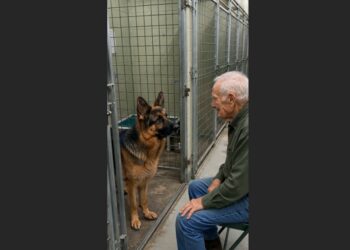
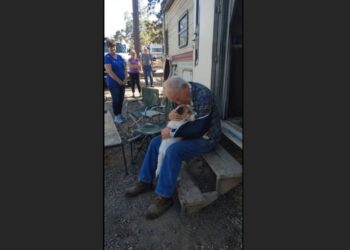
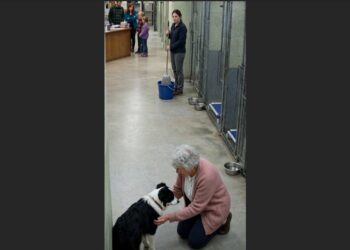
When I told the shelter staff I wanted to adopt Barnaby, the woman helping me looked genuinely surprised.
Her name was Elizabeth, and she’d spent enough time with the old pit bull to know what I was getting into.
“Arthur,” she said gently, “I think it’s wonderful that you want to take him home. But I need you to understand something.”
She glanced toward the kennel.
“Barnaby has been through a terrible loss. He may never become the kind of dog who runs to greet you. He might not play, wag his tail, or even look you in the eye. We’ve been trying to help him for two years.”
I looked at the dog sitting in the far corner.
He was thirteen years old, with a graying muzzle, stiff joints, and the tired expression of an animal who had stopped expecting much from people.
He didn’t come forward when I approached.
He didn’t even lift his head.
And yet, for reasons I couldn’t fully explain, I wanted to take him home.
“I understand,” I told Elizabeth. “I’m not exactly an easy old man myself.”
She smiled a little.
I looked back at Barnaby.
“I’ve got an empty house and more memories than I know what to do with. Maybe we can keep each other company.”
I had walked into the shelter hoping to find a cheerful young dog who would make my days less lonely.
Instead, I was preparing to bring home an elderly pit bull who had barely left the corner of his kennel in two years.
I didn’t know it then, but that decision would change the way I lived.
My name is Arthur Pendelton.
Two years before I met Barnaby, my wife died.
We’d shared a long marriage, raised our children, and spent most of our adult lives building a home together.
I worked as a craftsman for many years, and she was the person who knew every part of my life.
She knew when I was worried before I said a word.
She knew how I liked my coffee.
And she had a habit of humming old love songs while we worked in the garden during the spring.
After she died, those ordinary things became the ones I missed most.
The house felt much larger without her.
My children had grown up and made lives for themselves overseas. They kept in touch, but distance made visits difficult.
I had friends and neighbors, and I wasn’t completely without company.
Still, the evenings were long.
I would make dinner, wash the dishes, and sit in my leather chair with the television on.
Sometimes I realized I hadn’t spoken to another person all day.
Eventually, I decided I needed a dog.
Nothing too demanding, I thought.
Perhaps a younger, friendly companion who would enjoy walks and keep me company while I worked around the house.
That was my plan when I entered the shelter.
Then I saw Barnaby.
His story was more complicated than I’d expected.
For eleven years, Barnaby had lived with the same man, someone who had raised and cared for him since he was young.
Then he lost that familiar life.
By the time he arrived at the shelter, he had already experienced a painful separation from the person and home he’d known.
The staff didn’t pretend to know exactly what he understood about the loss.
But they could describe how he’d behaved afterward.
He withdrew.
He spent most of his time in the back of his kennel, away from visitors.
He rarely approached volunteers, even when they offered affection or treats.
He wasn’t aggressive.
He didn’t bark or threaten anyone who came near.
He simply seemed to prefer being left alone.
Over the following two years, his behavior changed very little.
People visited the shelter looking for dogs who would greet them enthusiastically.
Barnaby stayed in his corner.
And people moved on.
After completing the adoption paperwork, I went with Elizabeth to collect him.
Barnaby rose slowly when she opened the kennel.
His joints were stiff, and he took his time walking toward the doorway.
He followed us without resisting.
But there was none of the excitement I’d seen in other dogs leaving with new owners.
When I opened the back door of my car, he climbed inside carefully and settled on the seat.
I made sure he was safely secured for the ride.
Then we headed home.
For most of the journey, Barnaby sat quietly, looking out the window.
I talked to him now and then.
I told him about the house, the garden, and the quiet neighborhood where we would be living.
At one point, I even found myself humming one of the old songs my wife used to sing.
Barnaby didn’t respond.
But talking to him made the drive feel less lonely.
When we reached the house, I brought him outside and gave him time to look around.
He sniffed the driveway and stood for a while, taking in the unfamiliar surroundings.
Then he walked toward a sheltered corner near the old stone well beside the house.
He sat down there.
I stopped a few feet away.
Of all the places he could have chosen, that was the one spot I knew particularly well.
After my wife died, I’d often gone there when I didn’t want anyone to see me crying.
It was quiet and partly hidden from the rest of the property.
I’d spent many afternoons sitting there, thinking about the years we’d shared.
And now Barnaby had chosen the same place.
I didn’t imagine he understood any of that.
He’d probably found a corner where he felt protected.
Still, seeing him there made me feel an unexpected tenderness toward him.
I sat nearby for a while.
Neither of us had much to say.
That first night, I showed Barnaby the comfortable sleeping area I’d prepared in the living room.
I’d bought a thick mattress with a soft wool cover, hoping it would be easier on his aging joints.
He sniffed it briefly.
Then walked away.
He chose the bare floor in the darkest corner of the room.
I left the bed available and didn’t try to move him.
Later that evening, I settled into my leather chair with a book.
Barnaby lay against the wall, watching me occasionally.
The room was quiet except for the ticking clock and the faint sounds from outside.
I couldn’t sleep, so I stayed in the chair longer than usual.
Every now and then, our eyes met.
Then Barnaby looked away.
I remember thinking how strange it was that I had brought home a dog to make the house feel less empty, only to find myself sitting across from another creature who seemed just as comfortable with silence as I was.
But even that first night, the silence felt a little different.
There was someone else in the room.
The first few weeks required more patience than I’d expected.
Barnaby wouldn’t eat while I was watching him.
I’d place his food near the corner, but he would remain perfectly still until I walked into another room.
Then I’d hear his nails moving across the floor.
A moment later, he’d begin eating.
If I returned too soon, he stopped.
So I adjusted.
I fed him at regular times, gave him plenty of space, and made sure he could drink and eat without feeling watched.
I also spoke with his veterinarian about his age, his stiff joints, and the best way to help him settle comfortably into the house.
I wanted him to feel secure, but I had to accept that it might take months.
Maybe longer.
And there was no guarantee he would ever become a particularly affectionate dog.
Every afternoon, I made tea and carried a wooden chair into the living room.
I placed it several feet from Barnaby’s corner, making sure he had room to move away if he wanted.
Then I sat and talked.
Sometimes I told him stories about my younger days.
I talked about the work I’d done as a craftsman, the places I’d traveled, and the mistakes I’d made along the way.
More often, I talked about my wife.
I told him how she used to hum while gardening.
How she’d laugh when I misplaced my tools.
And how much I missed hearing her moving around the house.
Barnaby rarely looked directly at me.
Sometimes he rested with his eyes half closed.
Occasionally, an ear moved when my voice changed.
I had no idea how much attention he was paying.
But the routine became important to me.
For the first time in two years, I had someone to talk to at the end of the day.
Even if he never answered.
The first real change happened early in our second month together.
It was raining that morning.
I was standing in the kitchen, waiting for the coffee to finish brewing, when I heard a faint clicking sound behind me.
I turned.
Barnaby was standing in the doorway.
He’d never followed me into the kitchen before.
Usually, he remained in the living room until I returned.
But there he was.
He looked at me for a moment.
Then, very slowly, he walked forward.
He stopped beside my feet and sat down.
I didn’t reach toward him.
I didn’t want to startle him or turn a small moment of confidence into something uncomfortable.
I simply continued making my coffee.
Barnaby stayed.
And when I carried my cup to the table, he followed.
From that morning onward, he often joined me for breakfast.
He didn’t always want attention.
Most days he simply settled nearby while I drank my coffee and read the newspaper.
But he had begun choosing my company.
And that meant more to me than I could explain.
A couple of months later, I decided to take him somewhere quiet.
I rented a small piece of farmland outside town, bordered by open meadows and patches of trees.
It was a place I sometimes visited to enjoy the outdoors.
Barnaby had become more comfortable leaving the house, and I thought he might appreciate a change of scenery.
I brought him along for a gentle outing, taking care not to overexert him.
When we arrived, he lifted his head and began sniffing the air.
The grass was fresh from recent rain.
A breeze moved through the trees, carrying the smell of damp earth.
Barnaby stepped out carefully.
For a while, he stood looking across the field.
Then he began walking.
At first, his pace was slow.
His joints were still stiff, and he needed time to loosen up.
But after exploring for a little while, he became more animated.
His tail lifted slightly.
He sniffed along the grass.
And then, to my surprise, he broke into a run.
It wasn’t the graceful, effortless movement of a young dog.
Barnaby was thirteen, and his arthritis hadn’t disappeared simply because we were standing in a beautiful meadow.
His run was uneven and brief.
But there was enthusiasm in it.
For a short distance, he moved through the grass with a freedom I had never seen from him before.
Then he slowed and stopped.
He turned toward me.
I stood watching him, smiling so widely my face hurt.
For weeks, I’d seen Barnaby move cautiously through my house.
Now he was standing in an open field, looking around with obvious interest.
I walked toward him.
When I reached him, I knelt down and opened my arms slightly, allowing him to decide whether he wanted to come closer.
Barnaby took a couple of steps.
Then he leaned his heavy body against my chest.
His head settled near my shoulder.
I placed my arms gently around him, careful not to hold him too tightly.
He remained there.
For the first time since we’d met, Barnaby had come to me looking for affection.
I buried my face briefly against his fur.
And cried.
The change that followed wasn’t immediate or complete.
Barnaby still had quiet days.
There were mornings when he preferred his own space.
And he continued moving slowly when his joints were bothering him.
But he’d begun showing more interest in the world around him.
He sometimes wagged his tail when I came home from the store.
He started investigating toys.
One afternoon, he found an old leather ball in the garden and carried it toward me.
He placed it near my feet and looked up.
I rolled it a short distance.
He followed, picked it up, and brought it back.
We played for only a few minutes.
That was plenty for an old dog with stiff legs.
But I enjoyed every second.
Little by little, Barnaby developed his own household habits.
He liked sitting near the kitchen while I prepared breakfast.
He enjoyed slow walks through the garden.
And he eventually decided that the most comfortable place to sleep was near the foot of my bed.
I’d bought him several beds by then.
He used them occasionally.
But at night, he preferred being close enough to hear me moving around.
I found comfort in that, too.
After years of sleeping alone, I liked hearing the quiet rhythm of his breathing.
Sometimes I would wake in the early morning and see him lying peacefully nearby.
The house no longer felt quite so empty.
I never tried to make Barnaby forget the man who had raised him.
For eleven years, he’d known another home and another familiar person.
Those years were part of his life.
I couldn’t replace them, and I didn’t want to pretend I could.
I felt the same way about my wife.
People sometimes suggested that I needed to move on after her death.
I understood what they meant.
They wanted me to find happiness again.
But I didn’t want to leave the memories behind.
I wanted to remember our marriage and still have a life worth enjoying.
Barnaby helped me understand that the two things weren’t in conflict.
I could miss my wife and still look forward to breakfast with my dog.
I could remember the years we’d shared and enjoy an afternoon in the garden.
And Barnaby could carry the experiences of his first home while learning to feel comfortable in another.
Neither of us had to erase the past.
Today, Barnaby is fifteen years old.
His muzzle is almost completely white.
He moves more slowly than he did when I adopted him, and our walks have become shorter.
Some mornings, he needs extra time to get up.
I make sure he has his medication, comfortable bedding, and whatever help he needs to enjoy his days without unnecessary discomfort.
But he still has his little routines.
Each morning, he comes to the side of my bed and rests his head near the mattress.
I reach down and scratch behind his ears.
Then we go to the kitchen together.
In the evenings, we take a slow walk through the garden.
Sometimes we stop near the old stone well.
The corner Barnaby chose on his first day.
The same place where I once sat alone, trying to make sense of life without my wife.
It’s strange to think how much has changed since then.
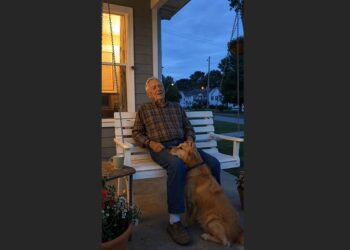
The other evening, I was sitting outside when Barnaby came over and settled beside my chair.
The sun was going down.
The garden was quiet.
I could hear the birds settling in the trees and the faint sound of traffic somewhere beyond the property.
Barnaby rested his head against my leg.
I placed a hand on his shoulder.
For a while, I thought about the day I’d met Elizabeth at the shelter.
I remembered her warning that Barnaby might never play or wag his tail.
She hadn’t been trying to discourage me.
She simply wanted to make sure I understood what adopting him might involve.
I appreciated that.
There was no promise that Barnaby would change.
No guarantee that he’d become affectionate.
And certainly no reason to expect him to recover from years of loss simply because I brought him into a different house.
But we gave each other time.
And over the months, a friendship developed.
I went to the shelter hoping to find a young dog who would help fill my empty days.
Instead, I adopted a thirteen-year-old pit bull who had spent two years hiding in the corner of his kennel.
At first, he wouldn’t eat in front of me.
He didn’t want to be touched.
And he seemed more comfortable on a bare floor than on the softest bed I could give him.
Now he sleeps near my bed, joins me for breakfast, and occasionally brings me a toy when he’s feeling playful.
He still has his limitations.
So do I.
But those things have never prevented us from enjoying each other’s company.
I don’t know how much longer we’ll have together.
At fifteen, Barnaby is an old dog, and I try to appreciate the ordinary days rather than worry constantly about the ones that may be ahead.
We have our morning coffee.
Our slow walks.
And our quiet evenings.
That’s enough.
Sometimes I think about the man who loved Barnaby for the first eleven years of his life.
I hope he’d be pleased to know that his dog is comfortable and cared for.
I think about my wife, too.
How much she would have enjoyed having Barnaby around.
She probably would have spoiled him terribly.
And I suspect she’d have laughed at the sight of me carefully making room on the bed for a large, elderly pit bull who insisted on sleeping close by.
I miss her as much as ever.
But my life is no longer made up entirely of missing her.
There are still things I look forward to.
And most of them are wonderfully ordinary.
I thought I was going to the shelter to rescue an old dog who had lost his home. I didn’t realize how much I needed his company, too.
Barnaby didn’t become the young, playful companion I’d originally imagined.
He became something better suited to the life I actually had.
A quiet friend.
A familiar presence.
Someone who was happy to sit beside me without needing conversation or explanation.
We are two aging companions with our own histories, our own aches, and people we’ll always miss.
But every morning, when Barnaby rests his gray muzzle against the side of my bed, I’m reminded that there are still good days ahead.
And I’m grateful we found each other in time to share them.