At 1:15 on a Sunday morning, a man walked into an emergency animal hospital in Little Rock, Arkansas, carrying a dog wrapped in a moving blanket.
He told the staff he’d found the animal behind a feed store off Asher Avenue.
The dog wasn’t his, he said.
He left a phone number and disappeared into the night.
Nobody at the hospital ever saw him again.
The number he’d provided was one digit short.
And the dog he’d brought in was in terrible condition.
He was a pale gray greyhound with a broken front leg and painful scrapes running along one side of his body.
Inside each ear was a tattoo.
The markings indicated that he’d once been a racing dog.
A microchip scan led to a racing kennel in Florida that had closed three years earlier.
There was no current owner to contact.
No one called looking for him.
So the staff gave him a name.
Ghost.
Partly because of his pale gray coat.
And partly because he’d appeared in the middle of the night, seemingly out of nowhere.
The following morning, a veterinarian set his broken leg. Ghost was placed in kennel four of the recovery ward with a cast and a plastic cone around his neck.
He wouldn’t eat.
He stood facing the back wall, trembling whenever someone approached.
Then, at seven o’clock that evening, a veterinary technician named Tanya Gibbs arrived for her overnight shift.
During her first break, she took a cup of coffee to kennel four.
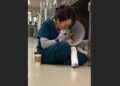
She sat on the floor outside the open kennel door.
And waited.
Twenty minutes later, Ghost finally turned around.
Nearly an hour after she sat down, he was lying beside her, his injured leg resting gently across her ankle.
Before Tanya returned to work, she offered him a spoonful of canned food.
For the first time since his arrival, Ghost ate.
That was how it began.
And eleven nights later, when Tanya learned that a rescue organization was coming to take him away, she discovered she wasn’t ready to say goodbye.
The Dog Under the Blanket
The emergency staff had seen animals arrive in all sorts of circumstances.
Some came in after accidents.
Others had been found wandering injured along roads.
Occasionally, someone brought in an animal without much explanation and left before the staff could ask everything they needed to know.
But Ghost’s arrival was especially troubling.
His front leg was broken.
One side of his body was scraped and raw.
And he was frightened enough that even gentle handling required patience.
The moving blanket offered little indication of what had happened to him.
The man who carried him inside said he’d found him behind a feed store.
That was all the staff knew.
They couldn’t confirm how Ghost had been injured.
They couldn’t know whether he’d been hit by a vehicle, fallen, or experienced something else.
And the incomplete phone number made it impossible to follow up with the person who had brought him in.
His ear tattoos provided one clue about his past.
Ghost had raced.
But his former racing kennel had closed years before.
The microchip didn’t lead to someone who could come collect him.
So the hospital treated the dog in front of them.
He was injured.
He needed care.
And whatever his history had been, he was alone now.
Kennel Four
After his leg was set, Ghost was moved into the recovery ward.
Kennel four became his temporary home.
There was bedding.
Water.
A bowl of food.
And the regular sounds of a busy emergency animal hospital.
Dogs barked in nearby kennels.
Equipment moved through the hallway.
Doors opened and closed.
Staff members came and went.
Ghost didn’t settle easily.
He stood near the back wall with his head lowered.
When someone approached, his body trembled.
He avoided eye contact and showed little interest in his surroundings.
The staff knew that dogs with racing backgrounds sometimes needed time to adjust to unfamiliar environments.
Some had limited experience with ordinary household routines or casual attention from strangers.
But Ghost’s specific history was unknown.
What mattered most was how he was behaving now.
He was frightened.
He was recovering from an injury.
And he wasn’t eating.
The medical team continued caring for him, but his refusal of food was becoming another concern.
An injured animal needed nutrition to recover.
The staff offered food and monitored him closely.
Ghost continued facing the wall.
The Woman Who Worked Nights
Tanya Gibbs worked the overnight shift as a veterinary technician.
She was accustomed to unusual hours.
While most people were finishing dinner or getting ready for bed, Tanya was preparing to spend the night caring for sick and injured animals.
Her work could be exhausting.
There were medications to administer.
Patients to monitor.
Emergency cases to assist with.
And records to update before the next shift arrived.
Some nights were quiet.
Others weren’t.
Tanya had learned not to expect much predictability from an emergency hospital.
But she loved the work.
She liked being there for animals who needed help, especially during the difficult hours when their owners were frightened or their condition was uncertain.
On Sunday evening, she arrived at seven.
During the shift handover, she heard about the greyhound in kennel four.
He’d been brought in overnight.
Broken leg.
Road rash.
Former racing dog.
No confirmed owner.
And he wasn’t eating.
Tanya went to see him.
Ghost was standing at the back of his kennel, facing the wall.
She watched him for a moment.
He didn’t turn around.
She didn’t try to force an introduction.
There was work waiting.
But she made a quiet decision.
When her first break came, she’d return.
A Cup of Coffee and a Concrete Floor
Later that evening, Tanya carried her coffee into the recovery ward.
She stopped outside kennel four.
Ghost remained near the back.
His cast looked large against his slender body.
The plastic cone made it harder for him to move comfortably.
And his injured side was still healing.
Tanya lowered herself onto the floor.
She opened the kennel door in a controlled, safe manner and stayed near the entrance, allowing Ghost to remain where he felt comfortable.
She didn’t reach for him.
Didn’t call him repeatedly.
And didn’t try to coax him out with an excited voice.
She simply sat.
At first, Ghost ignored her.
Or appeared to.
He remained facing the wall.
Tanya took a sip of coffee.
She could hear the familiar sounds of the hospital beyond the recovery ward.
A telephone ringing.
Someone speaking at the treatment station.
A kennel latch opening farther down the hall.
She had spent enough time around frightened animals to know that sometimes the most useful thing a person could do was stop asking them for a response.
So she waited.
Ten minutes passed.
Then twenty.
Ghost shifted.
His head turned slightly.
Tanya stayed still.
The dog looked toward the doorway.
For the first time that evening, he was looking at her.
“Hi, sweetheart,” she said softly.
Then she let him decide what happened next.
The Weight on Her Ankle
It took nearly an hour.
Ghost turned around completely.
He moved toward Tanya cautiously, adjusting to the cast on his front leg.
She watched his body language and gave him space.
He stopped near her.
Then slowly lowered himself to the floor.
His injured leg came to rest across her ankle.
Tanya barely moved.
She looked down at the pale gray dog lying beside her.
The same dog who had stood trembling against the back wall now seemed willing to share a little space.
She didn’t know whether he trusted her.
That would be too much to assume from one interaction.
But he was no longer facing away from everyone.
He was resting.
And for a dog who hadn’t eaten since arriving, even that felt encouraging.
Tanya stayed until she needed to return to work.
Then she reached for the canned food she’d brought.
She took a small spoonful and offered it carefully.
Ghost sniffed.
Hesitated.
Then ate.
Tanya smiled.
“There you go.”
She offered a little more according to his care plan.
He accepted it.
And when she finally returned to her duties, she told the overnight veterinarian what had happened.
Ghost had eaten.
Not much.
But enough to give them a little hope.
Tanya’s Office
The next evening, Tanya came back.
On her break, she went straight to kennel four.
Ghost was still frightened by unfamiliar activity, but he seemed less hesitant when she sat down.
She stayed with him.
Offered food when appropriate.
And let him rest near her.
The following night, she did the same thing.
Soon, every break seemed to lead her back to kennel four.
She ate her supper there.
Sat beside Ghost with her coffee.
And spent the quiet moments of her shift keeping him company.
The overnight veterinarian, Dr. Sam Okafor, noticed the routine.
Eventually, he began referring to kennel four as Tanya’s office.
“She’s in her office,” he’d tell someone looking for her.
Tanya laughed when she heard it.
But she didn’t object.
The name fit.
For the length of every break, the recovery kennel had become the place she most wanted to be.
There were still medical responsibilities.
Ghost still needed professional care and monitoring.
But Tanya’s quiet presence seemed to help him settle.
He began eating more reliably.
He spent less time facing the wall.
And when she sat beside him, he often moved close enough to rest against her.
The Old Fleece
On the third night, Tanya brought something from home.
An old fleece.
It was soft, familiar, and carried the scent of her house.
She placed it with Ghost’s bedding after checking that it was suitable for his recovery area.
Later that night, she found him sleeping with his nose buried in it.
Tanya stood outside the kennel for a moment.
The hospital was still busy.
Somewhere down the hallway, another patient needed attention.
But Ghost was resting.
His body looked less tense.
His gray muzzle was tucked into the folds of the fleece.
Tanya smiled.
Then went back to work.
The fleece became part of his bedding.
She noticed that he often rested against it even when she wasn’t sitting beside him.
It wasn’t a remarkable object.
She’d worn it around the house for years.
But seeing Ghost use it made her glad she’d brought it.
The dog who had arrived wrapped in a stranger’s moving blanket now had something soft and familiar to sleep against.
And someone who came back every night.
Five Days
The hospital’s stray-hold period was five days.
During that time, the staff continued trying to identify an owner and establish what should happen next.
Nobody claimed Ghost.
The former racing kennel connected to his microchip was no longer operating.
The person who had brought him in had left no usable contact number.
And there was no confirmed family waiting for him.
By the end of the hold period, the practice manager had arranged for a greyhound rescue in Hot Springs to take Ghost once he was medically ready to travel.
It was a good plan.
The rescue had experience with the breed and could help him recover and eventually find an appropriate permanent home.
Tanya understood that.
She was relieved to know he wouldn’t be left without somewhere to go.
She also knew she couldn’t adopt every animal she grew attached to.
She and her husband already had two cats.
They had discussed adding more pets before.
And they’d agreed that their household was full.
No more animals.
It was a sensible rule.
Tanya reminded herself of it whenever she began imagining Ghost lying in their living room.
She was only keeping him company.
That was what she told her husband.
That was what she told her coworkers.
And most evenings, it was what she tried to tell herself.
The Eleventh Night
By Tanya’s eleventh night with Ghost, his routine had changed considerably.
He still had his cast.
He still needed time to recover.
And the hospital environment wasn’t always easy for him.
But he knew Tanya.
When she came to kennel four, he no longer spent the entire visit trembling at the back wall.
He approached.
Settled nearby.
And rested against her.
Tanya had become accustomed to the feel of his cast against her shoe.
The sound of him shifting on the bedding.
And the careful way he lowered himself beside her.
Then the rescue called.
They could collect Ghost on Thursday.
The practice manager shared the news.
Tanya smiled politely.
She knew it was what everyone had been working toward.
Ghost would leave the hospital and continue recovering in a setting better suited to his long-term needs.
But when her next break came, she went to kennel four and sat down.
Ghost approached.
He lowered himself beside her.
Then rested his head on her knee.
His plastic cone pressed awkwardly against her scrubs.
Tanya looked down at him.
And began to cry.
The Dog She Wasn’t Supposed to Keep
Tanya had spent years working with injured animals.
She knew how easy it could be to become attached.
She also knew that caring about an animal didn’t always mean bringing it home.
Sometimes the best thing was finding a suitable rescue.
Sometimes it was helping someone else’s pet recover.
Sometimes it was saying goodbye.
She’d done all of those things.
But Ghost was different.
Perhaps it was because she’d met him when he was so frightened he couldn’t bring himself to face the kennel door.
Perhaps it was because he had finally eaten from the spoon she held out.
Or because she’d spent eleven nights sitting on that floor, listening to him breathe while she drank her coffee.
Whatever the reason, the thought of him leaving hurt more than she expected.
Ghost lay quietly against her.
Tanya rested a hand on his pale gray head.
She didn’t want to interfere with the rescue’s plans unless she could offer him a genuinely suitable home.
She knew his recovery would require attention.
He would need follow-up veterinary care.
He might need help adjusting to household sounds, furniture, and routines.
And there were the cats.
Her husband.
The household rule they’d made together.
She couldn’t decide for everyone.
So she sat with Ghost until her break ended.
Then she went back to work.
But she couldn’t stop thinking about him.
The Phone Call
On her next break, Tanya called her husband.
He answered sleepily.
She told him about Ghost.
Not just the medical details he’d already heard.
She told him about the first night.
The way Ghost had stood facing the wall.
How she’d sat on the floor with her coffee.
And how, nearly an hour later, he’d laid his cast across her ankle.
She told him about the spoonful of canned food.
The old fleece.
And how he’d begun resting his head against her knee.
Then she explained that the greyhound rescue was coming on Thursday.
Her husband listened.
Tanya kept talking.
She acknowledged that they had two cats.
That they’d agreed not to adopt another animal.
And that a greyhound recovering from a broken leg wasn’t exactly a small commitment.
There would need to be careful introductions, safe separation from the cats initially, and appropriate management of Ghost’s prey drive and recovery needs.
She understood all of that.
But she wanted to give him a home.
Eventually, her husband asked a question.
“What did you say his name was?”
“Ghost.”
There was a pause.
Then he asked a little more about the dog.
And by the time Tanya ended the call, they had agreed to find out whether bringing Ghost home could work.
She wasn’t simply taking pity on him.
She was ready to take responsibility for his care.
And her husband was willing to help.
The Last Shift at the Hospital
Tanya returned to kennel four before her shift ended.
Ghost was resting on the fleece.
When she approached, he lifted his head.
She smiled.
“Come on, sweetheart.”
She clipped a leash onto him carefully.
The staff made sure his discharge plan was appropriate and that Tanya understood his ongoing care requirements.
There would be veterinary follow-up.
His cast would need monitoring.
His activity would remain restricted while the fracture healed.
And the household transition would need to be managed carefully.
Tanya knew all that.
She was a veterinary technician.
But knowing the instructions professionally felt different from knowing the dog was now her responsibility at home.
She looked at him.
The pale gray greyhound who had arrived at 1:15 on a Sunday morning with a broken leg and no known owner.
Eleven nights earlier, he’d refused to eat.
Now he was leaving the hospital with the person who’d spent her breaks sitting beside him.
Tanya led him outside.
The morning air felt cool after the warmth of the hospital.
Her Corolla was parked nearby.
She helped Ghost settle safely in the back seat, with his injured leg supported and his movement appropriately restricted.
His cast rested against her gym bag.
Tanya checked that he was comfortable.
Then closed the door.
For a moment, she stood beside the car.
She’d driven home after hundreds of overnight shifts.
Usually exhausted.
Usually thinking about breakfast and sleep.
But this morning was different.
There was a dog in the back seat.
And he was coming home with her.
The House With Two Cats
Tanya had prepared for Ghost’s arrival as carefully as she could.
She and her husband arranged a quiet space where he could recover without needing to navigate stairs or move around more than his injury allowed.
They kept the cats separated while they began the introduction process.
The goal wasn’t to rush everyone into becoming friends.
It was to make sure each animal was safe.
Ghost was a former racing greyhound.
His individual behavior around cats still needed to be assessed carefully.
Tanya understood that some greyhounds could live peacefully with cats while others could not.
She wasn’t going to make assumptions.
So they followed a gradual, supervised plan and used appropriate barriers.
Ghost seemed mostly interested in resting.
The new surroundings were unfamiliar.
There were household sounds he’d never heard at the hospital.
The hum of appliances.
Footsteps in the hallway.
The occasional noise from outside.
Tanya let him settle at his own pace.
She prepared his bedding.
Placed his familiar fleece nearby.
And gave him the quiet recovery space he needed.
Then she sat down on the floor.
Just as she’d done in kennel four.
Ghost looked toward her.
Slowly, he moved closer.
And laid his head against her leg.
A Different Kind of Recovery
Recovery took time.
Ghost’s broken leg needed continued care.
He had to regain strength.
And the scrapes along his side had to finish healing.
Tanya followed his veterinary instructions and monitored him closely.
There were appointments.
Medication schedules.
And days when keeping a recovering dog calm required more patience than she expected.
But she was prepared for that.
She had spent eleven nights learning how frightened Ghost could be.
She didn’t expect him to become confident overnight simply because he was in a house.
Sometimes he hesitated at unfamiliar sounds.
Sometimes he needed extra time to understand where he was supposed to settle.
And sometimes he simply wanted to be near Tanya.
She made room for him.
Her husband helped with his care.
And slowly, the house began to feel like Ghost belonged there.
The two cats continued their own routines while introductions were managed carefully.
The living room gained another dog bed.
The kitchen gained another food bowl.
And Tanya’s old fleece never quite made it back into her closet.
Ghost seemed to have claimed it permanently.
What Dr. Okafor Remembered
Back at the emergency hospital, the staff still remembered kennel four.
They remembered the pale gray greyhound who wouldn’t eat.
The cast.
The cone.
And the way he stood facing the back wall.
Then they remembered Tanya.
Sitting on the floor with her coffee.
Eating supper beside the kennel.
And returning during every break.
Dr. Sam Okafor had joked about the kennel being Tanya’s office.
Now the office was empty.
Ghost had gone home with her.
And the staff were pleased that his story had ended with a permanent placement instead of another uncertain transition.
They knew Tanya had thought carefully about the responsibility.
A recovering greyhound wasn’t a simple addition to a household.
But she had the experience, commitment, and support needed to give him a good chance.
The dog who had arrived without a known owner now had people who intended to keep him.
Eleven Nights
When Tanya thinks about Ghost’s first weeks at the hospital, she remembers how little happened during that first hour.
She’d expected to spend a short break sitting near him.
Perhaps he’d eat.
Perhaps he’d become a little less frightened.
She hadn’t expected anything dramatic.
And for twenty minutes, nothing changed.
He stood facing the wall.
She drank her coffee.
Then he turned around.
That was all.
A frightened dog turning toward someone who wasn’t asking anything of him.
Later, he lay down.
And his cast rested against her ankle.
Tanya still remembers how carefully she tried not to move.
She didn’t want to disturb him.
She wanted him to understand that resting beside her was safe.
Then came the spoonful of food.
The first small sign that he might be settling enough to eat.
It hadn’t been a spectacular rescue.
There were no television cameras.
No crowd waiting outside.
Just a night-shift veterinary technician sitting on a hospital floor while an injured greyhound slowly decided to come closer.
But those ordinary moments changed the direction of Ghost’s life.
And, unexpectedly, Tanya’s too.
The Dog Who Came Home in a Corolla
There are mornings when Tanya gets home from work feeling as tired as she did before Ghost arrived.
The hours are still long.
The hospital still gets busy.
And emergency cases don’t always have happy endings.
But now, when she opens her front door, there’s a pale gray greyhound waiting in the house.
His leg has continued healing.
He’s learning the routines of home.
And he has a soft place to sleep that doesn’t come with the noise of a recovery ward.
Sometimes Tanya sits on the floor beside him.
She doesn’t need to.
There are chairs and couches.
But she likes being close enough to rest a hand against his shoulder.
Ghost often moves nearer.
The old fleece is usually somewhere beside him.
And every now and then, he settles with his head across Tanya’s knee.
Just as he did in kennel four.
She looks down at him and remembers the Thursday she thought she was going to lose him.
The rescue had called.
The arrangements were ready.
And she’d gone to sit with Ghost, intending to prepare herself to say goodbye.
Instead, he laid his head on her knee.
His cone pressed against her scrubs.
And she cried.
Then she called her husband.
Told him about the dog.
And heard him ask the question that changed everything.
“What did you say his name was?”
She still smiles when she remembers it.
Ghost.
A name the hospital staff gave him because he arrived in the middle of the night, pale and frightened, with no one looking for him.
Now he has a home.
A family.
A fleece that smells familiar.
And a woman who doesn’t have to leave him behind when her break ends.
The Last Time She Closed Kennel Four
Tanya has never forgotten the morning she took Ghost home.
She remembers clipping on his leash.
Helping him into the back seat of her Corolla.
And arranging her gym bag beneath his cast so he could ride comfortably.
It was such an ordinary little car.
Nothing special.
Just the vehicle she’d driven back and forth to work for years.
But that morning, the back seat held a dog who’d arrived at the hospital injured and afraid.
A dog whose microchip led nowhere.
Whose first response to the world was to face the wall.
And who had needed almost an hour before he could bring himself to lie down beside a stranger.
Tanya had started by giving him a little time.
Then another break.
Then another.
By the eleventh night, she’d given him something she hadn’t planned to offer.
A permanent place in her life.
She still works nights.
Still drinks coffee during her breaks.
And still cares for animals who arrive frightened, hurt, or without anyone to claim them.
But kennel four no longer belongs to Ghost.
He has a bed at home now.
And when Tanya settles beside him, he often rests his head against her leg.
She can feel the familiar weight.
The same quiet gesture that began on a hospital floor in Little Rock.
Ghost doesn’t know about the incomplete phone number.
Or the racing kennel in Florida that closed years ago.
He doesn’t know how close he came to leaving for a rescue in another city.
And he certainly doesn’t know about the household rule Tanya and her husband had made.
No more animals.
He only knows the life he has now.
A soft place to sleep.
A familiar voice.
And someone who comes home every morning.
Tanya looks down at him, strokes his pale gray head, and smiles.
The first night she sat beside kennel four, she thought she was simply helping a frightened dog feel less alone.
She had no idea she was meeting the dog she’d eventually bring home.
But perhaps that’s how some of the best things begin.
Not with a plan.
Not with a promise.
Just with someone sitting down on the floor, opening a door, and giving a frightened animal enough time to come closer.
And when Ghost finally did, Tanya stayed.
Editor’s Note: This is a fictionalized storytelling adaptation of the account provided. It preserves Ghost’s arrival at the Little Rock emergency animal hospital, his injuries and racing tattoos, the unsuccessful ownership search, Tanya’s overnight visits, the eleventh-night rescue call, and his adoption. Dialogue and scenes after his departure have been reconstructed for narrative purposes. His exact history and cause of injury are unknown, and the underlying account has not been independently verified.