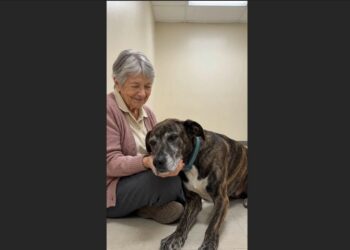
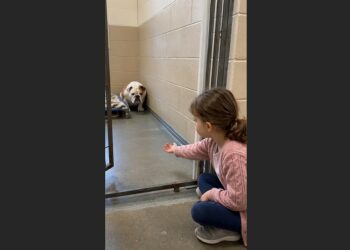
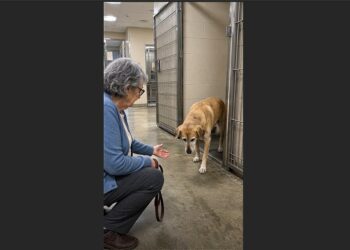
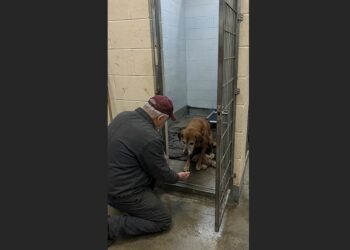
Mabel had spent 63 days at the animal shelter, and by then, the older beagle mix had stopped coming to the front of his kennel.
He spent most afternoons lying on a folded blanket near the back wall. When families walked past, he watched quietly, making no effort to attract their attention.
If someone reached through the gate, he turned his face away.
The shelter staff had tried everything they could think of to make him more comfortable. They offered treats, brought toys, and spent time sitting quietly nearby.
Nothing seemed to help.
Mabel had grown so withdrawn that he often waited until the hallway was empty before approaching his food.
Then, one Saturday morning, a nine-year-old boy arrived carrying a paperback book.
His name was Owen.
He wasn’t particularly confident around strangers, either.
And although he had come to practice reading aloud, he had no idea that the quiet dog at the back of the kennel would become his most important listener.
A boy who struggled to find his voice
Owen was nine, small for his age, with brown hair that never seemed to stay neatly in place.
At school, he struggled whenever his teacher asked him to read aloud in front of the class.
He knew the words.
That wasn’t the problem.
But when other children turned to listen, his confidence disappeared.
He would freeze, sometimes unable to get through a sentence even when he’d practiced it at home.
His mother wanted to help him become more comfortable reading without making the experience feel like another test.
When she learned that the local animal shelter offered a Saturday reading program, she signed him up.
Children could sit near the kennels and read to the dogs.
There were no grades, no classmates waiting for mistakes, and no pressure to perform.
The dogs didn’t care if a child stumbled over a word or needed to begin a sentence again.
For Owen, that sounded manageable.
At least until he arrived and heard the barking.
The quiet dog at the back
On his first Saturday, Owen walked through the shelter with his book tucked beneath his arm.
Some dogs barked when he approached. Others jumped excitedly against their kennel doors.
Owen wasn’t sure where to sit.
Then he noticed Mabel.
The older beagle mix was resting on a blanket near the back wall.
He didn’t bark.
He didn’t rush forward.
He barely moved.
Owen decided to read to him.
A volunteer helped him settle in the hallway outside the kennel, and he opened his book.
His voice was so soft that the volunteer sitting at the desk could hardly make out the words.
But Owen kept reading.
Mabel remained on his blanket.
For most of the visit, the dog showed little outward interest.
Then, partway through the reading, one of his tan ears slowly turned toward the boy.
It was a tiny movement.
But it was the first sign that Mabel might be listening.
The second Saturday
The following week, Owen came back with the same paperback.
This time, the shelter arranged for him to sit in a small visiting room with Mabel.
The dog stayed against the far wall.
Owen sat down, opened his book, and started again from the first page.
He didn’t call Mabel over.
He didn’t reach for him.
He simply read.
When he came to a difficult word, he stopped and worked through it.
Sometimes he repeated a sentence.
Mabel didn’t seem to mind.
The older dog remained quiet, and Owen gradually became more comfortable hearing his own voice in the room.
They weren’t doing anything that looked especially important.
A child was practicing his reading.
A shelter dog was resting nearby.
But every Saturday, Owen returned.
And little by little, Mabel’s behavior began to change.
Progress measured in small distances
By Owen’s fourth visit, Mabel was willing to eat a treat while the boy read.
That was encouraging.
Previously, the dog often avoided eating until the shelter hallway had emptied.
Now he could accept food with someone nearby.
Owen noticed, but he didn’t interrupt his reading to celebrate.
He simply turned the page and continued.
By the sixth visit, Mabel had begun leaving his blanket during their time together.
Instead of staying against the far wall, he sometimes settled near the water bowl.
It wasn’t especially close to Owen’s chair.
But it was closer than before.
The shelter staff understood that these were meaningful changes for a dog who had spent so much time withdrawing from human contact.
Mabel still wasn’t ready to approach or be petted.
And Owen didn’t ask him to.
The boy had learned that the dog seemed most comfortable when he was allowed to make his own decisions.
So Owen continued reading, slowly and steadily.
Mabel continued listening.
The Saturday Owen couldn’t come
Then Owen got sick.
He developed a fever and had to stay home on the day of the next reading session.
His mother let the shelter know he wouldn’t be coming.
At the usual time, Mabel left the blanket at the back of his kennel.
He went toward the visiting-room door and lay down beside it.
The shelter staff noticed.
It was the place where Owen had been spending his Saturdays.
But that morning, the boy with the paperback wasn’t there.
Mabel remained near the door for much of the day.
Even after the usual reading hour had passed, he stayed.
According to the volunteers, he didn’t return to his customary resting spot until someone began switching off the hallway lights.
Nobody could know exactly what Mabel expected.
But it was clear that his routine had changed.
The dog who had once avoided visitors had begun spending his Saturdays in a place associated with one particular child.
And when that child was absent, Mabel still went there.
The day Mabel crossed the room
Owen returned the following Saturday.
Rain was falling outside when he and his mother arrived.
He brought the familiar paperback and settled into his chair in the visiting room.
Mabel was resting across the room.
Owen opened the book and began reading.
He was halfway through a chapter when Mabel stood up.
The boy continued reading as the older dog slowly crossed the floor.
Mabel stopped twice to sniff the ground.
Then he walked toward the blue mat beside Owen’s chair.
Owen grew quiet.
For weeks, he’d been careful not to approach Mabel or ask him to come closer.
Now the dog was making that decision himself.
Mabel stepped onto the mat.
He lowered his white muzzle onto the bottom edge of Owen’s open book.
And stayed there.
Owen looked toward his mother.
She didn’t need to say anything.
After a moment, he reached down and gently placed two fingers behind Mabel’s ear.
The dog remained still.
Owen began reading again.
His voice was quiet but steady.
And Mabel stayed beside him until the chapter was finished.
The adoption form
Owen’s mother returned to the shelter alone the next morning.
She brought a leash.
She also brought an adoption form.
Much of it had been filled out in her son’s careful block letters.
After weeks of watching Owen and Mabel grow comfortable together, she had decided to bring the older dog into their family.
The staff completed the adoption arrangements.
That afternoon, Mabel walked through the shelter’s front entrance wearing the same teal collar he’d worn during his 63-day stay.
He was leaving with a family.
And the boy who had first chosen him because he didn’t bark would no longer need to wait until Saturday to see him.
A new place to listen
At home, Mabel began settling into a different routine.
There were unfamiliar rooms and new sounds, but there was also someone he already knew.
Owen continued reading every Saturday.
Only now, he didn’t have to visit the shelter to do it.
Instead of sitting on a chair beside the blue mat in the visiting room, he read in his bedroom.
Mabel found a comfortable place near the end of the bed, beside Owen’s left knee.
It became their familiar arrangement.
Owen opened his book.
Mabel settled beside him.
And the reading continued.
There was no need to call the dog over.
He already knew where he wanted to be.
Two kinds of courage
What makes Owen and Mabel’s story so touching is that neither one needed the other to be especially brave.
Owen didn’t have to stand in front of a classroom and speak loudly.
He could begin with a whisper.
Mabel didn’t have to rush toward a stranger or tolerate being touched before he was ready.
He could remain on his blanket.
For weeks, that was enough.
Owen read.
Mabel listened.
And as their Saturday routine became more familiar, both grew comfortable in ways that hadn’t seemed possible at the beginning.
Owen learned that he could read without worrying about being judged.
Mabel learned that a person could sit nearby without demanding anything from him.
The progress was slow.
There was no single moment when all of Mabel’s anxiety disappeared.
But by the time he crossed the visiting room and rested his chin on Owen’s book, something important had changed.
The dog who had spent weeks avoiding human contact was choosing to be close to someone.
And the boy who once struggled to read aloud was comfortable enough to continue his chapter with a dog’s head resting on the pages.
There’s one detail I keep coming back to.
The Saturday Owen was sick.
Mabel went to the visiting-room door anyway.
He stayed there through the usual reading hour, even though nobody was sitting inside with a book.
For a dog who had spent so much time avoiding people, it was a remarkable change.
He had grown accustomed to Owen’s visits.
Perhaps it was the familiar room, the quiet voice, or simply the predictable routine that made those Saturdays different.
Whatever the reason, Mabel had begun to seek out the place where he and Owen spent time together.
And when Owen returned, the dog finally crossed the room to be beside him.
The paperback still sits on Owen’s shelf.
One corner is bent from the day Mabel lowered his chin onto the open pages.
It’s an ordinary book, the kind a child might eventually outgrow or replace with something more challenging.
But Owen has kept it.
It reminds him of the quiet dog who listened when he could barely speak above a whisper.
And of the afternoon Mabel finally came close enough to be touched.
Mabel spent 63 days at the shelter, frightened of strangers and unwilling to leave the back of his kennel. Owen was nine and afraid to read aloud in front of his classmates.
Week after week, the boy read quietly while the dog listened. Neither was hurried. Neither was asked to do more than he could manage.
Eventually, Mabel walked across the room and rested his head on Owen’s book.
The next day, Owen’s mother came back to adopt him.
Now, every Saturday, the older beagle mix settles beside the boy’s left knee while he reads.
The setting has changed.
There are no kennel doors between them.
No shelter hallway.
No volunteers waiting nearby.
Just a boy with a book and an old dog who likes to listen.
And somewhere on Owen’s shelf is the paperback with a bent corner, marking the exact place where Mabel first decided it was safe to come close.
For weeks, Owen had been helping Mabel learn to trust. Without either of them realizing it, Mabel had been helping Owen find his voice.