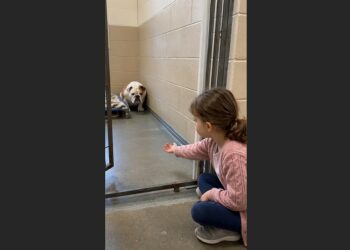
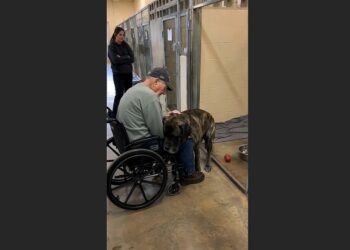
For 47 days, Milo watched people come and go from the back of his shelter kennel.
He never rushed toward the gate when visitors appeared. He didn’t bark, growl, or show his teeth. He simply watched, following every movement with his eyes until the person moved on.
The shelter workers had tried to help him feel comfortable. They offered treats, brought toys, and spent long afternoons sitting quietly outside his kennel.
Nothing seemed to make much difference.
Milo stayed near the back wall, keeping his distance from anyone who approached.
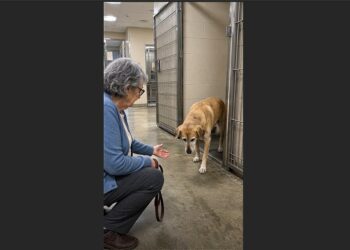
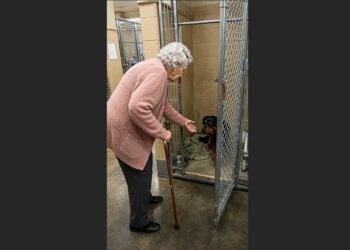
Then, on a rainy Tuesday afternoon, an elderly woman named Eleanor Price stopped outside his kennel.
She was 81 years old, walked slowly, and had spent more than three decades teaching children with serious hearing loss.
She hadn’t come looking for a dog with special needs.
But when she learned that Milo could barely hear, she understood something about him that most visitors hadn’t considered.
She didn’t call his name.
She didn’t ask him to come closer.
Instead, Eleanor waited until Milo looked at her.
Then she raised her hand.
And for the first time in weeks, the frightened dog stood up.
The dog behind the furniture store
Milo had been found behind a closed furniture store wearing a faded teal collar.
There was no identification tag attached, and the shelter had no information about where he’d come from.
He appeared frightened but wasn’t aggressive.
During his veterinary examination, the staff learned something important.
Milo had lost most of his hearing.
That discovery helped explain why he sometimes seemed particularly watchful when people approached.
The shelter workers adjusted the way they interacted with him.
They tried to remain within his field of vision rather than approaching unexpectedly. They also used gentle vibrations on the floor to make him aware that someone was nearby.
Milo could see people coming.
He could sense movement around him.
But he didn’t seem comfortable enough to approach.
As the days passed, he developed a predictable routine.
When visitors stopped outside his kennel, he watched them.
If someone reached toward him, he stayed back.
Eventually, they moved on to another dog.
And Milo remained alone.
After 47 days, the staff still hadn’t found anyone he was willing to approach.
A widow looking for companionship
Eleanor Price hadn’t planned on adopting a young, energetic dog.
She lived in a small apartment and preferred a quiet, predictable routine.
Her husband had died the previous year, leaving a silence in the home that she was still learning to live with.
There was no one sitting across from her during ordinary evenings.
No familiar voice from another room.
She’d considered the possibility of adopting a dog, but she knew she needed one whose needs she could manage.
At 81, she wasn’t interested in bringing home a puppy.
When she arrived at the shelter that rainy afternoon, she explained as much to the receptionist.
Then she began walking slowly through the kennel corridor, one hand resting on the rail.
Dogs barked as she passed.
Some stood eagerly at their gates.
But Eleanor eventually stopped in front of Milo’s kennel.
He was near the back, watching her.
She studied him for several seconds before asking a question.
“Does he hear anything?”
The volunteer explained that a veterinary examination had confirmed significant hearing loss.
Eleanor nodded.
Then she asked the people nearby to stop calling Milo’s name.
She wanted him to see her.
Thirty years of knowing how to wait
Eleanor had spent more than 30 years working with children who had serious hearing loss.
She understood the importance of visual communication, patience, and allowing someone enough time to respond.
She also knew that being unable to hear wasn’t the same as being unable to understand.
Milo might not recognize his name when someone called across the kennel.
But he could see a face.
He could notice an open hand.
And he could learn familiar visual signals.
Eleanor lowered herself carefully beside his kennel gate.
She kept her hands still.
Milo watched from the back.
She didn’t wave to get his attention or make exaggerated movements.
She simply waited.
After a while, Milo looked directly at her.
Eleanor raised one open palm.
Then she made a slow, gentle motion toward herself.
There was no spoken command.
Milo studied her.
And then he stood.
The first step
The volunteer remained nearby as Milo slowly moved away from the back wall.
He took one step.
Then he stopped.
Eleanor didn’t reach through the gate.
She held her hand where he could see it, leaving the decision to him.
Milo took another step.
He was still cautious, and his head remained low, but he was moving toward her.
When the kennel gate was opened, Eleanor stayed in place.
Milo approached slowly.
He lowered his nose toward her open palm and sniffed.
Then he remained there for several seconds.
Eleanor didn’t try to pull him closer.
She allowed him to decide how much contact he wanted.
Finally, Milo gently rested his muzzle in her hand.
The woman smiled.
“Hello,” she whispered.
She knew he probably couldn’t hear the word.
But Milo was looking at her face.
And as Eleanor smiled down at him, he stayed.
For a dog who had spent nearly seven weeks avoiding human contact, it was an extraordinary little moment.
He hadn’t suddenly become fearless.
But he’d chosen to approach someone.
And Eleanor had given him the time to make that choice.
She came back
Eleanor didn’t adopt Milo immediately.
She returned the following morning.
Then she visited again two days later.
Each time, she used the same gentle approach.
She allowed Milo to notice her before trying to communicate.
She kept her gestures clear and predictable.
And she continued giving him space whenever he seemed uncertain.
Their visits became more comfortable.
Milo began responding to the visual cues Eleanor introduced.
Within a week, he had learned three simple hand signals.
The dog who had once remained motionless at the back of his kennel was beginning to understand what Eleanor wanted without needing to hear her voice.
For Eleanor, the process was familiar.
She’d spent much of her working life helping children learn through methods suited to their needs.
Now she was applying some of that same patience to a dog who experienced the world differently.
She wasn’t trying to make Milo hear.
She was learning how to communicate with him as he was.
A teal collar by the front door
Within a month, Milo had a new home.
His faded teal collar, the same one he’d been wearing when he was found behind the furniture store, now hung beside Eleanor’s front door.
It was a quiet but meaningful change.
For 47 days, Milo had waited at the shelter while visitors passed his kennel.
He’d watched people approach, then leave.
He hadn’t known what to expect from them, and most hadn’t stayed long enough to build trust.
But Eleanor had approached him differently.
She’d recognized that calling his name wasn’t necessarily useful.
She’d waited for him to look at her.
And when he finally did, she communicated in a way he could understand.
That first visit became several more.
Those visits became a relationship.
And eventually, Milo went home with her.
Eleanor’s apartment was small, and her life was quiet.
But it offered something Milo hadn’t found at the shelter.
A familiar person who understood how to communicate with him.
Two lives that had grown quiet
There was something fitting about Eleanor and Milo finding each other.
Eleanor had spent the year after her husband’s death adjusting to a home that no longer sounded the same.
Milo had spent weeks at the shelter unable to hear most of what happened around him.
Their circumstances were very different, but both had been living with a kind of separation from the world around them.
Eleanor didn’t need a loud, playful companion.
She wanted a dog she could share her days with.
And Milo didn’t need someone who could call his name across a room.
He needed a person who understood how to get his attention without frightening him.
Neither could change what had happened before they met.
Eleanor couldn’t bring her husband back.
Milo couldn’t simply regain the hearing he’d lost.
But they could create a new routine together.
One built on familiar gestures, patience, and the comfort of having someone nearby.
I keep thinking about the moment Eleanor first knelt beside Milo’s kennel.
She was 81 years old.
He was a frightened dog who had spent 47 days refusing to come forward.
Around them, there were people who wanted to help.
They’d called his name, brought treats, and tried to encourage him to trust them.
But Eleanor understood that the first step wasn’t asking Milo to listen.
It was giving him something he could see.
She waited until their eyes met.
Then she raised her open palm.
And Milo stood.
It was such a small beginning.
One movement.
One uncertain step.
Then another.
But those few steps eventually carried him out of the shelter and into a home of his own.
For 47 days, Milo stayed near the back of his kennel, too frightened to approach visitors. A veterinary examination had shown that he had lost most of his hearing.
Then 81-year-old Eleanor Price, a retired teacher who had spent more than 30 years working with children with hearing loss, came to visit. She didn’t call his name. She waited for him to look at her and offered a simple hand signal.
Milo stood.
He approached.
And when the gate opened, he gently rested his muzzle in her hand.
Eleanor returned several times, and within a week, Milo had learned three visual cues.
Within a month, his teal collar was hanging beside her front door.
For the first time in nearly two years, Eleanor had a companion sharing her quiet apartment.
And Milo had someone who knew how to reach him.
The shelter had spent weeks trying to call Milo closer. Eleanor never needed him to hear her. She simply made sure he knew she was there.