Susan hadn’t planned to adopt a dog the afternoon she first saw Ben.
She’d only stopped at the shelter to look around. Her friends had been encouraging her to get a companion ever since her husband passed away, but nearly two years later, she still wasn’t sure she was ready.
The house had become terribly quiet without him.
At first, that silence had been difficult to bear. Eventually, she’d grown accustomed to it. She had her routines, her familiar furniture, and her days arranged exactly the way she wanted them.
Bringing a dog into her life meant changing all of that.
She wasn’t certain she could.
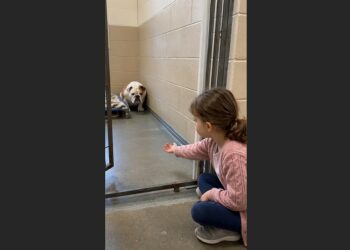
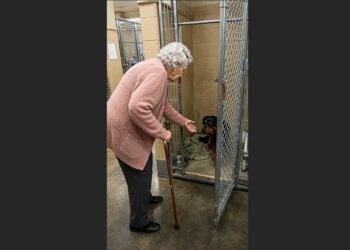
Then she walked past a kennel where a brown dog sat alone near the back wall.
His name was Ben.
He had been waiting for a home for 126 days.
And unlike the other dogs hoping to catch someone’s attention, Ben seemed to be doing everything he could to avoid being noticed.
The dog nobody could get close to
Ben wasn’t aggressive.
He didn’t bark at visitors or cause trouble for the shelter workers.
But whenever someone reached toward him, he lowered his head and backed away.
Most people interpreted his behavior as disinterest.
They wanted a dog who would greet them happily, accept affection, and seem excited about going home.
Ben couldn’t offer that kind of greeting.
A shelter worker explained that he’d come from a home where people had handled him roughly and left him alone for long stretches.
Those experiences had made him wary of human contact.
He had learned to be cautious around hands, especially unfamiliar ones.
The longer he remained at the shelter, the more difficult it became for visitors to see beyond his fear.
He stayed at the back of his kennel while families stopped to meet other dogs.
Some looked at him briefly.
Most moved on.
By the time Susan arrived, he’d spent more than four months waiting.
She stopped outside his kennel and watched him for a moment.
Ben looked back but didn’t approach.
Susan didn’t try to change that.
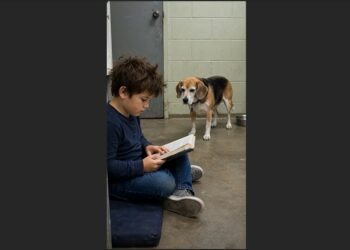
Instead, she sat down outside the kennel and began speaking softly.
She stayed only a few minutes.
Then, before Ben became overwhelmed, she got up and left.
She hadn’t touched him.
She hadn’t offered him a leash or asked him to come closer.
But she knew she wanted to visit him again.
A reason to return
The next time Susan came to the shelter, Ben was still cautious.
He watched her from the corner while she sat outside his kennel.
She spoke quietly, just as she had on the first visit.
Nothing remarkable happened.
Ben didn’t rush forward or suddenly decide he trusted her.
But Susan hadn’t expected him to.
She returned again.
And again.
Over the following weeks, those visits became part of her routine.
At first, Ben remained near the back whenever she appeared.
Later, he began staying a little closer to the front.
Eventually, he accepted a treat from her hand.
For a dog who had spent so long avoiding human contact, it was an important step.
Susan noticed the small changes without trying to hurry him.
She understood that Ben needed to decide for himself when he felt comfortable approaching.
And as the weeks passed, another change became apparent.
When Susan’s voice carried down the hallway, Ben began lifting his head.
He was learning to recognize her.
The woman who once arrived as a stranger had become someone familiar.
Two lives shaped by loss
Susan hadn’t expected to feel so attached.
When she’d first visited the shelter, she’d been uncertain about adopting any animal.
Now she found herself thinking about Ben between visits.
She wondered whether he’d been comfortable that day and whether another family might finally see what she saw in him.
But she also worried about what bringing him home would mean.
Her husband’s death had changed so much about her life.
For almost two years, she’d been learning how to manage the house alone.
There were routines she’d developed simply to get through the days.
She’d grown used to the quiet.
Inviting a dog into that space meant allowing her life to change again.
Part of her wanted that.
Another part was frightened by it.
Ben seemed to be facing a different version of the same difficulty.
He had lived through experiences that made it hard for him to trust.
Even when people approached with kindness, his first instinct was to protect himself by moving away.
Susan couldn’t erase his past.
And Ben couldn’t fill the place her husband had held in her life.
But perhaps they could offer each other something neither had found in a long time.
A little companionship.
And the chance to build a new routine.
Making a place for Ben
Eventually, Susan decided she wanted to adopt him.
She understood that Ben might need time to adjust to living in a home.
She didn’t expect him to become affectionate overnight.
And she knew that bringing home a frightened dog required more than simply opening the front door.
Once the adoption was approved, she began preparing.
She placed a soft dog bed beside the couch, close enough for Ben to be near her without feeling crowded.
She laid rubber mats across the kitchen floor so he would have secure footing.
His food and water bowls went into a quiet corner where he could eat without being disturbed.
Susan checked the garden gate twice.
She moved fragile objects out of the way and looked around the house for anything that might cause a problem.
Then she cleared her calendar.
She didn’t want Ben’s first days to be filled with visitors, noise, or unfamiliar demands.
He would have time to explore.
Time to rest.
And time to learn that nobody in his new home was going to rush him.
By the time adoption day arrived, everything was ready.
Except Susan wasn’t entirely sure her nerves were.
The day she came back with a leash
Susan arrived at the shelter carrying a simple brown leash.
She’d imagined this moment during the weeks she’d spent visiting Ben.
But when she reached his kennel, he was still standing near the back.
The door opened.
Ben didn’t move.
The shelter worker gave him time.
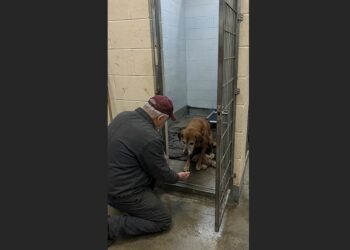
Susan lowered herself carefully, keeping one hand against her knee for support.
With her other hand, she made a small, gentle gesture toward him.
She didn’t reach into his space.
She simply held her hand where he could see it.
“Finally… you’re coming home,” she said.
Ben watched her.
He had heard that voice so many times now.
It was the voice that came down the hallway and stopped outside his kennel.
The voice that never demanded anything from him.
The voice that had become familiar enough that he sometimes lifted his head before she reached the door.
Now Susan was there again.
And this time, she wasn’t leaving without him.
The moment Ben came forward
For a few seconds, Ben remained still.
Then he took one uncertain step toward the open doorway.
He stopped.
Susan didn’t move closer.
The leash stayed looped in her hand.
Ben took another step.
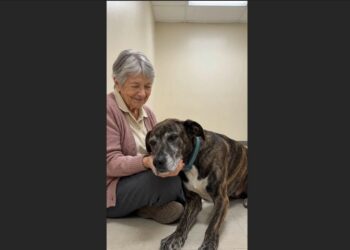
When he reached her, he lowered his head and sniffed her fingers.
Susan waited.
Then Ben moved closer still.
He pressed his head against her shoulder.
It was such a quiet gesture that nobody needed to say anything.
For months, Ben had pulled away whenever unfamiliar hands approached.
Now he was choosing to lean against someone.
Susan gently put her arms around him.
And Ben stayed.
He didn’t immediately retreat to the back of the kennel.
He didn’t turn away from her touch.
He simply rested against the woman who had spent weeks showing him that he could come closer whenever he was ready.
The brown leash remained unused in Susan’s hand.
There was no need to hurry him into the hallway.
They had waited a long time for this moment.
A few more minutes wouldn’t matter.
The home waiting for them
Outside the shelter, Susan’s car was waiting.
At home, the soft bed stood beside the couch.
The kitchen mats were in place, the garden gate was secure, and the food bowls were ready.
Susan had done everything she could to make the transition easier.
She knew Ben might still be nervous.
There would be unfamiliar sounds, new rooms, and routines he would need time to understand.
Some days might be more difficult than others.
But he wouldn’t have to figure everything out at once.
Susan had already shown him that.
During all those visits, she had never insisted he become a different dog just to make her feel welcome.
She’d accepted his caution.
She’d allowed him to keep his distance.
And gradually, he’d begun to trust her.
Now they would have the opportunity to continue that work at home.
A different kind of beginning
What stays with me about Susan and Ben is that neither one arrived at the shelter particularly certain about the future.
Susan was a widow who had spent nearly two years learning to live alone.
She wasn’t convinced she had room in her life for another companion.
Ben was a frightened dog who had spent 126 days watching families pass his kennel.
He couldn’t easily trust the hands that reached toward him.
Their first meeting was almost uneventful.
Susan sat outside.
Ben watched from the back.
After a few minutes, she left.
But she came back.
And each time she returned, Ben had another opportunity to discover that her presence didn’t mean something frightening was about to happen.
She never demanded a greeting.
She let him make the decisions.
Eventually, the dog who once moved away from every approaching hand began accepting treats from hers.
Then he started lifting his head when he heard her voice.
And on adoption day, he pressed his face against her shoulder.
It wasn’t a dramatic transformation.
It was something quieter.
A frightened animal deciding that one person might be safe.
Susan had wondered whether she was ready to let someone new into her life.
Perhaps she’d been waiting for a day when she would feel completely certain.
A day when adopting a dog would no longer seem frightening or complicated.
But that day hadn’t arrived.
Instead, she’d met Ben.
And somewhere between their first quiet visit and the afternoon she brought a leash to the shelter, she’d realized that uncertainty didn’t mean she had to remain alone forever.
She could miss her husband and still make room for a dog.
She could be nervous about change and still choose it.
Ben didn’t need to replace anyone.
He simply needed a home where he could feel safe.
And Susan had one waiting.
For 126 days, Ben stayed near the back of his kennel, too frightened to approach the people who came looking for a dog. Susan, a widow who had spent nearly two years living alone, began visiting him without asking for anything in return.
Weeks later, she returned with an adoption form approved and a brown leash in her hand. When the kennel door opened, Ben slowly approached and rested his head against her shoulder.
Susan put her arms around him.
The leash remained looped in her hand.
For once, neither of them needed to think about what came next.
The shelter door would be there when they were ready.
And beyond it was a quiet house with a soft bed beside the couch, waiting for a dog who had spent too long afraid to come close.
Susan had prepared a place for Ben.
But standing there with his head against her shoulder, she realized something else.
For the first time in almost two years, she was looking forward to going home with someone beside her.