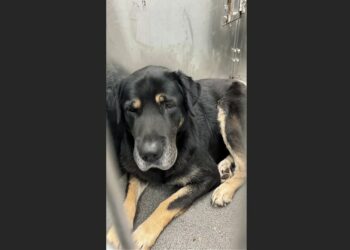
Daisy had learned to stay in the back corner of her kennel.
She was a large bulldog, broad and strong-looking, but the way she stood told a different story. Her head hung low, her body remained tense, and her paws seemed planted firmly against the floor.
A raised dog bed sat nearby, untouched.
Whenever visitors passed through the shelter, Daisy watched them without moving.
She didn’t bark or growl. She didn’t rush toward the gate looking for attention.
She simply stayed where she was, too frightened to come closer.
The shelter staff knew she was struggling. Since arriving, Daisy had shown little willingness to approach unfamiliar people, even when they were trying to be kind.
Most visitors took one look at the nervous dog and continued down the hallway.
Then a little girl named Molly stopped outside her kennel.
She wasn’t there to train Daisy or work with frightened animals.
Her mother had brought her to the shelter for a short visit, expecting they’d meet a few dogs before heading home.
But Molly saw something in Daisy that made her want to stay.
And rather than asking the dog to come to her, she sat down on the floor and waited.
The dog who wouldn’t come forward
Daisy’s kennel was in one of the quieter rows of the shelter.
There were other dogs nearby, some eager to meet visitors and others resting on their beds.
Daisy stood pressed against the back wall.
Her body was large enough to make her look intimidating from a distance, but she showed none of the confidence people might associate with a dog her size.
Her eyes followed anyone who approached.
And when someone lingered near her enclosure, she remained tense.
The shelter workers explained that Daisy wasn’t aggressive.
She was frightened.
They didn’t know how long it would take for her to become comfortable around new people.
They only knew that trying to rush her wasn’t helping.
Her fear made it difficult for visitors to see what she might be like in a home where she felt secure.
So Daisy waited.
And the people looking for a dog usually chose someone else.
A little girl who didn’t hurry
Molly was wearing a pink cardigan when she stopped outside Daisy’s kennel.
Her mother had expected them to continue walking, but Molly lowered herself to the concrete floor instead.
She sat near the entrance, watching the bulldog quietly.
Her cardigan bunched around her elbows as she leaned forward.
Daisy remained against the wall.
Molly didn’t seem bothered.
She wasn’t holding a treat, and she hadn’t brought a toy.
She didn’t try to get Daisy excited or make her come closer.
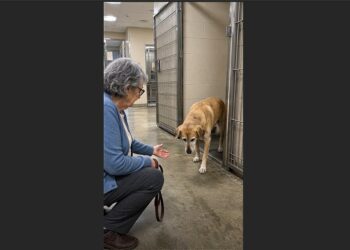
Instead, she slowly extended one hand, palm facing upward.
Then she spoke in a soft voice.
“Come on,” she said. “It’s okay.”
Daisy didn’t move.
Her eyes remained fixed on Molly.
The little girl kept her hand where it was, making no sudden movements.
There was no need to hurry.
For a while, they simply watched each other.
One small step
After several quiet moments, Daisy shifted her weight.
One front paw moved away from the corner.
Then she stopped.
Her body was still tense, and she seemed uncertain about leaving the spot where she’d felt safest.
Molly didn’t lean forward to close the distance.
She continued speaking gently.
Daisy watched her.
Then the bulldog moved another step.
And another.
She was still cautious, but she was no longer standing pressed against the back wall.
For the shelter workers, even that was encouraging.
Daisy had been reluctant to approach people since arriving.
Yet here she was, moving toward a child who had done little more than sit quietly and offer her hand.
Molly continued waiting.
She didn’t seem interested in making the moment happen faster.
As Daisy approached, the little girl’s voice grew even softer.
And eventually, the dog’s nose came close enough to sniff her hand.
The moment Daisy allowed herself to be held
Molly smiled.
She leaned toward Daisy carefully.
The large bulldog remained close.
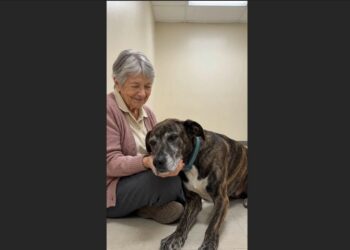
Then Molly gently put her arms around the dog’s neck.
For a moment, the contrast was striking.
A small child in a pink cardigan was embracing a powerful dog who had been too frightened to leave the corner of her kennel.
Daisy didn’t pull away.
Instead, she remained beside Molly, allowing the contact.
Her body was still cautious, and there was no reason to assume all her fears had disappeared.
But for that moment, she was comfortable enough to stay close.
The dog who had watched so many visitors walk past was accepting affection from someone who had simply given her time.
Molly hadn’t needed to convince Daisy with a toy or a treat.
She’d let the dog approach at her own pace.
And Daisy had made the decision to come forward.
Trust begins quietly
It would be easy to describe Daisy’s behavior as a complete transformation.
But that wouldn’t be fair to her.
She was still a frightened dog.
One gentle encounter couldn’t erase whatever experiences had made her so cautious.
She would likely need continued patience, careful handling, and a predictable environment to become fully comfortable.
But something meaningful had happened.
Daisy had voluntarily approached a person.
She had sniffed an offered hand.
And she had remained close enough to accept a gentle embrace.
Those might seem like ordinary things for a friendly, confident dog.
For Daisy, they were important steps.
The shelter staff had been trying to help her feel comfortable since she arrived.
Now they had seen her respond to a quiet approach that allowed her to make her own decisions.
Molly hadn’t treated her fear as something she needed to overcome immediately.
She’d simply made room for it.
The visit neither of them expected
Molly’s mother had brought her to the shelter thinking they’d spend a little time looking at dogs and then go home.
She couldn’t have anticipated that her daughter would stop beside a frightened bulldog and remain there patiently while the dog decided whether to approach.
Molly didn’t arrive with any special knowledge about animal behavior.
She just seemed to understand that Daisy was scared.
And when she saw the dog pressed into the corner, she didn’t demand anything from her.
She sat down.
She offered her hand.
She spoke gently.
Then she waited.
For a dog who had learned to be wary when people approached, that small amount of space appeared to make a difference.
Daisy could move forward without feeling chased.
She could stop whenever she needed to.
And when she finally reached Molly, the greeting belonged to her as much as it did to the child.
What stays with me about their meeting is the distance Daisy crossed.
At first, she was pressed against the back wall.
Her head was low.
Her paws were planted firmly beneath her.
And every part of her posture suggested that she wanted to remain where she felt safe.
Molly was sitting some distance away, with her palm turned upward.
Nothing happened for a while.
Then Daisy moved one paw.
She stopped.
She moved again.
And eventually, the space between them disappeared.
It wasn’t a dramatic rescue.
No one carried Daisy out of danger or promised that she’d never feel afraid again.
A little girl simply sat with a nervous dog and gave her enough time to make a choice.
That was what made the moment special.
Daisy had been too frightened to approach visitors at the shelter, spending much of her time pressed into the back corner of her kennel. When Molly arrived, she didn’t try to force a greeting. She sat down, held out her hand, and spoke softly.
Slowly, Daisy left the corner. She approached the little girl, sniffed her hand, and allowed herself to be embraced.
There was no confirmed adoption at the end of their visit.
Daisy’s future was still uncertain.
But for a few quiet minutes, she had stepped beyond the fear that had kept her apart from everyone.
And Molly had been there to welcome her.
The large bulldog was still learning whether people could be trusted.
That day, a little girl in a pink cardigan gave her one more reason to believe they could.
Daisy hadn’t stopped being afraid. She had simply found someone patient enough to let her come closer when she was ready.