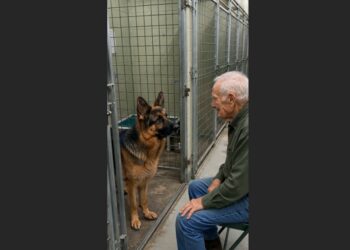
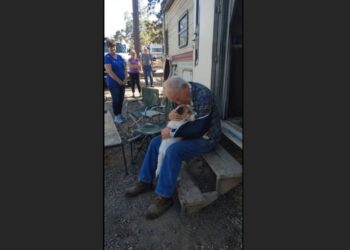
Noah hadn’t gone to the county animal shelter looking for a dog to adopt.
He’d recently started volunteering after his sister encouraged him to spend less time working on weekends and more time doing something outside his usual routine.
His plan for the afternoon was simple.
Walk a few dogs, help clean some kennels, and go home.
But before he’d even signed the visitor log, a senior volunteer stopped him.
“If you’re thinking about walking dogs today,” she said, “just… don’t start with Titan.”
Noah looked surprised.
“Why? Is he aggressive?”
The woman immediately shook her head.
“No. That’s the strange part.”
She glanced toward the last row of kennels.
“He’s one of the sweetest dogs we’ve ever had.”
Then she explained the problem.
Titan had been adopted five times.
And five times, he’d been returned.
Every family had described him as gentle and affectionate. He was house-trained, had never bitten anyone, and hadn’t caused the usual problems people sometimes associate with difficult shelter dogs.
But he became deeply attached to the people caring for him.
He followed them everywhere.
He whined when they left.
And his constant need for companionship was more than those families had expected.
Eventually, each one brought him back.
After the fifth return, Titan had barely shown any interest in leaving his bed.
Noah listened quietly.
Then he asked to meet him.
An hour later, the dog who had been returned by five different families did something none of the shelter workers had seen before.
He placed one paw across Noah’s foot.
And refused to move.
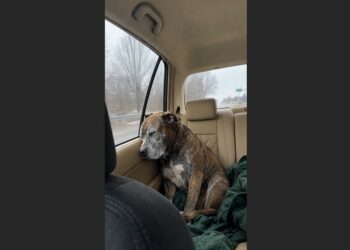
Titan was a broad-headed blue Pit Bull with a white chest and soft amber eyes.
He lived in one of the quietest kennels at the far end of the adoption building.
When Noah first saw him, Titan was lying on his bed with his head resting between his front paws.
He wasn’t barking at passing visitors.
He wasn’t jumping against the gate.
He simply watched the hallway.
Most of the other dogs became excited when someone approached.
Titan barely reacted.
The volunteer explained that he hadn’t always been so withdrawn.
When he first arrived at the shelter, he’d been friendly and eager for attention.
He enjoyed meeting people.
He played with toys.
And whenever someone stopped near his kennel, his tail began wagging.
Then came the adoptions.
And the returns.
A thick folder hung beside Titan’s kennel.
Noah opened it.
Inside were five surrender forms from five different families.
The explanations weren’t identical, but they described a similar difficulty.
“Too attached.”
“Whines whenever we’re gone.”
“Follows us constantly.”
“Seems anxious all the time.”
“Needs someone who’s home more often.”
Noah read through the paperwork.
None of the families had described Titan as vicious or destructive.
There were no reports of him snapping at people or destroying furniture.
In fact, the families had generally agreed that he was a sweet dog.
But they hadn’t been prepared for how strongly he wanted to remain near them.
One by one, they’d decided they couldn’t give him the kind of home he needed.
And each time, Titan returned to the shelter.
The volunteer told Noah that his behavior had changed after those experiences.
Following the first return, Titan was still enthusiastic about meeting people.
He greeted visitors and showed interest in the other dogs.
After the second, he became less eager to approach strangers.
By the fourth return, he’d stopped playing with his toys.
And after the fifth, he spent most of his time lying quietly on his bed.
The staff tried to encourage him.
They offered puzzle toys and arranged training sessions.
They took him for additional walks.
Some volunteers spent hours sitting with him, hoping the extra companionship would help.
But Titan remained withdrawn.
Nobody could know exactly what he understood about being returned.
Still, the pattern was difficult for the staff to ignore.
Every time he’d begun settling into a family, he’d eventually been brought back to the same kennel.
And with each return, he seemed less interested in forming another connection.
Noah looked at Titan through the gate.
The dog watched him quietly.
There was no excitement or obvious invitation to approach.
But Noah was curious.
He wanted to spend time with the dog everyone had been struggling to help.
“I’ll take him for today’s walk,” he told the volunteer.
She opened the kennel and prepared the leash.
Titan stood.
He moved slowly, without jumping or pulling.
Then he approached Noah and waited.
There was something cautious about him, as though he was unsure what this unfamiliar man wanted.
Noah didn’t try to make him excited.
He simply led him outside.
The shelter had a wooded exercise trail where volunteers could walk the dogs away from the noise of the kennels.
For the first fifteen minutes, Titan kept a little distance between himself and Noah.
His head stayed low.
His tail barely moved.
When Noah spoke, Titan seemed to listen, but he showed little response.
They continued along the trail at a comfortable pace.
Noah wasn’t expecting an immediate connection.
He knew Titan had been through several unsuccessful placements, and he didn’t want to pressure him into interacting.
So they walked.
Then a loud truck passed near the shelter entrance.
Titan startled.
His body tightened, and he moved closer to Noah.
For the first time during the walk, his shoulder brushed against the man’s leg.
Noah reached down and gently scratched behind his ears.
Titan became still.
He didn’t pull away.
But he didn’t immediately relax, either.
Noah kept the interaction brief and allowed him to decide whether to remain close.
A few minutes later, Titan glanced up at him.
His tail moved.
Just one slow wag.
As they continued walking, something began to change.
Titan stopped keeping several feet between them.
Instead, he walked beside Noah.
When Noah slowed down, Titan slowed down.
When he stopped, the dog stopped with him.
They reached a small pond beside the trail, and Noah paused to look at the water.
Titan sat down next to him.
Then he leaned his warm body against Noah’s knee.
For several minutes, neither moved.
The dog who had barely responded to visitors inside the shelter was now sitting quietly beside someone he’d only recently met.
Noah rested there with him.
He hadn’t planned to form an attachment that afternoon.
But he was beginning to understand why the shelter workers spoke so affectionately about Titan.
The Pit Bull wasn’t difficult to be around.
He seemed to want very little beyond gentle attention and the freedom to remain close.
And Noah found himself enjoying the company just as much.
Eventually, they had to return to the shelter.
Noah led Titan back inside and knelt to remove his leash.
The metal clip opened.
Normally, the dogs would return to their kennels after a walk.
But Titan didn’t move.
Instead, he lowered his head and rested his chin on Noah’s sneaker.
Noah smiled.
“Come on, buddy.”
Titan stayed where he was.
A volunteer called his name.
He didn’t respond.
Another employee brought out one of his favorite toys and squeaked it.
Titan didn’t even look.
Someone tossed a tennis ball along the hallway.
Still nothing.
The Pit Bull remained close to Noah.
Then, very slowly, he lifted one front paw.
And placed it across Noah’s foot.
The volunteers stopped to watch.
Titan wasn’t pulling at Noah’s clothes or barking to keep his attention.
He wasn’t displaying the frantic behavior described in some of his previous surrender forms.
He was sitting quietly with his chin near the man’s shoe and one paw resting across his foot.
Noah tried standing.
Titan stood with him.
When Noah stepped toward the exit, Titan followed.
But when Noah turned back toward the kennel, the dog sat down in front of him.
He looked up with those soft amber eyes.
The staff had spent months trying to encourage Titan to become interested in people again.
Now he was showing a clear preference for staying near this particular volunteer.
The shelter director happened to pass through the hallway and stopped.
She watched the two of them for a moment.
“I’ve worked here for almost six years,” she said quietly. “I don’t think he’s ever asked anyone to stay.”
Noah looked down at Titan.
He hadn’t come to the shelter looking for a companion.
He’d come because his sister thought volunteering might be good for him.
He’d expected to spend a few hours helping animals and then return to his usual life.
Instead, a dog who’d been returned five times was resting a paw across his foot.
“I wasn’t planning on taking home a dog today,” Noah admitted.
The director smiled.
Noah crouched again.
He wrapped his arms gently around Titan’s thick neck.
The Pit Bull let out a long sigh and pressed his forehead against Noah’s shoulder.
There was no way to know what Titan was thinking.
He couldn’t understand the adoption paperwork or the reasons five families had brought him back.
But he seemed comfortable with Noah.
And after everything the volunteers had told him, Noah didn’t want to dismiss that small connection.
He stayed beside the dog for another moment.
Then he made his decision.
“I think you’ve waited long enough.”
The adoption paperwork was completed before sunset.
That evening, Titan climbed into Noah’s truck.
He looked toward the shelter before settling into the passenger seat.
During the drive home, he rested his head near the center console.
For Noah, the day had taken a completely unexpected turn.
He’d left home intending to volunteer.
Now he was bringing back a dog with a history of struggling whenever he became separated from the people caring for him.
He understood that this might not be easy.
Titan had been described as gentle and well behaved, but his attachment-related anxiety was a real concern.
Noah couldn’t assume that one pleasant afternoon would solve everything.
He would have to learn Titan’s routines, understand his needs, and help him adjust to a new home.
But he was willing to try.
That first evening, Noah gave Titan time to explore.
The Pit Bull moved carefully through the house, sniffing unfamiliar corners and investigating the rooms.
He didn’t rush around.
He didn’t chew anything or begin barking.
Eventually, he settled beside the living room couch.
For several minutes, he rested with one eye open, watching Noah.
Noah stayed nearby.
When it was time for bed, he turned off the lights.
“Goodnight, buddy,” he said softly.
Titan stretched out.
His breathing slowed.
And before long, he was sleeping deeply.
It was a peaceful beginning.
Noah knew that adjustment could take longer than one night, but he was glad Titan had found a comfortable place to rest.
The next morning, Titan was waiting near the kitchen door.
His tail was wagging.
He seemed pleased to see Noah moving around the house.
As breakfast was prepared, he stayed nearby, following the familiar movements of a person beginning the day.
It was a small thing.
But after hearing how withdrawn Titan had become at the shelter, Noah appreciated seeing him interested in his surroundings.
The dog who had barely wanted to leave his bed was now looking forward to ordinary activities.
A morning meal.
A walk.
Time spent with someone he was beginning to know.
Weeks passed.
Then months.
Titan gradually became more comfortable in his new home.
The shelter dog who’d been returned repeatedly because of his attachment to people began developing a predictable routine with Noah.
They took regular walks.
Titan became familiar with the neighborhood.
And the people who met him soon came to recognize him as a friendly Pit Bull who greeted others with gentle tail wags.
He still enjoyed being close to Noah.
That part of his personality hadn’t disappeared.
But the relationship was becoming more settled.
His need for companionship no longer meant another immediate return to the shelter.
He had someone willing to understand him.
And that made a difference.
Neighbors sometimes asked Noah how he’d managed to change Titan.
They’d heard that the dog had been adopted and returned five times.
They knew he’d struggled with anxiety and become withdrawn at the shelter.
Yet when they met him, they saw a gentle dog who enjoyed walks and seemed comfortable in his home.
Some people asked how Noah had “fixed” him.
Noah always gave the same answer.
“I didn’t.”
Then he’d explain what he believed had changed.
Titan had finally begun to experience a stable home where he could develop familiar routines without being repeatedly returned.
It wasn’t that Noah had discovered some secret technique.
He’d simply made room for a dog whose need for closeness had overwhelmed other families.
And he had stayed.
That doesn’t mean every dog with separation-related anxiety will improve simply because someone adopts them.
Some need careful training, structured routines, professional behavioral support, or veterinary guidance.
And families considering adoption should understand what they’re realistically able to provide.
The five households that returned Titan had described difficulties they couldn’t manage.
Their decisions had left him without a permanent home, but that didn’t necessarily mean they hadn’t cared about him.
What mattered was finding a situation suited to Titan’s needs.
For Noah, the match worked.
He appreciated Titan’s affectionate nature.
He was willing to make a lasting commitment.
And over time, Titan seemed to become more comfortable with the predictability of their life together.
The shelter staff had once known Titan as the dog who stopped playing after repeated returns.
They remembered when he greeted everyone enthusiastically.
Then came the gradual withdrawal.
Less interest in visitors.
Less excitement about toys.
More time spent lying quietly in his kennel.
Nobody knew how long it would take to find a family willing to try again.
Then Noah appeared.
A man who hadn’t intended to adopt anyone.
He listened to the warnings.
Read the surrender forms.
And still decided to take Titan for a walk.
That simple decision gave them time to meet without expectations.
They walked along the wooded trail, stopped beside a pond, and spent a few quiet minutes together.
By the time they returned, something had changed.
I think the most memorable part of Titan’s story happened in the shelter hallway.
The walk was over.
The leash had been unclipped.
And Noah was preparing to leave.
There was nothing unusual about that moment.
Volunteers walk dogs every day.
They return them to their kennels and move on to the next task.
But Titan didn’t return to his bed.
He lowered his chin onto Noah’s sneaker.
When staff members tried toys and called his name, he remained close.
Then he rested one paw across Noah’s foot.
It wasn’t proof that the dog understood what adoption meant.
But it was an unmistakable sign that he wanted to remain near the person who’d just spent time with him.
And Noah paid attention.
Five families had adopted Titan. Five families had returned him because his need for companionship was more than they could manage.
After the fifth return, he became so withdrawn that he barely left his bed. But during one walk with a new volunteer, he slowly began seeking closeness again.
When the walk ended, he placed his paw on Noah’s foot and stayed there.
By sunset, the two of them were heading home together.
Months later, Titan was still with Noah.
The dog who once spent his days watching people pass his kennel now had familiar walks, a comfortable place to sleep, and someone who enjoyed having him close.
Titan didn’t need to become a different dog to deserve a home.
He was affectionate.
He liked company.
And he felt safest when he could remain near someone he trusted.
Those qualities had been difficult for his previous families to accommodate.
But they weren’t reasons he was incapable of being loved.
Noah saw the same needs and decided he could make room for them.
The result wasn’t an instant cure or a perfect transformation.
It was a relationship that grew more comfortable with time.
And that was enough.
Noah went to the shelter expecting to walk a few dogs and go home alone.
Titan had already been brought back five times. But on the afternoon they met, he rested one paw across Noah’s foot—and Noah decided there wouldn’t be a sixth return.
The old kennel at the end of the hallway was no longer where Titan spent his evenings.
He had a home.
And for the rest of his life, Noah intended to make sure he could keep it.
If Titan’s story touched your heart, please consider sharing it with someone who loves rescue dogs. Sometimes the animal others find difficult to adopt is simply waiting for a person whose life has room for the companionship they need.