The old chocolate Labrador didn’t belong to me.
At least, that’s what I kept telling myself every evening when he appeared on my front porch.
He had no collar, no identification tags, and no obvious interest in going anywhere else. He simply arrived before sunset, settled beside the wooden bench where my late wife used to tend her flowers, and waited.
I called him Moose.
Not because I intended to keep him. I just needed something to call the old dog who kept showing up at my house.
For eighteen days, he became part of my evening routine.
Then one rainy night, I finally let him inside.
He wandered through the hallway, past the living room and dining table, until he reached the sunroom.
There, he stopped beside my wife Eleanor’s wicker rocking chair.
She had died of cancer nearly a year earlier.
Her reading glasses were still on the side table, and the knitting basket beside her chair held a scarf she’d never finished.
Moose circled twice, settled onto the faded rug, and fell asleep.
The following morning, I found him curled beneath her knitting basket, one paw resting against the unfinished scarf.
That was when I stopped pretending he was just a neighborhood dog passing through.
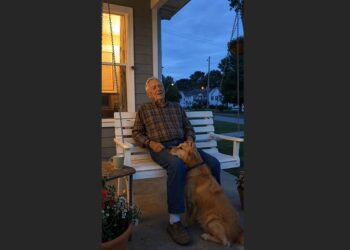
Eleanor had always loved our front porch.
She kept flower boxes along the railing and spent her evenings caring for the plants, often sitting on an old wooden bench while the neighborhood settled down around us.
After she died, I continued watering the flowers.
It was one of the few routines I hadn’t changed.
Our quiet cul-de-sac was lined with maple trees. In the evenings, I could hear distant lawn mowers, dogs barking, and children riding bicycles home before dinner.
Everything around me seemed to continue as it always had.
But the house felt different.
I no longer heard Eleanor moving around in the kitchen or calling from the sunroom.
There was no one sitting beside me when the sun began to set.
I’d grown accustomed to doing things alone, although I can’t say I’d grown comfortable with it.
Then, on a cool Thursday evening, Moose appeared.
I was watering the flower boxes when I noticed him standing at the end of the walkway.
He was an elderly chocolate Labrador with a graying muzzle and warm brown eyes.
His coat had faded in places, and white hairs covered his chin and eyebrows.
One ear bent slightly where an old injury appeared to have healed.
He looked to be around eleven years old.
He didn’t seem frightened, but he wasn’t particularly excited, either.
He simply watched me.
“Wrong house, buddy,” I told him.
He blinked.
Then he slowly climbed the porch steps and lay down beside Eleanor’s bench.
I waited for him to leave.
He didn’t.
Five minutes later, I was filling an old mixing bowl with water.
A little while after that, I found myself warming leftover roasted chicken.
Apparently, I wasn’t nearly as good at ignoring elderly dogs as I’d imagined.
Moose ate slowly and carefully.
When he finished, he nudged the empty bowl toward me with his nose.
Then he wandered down the walkway and disappeared into the evening.
I assumed that would be the end of it.
The next afternoon, he returned.
He appeared at almost the same time, walked up the porch steps, and settled beside Eleanor’s bench.
I gave him water.
He stayed for a while, then left.
The following afternoon, he came back again.
Soon, I found myself expecting him.
Just before sunset, I’d glance toward the walkway.
And more often than not, Moose would appear, making his way toward the porch with the unhurried confidence of a dog who knew where he wanted to go.
I still believed he must belong to someone.
He was too comfortable around people to seem entirely unfamiliar with family life.
So I started looking for his owner.
I checked neighborhood social media groups and called two nearby animal shelters.
I visited the veterinary clinic three streets away, hoping someone might recognize his description.
Nobody did.
There were no missing-dog reports matching an elderly chocolate Labrador with a bent ear.
Even Officer Ramirez, who seemed to know practically everyone in town, didn’t recognize him.
One afternoon, he scratched Moose behind the ears and smiled.
“Funny thing. This old fellow doesn’t seem lost.”
“What makes you say that?” I asked.
“He walks like someone who already knows exactly where he’s supposed to be.”
I laughed.
But I thought about those words afterward.
For another week, Moose continued visiting.
I left food and fresh water on the porch.
As the autumn evenings grew colder, I brought out an old blanket for him.
He seemed content with the arrangement.
He never demanded to come inside.
He simply arrived, rested near Eleanor’s bench, accepted whatever food I offered, and eventually wandered away.
Then a storm moved into the neighborhood.
The wind picked up, and heavy clouds gathered before evening.
Thunder sounded in the distance.
When I looked outside, Moose was still on the porch.
I opened the door.
“Only until the storm passes,” I told him.
He walked inside without hesitation.
He didn’t rush around investigating everything.
He moved slowly through the hallway and past the furniture, his nails making a faint sound against the floor.
Then he entered the sunroom.
And stopped beside Eleanor’s rocking chair.
I hadn’t changed much in that room since Eleanor died.
Her wicker chair remained in its usual place.
Her reading glasses were folded on the little table beside it.
And her unfinished knitting project was still tucked into the woven basket.
I dusted the room occasionally.
Sometimes I’d stand in the doorway for a moment.
But I rarely sat there.
It was easier to keep the room as she’d left it than to decide what to do with her things.
Moose walked to the braided rug beside the chair.
He circled twice and lay down.
Within minutes, he was asleep.
I stood watching him.
There was nothing particularly unusual about a tired dog choosing a comfortable rug.
But seeing him there, beside Eleanor’s belongings, brought back feelings I’d been trying to manage on my own.
I lowered myself onto the floor.
And for the first time in months, I cried without trying to stop.
Moose opened one eye.
He didn’t climb into my lap or lick my face.
He simply remained where he was.
His quiet presence made the room feel less empty.
The following morning, I found him curled beneath Eleanor’s knitting basket.
One of his paws rested against the unfinished scarf.
I sat nearby for a long time.
The scarf was still exactly as Eleanor had left it.
I’d never been able to finish it or put it away.
Yet there was something comforting about seeing Moose resting beside it.
He hadn’t known my wife, as far as I was aware.
He couldn’t understand what those belongings meant to me.
But he was there.
And I hadn’t realized how much I’d missed having another living creature quietly sharing the house.
A few days later, my next-door neighbor, Linda, stopped by with homemade cinnamon rolls.
She noticed Moose sleeping in the sunroom.
“You know,” she said, “I’ve seen that old boy before.”
I looked at her.
“You have?”
She nodded.
She told me she’d seen a dog she believed was Moose spending afternoons outside Mr. Jenkins’s house after his wife died.
She also remembered him visiting a retired school librarian across town after the woman’s husband entered hospice care.
I looked toward the sunroom.
“So he just visits lonely people?”
Linda smiled.
“Some dogs chase tennis balls. I think this one chases loneliness.”
I knew she was speaking affectionately.
There was no way to know whether Moose understood grief or deliberately sought out people who were alone.
But the stories stayed with me.
I began wondering how many homes he’d visited before finding my porch.
And whether anyone else had grown as accustomed to his company as I had.
The next evening, Moose didn’t come.
At first, I thought nothing of it.
He’d always been free to leave, and I still didn’t know where he spent the rest of his time.
But sunset passed.
Then dinner.
When the neighborhood grew quiet, I looked outside again.
The porch was empty.
By nine o’clock, I was beginning to worry.
At ten, I took a flashlight and went looking for him.
I walked along the nearby streets, checking the places an old dog might stop to rest.
Nearly half an hour later, I found him beneath an oak tree beside the community walking trail.
He wasn’t visibly injured.
But he was exhausted.
Cold rain had dampened his coat, and his aging body was trembling.
When he heard me approaching, he lifted his head.
His tail gave one slow wag.
I knelt beside him.
“Come on, old friend.”
This time, I didn’t wait for him to decide whether to follow me home.
I carefully lifted him into my truck.
He rested his head against my shoulder without resisting.
Back at the house, I dried him with Eleanor’s favorite quilt.
Then I arranged a warm place for him beside the fireplace.
He settled down and let out a long sigh.
I sat nearby until he was comfortable.
I’d spent weeks telling myself that Moose was only visiting.
But finding him cold and exhausted beneath that tree had made something clear.
I didn’t want him wandering alone anymore.
I wanted to know he had food, somewhere warm to sleep, and someone looking after him.
So I arranged a veterinary visit.
The veterinarian examined Moose and confirmed that he was an elderly dog with aching joints and some hearing loss.
Thankfully, there was no indication of a serious immediate illness.
His previous history was still uncertain, and nobody could tell me exactly how long he’d been wandering.
But at his age, continuing to spend nights outside wasn’t a good arrangement.
He needed consistent care and a safe place to rest.
I knew where I wanted that place to be.
That afternoon, I bought a large orthopedic dog bed.
I found a proper food bowl and a soft blue collar.
Then I ordered a tag.
I had just two words engraved on it.
Moose.
Beloved.
For the first time since he appeared at the end of my walkway, I stopped thinking of him as someone else’s responsibility.
He was going to stay with me.
The months that followed were quieter and happier than I’d expected.
Moose didn’t transform into an energetic young dog.
He still moved slowly.
His joints needed care, and his hearing wasn’t what it once had been.
But he seemed comfortable with a predictable routine.
He had his meals, his favorite places to rest, and someone who looked forward to seeing him each morning.
I began spending more time in the sunroom.
At first, I’d sit near Eleanor’s rocking chair while Moose slept.
Then I started looking through her knitting basket.
Tucked inside were handwritten instructions for the scarf she’d been working on before she became ill.
I hadn’t touched the project in almost a year.
But one evening, I picked it up.
I read through her notes and began working on it.
It took patience.
There were mistakes.
And there were evenings when I had to put everything down because I missed her too much.
But I kept going.
Eventually, I finished Eleanor’s scarf.
Moose was lying beside the rocking chair when I completed the final stitches.
There was nobody there to admire my work or tell me what I’d done wrong.
But I could almost imagine Eleanor smiling at the sight of me trying.
The flower boxes began blooming again when the seasons changed.
I continued watering them in the evenings, just as I had when Eleanor was alive.
Moose often joined me.
Sometimes he rested on the porch while I tended the plants.
Other evenings, he stayed inside near his bed.
He didn’t need constant attention.
And I didn’t feel the need to fill every quiet moment with conversation.
Sometimes I talked to him about Eleanor.
I told him little things I remembered about her, especially the ordinary habits that had made our life together what it was.
Other times, I said nothing.
Moose seemed equally content either way.
His presence didn’t take away my grief.
I still missed my wife.
But there was comfort in having someone nearby when the evenings became quiet.
Visitors often assume Moose has lived with me for years.
They see an elderly Labrador sleeping in the sunroom, his gray muzzle resting against a blanket, and imagine he’s always belonged there.
I understand why.
He seems comfortable in the house.
He knows where his bed is.
And he’s made a favorite place for himself near Eleanor’s old chair.
Sometimes I think about the day he first appeared on the walkway.
I was watering the flowers.
He stood watching me.
And I told him he had the wrong house.
Now that memory makes me smile.
Because although I still don’t know where Moose spent the first eleven years of his life, I’m glad his wandering eventually brought him to my porch.
I also think about Linda’s stories.
The visits to Mr. Jenkins after his wife died.
The retired librarian whose husband had moved into hospice care.
I can’t say whether Moose understood what those people were experiencing.
Perhaps he simply found kind neighbors who welcomed him.
Perhaps he enjoyed the quiet places where someone offered food and a little companionship.
Whatever drew him to those homes, I’m grateful he found people willing to be gentle with him.
And I’m grateful he found me.
For eighteen days, an old chocolate Labrador visited my porch at sunset. I kept insisting he wasn’t my dog, even as I began looking forward to seeing him every evening.
Then he came inside during a storm and fell asleep beside my late wife’s rocking chair. For the first time in months, the sunroom felt a little less lonely.
That didn’t mean I was ready to stop missing Eleanor.
I never will.
But Moose gave me another reason to spend time in the rooms I’d been avoiding.
He gave me someone to care for.
And eventually, he helped me return to a small part of my life I’d left untouched after she died.
These days, when I walk into the sunroom, I often find Moose asleep near the rocking chair.
Sometimes his head rests against Eleanor’s old quilt.
Sometimes he stretches out on the rug with his gray face turned toward the window.
And sometimes I sit beside him with a book or a cup of coffee.
The room still holds Eleanor’s belongings.
Her chair.
Her glasses.
And the knitting basket where I found the scarf she’d left unfinished.
But it no longer feels like a place I have to avoid.
It has become somewhere I can remember her without always feeling overwhelmed by the absence.
Moose doesn’t know everything that room means to me.
He doesn’t need to.
He’s simply there.
And after so many months of living alone, that has made a greater difference than I expected.
I once thought Moose was an old wandering dog who had chosen the wrong porch.
Now I think we were two aging souls who happened to need a little company at the same time.
He needed a safe home.
I needed a reason to open the door again.
And somehow, we found each other.
If Moose’s story touched your heart, please consider sharing it with someone who has experienced the quiet loneliness of losing a loved one. Sometimes companionship arrives when we least expect it, and even the smallest daily routines can help a house feel like home again.