Hunter Had Lost the Only Life He Knew
One day after his owner was laid to rest, a six-year-old Bloodhound mix named Hunter arrived at a small animal shelter in rural North Carolina.
His family completed the surrender paperwork quietly.
They explained that they could not provide the space or care he needed. The decision had come quickly, forced by circumstances none of them had expected to face that week.
A shelter employee attached an identification card to Hunter’s kennel.
Another brought fresh water.
Food was placed in a stainless-steel bowl.
Hunter ignored it.
He walked to the back of the kennel, lowered himself onto the floor, and rested his chin between his front paws.
By evening, the food was untouched.
The next morning, staff replaced it.
Hunter still would not eat.
Four days passed that way.
For Nearly His Entire Life, There Had Been Earl
Hunter had belonged to Earl Dawson, a seventy-one-year-old retired farmer.
Earl had brought him home as a puppy.
From then on, according to Earl’s daughter Karen, the two were rarely far apart.
Retirement had not changed Earl’s habit of waking early.
Most mornings, he still walked his property at sunrise.
He checked fences.
Looked over fields.
Noticed what the weather had done overnight.
Hunter followed.
Sometimes he ranged a little ahead, nose working through damp grass.
Other times he stayed beside Earl’s boots.
Back at the house, Hunter waited near the kitchen table.
Earl regularly shared small pieces of appropriate food with him.
At night, the bedroom door remained open so Hunter could move in and out as he pleased.
Karen used to joke that her father liked the dog better than many people.
She was never entirely sure it was a joke.
Their Days Were Built From Small Habits
There was nothing remarkable about most of Hunter’s life with Earl.
That was what made the loss so disruptive.
Dogs build strong associations around repeated routines.
The sound of a familiar person getting out of bed.
Boots crossing a floor.
A truck starting.
A door opening at the same hour.
Meals.
Walks.
Resting places.
Hunter’s life had contained years of those predictable details.
Then Earl died from heart failure.
The routines stopped at once.
The morning walk did not happen.
The bedroom changed.
Family members came and went through the house.
Voices sounded different.
Objects moved.
Then Hunter himself was taken somewhere unfamiliar.
He could not understand a funeral, estate decisions, or why Earl had disappeared.
He could only experience the absence.
Earl’s Family Had to Decide Quickly
Karen and the other relatives faced a problem immediately after the funeral.
Hunter was not a tiny dog who could easily fit into any household.
He needed space.
He was accustomed to outdoor access and rural walks.
Several relatives already had pets.
Others lived in homes where keeping a large hound would be difficult.
None felt equipped to take him permanently.
That did not make the surrender painless.
Karen reportedly cried while explaining his routines to shelter workers.
She told them what food he was used to.
Which commands he knew.
How he preferred sleeping near an open doorway.
She also warned them that Hunter had barely eaten since Earl died.
The morning after the funeral, the family left him at the shelter.
Hunter watched them walk away.
Then he retreated to the back of his kennel.
The Shelter Expected Stress, but Hunter Barely Responded
New dogs often arrive overwhelmed.
Some bark continuously.
Some pace.
Others refuse food for a meal or two.
Hunter did almost none of that.
He showed little interest in neighboring dogs.
When employees entered the kennel area, he barely lifted his head.
A volunteer rolled a ball toward him.
Hunter watched it stop.
Then looked back at the wall.
Someone offered cooked chicken.
Nothing.
Another person sat nearby and spoke softly.
Hunter remained where he was.
He drank enough water to prevent immediate concern, but his food stayed untouched.
By the fourth day, staff were increasingly worried.
The shelter manager, Becky Thorn, described his behavior as grief-like.
She had seen animals become withdrawn after abrupt changes before.
Hunter seemed especially affected.
Dogs Can Respond Deeply to a Familiar Person’s Absence
No one at the shelter claimed Hunter understood that Earl had died.
There was no way to know what concept he had of permanent loss.
But dogs can react strongly when a person they are bonded to suddenly disappears.
Changes may include reduced appetite, altered sleep, searching behaviors, vocalizing, withdrawal, or reduced interest in activities.
Hunter showed several of those signs.
His social world had changed.
So had his environment.
Instead of Earl’s farmhouse, he now heard barking echoing from concrete walls.
Instead of walking fields at sunrise, he woke behind a kennel door.
Every familiar scent was gone.
Whatever Hunter understood, the life he recognized had vanished within days.
The shelter could treat dehydration or illness if those developed.
Helping him adjust emotionally would take something less measurable.
Time.
Routine.
And perhaps one person willing not to ask too much from him.
Pete Arrived on Hunter’s Fifth Day
Pete was sixty-eight.
He had spent much of his life farming.
Three years earlier, after his wife died, he began volunteering at the shelter.
At first, he helped with practical work.
Cleaning kennels.
Carrying food.
Repairing fencing.
Eventually, staff noticed that Pete had a particular patience with frightened or withdrawn animals.
He did not approach every dog as though affection were something he had to win immediately.
If a dog wanted distance, Pete gave it.
Sometimes he sat near a kennel for twenty minutes without trying to touch the animal inside.
He had learned that silence could be useful.
On Hunter’s fifth day, Becky mentioned the Bloodhound mix who had stopped eating.
Pete walked down the kennel row.
Hunter did not look up.
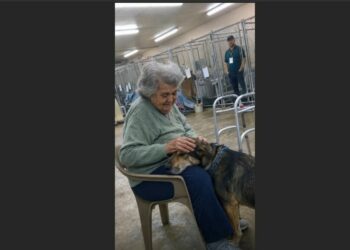
Pete pulled over a chair.
Then he sat.
He Didn’t Call Hunter’s Name Repeatedly
Pete did not reach through the bars.
He did not offer a hand.
He did not tell Hunter everything would be fine.
Instead, he sat outside the kennel and looked toward the opposite wall.
Occasionally, he shifted in the chair.
That was all.
After half an hour, Hunter raised his head.
Pete noticed from the corner of his eye.
He did not respond.
Hunter watched him briefly.
Then lowered his chin again.
Pete stayed a little longer.
Before leaving, he told a staff member he would be back the next morning.
He was.
Same chair.
Same quiet presence.
Hunter remained at the back.
Pete did not seem disappointed.
On the Third Visit, Hunter Watched Him Longer
Pete had brought a thermos of coffee.
He sat with it balanced between both hands.
After several minutes, Hunter turned his head.
This time, he kept watching.
Pete did not stare back.
Direct attention can be too much for an uncertain dog.
Instead, he spoke once.
“Morning, buddy.”
Then the kennel became quiet again.
There was no breakthrough.
Hunter did not walk forward.
He did not eat from Pete’s hand.
Pete went home.
The following morning, he returned once more.
By then, shelter workers had begun noticing something.
Hunter seemed aware of Pete’s arrival.
His ears moved when the older man’s steps approached.
That did not prove attachment.
It meant Pete had become familiar.
For a dog whose familiar world had suddenly disappeared, familiarity was valuable.
On the Fourth Morning, Hunter Finally Got Up
Pete sat down.
Minutes passed.
Then Hunter shifted.
He brought his front legs underneath himself.
Slowly, he stood.
Nobody nearby spoke.
Hunter walked toward the kennel door.
Not quickly.
His head stayed low.
When he reached the front, he lowered himself onto the floor.
He did not press against the gate.
He did not ask to be touched.
He simply lay there facing Pete.
The distance between them was now only the width of the kennel door.
Pete stayed where he was.
After a while, he rested one hand on his knee.
Hunter’s nose moved.
That was enough for the morning.
Later that day, Pete asked for an adoption application.
The Staff Made Sure Grief Wasn’t Making the Decision for Him
Pete had lost his wife.
Hunter had lost Earl.
The parallel was obvious.
The shelter staff did not want emotion alone to determine what happened next.
They asked practical questions.
Did Pete have enough space?
Yes.
His farmhouse sat on several acres.
Was the property secure?
Most of it was fenced, and he was willing to make adjustments.
Could he manage a large Bloodhound mix?
Pete had kept farm dogs for decades.
What about veterinary costs?
He understood them.
Was he prepared if Hunter remained withdrawn or developed separation-related behaviors?
Pete said he was.
Then he explained why he was interested.
He was not expecting Hunter to make him stop missing his wife.
He did not believe the dog could cure grief.
He simply recognized what it was like to wake up and discover that the person who had organized most of your life was no longer there.
Maybe, he said, two quiet creatures could share a house while they figured out what came next.
Hunter Ate Before the Adoption Was Final
The change was small.
A shelter employee placed food in his kennel.
Hunter looked at it.
Pete was sitting outside.
After several minutes, Hunter stood.
He walked to the bowl.
Then he ate.
Not much.
Enough.
Nobody interpreted it as Pete magically healing him.
Hunter had been at the shelter several days.
His body needed calories.
He may have been beginning to adjust.
Pete’s presence may have helped him feel safer.
Several explanations could all be true.
Still, when Hunter finished, Pete smiled.
“That’ll do,” he said.
By Friday, the application had been approved.
Hunter was going home.
Leaving the Shelter Was Quieter Than Anyone Expected
A staff member attached a leash.
Hunter followed slowly.
At the exit, he stopped.
The outside air seemed to catch his attention.
He lifted his nose.
Bloodhound mixes often experience the world intensely through scent.
Hunter stood there for several seconds, processing whatever information the breeze carried.
Then Pete stepped outside.
Hunter followed him.
Pete opened the vehicle door.
Getting a large dog inside took a little encouragement, but no force.
Once settled, Hunter remained upright for much of the drive.
He watched through the window.
Pete did not talk continuously.
He let the dog observe.
When they reached the farm, Hunter stepped out and immediately lowered his nose toward the ground.
For the first time in days, his posture changed.
The Fields Smelled Familiar, Even if They Weren’t
Pete’s land was not Earl’s farm.
Hunter had never walked those exact trails.
Still, the environment contained familiar categories of things.
Grass.
Soil.
Fence posts.
Barn wood.
Wildlife.
Machinery.
Open space.
The next morning, Pete woke before sunrise.
Old habits die slowly.
He made coffee.
Put on his boots.
Then noticed Hunter standing nearby.
Pete opened the back door.
Hunter walked outside.
The hour was roughly the same one when Earl had once begun his morning rounds.
Hunter lowered his nose.
Then started toward the fields.
Pete followed.
Hunter Walked Differently That Morning
At the shelter, every movement had looked heavy.
Now he moved with more purpose.
Not excitement exactly.
His nose led him along the trail.
He paused at fence lines.
Investigated patches of grass.
Looked back occasionally.
Pete stayed nearby.
He did not decide Hunter somehow believed he was back on Earl’s property.
The farms were different.
Hunter was simply in an environment where many old behaviors made sense again.
Walking beside a farmer at sunrise was familiar.
Following outdoor scents was familiar.
Moving through fields instead of concrete corridors was familiar.
Sometimes recovery begins not with a dramatic emotional moment but with the return of a routine the body already knows.
Pete let Hunter choose the pace.
They walked until both were ready to go home.
The Morning Walk Became Their Anchor
The next day, they did it again.
Then the next.
Pete woke.
Coffee.
Boots.
Door.
Hunter waited.
They crossed the fields together.
Some mornings, Hunter ranged several yards ahead.
Other days, he stayed close.
Rain shortened the walks.
Warm weather lengthened them.
When Hunter became interested in a scent, Pete stopped.
There was nowhere they needed to be.
The routine gave structure to both of them.
Pete had lived alone for three years.
He was capable of it.
Still, sharing the morning with another living creature changed the shape of the day.
Hunter benefited too.
Predictable meals returned.
Doors opened at familiar times.
A person came back after leaving.
The world began containing patterns again.
Pete Never Tried to Become Earl
That mattered.
Hunter had spent six years with one man.
Pete did not expect that history to disappear in a week.
He used Hunter’s known commands when appropriate.
He kept feeding schedules consistent.
Karen had told the shelter that Earl always left the bedroom accessible, so Pete did the same.
At first, Hunter slept near the doorway.
Later, he moved to a rug beside the bed.
Pete did not insist on affection.
Some evenings, Hunter lay across the room.
Other nights, he rested close enough that Pete could touch his ears.
Eventually, Hunter began leaning against Pete’s chair.
The relationship formed at its own pace.
There was no need for Hunter to replace Earl.
Pete did not need to replace his wife either.
They were building something new beside the things they had lost.
Karen Came to Visit
After the adoption settled, Pete remained in contact with Earl’s daughter.
Karen wanted to know how Hunter was doing.
Eventually, she visited the farm.
Hunter recognized something when she arrived.
Whether it was scent, voice, movement, or a combination, his response was immediate.
His tail moved.
He approached.
Karen knelt.
She cried into his neck.
Pete stepped away and gave them space.
Later, she walked part of the morning route with them.
She told Pete stories about her father.
How Earl used to complain that Hunter stole his place in bed.
How the dog waited beside the truck.
How Earl occasionally bought an extra breakfast biscuit and pretended he had ordered it by mistake.
Pete listened.
Hunter wandered ahead.
For Karen, seeing him settled helped.
It did not erase the loss of her father.
It simply answered one painful question.
Hunter was all right.
The Shelter Remembered the Dog Who Wouldn’t Eat
Becky received photographs periodically.
Hunter in a field.
Hunter asleep near Pete’s chair.
Hunter with mud on his legs after a rainy morning.
The difference was striking.
At the shelter, he had spent days facing the wall.
Now photographs showed him engaged with his surroundings again.
That did not prove he had forgotten Earl.
There was no way to know what memories dogs retain in the same form humans do.
What staff could see was that Hunter had adapted.
He was eating.
Exploring.
Resting comfortably.
Seeking interaction.
Those were meaningful measures of welfare.
Pete had not rescued him through shared sadness.
He had given Hunter conditions that helped him settle.
Routine.
Space.
Patience.
And company.
Grief Didn’t Leave Pete Either
Some mornings, Pete still thought about his wife before he got out of bed.
Certain dates remained difficult.
There were places in the house he had changed very little since she died.
Hunter did not remove those feelings.
The dog did something more modest.
He gave Pete responsibilities that happened regardless of mood.
Breakfast still needed serving.
A leash still needed clipping.
The back door still needed opening.
On mornings when Pete might otherwise have sat alone too long with his memories, Hunter stood near his boots.
That did not make grief disappear.
It got them both outside.
Sometimes movement is useful even when it solves nothing.
Pete understood that.
Hunter’s Appetite Returned With Routine
Within weeks, his meals were no longer an issue.
At breakfast, he appeared before Pete finished preparing the bowl.
Sometimes he drooled onto the kitchen floor.
Pete kept a towel nearby.
Hunter became interested in food enough that portion control eventually mattered more than encouraging him to eat.
That made Pete laugh.
The dog who once refused meals at the shelter now stood in the kitchen acting as though breakfast had been delayed for days.
Other parts of his personality returned too.
He liked sleeping in sunlight.
He disliked heavy rain.
He could spend astonishing amounts of time investigating one scent near a fence.
And if Pete left a plate too close to the edge of the table, Hunter considered that a management failure rather than a moral problem.
The house had sounds again.
Toenails.
Water bowls.
A hound’s long sigh.
They Never Needed a Dramatic Ending
There was no moment when Hunter suddenly stopped missing Earl.
No scene in which Pete announced he was finished grieving his wife.
Life rarely changes that neatly.
Instead, ordinary days accumulated.
Morning walks.
Vet appointments.
Meals.
Weather.
Mud.
Afternoons on the porch.
Somewhere inside those repetitions, the farm became Hunter’s home.
Pete became his person.
Not the same person he had lost.
A new one.
And Pete’s house became less empty.
Not because Hunter filled his wife’s place.
Because another relationship had begun where silence had previously taken up most of the room.
That distinction mattered to Pete.
They Still Walk the Fields at Sunrise
Every morning begins much the same way.
Pete wakes early.
Hunter hears him moving.
Boots go on.
The door opens.
Then the two of them step outside.
The world is usually quiet at that hour.
Fog sometimes sits low over the ground.
On colder mornings, Pete moves more slowly than he used to.
Hunter does too.
Neither seems bothered.
The dog lowers his nose toward the trail.
Pete follows.
Years earlier, Hunter had walked beside Earl at roughly the same hour.
Now the landscape is different.
The man beside him is different.
The routine remains familiar.
Perhaps that is part of why it works.
One day after Earl’s funeral, Hunter entered a shelter and stopped eating.
A few days later, an older farmer sat outside his kennel and asked for nothing.
He returned.
Then returned again.
Eventually, Hunter came forward.
Since then, the two have continued doing something neither of them needed explained.
At sunrise, they walk.
Pete does not try to decide what Hunter remembers about Earl.
Hunter does not need to understand what Pete lost before they met.
They simply move through the fields together, one quiet morning at a time.
Editor’s Note: The characters in this story are fictional. Through these stories, we hope to share the intelligence, loyalty, compassion, and loving nature of dogs with people everywhere.