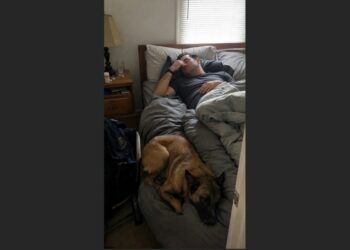
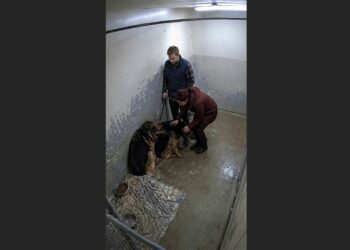
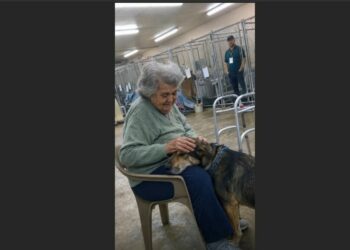
When we adopted Oscar, we believed we were bringing him home to make the end of his life comfortable.
It still feels uncomfortable to admit that.
But it was the truth.
Oscar was 14 years old, a mixed-breed dog with cloudy eyes, a whitening face, and the careful movements of an animal whose body had been working for a long time.
At the shelter, he slept through much of the day.
Getting up took effort.
He moved slowly.
His former family had surrendered him after his care became more difficult, and by the time we met him, everyone understood that his remaining time might be limited.
The shelter had placed him in a hospice-style adoption program so that, whatever happened next, he would not spend it in a kennel.
We went into the adoption expecting months at best.
Possibly weeks.
We bought supportive beds.
Installed ramps.
Moved rugs onto slippery floors.
And quietly prepared ourselves to love a dog we expected to lose almost immediately.
Oscar had other plans.
He Looked Older Than Fourteen
Age affects every dog differently.
Some fourteen-year-old dogs still move briskly.
Others carry every year in their joints.
Oscar seemed to belong to the second group.
His eyes had developed a bluish haze.
He moved deliberately, particularly after lying down for a while.
His back legs sometimes needed an extra second before they seemed ready to cooperate.
At the shelter, he rarely stood when visitors passed.
Most younger dogs rushed toward their gates.
Oscar usually stayed on his bedding.
He might raise his head.
Sometimes his tail moved once or twice.
Then he went back to sleep.
There was nothing dramatic about him.
That may have been why so many people walked past.
We Were Not Looking for a Young Dog
We had discussed fostering older dogs before.
There was something difficult about watching senior animals remain in shelters while families understandably gravitated toward puppies and younger dogs.
Still, talking about taking home an elderly dog was easier than actually doing it.
Older dogs can be expensive.
Mobility can decline quickly.
Medications may become part of everyday life.
Accidents happen.
Hearing and vision change.
And eventually, there are decisions about pain, comfort, and quality of life.
We understood that.
At least intellectually.
Then we met Oscar.
He was asleep.
He Barely Reacted When We Sat Beside Him
A shelter worker brought him into a quiet meeting room.
Oscar walked slowly across the floor.
Then he lowered himself onto a blanket.
I sat several feet away.
My partner sat beside me.
Oscar looked at us briefly.
He did not come over.
He did not need to.
After a few minutes, he stretched one front paw forward and went back to sleep.
The shelter worker explained what they knew.
Oscar had been surrendered.
He had become increasingly inactive.
He seemed tired much of the time.
Veterinary staff had evaluated him, and the rescue wanted a home prepared to focus on comfort, monitoring, and quality of life rather than expecting a dramatic transformation.
We understood.
“We just don’t want him to be alone at the end,” my partner said.
That became the reason we brought him home.
We Prepared for a Goodbye Before He Arrived
The strange thing about adopting a hospice or medically fragile senior dog is that you begin grieving before anything has happened.
We measured doorways for ramps.
We placed thick beds in three rooms so Oscar would never have to travel far to rest.
Water bowls went in more than one location.
We covered the slickest parts of the floor.
The veterinarian gave us guidance about monitoring his mobility, appetite, breathing, comfort, bathroom habits, and interest in normal activities.
We also talked about quality of life.
Not in vague terms.
Could Oscar get comfortable?
Was pain controlled?
Did he still enjoy food?
Did he seek interaction?
Could he move around enough to reach the things he needed?
Those questions mattered more than a number on a calendar.
We expected to be asking them soon.
During the First Week, Oscar Mostly Slept
And slept.
And slept some more.
The first afternoon, he found the bed nearest the living room window and stayed there for hours.
At first, I worried.
I checked his breathing too often.
I walked past and looked for chest movement.
If he changed position, I noticed.
At night, I expected restlessness.
Instead, Oscar slept so deeply that once I knelt beside him because I was afraid something was wrong.
He opened one cloudy eye.
Then shut it again.
The veterinarian had warned us that newly adopted dogs sometimes need substantial rest after shelter life and major transitions.
So we let him sleep.
His Sleep Didn’t Look Troubled
That distinction became important.
Oscar was not pacing.
He was not panting continuously.
He was not crying.
He did not keep changing position as though he could not get comfortable.
He slept.
Deeply.
His body sometimes stretched completely across the bed.
His head rested sideways.
One front leg extended.
Every so often, he gave a soft snore.
We still monitored him.
An older dog sleeping more does not automatically mean everything is fine.
Pain, illness, medication, metabolic problems, and many other conditions can alter energy levels.
But medically, Oscar seemed stable enough for the plan we had made with his veterinarian.
So instead of constantly waking him, we allowed the rest.
Maybe He Was Finally Decompressing
We could not know what Oscar thought about the change.
It would be tempting to say he understood immediately that he was safe.
Dogs do not evaluate adoption contracts or permanence the way humans do.
But they do experience environments.
Noise changes.
Smells change.
Sleep quality changes.
Predictability changes.
A shelter can be stressful even when the staff are excellent.
There are barking dogs, unfamiliar people, cleaning routines, doors, movement, and interruptions.
Our house was quieter.
Meals appeared at consistent times.
Nobody asked Oscar to compete for attention.
He had soft surfaces.
He could sleep without a kennel corridor waking him.
Perhaps that was all the first week meant.
For the first time in a while, he had enough quiet to rest deeply.
The Second Week Brought Small Changes
Oscar began lifting his head before breakfast.
Then he started standing when one of us entered the kitchen.
At first, he watched from the doorway.
A few days later, he walked in.
Slowly.
But voluntarily.
His appetite improved.
He became interested in going outside at predictable times.
He started sniffing more.
Instead of walking only far enough to relieve himself, he occasionally continued toward the edge of the yard.
Not far.
Maybe twenty extra feet.
For a fourteen-year-old dog whose world had recently consisted mostly of sleeping, those twenty feet caught our attention.
We did not call it a recovery.
We called it a good day.
Then there were more good days.
We Changed Our Expectations Carefully
It would have been easy to decide that Oscar had been misjudged.
We resisted that.
He was still an elderly dog.
His eyes remained cloudy.
His joints remained stiff.
He still needed the ramps.
He still slept far more than a young animal.
Nothing about moving into our house reversed aging.
So we continued his veterinary care.
We paid attention to discomfort.
We kept exercise gentle.
What changed was not his age.
It was his engagement.
Oscar was beginning to participate in the household.
That felt different from merely existing in it.
Then He Found the Toy
During his third week with us, Oscar wandered toward a basket in the living room.
It contained old dog toys.
Most had belonged to previous fosters.
There was a rope toy.
A rubber ball.
Two squeaky animals.
And buried near the bottom was a faded stuffed toy that had once been some kind of animal.
Its original shape was difficult to identify.
One ear was flattened.
The fabric had gone soft from age.
Oscar pushed his nose into the basket.
Then he pulled that particular toy out.
We laughed.
It was the first object he had shown any interest in.
Oscar carried it away.
We Expected Him to Drop It
He did not.
He brought it to his bed.
Later, when he stood for water, the toy came with him.
He placed it down beside the bowl.
Drank.
Picked it up again.
That evening, he carried it into the bedroom.
The next morning, it was still beside him.
There was nothing special about the toy from our perspective.
It was old.
Faded.
Worth almost nothing.
Oscar disagreed.
From then on, the stuffed animal became part of his routine.
The Toy Went Everywhere He Could Carry It
Oscar moved slowly through the house with the toy held between his teeth.
His gait remained stiff.
That never disappeared.
But he seemed increasingly motivated to get from one place to another.
Living room.
Kitchen.
Bedroom.
Back toward the living room.
He often carried the toy.
Sometimes he forgot it and walked halfway down the hall before turning around.
He went back.
Picked it up.
Continued.
We began leaving it wherever he placed it.
No one moved it into the toy basket anymore.
It belonged to Oscar now.
He Started Waking Us Up
The dog who once slept through most mornings developed an opinion about breakfast.
At first, he stood near the bedroom door.
Then he began approaching the bed.
Eventually, he learned that a cold nose near my hand was effective.
One morning, I opened my eyes before sunrise and found Oscar staring at me.
The stuffed toy hung from his mouth.
“You cannot be serious,” I whispered.
His tail moved.
I laughed.
The hospice dog wanted breakfast.
Immediately.
Apparently, waiting was unacceptable.
We Called the Veterinarian With Better Questions
Instead of asking how to recognize the end, we began asking how to support the life Oscar was showing us.
Was his activity level appropriate?
Should we adjust his walks?
Was his pain management adequate?
How could we support his joints without encouraging more activity than his body could comfortably handle?
Senior-dog care became less about waiting and more about balancing.
Movement helped him maintain strength.
Too much could leave him sore.
Rest was important.
So was engagement.
The goal remained the same as before.
Quality of life.
Only now Oscar was showing us more ways that quality could look.
He Was Still Fourteen
That fact never stopped mattering.
Some mornings were slower.
After active days, Oscar occasionally seemed stiffer.
Cold weather made him more reluctant to go outside.
The ramps stayed.
So did the rugs.
There was no point pretending the stuffed toy had somehow cured arthritis or reversed age.
Love did not make his cloudy eyes clear.
A comfortable home did not guarantee more years.
What it seemed to provide was opportunity.
Rest when he needed rest.
Movement when he wanted movement.
Food.
Attention.
Predictability.
And one very battered toy.
We Learned Not to Confuse Quiet With Giving Up
That was probably our biggest mistake in the beginning.
We saw a dog who slept constantly and assumed he was nearing the end.
His age made the assumption easy.
But behavior needs context.
Sometimes increased sleep reflects illness.
Sometimes pain.
Sometimes medication.
Sometimes stress and exhaustion.
Sometimes an elderly animal simply needs more rest.
Oscar had required proper veterinary evaluation all along.
Once serious problems were being monitored and his comfort was supported, we began seeing a fuller picture.
He was old.
He was not finished.
Those were not the same thing.
Oscar Rediscovered the Kitchen
Unfortunately, increased engagement had consequences.
One afternoon, I left food too close to the edge of the counter.
Oscar had previously shown no interest in stealing anything.
That confidence turned out to be misplaced.
I walked away.
When I came back, the food was gone.
Oscar was standing several feet away.
He had the stuffed toy in his mouth.
His expression offered no useful information.
“Did you do this?”
Oscar looked at me.
The question was ridiculous.
Of course he did not understand the accusation.
But the missing food and suspiciously accessible plate told me enough.
The supposedly fading old dog had become a kitchen thief.
We adjusted our habits.
Oscar seemed satisfied with this development.
Then He Started Racing Me to the Yard
“Racing” is a generous description.
Neither of us was setting records.
But Oscar turned the walk toward the back door into a competition.
He learned the routine.
Door opens.
Ramp.
Yard.
If I moved ahead of him, he accelerated.
His stiff little trot became faster.
Sometimes he reached the grass first.
I always told him he cheated.
He did not care.
We watched his body carefully and did not encourage strenuous running.
But his enthusiasm mattered.
A dog who once barely reacted when people entered the room now had places he wanted to go.
The Toy Became Part of Everything
Oscar carried it outside once.
We discouraged that after discovering it damp and muddy.
Mostly, it stayed indoors.
He slept with it.
Carried it to breakfast.
Left it beside his water.
Sometimes he pressed it against his chest while resting.
We could not know what the object meant to him.
Perhaps the texture was comforting.
Maybe carrying things had been a behavior from his younger years.
Perhaps it simply smelled familiar after several weeks.
We stopped trying to give it a deeper explanation.
Oscar liked it.
That was enough.
Sometimes He Seemed Worried We Would Take It
Early on, if I reached near the toy, Oscar occasionally pulled it closer.
He never snapped.
He simply repositioned it.
So I stopped reaching unnecessarily.
There was no reason to create conflict over a harmless object.
If the toy eventually became damaged enough to pose a swallowing risk, we would deal with that.
Until then, Oscar could keep it.
Over time, he became less concerned when we touched it.
He learned the toy usually came back.
Another small pattern.
Take.
Return.
Nothing lost.
We Stopped Counting Days
At first, I mentally measured everything.
First night.
Third day.
One week.
Second week.
It was as though I expected a clock to run out.
Eventually, I stopped.
Oscar still had regular veterinary checks.
We still understood that his health could change quickly.
But living with constant anticipation of his death was unfair to all of us.
He was alive now.
That required attention too.
So we began measuring other things.
Did he eat breakfast?
Did he enjoy his walk?
Was he comfortable resting?
Did he still steal food when given the opportunity?
Did the stuffed toy make its morning appearance?
Those became our daily questions.
Hospice Care Was Never About Giving Up
I also began understanding the word differently.
Hospice does not mean an animal has stopped living.
It means comfort and quality of life are central.
For some animals, that period may be very short.
For others, it can last longer than expected.
And when a dog has significant or terminal disease, a new home cannot remove that diagnosis simply through affection.
Oscar’s medical needs still mattered.
His veterinary team still guided us.
If his quality of life declined, we would face that honestly.
But supportive care and enjoyment could exist at the same time.
Oscar demonstrated that every morning when he appeared with the toy in his mouth.
His Personality Had Been There All Along
We sometimes joked that Oscar had fooled us.
He had not.
The dog stealing food and trying to beat me into the yard was not a completely different animal.
Those behaviors had probably existed somewhere in his past.
We simply had not met that version yet.
At the shelter, exhaustion, age, stress, medical issues, or some combination of those factors may have limited what anyone saw.
In our house, more of his personality gradually became visible.
That did not mean the shelter had done anything wrong.
They had described the dog in front of them.
Then his circumstances changed.
So did some of his behavior.
He Began Following Us More
Not constantly.
Oscar was far too committed to napping for that.
But if one of us went into the kitchen, he noticed.
If the refrigerator opened, he noticed faster.
When we settled in the living room at night, Oscar often chose a bed nearby.
Sometimes he carried the toy over first.
Then he lowered himself with a long groan.
We learned the difference between his ordinary old-dog noises and signs that meant he might be uncomfortable.
The household developed around him.
We stopped preparing for his departure every hour.
We started including him in the day.
There Were Still Difficult Conversations
Every senior dog deserves people willing to see decline when it comes.
We did not want our happiness over Oscar’s improvement to make us ignore future suffering.
So we kept discussing quality of life with the veterinarian.
Pain.
Mobility.
Appetite.
Hydration.
Breathing.
Interest in interaction.
Ability to rest.
Good days and difficult days.
Those conversations did not ruin the experience.
They protected it.
Loving Oscar meant being willing to enjoy his good days without demanding that they continue forever.
It also meant being willing to act compassionately if someday they stopped.
The Old Toy Became a Measure of His Interest
Not a medical test.
Just something we noticed.
On good mornings, Oscar picked it up.
On slower mornings, he might leave it in bed until later.
If he did not touch it, we paid a little more attention.
Was he eating?
Moving normally for him?
Was anything else different?
Most of the time, the toy appeared eventually.
Oscar would emerge carrying it as though there had never been any reason for concern.
Then he would head toward breakfast.
The object became part of our observations because it was part of his normal behavior.
Normal mattered.
We Never Learned Why He Chose That Particular Toy
There were better toys in the basket.
Cleaner ones.
Newer ones.
Some squeaked.
Oscar wanted the faded one.
We eventually washed it carefully and worried the entire time that he would reject it afterward.
He did not.
He sniffed it.
Picked it up.
Walked away.
Apparently, its value survived laundry.
Over time, one seam began loosening.
I repaired it.
My sewing was terrible.
Oscar remained loyal.
People Were Surprised When They Met Him
Visitors who knew why we had adopted Oscar expected a fragile dog sleeping in the corner.
Instead, they often encountered him walking through the room with the toy.
“That’s the hospice dog?”
“Yes.”
Oscar would usually ignore them unless food was involved.
We always explained the same thing.
He was still old.
He still had medical needs.
His improved engagement did not mean elderly or hospice dogs simply require more love and will recover.
That idea can be harmful.
Serious disease remains serious.
Pain requires medical treatment.
What happened with Oscar was more modest.
A stable environment and appropriate care allowed us to see that he still had interests and enjoyment left.
His Age Became Less Important Than His Days
Fourteen is old for many dogs.
We could not negotiate with that number.
But age alone did not tell us everything about Oscar’s experience.
A fourteen-year-old dog could have a miserable day.
Or a comfortable one.
Our job was to increase the chances of the second.
Soft places.
Traction.
Pain management.
Good food.
Gentle activity.
Veterinary care.
Company.
And, apparently, unrestricted access to one battered stuffed animal.
That was what we could control.
How much time remained was not.
Oscar Never Needed Us to “Give Him a Reason to Live”
I eventually stopped using that phrase.
It sounded beautiful.
It also gave us too much credit.
Oscar’s desire to eat, explore, carry his toy, follow smells, seek company, and steal forbidden food belonged to him.
We did not manufacture it.
We created conditions where some of those behaviors could emerge.
There is an important difference.
Humans like stories in which love saves an animal.
Sometimes what love actually does is quieter.
It provides the bed.
Pays for the veterinarian.
Places rugs on the floor.
Notices discomfort.
Lets the dog rest.
Leaves the toy where the dog can find it.
Then the animal does the rest.
We Had Prepared for Quiet
Our imagined hospice experience had looked very different.
We pictured long afternoons.
Soft music.
Oscar sleeping.
Gentle hands on an old dog’s head.
A peaceful goodbye when the time came.
Some of that still existed.
Oscar slept plenty.
Our evenings were usually calm.
But the experience also included stolen food.
Mud.
An elderly dog blocking the hallway because he had stopped to retrieve his toy.
A cold nose waking me before sunrise.
And one ridiculous race to the yard that Oscar believed he had won decisively.
End-of-life care, we learned, can still contain ordinary life.
One Morning, I Found the Toy Beside My Pillow
I still do not know how it got there.
Oscar was sleeping on his bed.
The toy was on the floor beside mine.
Maybe he had carried it in during the night.
Perhaps he dropped it while checking where we were.
I picked it up.
Oscar opened his eyes.
His head lifted.
I handed it back.
He took it gently.
Then he stood.
Slowly.
Front legs first.
Back legs after.
He paused until he was steady.
Then he carried the toy toward the kitchen.
Breakfast.
Another morning.
Oscar Was Never Young Again
That deserves saying plainly.
He did not become a puppy.
He did not suddenly run without stiffness.
His vision did not return to what it had once been.
Age continued moving in one direction.
We adapted along with it.
Some walks got shorter.
Sometimes he needed more help with the ramp.
We watched his body closely.
Love did not stop time.
Nothing does.
But quality of life is not measured by youth alone.
Oscar could be old and still interested.
Old and still comfortable.
Old and still ridiculous.
Old and still himself.
The Shelter Expected the Same Thing We Did
When we sent the first update, staff were surprised.
The picture showed Oscar standing in the kitchen.
Toy in his mouth.
Tail up.
They remembered the dog who had slept through most afternoons.
We explained the changes carefully.
They were happy.
But nobody declared a miracle.
They knew senior dogs could behave differently once settled into a home.
They also knew we were still working closely with a veterinarian.
The next update showed Oscar asleep on a supportive bed.
The toy was tucked under his chin.
That photograph probably described his life better than any story could.
Rest.
Comfort.
Something he enjoyed nearby.
We Still Know a Goodbye Is Coming
Every person who loves an old dog knows this.
Oscar’s good days do not cancel the future.
Eventually, his body will ask more of him than is fair.
When that time arrives, our responsibility will change.
We will not demand one more morning because we are afraid of losing him.
We will listen to the veterinarian.
We will pay attention to Oscar’s comfort.
We will make decisions based on his quality of life rather than our desire to keep him.
That is part of the promise too.
But that day is not today.
Today he has his toy.
We Thought We Were Bringing Him Home to Die
In a sense, perhaps we were.
Every living thing we bring home will eventually leave us.
Oscar simply made that truth impossible to ignore from the beginning.
But focusing only on the ending caused us to miss something.
He still had a present.
A fourteen-year-old dog’s present may look small from the outside.
Breakfast.
A patch of sunlight.
A short walk.
A comfortable bed.
A familiar hand.
A worn toy.
To Oscar, those things appear to be enough to get up for.
The Toy Is Still With Him
It looks worse now.
My repairs have not improved its appearance.
One side is faded almost white.
The fabric has flattened where Oscar carries it.
I have considered replacing it.
I know better.
Oscar still brings it from room to room.
Sometimes he falls asleep with his chin beside it.
Sometimes he leaves it in the kitchen and returns several minutes later to retrieve it.
When we head toward the bedroom, he often carries it along.
An old dog.
An old toy.
Moving slowly through a house that has learned to move at his pace.
We Were Wrong About What His Final Chapter Would Look Like
We expected hospice to be mostly about preparing for death.
Oscar taught us that it also meant paying attention to whatever life was still present.
Not manufacturing happiness.
Not denying age.
Not pretending comfort could cure disease.
Simply noticing.
Oscar wanted food.
Sleep.
Company.
The yard.
A little mischief.
And that battered stuffed toy.
So we gave him room for those things.
We still do not know how much time remains.
That question no longer controls every day.
Oscar wakes up.
He finds his toy.
He looks toward the kitchen.
And another morning begins.
Perhaps that is the most honest thing we gave him.
Not a reason to live.
A place where whatever life he already had left could finally be used.
Editor’s Note: The characters in this story are fictional. Through these stories, we hope to share the intelligence, loyalty, compassion, and loving nature of dogs with people everywhere.