Walter had spent years wondering what would happen if Zeus ever saw him again.
The last time they lived under the same roof, Zeus was still a young Rottweiler with a black muzzle, strong legs, and the habit of following Walter through nearly every room in the house.
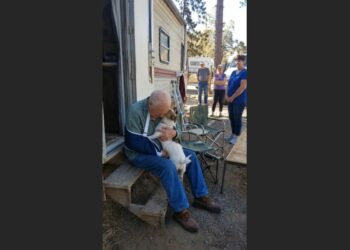
Eight years later, Walter sat outside a senior residence in a wheelchair with a blanket across his knees.
Several yards away stood an elderly Rottweiler whose face had turned almost completely gray.
For a few seconds, neither moved.
Walter leaned forward.
“Zeus?”
The dog’s tail moved once.
Then he took a few careful steps.
Stopped.
Walter raised one hand.
Whatever Zeus recognized after that — the voice, the movement, the scent carried on the air, or some combination of all three — changed the moment.
The old dog began moving toward him.
And after eight years apart, Walter reached out for the face he had never expected to touch again.
Zeus Had Once Been Part of Every Ordinary Morning
Walter adopted Zeus as a puppy.
There was nothing unusual about the way they became attached.
It happened through repetition.
Breakfast.
Walks.
Doors opening.
Doors closing.
Walter putting on shoes.
Zeus appearing beside him.
The dog learned the small signals that predicted the structure of a day.
If Walter picked up his jacket, Zeus became alert.
A walk might be coming.
If Walter went into the bathroom, Zeus waited outside.
If he entered the kitchen, Zeus followed.
By the time Zeus reached adulthood, Walter rarely thought about these habits.
They were simply life.
The dog was there.
Then Walter got sick.
What Was Supposed to Be Temporary Became Something Else
Walter was 74 when he entered the hospital.
At first, the family treated it as a short interruption.
A medical problem needed attention.
He would be home after treatment.
Zeus would stay with Walter’s daughter until then.
Everyone understood the plan.
Then came complications.
Walter’s stay became longer.
Recovery slowed.
His strength did not return the way doctors had hoped.
Eventually, it became clear that living alone would no longer be safe.
The conversations about rehabilitation became conversations about long-term care.
Walter moved into a senior residence.
Zeus could not move with him.
Walter’s Daughter Took the Dog
There was no question of abandoning Zeus.
Walter’s daughter brought him into her own home.
It was not an effortless adjustment.
Zeus was large.
He was used to Walter’s routines.
He had opinions about furniture.
He reportedly destroyed a few things while settling in.
Eventually, he claimed a place on the couch as though it had always belonged to him.
Walter’s daughter sent pictures.
At first, Walter asked about Zeus almost every day.
Did he eat?
Was he sleeping?
Was he behaving?
Had he adjusted?
She reassured him.
Zeus was safe.
He was cared for.
He still had walks.
He still had people around him.
Walter was grateful.
Gratitude and loss can exist at the same time.
Photographs Were Not the Same as Having Him There
His daughter brought new pictures when she visited.
Zeus in the yard.
Zeus asleep on the couch.
Zeus looking guilty beside something he had chewed.
Walter smiled.
Sometimes he laughed.
Still, when the visit ended, the photographs went into a drawer or stayed on the bedside table.
Zeus did not follow Walter into the hallway.
There was no weight beside his chair.
No sound of paws approaching.
No dog waiting outside the bathroom door.
The separation everyone had originally imagined as temporary became permanent.
At least, that was what it seemed like.
Years Passed
Eight of them.
Zeus aged in Walter’s daughter’s home.
The black fur around his muzzle gradually faded.
His pace changed.
Long walks became shorter.
After naps, he needed a little more time to stand.
He still had the large frame of a Rottweiler.
But age had softened him.
Walter aged too.
There were better periods.
There were difficult ones.
Family visited.
Staff cared for him.
Life inside the residence developed its own routines.
Every so often, someone discussed whether Zeus might be able to visit.
Timing, health, logistics, and facility arrangements never seemed to align.
The years accumulated anyway.
Walter Never Stopped Asking About Him Entirely
The questions became less frequent.
Not because Zeus mattered less.
Life had simply changed.
Walter understood that his daughter was giving the dog a good home.
He did not want her to feel guilty.
So he listened to stories.
He looked at pictures.
Sometimes he asked her to bring a recent one.
Once she showed him a photograph of Zeus lying in the sun with his gray chin on his paws.
Walter studied it for a long time.
“He’s getting old.”
His daughter smiled.
“So are you.”
Walter laughed.
But neither of them could ignore the truth.
Time was moving for both.
Earlier This Year, Walter’s Health Declined Again
There were more appointments.
More tests.
More conversations with doctors.
Eventually, the family was told that Walter’s condition had progressed significantly.
No physician could predict exactly how much time remained.
Bodies do not follow calendars that neatly.
But the family was advised to prepare for the possibility that Walter might have roughly six months.
His daughter left that conversation carrying the kind of information that makes ordinary things look different.
She drove home.
Walked into the living room.
And found Zeus asleep.
She Looked at the Gray Around His Face
For a while, she simply stood there.
Zeus did not wake.
His breathing was steady.
One front paw moved slightly in sleep.
Her father had limited time.
Zeus was now an elderly dog.
The possibility she had always assumed would remain available suddenly did not feel available anymore.
Someday, she had thought, they should see each other again.
Someday had quietly become eight years.
She looked at Zeus.
Then she called the residence the following morning.
Staff Helped Arrange the Visit
Walter’s daughter explained the situation.
The residence could not simply bring a large dog through every part of the building without planning.
So staff helped arrange an outdoor visit.
There would be plenty of room.
Walter could remain comfortably in his wheelchair.
Zeus could approach without being crowded.
His daughter would keep him leashed initially.
The plan was simple.
She did not tell Walter exactly when the visit would happen.
Partly because she wanted to surprise him.
Partly because she was afraid.
She Wasn’t Sure Zeus Would Remember
Eight years is a long time.
Walter had changed.
His body was thinner.
His posture was different.
He now used a wheelchair.
His voice had aged.
Zeus had changed too.
The young dog Walter remembered no longer existed.
His daughter knew dogs can retain long-term memories associated with familiar people, particularly through scent and voice.
But knowing that did not guarantee a particular reunion.
Maybe Zeus would approach him like any other friendly person.
Maybe he would hesitate.
Maybe Walter would expect something the dog could no longer provide.
She worried about that during the entire drive.
Zeus rode beside her, unaware that anything unusual was happening.
At First, Zeus Walked Normally
They arrived at the residence.
Zeus climbed out carefully.
His daughter clipped the leash securely.
They started toward the building.
The old dog moved at his usual pace.
Slow but steady.
Then they reached the path in front of the residence.
Zeus stopped.
His daughter looked ahead.
Walter was sitting several yards away.
A blanket covered his knees.
He looked smaller than he once had.
Zeus stared at him.
Walter stared back.
For a few seconds, nobody spoke.
Recognition Wasn’t Instant or Dramatic
That detail mattered to Walter’s daughter later.
Zeus did not immediately pull the leash from her hand.
He did not erupt into jumping or barking.
He simply looked.
Perhaps he was processing familiar and unfamiliar information at the same time.
A known voice in an older body.
A familiar scent altered by years, medication, environment, and age.
A person who once stood beside him now sitting in a wheelchair.
Dogs identify people through multiple cues.
Eight years can change many of them.
Walter leaned forward.
“Zeus?”
The dog’s tail moved once.
Zeus Took Two Steps
Then he stopped again.
Walter lifted his hand.
He did not slap his knee.
He did not call loudly.
He simply held his hand out.
Something about the gesture seemed to settle the old dog.
Zeus moved again.
Slowly at first.
Then with more purpose.
His daughter loosened her grip on the leash.
When she was confident the setting was secure, she allowed Zeus to cover the remaining short distance himself.
Walter already had both hands extended.
Zeus Put His Head Under Walter’s Hands
He reached the wheelchair.
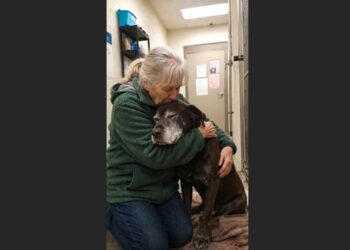
Then lowered his gray muzzle beneath Walter’s palms.
Walter’s face changed.
He held Zeus’s head between both hands.
For several seconds, he simply looked at him.
The face was older.
The fur was gray.
But one ear still moved the same way when Walter rubbed the side of his head.
“Oh, Zeus.”
Walter’s voice broke.
“I missed you so much.”
Zeus pressed closer against his knees.
His Daughter Stopped Worrying About Whether He Remembered
No one could know exactly what Zeus was thinking.
It would be too much to claim the dog understood that eight years had passed or that Walter had been prevented from returning home because of illness.
But recognition does not require that kind of understanding.
Dogs can remember familiar individuals through scent, voice, appearance, movement, and learned associations.
Zeus’s behavior changed when Walter called his name.
He approached.
He sought close physical contact.
Then he remained there.
For Walter’s daughter, that was enough.
She no longer needed a scientific answer to the question she had carried during the drive.
Walter Ran His Hands Over Zeus’s Face
He touched the dog’s ears.
His cheeks.
The thick fur around his neck.
He seemed to be comparing the animal in front of him with the young Rottweiler stored in his memory.
“This was all black,” Walter said, touching the dog’s muzzle.
His daughter laughed.
“So was your hair.”
Walter ignored her.
Zeus stayed pressed against the wheelchair.
After a while, Walter leaned forward.
His forehead rested lightly against the dog’s head.
“I missed you every day.”
Zeus remained still.
They Could Not Recover the Missing Years
Nobody tried to pretend otherwise.
Walter had missed Zeus growing old.
He had not been there for the slower walks.
The veterinary appointments.
The first gray hairs.
The shift from youthful energy to long naps.
Zeus had missed eight years of Walter’s life too.
There were hospital stays.
Birthdays.
Illness.
Quiet afternoons in the residence.
Their reunion did not erase that separation.
It did not return Walter to his old house.
It did not make Zeus young again.
What it gave them was an afternoon.
That had to be enough.
Walter Talked to Him as Though No Time Had Passed
He told Zeus things.
Some made sense.
Some probably did not.
He asked whether the dog still stole food.
His daughter confirmed that he did.
Walter seemed pleased.
He reminded Zeus about a pair of shoes destroyed years earlier.
He talked about the yard behind the old house.
The walks they used to take.
At times, his daughter joined the conversation.
Other times, she stepped away.
Walter kept one hand on Zeus whenever possible.
The dog often leaned into it.
Zeus Eventually Lay Down Beside the Wheelchair
Standing for long periods was hard now.
So Zeus lowered himself onto the grass.
Slowly.
Front legs first.
Then his rear body.
Walter watched with an expression his daughter recognized.
Concern.
“You stiff, old man?”
Zeus settled.
Walter smiled.
“Me too.”
For much of the afternoon, they remained that way.
Walter in the wheelchair.
Zeus beside him.
The distance between Walter’s hand and the dog’s shoulder only a few inches.
Nothing dramatic needed to happen after the first approach.
Their closeness became ordinary surprisingly quickly.
Perhaps that was the most familiar part of all.
Walter’s Daughter Remembered the Young Zeus
She had seen the dog when he was a puppy.
She remembered him racing through her father’s house.
She remembered Walter complaining that the dog followed him everywhere while clearly enjoying the attention.
She remembered Zeus sitting beside the door whenever Walter left.
Now both of them moved carefully.
Walter needed help adjusting his blanket.
Zeus needed time to reposition himself.
Age had changed the pace.
It had not removed the ease with which they sat together.
The Visit Was Also Hard
Joy and grief occupied the same afternoon.
Walter knew Zeus would leave again.
His daughter knew the visit might be one of relatively few opportunities remaining.
The family’s estimate of Walter’s time was uncertain, but everyone understood why the reunion had become urgent.
Zeus was old too.
No one could promise eight more months.
Much less eight years.
That knowledge remained present even while Walter smiled.
It made the small things matter more.
One hand on the dog’s head.
One slow tail movement.
One familiar name spoken again.
At One Point, Walter Became Quiet
He stopped talking.
His daughter asked whether he was tired.
He shook his head.
Zeus was lying beside him.
Walter looked down.
“I should have found a way sooner.”
His daughter immediately started to respond.
Walter lifted one hand.
He was not blaming her.
He was not blaming the residence.
Life had simply made something difficult, and difficult things are easy to postpone.
There had always been a reason.
Health.
Policy.
Transportation.
Timing.
Eight years had accumulated one reasonable delay at a time.
Now Walter understood how long that was.
His Daughter Had Her Own Regret
She wondered why she had not pushed harder years earlier.
Then she reminded herself that the past circumstances had been real.
Walter’s health had sometimes been unstable.
Zeus had been difficult to transport when younger.
Policies had changed.
There were periods when everyone was simply managing the next immediate problem.
Regret often simplifies the past.
Real life is rarely that simple.
She could not recover eight years.
She could decide what happened next.
Before Leaving, She Made a Promise
Walter looked at her when it was time for Zeus to go.
His face tightened.
His daughter crouched beside the wheelchair.
“This isn’t another eight-year goodbye.”
Walter looked at her.
“I mean it.”
She glanced toward Zeus.
“We’ll bring him back.”
The promise was modest.
No one promised monthly visits for years.
No one promised that Walter’s health would remain stable.
No one promised Zeus’s would either.
She promised one thing.
Soon.
Zeus Was Reluctant to Stand
Partly because he was comfortable.
Partly because he was old.
Walter rubbed his neck one more time.
“Come on, boy.”
Zeus looked up at him.
His daughter helped encourage him to rise.
It took a moment.
Then the Rottweiler stood.
Walter kept his hand extended until Zeus was just beyond reach.
His daughter picked up the leash.
For several steps, Zeus looked back.
Again, no one could say exactly what that meant.
But Walter saw it.
He smiled.
“I’ll see you again.”
The Second Goodbye Was Different
The first separation had happened eight years earlier under uncertainty.
Walter had gone into the hospital expecting to return home.
Zeus had gone to his daughter’s house temporarily.
Nobody understood that a permanent separation had begun.
This goodbye was clear.
Zeus was leaving.
Walter was staying.
But now there was a plan to meet again.
That changed the shape of the moment.
A known separation can be painful.
An indefinite one can become something else entirely.
This time, Walter knew where Zeus was going.
His daughter knew when she intended to bring him back.
Recognition After Many Years Is Possible
Dogs do not remember people exactly the way humans do.
We reconstruct memories through stories, dates, photographs, and language.
Dogs rely much more heavily on sensory associations.
Scent is especially powerful.
Voices, movement patterns, and familiar gestures can also remain meaningful.
There are documented examples of dogs showing recognition after long periods apart.
Still, no one should expect every reunion to look the same.
A dog may respond immediately.
Or cautiously.
Age can change hearing, vision, mobility, and behavior.
Stress can alter reactions too.
Zeus’s slow approach did not make the recognition weaker.
In many ways, it made the moment more believable.
Walter Had Changed Too Much to Look Exactly Familiar
Eight years earlier, he had walked beside Zeus.
Now he sat.
His body was thinner.
His movement was limited.
His scent may have changed because of illness, medication, and living environment.
Yet the old dog’s hesitation gradually gave way to approach.
Perhaps Walter’s voice helped.
Perhaps the raised hand resembled an old gesture.
Perhaps once Zeus came closer, scent provided the strongest confirmation.
There is no way to know which cue mattered most.
The observable result was simpler.
Zeus chose to close the distance.
Then he stayed.
Walter Did Not Need More Than That
Afterward, his daughter asked him what he had expected.
“I didn’t know.”
“Were you worried he wouldn’t remember you?”
Walter looked surprised.
“No.”
Then he reconsidered.
“Maybe a little.”
He smiled.
“I remembered him.”
That was what had occupied Walter for eight years.
Not whether Zeus could explain the separation.
Not whether dogs experience time as humans do.
He had wondered whether something between them remained recognizable after everything changed.
That afternoon gave him his answer in the only form Zeus could provide.
A slow approach.
A gray muzzle under familiar hands.
A body pressed against his knees.
Zeus Went Home and Slept
The reunion tired him.
At his daughter’s house, he drank water and settled in the living room.
Within minutes, he was asleep.
His daughter sat nearby looking at photographs from the afternoon.
In several, Walter was smiling.
In one, Zeus’s head rested against his legs.
In another, Walter had both hands buried in the thick fur around the dog’s neck.
She sent a few pictures to family.
Then she put down the phone.
Zeus snored softly.
Eight years of worrying had ended in a very quiet room.
Walter Asked About the Next Visit
Not long afterward, his daughter called.
She expected him to talk about the first reunion.
Instead, he asked one question.
“When’s he coming back?”
That made her laugh.
They began arranging another visit.
This time, there was no need for a surprise.
Walter wanted to know.
He wanted something on the calendar.
His world had become full of appointments he did not particularly look forward to.
Medical visits.
Assessments.
Tests.
Now there was one date that meant something different.
Zeus.
The Reunion Did Not Cure Walter’s Illness
It did not change his prognosis.
It did not make his body stronger.
It did not undo eight years in senior care.
Those realities remained.
What the visit gave him was companionship with a specific history.
Zeus was not a therapy dog brought in to comfort any resident.
He was Walter’s old dog.
That distinction mattered.
The Rottweiler carried familiar routines that existed before illness reorganized Walter’s life.
Touching Zeus connected him to that earlier period without pretending he could return to it.
Zeus Was Not Young Again Either
His gray muzzle remained.
His joints were still stiff.
He needed more rest after the visit.
If future visits happened, they would have to respect his limits too.
Older dogs should not be pushed into long, exhausting interactions simply because humans find the reunion emotional.
His comfort mattered as much as Walter’s.
Fortunately, sitting beside a wheelchair did not require much from him.
That was exactly what both of them seemed to prefer.
Quiet proximity.
The same kind of companionship they had practiced years before.
Their Relationship Had Always Been Built From Ordinary Things
That may be why the reunion worked without needing spectacle.
Walter and Zeus had never been connected through dramatic adventures.
Their history was made from repetition.
A dog outside a bathroom door.
A jacket picked up before a walk.
A kitchen floor.
Meals.
A couch.
A hand resting on a dog’s head.
Eight years later, they returned to the same language.
Walter’s hand.
Zeus’s head beneath it.
Very little had to be explained.
Time Had Taken Plenty From Both of Them
Walter had lost independence.
Zeus had lost speed.
Walter’s world had narrowed to a senior residence and the people who visited it.
Zeus’s world had shifted to the daughter’s home.
Both had adapted.
Neither had chosen the separation.
Yet they survived it.
That did not make the missing years unimportant.
It made the afternoon they were given more valuable.
There Was No Need to Call It Fate
Walter’s daughter could easily have waited longer.
The medical news made her act.
That was the practical truth.
A worsening prognosis brought urgency to something the family had postponed.
Staff cooperated.
Weather allowed an outdoor meeting.
Zeus was healthy enough to travel.
Walter felt well enough to sit outside.
Several ordinary circumstances aligned.
Sometimes meaningful moments happen that way.
Not because they were destined.
Because someone finally decides not to delay them again.
Walter Still Could Not Bring Zeus Home
The reunion did not solve the original problem.
He remained in the residence.
Zeus returned home with his daughter.
The dog still could not become Walter’s full-time companion again.
That might have made the visit feel insufficient.
Instead, Walter seemed grateful for what was possible.
A few hours.
Another visit planned.
More photographs.
The chance to touch a dog he had spent years knowing only through stories.
Life rarely returns exactly what was lost.
Sometimes it offers a smaller version.
That does not make it meaningless.
The Question Was Never Really Whether Zeus Remembered Eight Years
Dogs do not count separation in anniversaries.
Zeus did not know the number eight.
What mattered was whether familiar sensory information remained recognizable after a long absence.
His behavior suggested that it did.
But Walter’s deeper question was probably human.
Had something important survived?
Had time erased the relationship completely?
When Zeus pressed his muzzle under Walter’s hands, the uncertainty eased.
No explanation was necessary.
Before Zeus Left, Walter Touched His Gray Face One More Time
The young Rottweiler was gone.
So was the stronger man who had once walked him every morning.
What remained were two older bodies.
One in a wheelchair.
One standing carefully on aging legs.
Walter ran his hand across Zeus’s muzzle.
The dog leaned into it.
Eight years earlier, neither had known their separation would last.
This time, everyone did know something.
Time was limited.
That was precisely why they intended to use what remained.
Walter’s daughter clipped the leash securely and started toward the parking area.
Zeus walked beside her.
After a few steps, he looked back.
Walter raised his hand.
Not a goodbye for another eight years.
Just goodbye for now.
And this time, that difference was enough.
Editor’s Note: The characters in this story are fictional. Through these stories, we hope to share the intelligence, loyalty, compassion, and loving nature of dogs with people everywhere.