I work nights at an emergency veterinary clinic, so frightened animals are nothing unusual.
Neither are people arriving angry, exhausted, or overwhelmed.
But I still remember the way the man described the Great Dane he brought through our doors that night.
“He destroyed the apartment and attacked my tenant,” he said.
The dog beside him was enormous.
Dark coat.
Long legs.
Blood on all four paws.
Several cuts crossed his muzzle, and tiny pieces of debris clung to the fur around his chest.
His name, according to the paperwork, was Moose.
The man identified himself as the landlord of the apartment where Moose lived.
“Nobody can control him,” he continued. “I want him gone.”
He refused to pay for treatment.
He completed paperwork surrendering whatever authority he claimed over the dog, then walked out of the clinic without looking back.
We were left with a wounded Great Dane and one alarming version of what had happened.
Except Moose did not behave like the dog we had just been warned about.
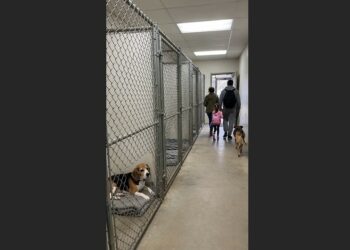
He lay beside the kennel door most of the night.
Whenever footsteps came down the hallway, he raised his head.
Then, when the person passed without stopping, he lowered it again and quietly whined.
It looked less like aggression than waiting.
The following afternoon, we learned who he was waiting for.
Moose Was Covered in Injuries, but None Immediately Explained the Story We Had Been Given
Our first concern was medical.
Whatever had happened in that apartment, Moose needed treatment.
His paw pads were cut.
There were several superficial injuries around his legs.
The wounds across his muzzle required cleaning and examination.
We checked him carefully for deeper trauma.
Because we had been told he had attacked someone, we also watched his behavior closely.
Pain can make even a normally tolerant dog defensive.
A Great Dane in pain is also a very large patient.
So we moved slowly.
Moose did not lunge.
He did not snap.
When one technician approached his injured paws, he pulled them back at first.
She paused.
A few seconds later, he allowed her to continue.
He looked frightened and exhausted.
That did not prove he had never acted aggressively.
Behavior inside a clinic cannot establish what happened somewhere else.
Still, what we were seeing did not fit neatly with the description of an uncontrollable dog who had just attacked his owner.
He Kept Listening for Someone
Once his immediate injuries had been addressed, Moose was moved to a recovery kennel large enough for him to lie comfortably.
He ignored his first meal.
He drank some water.
Then he positioned himself near the door.
Every time the hallway became busy, his eyes opened.
A receptionist walked past.
Moose lifted his head.
A veterinarian entered another room.
He stood.
Someone pushed a cart down the hall.
His ears moved forward.
Then he settled again.
At one point, I sat outside his kennel for several minutes.
Moose watched me.
I did not reach through the door.
He eventually lowered his head.
A moment later, another set of footsteps approached.
He was standing again before I was.
It seemed clear he was listening for something familiar.
The Landlord’s Account Had Left Us With Questions
He had said Moose destroyed the apartment.
That part might have been true.
He had said a tenant had been attacked.
That required more context.
We did not have it.
No tenant had accompanied Moose.
There was no detailed account from the injured person.
The landlord had been angry about property damage and adamant that the dog should not return.
Those facts alone could not tell us whether Moose had bitten anyone, panicked during an emergency, or been involved in something entirely different.
There was another complication too.
A landlord does not automatically become the legal owner of a tenant’s dog merely because the animal is found in a rented apartment.
Ownership and surrender authority have to be verified.
That question was being sorted out separately.
Meanwhile, Moose remained our patient.
He needed care regardless of the dispute around him.
He Barely Slept That Night
When he did, it came in short stretches.
He would curl awkwardly on his bedding, close his eyes, then wake when someone entered the corridor.
Once he stood so quickly that he slipped slightly on a bandaged paw.
We changed his setup to give him better footing.
I offered food again.
He sniffed it.
Nothing.
Later, I hand-fed him a small piece approved by the veterinarian.
He took it carefully and then turned his attention back toward the door.
By dawn, I had stopped thinking of Moose as the dangerous dog the landlord had described.
I still did not know what had happened.
But I knew he was waiting for someone.
That Someone Arrived the Following Afternoon
I had stayed later than usual to finish charting and hand over several cases.
The front desk called into the treatment area.
“There’s a man here asking about a Great Dane.”
I walked out.
He looked like someone who had come directly from a hospital.
A plastic hospital bracelet remained around one wrist.
One arm was wrapped in bandages.
There were smaller dressings near his hand and along the side of his face.
He looked exhausted.
In one hand, he held his phone.
On the screen was a photograph of Moose.
Healthy.
Standing in a living room beside a couch.
“Please,” the man said. “Tell me he’s here.”
I Asked His Name and His Relationship to Moose
He gave both.
Moose was his dog.
He had owned him for years.
Once we had enough information to begin verifying that, I explained why the dog had been brought to us.
I told him about the landlord.
About the damaged apartment.
And about the claim that Moose had attacked him.
The man’s expression changed immediately.
“No.”
His voice shook.
“No, Moose never attacked me.”
He looked down at the bandages on his arm.
Then back at me.
“There was a fire.”
That sentence changed the entire situation.
The Fire Had Started While He Was Sleeping
According to the man, he had fallen asleep with Moose elsewhere in the apartment.
At some point, a fire began in or near the kitchen.
Exactly what caused it was not part of the story he told us that afternoon.
What mattered was that Moose noticed the emergency before his sleeping owner did.
The dog became agitated.
He moved through the apartment.
Furniture was knocked over.
Objects hit the floor.
Moose reportedly pushed against his owner and continued making noise until the man woke.
By then, smoke had spread.
The normal route out had become difficult.
What the landlord later described as a dog “destroying the apartment” had happened during that frantic period.
The overturned furniture was real.
So was the damage.
The reason behind it was very different.
Then I Looked Again at Moose’s Paws
The man described shattered glass.
Suddenly, the pattern of Moose’s injuries made far more sense.
Cuts beneath the feet.
Lacerations on the muzzle.
Small wounds along the lower legs.
According to his owner, the dog forced his way through a glass door when the smoke made the other route unsafe.
We could not reconstruct every second from the injuries alone.
But broken glass was consistent with what we had treated.
The man also had bandages.
He told us he had been hurt during the escape and later taken to the hospital.
He believed he might not have gotten outside at all without Moose.
“He Grabbed My Sleeve”
That was how the man described the final part.
Moose did not pick him up.
He did not somehow understand fire evacuation the way a trained firefighter would.
What he reportedly did was grab clothing and pull while moving toward an exit.
Dogs can tug at clothing when highly aroused or trying to get a person’s attention.
In this case, the behavior apparently helped prompt the man to move.
“He pulled until I followed him,” the owner told me.
Once outside, the man was injured and disoriented.
Moose stayed nearby.
Then he barked.
Neighbors eventually came.
Emergency services followed.
The owner went to the hospital.
And somewhere during the confusion afterward, Moose and his person were separated.
The Landlord Saw the Apartment After the Emergency
From that perspective, the damage must have looked terrible.
Furniture overturned.
A broken glass door.
Fire and smoke damage.
An enormous dog with blood around his mouth and paws.
But property damage does not explain motive.
Neither does a dog’s appearance.
A frightened 150-pound Great Dane covered in blood can look intimidating.
That does not make him responsible for the emergency.
According to the owner, there had been no attack.
The injuries on his arm came from the fire and escape, not from Moose biting him.
The story we had been given was beginning to collapse.
Moose Had Spent the Night Waiting for the Person Who Disappeared
The owner had been taken away.
Moose could not know why.
He did not understand hospitals.
He did not know that his person was receiving treatment.
He did not know the difference between temporary separation and permanent loss.
What he had was the sequence he experienced.
Emergency.
Smoke.
Escape.
Neighbors.
Confusion.
Then his person was gone.
After that, he was transported to another unfamiliar place.
That helped explain what we had seen in the kennel.
The lifted head whenever footsteps approached.
The refusal to eat.
The soft whining.
He may have been searching for familiar sensory cues.
A voice.
A smell.
A gait he recognized.
Then, finally, that person had walked into our lobby.
I Took Him Toward the Recovery Area
We could not simply throw open the kennel without controlling the situation.
Moose was injured.
His owner was injured too.
An excited Great Dane can knock over a healthy adult without meaning to.
So we explained that the reunion needed to happen calmly.
The man nodded.
He seemed almost afraid to believe Moose was really there.
As we approached the recovery area, the dog heard us before he could see us.
Moose stood.
His head lifted.
Then the owner’s voice came from behind me.
“Moose?”
The Great Dane froze.
It lasted perhaps one second.
Then his entire body began trembling.
The Sound Moose Made Was Not a Growl
It was a high, strained cry.
One I had not heard from him during the entire night.
He pressed close to the kennel door.
His tail moved rapidly.
Then stopped.
Then moved again.
His owner covered his mouth with his unbandaged hand.
“Hey, buddy.”
Moose pushed his nose toward him through the opening.
We prepared to let them make contact safely.
Nobody rushed.
The owner lowered himself as much as his injuries allowed.
Then we opened the kennel.
For a dog described as uncontrollable, Moose came out slowly.
He Did Not Charge
He walked toward his owner.
Carefully.
His bandaged paws changed his gait.
When he reached the man, he lowered his head.
Then he rested it across the man’s lap.
That was all.
The owner placed his good hand against Moose’s neck.
Moose’s eyes closed.
The Great Dane who had spent hours raising his head whenever strangers passed the kennel door finally stopped watching the hallway.
His person was there.
No one in the room needed to assign human thoughts to him to understand the behavioral change.
Before the reunion, Moose had been restless and vigilant.
After contact with his familiar person, his body relaxed.
His Owner Kept Apologizing
Not because he believed the fire was his fault.
Because Moose had spent a night alone.
“I didn’t know where they took him,” he said.
His phone had apparently been unavailable during part of his hospital treatment.
By the time he began asking questions, the trail was unclear.
A neighbor eventually told him that the landlord had removed Moose from the property.
That sent him searching clinics and shelters.
The photograph on his phone was the quickest way to identify the dog.
He had come to us still wearing his hospital bracelet.
The reunion did not automatically settle every administrative problem.
But it gave us a much clearer picture of whose dog Moose was and what likely happened.
The Clinic Could Not Treat a Disputed Surrender Casually
This is the part stories often skip.
Once ownership became contested, documentation mattered.
Veterinary records mattered.
Photographs.
Microchip information, if available.
Licensing.
Previous medical records.
The owner’s statements.
The landlord’s paperwork.
The clinic had to follow appropriate procedures rather than simply choosing the person whose story felt more sympathetic.
Fortunately, the owner had information connecting him to Moose.
The story he gave was also consistent with the dog’s known history and injuries.
The process took time.
During that time, the owner stayed as long as he was allowed.
Moose slept with his head near him.
We Also Had to Be Careful About Calling Moose a “Hero”
I understand why people use the word.
If his owner’s account was accurate, Moose’s behavior contributed directly to getting him out of a dangerous apartment.
That matters.
Still, dogs do not think about heroism.
Moose did not wake during a fire and conduct a moral calculation about risking himself.
He responded to an immediate threat.
Fire.
Smoke.
A familiar person who was not moving.
A blocked or dangerous environment.
Dogs can become highly persistent when trying to wake or move someone.
Moose used the behaviors available to him.
Noise.
Physical contact.
Pulling.
Movement toward an exit.
Those behaviors appear to have helped.
The result was extraordinary without pretending Moose understood it as a rescue operation.
The Damage Was Real Too
I think that deserves acknowledgment.
Furniture had been overturned.
Glass had been broken.
The apartment needed significant repair after the fire.
The landlord was dealing with a damaged property.
Anger about that damage was understandable.
Misrepresenting the dog was not.
A dog fleeing a burning building cannot be evaluated as though he overturned a table on an ordinary afternoon.
Context changes behavior.
If Moose broke through a door while escaping smoke, the broken door was part of an emergency.
If he grabbed his owner’s sleeve while trying to move him, that was not automatically an attack.
Intent is difficult to prove in animals.
But physical behavior has context, and context matters.
Moose’s Injuries Told Part of the Story His Voice Could Not
The cuts across his face were painful.
His paws would require continued care.
He was lucky the injuries were not worse.
Glass can sever tendons, damage eyes, and cause serious blood loss.
Smoke exposure can also create complications that are not immediately obvious.
So even after his owner found him, our medical work was not finished.
The reunion did not heal Moose.
Veterinary treatment did that work gradually.
Rest mattered.
Wound care mattered.
Monitoring mattered.
Pain management mattered.
His owner’s presence could reduce stress.
It could not substitute for medicine.
The Owner Had Healing to Do Too
One of his arms remained bandaged.
He moved stiffly.
The fire had affected both of them.
That created a practical question.
Could he safely care for an enormous injured dog while recovering himself?
Those details had to be considered before discharge.
Friends and neighbors became part of the plan.
Moose needed somewhere safe while the apartment situation was addressed.
His owner needed help too.
The goal was not a dramatic scene in which man and dog simply walked out together and everything returned to normal.
There was no normal apartment to return to yet.
There were injuries on both sides of the leash.
Recovery required logistics.
What Changed First Was Moose’s Appetite
After spending hours uninterested in food, he ate once his owner had been with him for a while.
Not a huge meal.
Enough.
His posture changed too.
He stopped reacting to every set of footsteps.
He slept more deeply.
At one point, I passed and saw his owner sitting beside him.
Moose was lying on his side.
The man’s hand rested on his shoulder.
Neither was doing anything.
That image stayed with me longer than the dramatic details about broken glass.
The danger was over.
For the first time since Moose arrived, he seemed to know where the familiar person was.
He no longer had to keep checking the door.
Large Dogs Are Easy to Misread When People Are Afraid
Size changes perception.
A frightened Chihuahua trembling and scrambling through a room looks vulnerable.
A frightened Great Dane can knock over furniture simply because there is more dog moving through the same space.
A mouth large enough to grip an adult’s sleeve also looks alarming.
That does not mean size should be ignored.
Large dogs can cause serious injuries, intentionally or accidentally.
Responsible handling matters.
But describing behavior accurately matters too.
Moose had arrived labeled as dangerous before anyone at the clinic had heard from the person he was alleged to have attacked.
Once that person appeared, the label no longer matched his account.
I Kept Thinking About the Landlord’s First Sentence
“He destroyed the apartment and attacked my tenant.”
Technically, part of the first half may have described visible damage.
The rest changed once context appeared.
Moose had been inside an apartment during a fire.
His owner said the dog woke him.
The dog moved through a smoke-filled environment.
Glass shattered during their exit.
Moose grabbed clothing and pulled.
Then remained beside the injured man outside and barked until other people responded.
The same actions can sound completely different depending on what information is left out.
“Dog destroys apartment.”
“Dog panics during fire.”
“Dog helps owner escape.”
One animal.
One night.
Very different stories.
Moose Never Knew Any of Those Stories
He knew his person was there.
That was enough.
He did not understand that someone had accused him of attacking.
He did not know surrender papers had been signed.
He did not care about the argument over damaged property.
He did not know we were discussing whether the wounds across his face supported one account better than another.
Dogs do not live inside our narratives about them.
Moose experienced the immediate world.
Pain.
Unfamiliar kennel.
Strangers.
Footsteps.
Then one familiar voice.
His behavior after hearing that voice was the clearest change we saw all day.
By the Time I Left the Clinic, Moose Was Asleep
His head rested near his owner’s leg.
The same dog who had raised his head at every passing person the night before now slept through carts moving down the hall.
I stood outside the room for a moment.
I thought about how close we had come to knowing Moose only through somebody else’s anger.
An enormous dog.
A wrecked apartment.
Blood on his face.
A frightened landlord.
It would have been easy to assemble those details into a simple conclusion.
The dog was dangerous.
Then the injured tenant himself arrived.
And the story became something else.
Broken Furniture Did Not Tell Us Why It Was Broken
Neither did shattered glass.
Neither did blood.
Those things told us that something violent had happened inside the apartment.
The fire explained the violence.
Moose’s owner explained the rest.
He had gone to sleep with a Great Dane nearby.
He woke during an emergency because that dog would not leave him alone.
He followed Moose toward an exit.
He survived.
There was no need to claim Moose knew he was risking his own life.
There was no need to turn him into something supernatural.
A frightened, determined dog doing everything available to stay with a familiar person was remarkable enough.
The Last Thing I Remember Is the Owner’s Hand on Moose’s Head
The bandages made the movement awkward.
He scratched gently behind one ear.
Moose did not lift his head.
He was finally asleep.
The man looked at me.
“He didn’t hurt me,” he said again.
I believed that statement mattered to him almost as much as finding the dog.
The apartment could be repaired.
His own wounds could heal.
Moose’s paws would heal too.
But if the story about a dangerous dog had followed him without anyone questioning it, the consequences could have been much harder to reverse.
That afternoon, at least, Moose was no longer an accusation written on a surrender form.
He was an injured Great Dane resting beside the person who knew what had happened inside the smoke.
The furniture had been broken.
The glass had shattered.
Moose had blood on his paws.
But according to the man he was accused of attacking, those were not signs that the dog had turned on him.
They were the marks of the route they had taken out.
Moose was not the reason his owner had nearly died in that apartment.
He was part of the reason the man was sitting beside him afterward, alive enough to place one bandaged hand on his head.
And once Moose found that hand again, he finally stopped watching the door.
Editor’s Note: The characters in this story are fictional. Through these stories, we hope to share the intelligence, loyalty, compassion, and loving nature of dogs with people everywhere.