He was 58, newly retired after 32 years as a mail carrier, and still adjusting to a life without the daily routine he had followed for decades.
He had driven to Pine Hollow Animal Rescue in Bowling Green, Kentucky, on a Monday afternoon with no particular plans.
“I’m only browsing,” he told the woman at the front desk.
About half an hour later, he was standing in the hallway, preparing to leave.
That’s when Benny, a four-year-old rescue dog with a golden-brown coat and one permanently bent ear, did something Walter hadn’t expected.
The dog hurried toward him, rose onto his hind legs, and wrapped both front paws around Walter’s right leg.
He didn’t bark.
He didn’t jump around excitedly.
He simply pressed his forehead against Walter’s knee and held on, his body visibly trembling.
Walter stopped walking.
For almost a full minute, he remained standing there, looking down at the dog who had spent nearly six months waiting for another home.
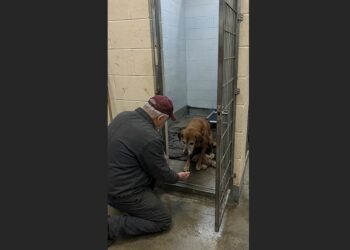
Then Walter slowly lowered himself to the floor.
Benny climbed into his lap and buried his face against his jacket.
Within seconds, the trembling stopped.
The shelter’s security camera recorded the entire encounter.
And before Walter left that afternoon, he would send his wife a text message neither of them had expected.
“I think somebody picked me.”
After 32 Years on the Same Routine, Retirement Felt Unfamiliar
Walter had spent most of his working life delivering mail.
For 32 years, his days followed a familiar structure.
He woke up early, prepared for work, and followed delivery routes through streets he knew well.
There were houses he passed regularly, people he recognized, and responsibilities that gave each day a clear beginning and purpose.
Then, three months before his visit to the shelter, Walter retired.
He had earned the opportunity to slow down.
But adjusting to retirement wasn’t as straightforward as he had imagined.
His wife, Denise, noticed the changes almost immediately.
Walter wasn’t particularly unhappy, she explained. He simply seemed unsure what to do with all the time that had suddenly become available.
He wandered between rooms without settling anywhere.
Some mornings, he remained at the kitchen table long after breakfast, staring through the window while the television played silently in the background.
The quiet was different from the rest he had expected.
After decades of working, having nowhere he needed to be each morning felt strange.
Denise noticed.
And she began suggesting something she believed might help.
Denise Had Been Encouraging Him to Get Another Dog
For several months, Denise gently raised the idea of adopting a dog.
“Something to keep you company,” she suggested.
Walter wasn’t opposed to it.
He simply wasn’t ready to make a decision.
“Maybe later,” he told her.
The answer became familiar.
He knew that bringing home a dog would mean taking responsibility for another living creature.
There would be daily walks, meals, veterinary appointments, and the work of helping an animal adjust to a new home.
Walter hadn’t decided whether he wanted that responsibility so soon after retirement.
Still, Denise’s suggestion remained in his thoughts.
Then, one Monday afternoon, he got into his truck and drove to Pine Hollow Animal Rescue.
He hadn’t told himself that he was going there to adopt.
He was curious.
Perhaps seeing the dogs would help him decide whether he was ready.
When he arrived around lunchtime, he made his intentions clear to the volunteer at the front desk.
“No promises today,” he said with a nervous laugh. “I’m only browsing.”
She understood.
Then someone introduced him to Benny.
Benny Had Already Lost One Home
Benny was a four-year-old mixed-breed dog.
He was medium-sized, with golden-brown fur, a white patch across his chest, and one ear that remained bent because of an old injury that hadn’t received treatment at the time.
He had been living at Pine Hollow for nearly six months.
But this wasn’t Benny’s first experience of having a family.
He had previously been adopted.
Then his owner moved into assisted housing where pets weren’t allowed.
Benny had to return to the shelter.
The staff said his behavior changed after that return.
During his earlier time with a family, he had formed an attachment. Back at the shelter, he became noticeably withdrawn.
He rarely approached visitors during meet-and-greets.
Instead, he often sat nearby, watching people move around the room and eventually leave.
His behavior notes described him as:
“Very gentle. Deeply attached once bonded. Sensitive to abandonment.”
The description reflected the shelter staff’s observations, rather than something they could know about Benny’s thoughts.
Dogs can respond to changes in their living arrangements and the loss of familiar people or routines, although those responses differ between individuals.
Whatever Benny understood about his circumstances, the staff had noticed that he was no longer as outgoing.
He had become a quiet dog who seldom made the first move.
Walter didn’t know much about that history when he first met him.
He simply agreed to spend some time with Benny in one of the shelter’s visiting rooms.
Their First Thirty Minutes Were Remarkably Ordinary
Walter sat cross-legged on the floor.
Benny approached cautiously, lowering his nose toward Walter’s hands.
The older man let him investigate.
Then he gently scratched behind Benny’s ears.
The dog moved closer and leaned against Walter’s knee.
There was no sudden burst of excitement.
Benny didn’t race around the room, and Walter didn’t try to persuade him to play.
They spent their time quietly together.
Whenever Walter shifted his position, Benny adjusted too, edging a little closer.
The volunteer supervising their meeting noticed the pattern.
Later, she described the encounter as feeling less like a stranger meeting a dog and more like “two lonely creatures recognizing each other.”
It was her impression of the moment, not something anyone could establish about what Benny was feeling.
But the two did seem comfortable together.
Walter allowed Benny to approach at his own pace.
Benny accepted the attention and remained close.
After approximately 30 minutes, Walter began preparing to leave.
He had enjoyed meeting the dog, but he still wasn’t certain he was ready to adopt.
He thanked the volunteer.
Then he stood up.
Benny’s Reaction Changed the Entire Afternoon
Walter turned toward the hallway exit.
Benny followed.
Then, without warning, the dog moved toward Walter’s right leg and wrapped his front paws around it.
His tail tucked beneath his body.
His shoulders and torso began trembling.
The movement was so unexpected that Walter froze mid-step.
Benny pressed his forehead against the man’s knee and remained there.
He made no sound.
People nearby stopped walking.
The volunteer watched as the dog continued holding onto Walter.
According to one staff member, the hallway became unusually quiet.
“The whole hallway went dead silent,” she later recalled. “You could feel everyone watching. Nobody wanted to interrupt whatever was happening between them.”
The security camera captured Benny’s behavior and Walter’s reaction.
No one could know precisely why Benny held onto his leg.
The dog may have been responding to the movement of someone whose company he had just enjoyed, or to the prospect of another separation from a familiar interaction.
But the visible details were clear.
Benny was trembling.
Walter had stopped.
And the dog was maintaining contact rather than allowing the encounter to end.
Walter Sat Back Down, and Benny Climbed Into His Lap
Walter remained standing for nearly a minute.
Then he slowly lowered himself toward the floor.
As soon as his knees touched the ground, Benny moved closer.
The dog climbed into Walter’s lap and pressed his face into the man’s jacket.
Walter wrapped both arms around him.
Benny’s trembling stopped within seconds.
For a while, they remained seated together.
Walter closed his eyes briefly as the dog rested against his chest.
He had spent the previous half hour wondering whether he was ready to make a commitment.
Now he was sitting on the shelter floor, holding a dog who had become visibly distressed when their visit appeared to be ending.
The interaction didn’t prove that Benny understood adoption or knew Walter might become his owner.
It did show that he was comfortable seeking contact with Walter.
And it gave Walter something important to consider.
He hadn’t expected to feel such a connection during a casual visit.
Finally, he looked toward the volunteer.
“I came here to look around. I really wasn’t planning on making a decision today.”
Then he glanced at Benny.
“But I think he already made it for me.”
Twenty Minutes Later, Walter Was Filling Out Adoption Papers
The staff had seen plenty of emotional adoption meetings.
But Benny’s response was unusual enough that several employees were moved to tears before the paperwork had even been printed.
The dog who usually stayed quietly beside visitors had initiated contact in a way none of them expected.
And Walter, who had arrived insisting that he was only looking, had decided to bring him home.
He completed the adoption forms approximately 20 minutes later.
Benny was no longer waiting for someone to choose him.
Walter had made that choice.
While sitting in the shelter lobby, he took out his phone and sent Denise a text.
It was brief.
“I think somebody picked me.”
After months of answering her adoption suggestions with “Maybe later,” he was finally bringing home a dog.
Denise came to the shelter shortly afterward.
Denise’s Reaction Was Caught on Camera Too
The shelter’s parking lot security camera captured another part of the afternoon.
Denise walked toward Walter’s truck.
As she approached, she noticed Benny sitting calmly in the passenger seat beside her husband.
She immediately began laughing through tears.
Walter later recalled the first thing she said.
“You made it longer than I thought you would.”
It was an affectionate response to a decision she had been encouraging him to consider for months.
Walter had been reluctant, even that morning.
He had expected to spend a little time looking around the shelter and then return home without adopting.
Instead, he had met Benny.
The dog had approached him cautiously, stayed close during their visit, and held onto his leg when he tried to leave.
Now they were going home together.
The parking lot footage showed a woman seeing the result of a decision her husband hadn’t been ready to make until that afternoon.
For Denise, it was a welcome surprise.
For Benny, it meant leaving the shelter where he had spent nearly six months.
Benny Quickly Made Himself Part of Walter’s Routine
A week after the adoption, Benny had become a constant presence in the house.
Walter reported that the dog followed him almost everywhere.
When Walter went into the kitchen, Benny followed.
When he went to the garage, Benny came along.
The same happened when Walter visited the mailbox or moved into the living room.
If Walter stood up, Benny often stood up too.
It was a noticeable change from the days when the retired mail carrier had wandered through his house without settling into a routine.
Now he had a dog accompanying him.
That didn’t mean every adjustment to retirement had been resolved.
Nor did it mean Benny had instantly overcome the effects of losing his previous home.
They were still getting used to each other.
But their days had begun developing a shared rhythm.
Walter moved around the house, and Benny stayed close.
They were learning what ordinary life together would look like.
And for a man accustomed to decades of familiar routes and responsibilities, those new routines mattered.
Every Morning, Benny Waits by the Door
At night, Benny sleeps on a blanket beside Walter’s side of the bed.
In the morning, when Walter gets up to make coffee, the dog waits near the front door.
He watches Walter as he moves through the house.
The behavior reminds Walter of Benny’s reaction at the shelter.
The dog still seems eager to remain near him.
There is no way to know whether Benny expects Walter to disappear or whether he simply enjoys keeping his new caregiver in sight.
Dogs often follow people with whom they have formed attachments, especially while adjusting to a new environment.
Some become more relaxed as household routines grow familiar.
For now, Benny prefers to stay close.
And Walter has discovered that he enjoys the company.
After years of spending his mornings preparing for a delivery route, he now begins them with a dog waiting nearby.
The change is simple, but it has become meaningful to him.
Walter Had Spent a Lifetime Showing Up at Other People’s Doors
After Benny had been home for about a week, Walter shared a reflection with the shelter staff.
It was later included alongside the security footage that circulated online.
“For thirty-two years, I spent my life showing up at people’s doors with things they were waiting for,” he said.
“Now I come home and there’s somebody waiting at the door for me instead. I didn’t realize how much I needed that.”
The words captured a change Walter hadn’t anticipated when he retired.
His career had given him structure.
Each day, there had been deliveries to make, people to see, and places he needed to go.
Retirement removed that routine almost overnight.
Bringing home Benny didn’t recreate his former working life.
It gave him something different.
A companion who wanted to be near him.
An animal who needed his care.
And an everyday responsibility that made the hours at home feel less empty.
Walter hadn’t gone to the shelter seeking a solution to retirement.
He had simply gone to look at dogs.
The relationship developed from there.
Benny Didn’t Need to Be the Loudest Dog in the Shelter
Walter also remembered the way Benny had behaved when their visit ended.
“He didn’t beg loudly. He didn’t try to impress me.”
“He just held onto my leg like he finally decided to trust somebody with the truth. And the truth was that he didn’t want to be left behind again.”
Those were Walter’s words, his interpretation of a moment that affected him deeply.
Benny couldn’t explain what he wanted or why he had reacted so strongly.
The dog had already experienced losing a home, and the shelter staff had noticed that he often withdrew during visits.
But on that Monday afternoon, he chose to move closer to Walter.
When the man stood up, Benny followed.
Then he placed his paws around Walter’s leg and stayed there.
The response was different from the energetic greetings that sometimes attract attention from prospective adopters.
Benny wasn’t performing tricks or showing off.
He was a quiet dog whose actions surprised everyone in the hallway.
Walter saw enough in that moment to decide he wanted to take him home.
They Were Both Adjusting to a New Chapter
Walter and Benny had arrived at the shelter from very different circumstances.
Walter was 58 and newly retired from a career that had occupied 32 years of his life.
He was adjusting to having fewer obligations and more unstructured time.
Benny was four, had spent nearly six months at the rescue, and had previously been returned when his owner moved into housing that prohibited pets.
Neither one’s situation could be reduced to loneliness alone.
Walter had a wife and a home. Benny had been receiving care from shelter staff.
But both were facing changes in familiar routines.
Their meeting offered the possibility of something new.
For Walter, adopting Benny meant accepting the responsibility of caring for a dog.
For Benny, it meant another opportunity to settle into a household with someone prepared to provide consistent care.
Their connection was meaningful, but it was also the beginning of an adjustment that would take time.
A week together was too soon to know every challenge they might encounter.
Still, the early signs were encouraging.
Benny was resting beside Walter’s bed and accompanying him around the house.
Walter was enjoying a daily routine that included his new companion.
And Denise, who had spent months suggesting they adopt another dog, had welcomed Benny into their home.
One Monday Afternoon Changed What Home Felt Like
The moment captured by the shelter camera lasted only a short time.
A man stood up after meeting a dog.
The dog followed him into the hallway.
Then Benny wrapped his front legs around Walter’s knee and began trembling.
Walter stopped.
After nearly a minute, he sat back down.
Benny climbed into his lap, and the two remained together while the activity of the shelter continued around them.
That moment became the reason Walter reconsidered his decision to leave without adopting.
Twenty minutes later, he had completed the paperwork.
He sent his wife a text from the lobby.
And Benny left the shelter with him.
Now, one week later, Walter’s mornings look different.
He gets his coffee while Benny waits near the door.
He walks through the house with the dog following behind him.
At night, Benny settles onto his blanket beside the bed.
For 32 years, Walter had been the familiar person arriving at other people’s homes.
Now he has a dog who pays attention when he comes through his own door.
He didn’t know how much he would enjoy that when he first retired.
And Benny, the quiet rescue dog who had spent months waiting for another family, has a person willing to stay.
The shelter footage ends, but their ordinary days together have begun.
If Walter and Benny’s story touched your heart, please share it so more people can appreciate the difference a loving home can make for a rescue dog—and the companionship a dog can bring into someone’s life.