“Which dog here is the oldest and still waiting?”
The woman behind the front desk looked at me for a moment.
She didn’t smile or immediately reach for adoption paperwork. Instead, she let out a quiet breath, picked up a set of keys, and stepped out from behind the counter.
“Alright,” she said softly.
Her name tag read Nina.
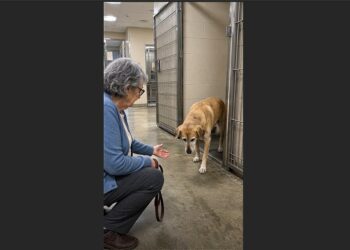
I followed her through the shelter, past rows of excited dogs pressing against their kennel gates.
There were puppies bouncing with energy, friendly dogs wagging their tails, and plenty of animals eager to meet anyone who stopped.
But Nina kept walking.
Eventually, we reached a quieter hallway at the back of the building.
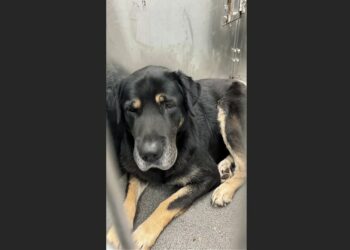
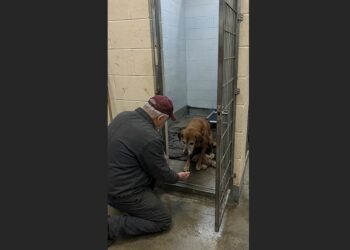
At the very end was a kennel that looked almost too large for the elderly dog resting inside.
He had a faded coat, a silver-gray face, one drooping ear, and cloudy eyes.
His name was Buddy.
He was a 16-year-old pit bull mix.
And according to Nina, he had been passed over more times than she could count.
I had come hoping to give an overlooked senior dog a comfortable place to spend his remaining time.
What happened after I brought Buddy home would surprise me.
Because the dog I thought needed nothing more than a peaceful place to rest wasn’t finished enjoying life.
Most Visitors Never Reached the Last Kennel
The shelter was busy when I arrived.
People naturally gravitated toward the younger dogs.
I could understand why.
The puppies were lively and curious. Some jumped toward their doors whenever visitors approached. Others barked and wagged their tails, hoping to attract attention.
It was easy to picture one of them growing up in a new home.
Nina led me past those kennels without stopping.
We entered a quieter corridor where the sound of barking echoed against the concrete walls.
“Most people don’t come back here,” she told me.
“I figured,” I answered.
She nodded.
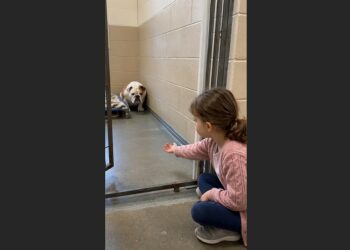
At the far end, she stopped and turned toward one of the enclosures.
Buddy was resting inside.
He was smaller and thinner than I had expected, with the worn appearance that sometimes comes with advanced age.
His coat had faded, and gray fur covered much of his muzzle.
One ear drooped slightly.
His eyes were cloudy, suggesting that his vision might not be what it once was.
But he was awake.
And when I approached, he looked in my direction.
I leaned forward to read the card attached to his kennel.
Buddy. 16 years old. Pit bull mix. Calm. Senior. Often overlooked.
The additional notes explained that he needed a quiet home, soft food, and patience.
There was nothing in his description that promised an easy, carefree adoption.
It was an honest account of an elderly dog’s needs.
And it was exactly why I wanted to meet him.
At Sixteen, Buddy Had Very Little Chance of Being Chosen
Nina stood beside me while I read his information.
“He’s been passed over more times than I can count,” she said.
I looked through the kennel gate.
Buddy hadn’t moved from his resting place.
“Why?” I asked.
Nina glanced at his card.
“Because people don’t want something that comes with an ending they can already see.”
Her answer stayed with me.
Adopting a senior dog means accepting that the time together may be limited.
A 16-year-old dog might need additional veterinary attention, assistance with mobility, changes in diet, or help navigating the ordinary challenges of old age.
There is also the emotional reality of knowing that goodbye may come sooner than anyone would like.
I understood why those responsibilities could feel overwhelming.
But as I watched Buddy resting quietly inside his kennel, I couldn’t stop thinking about what those concerns meant for him.
He was still a living animal who needed care.
He still deserved comfort, companionship, and a place where he could feel secure.
His age hadn’t made those needs disappear.
If anything, it made them more immediate.
I hadn’t come looking for a dog who could give me ten or fifteen years of companionship.
I had come because I wanted to offer a home to someone who might otherwise spend his final chapter waiting behind a kennel door.
And Buddy was right in front of me.
He Didn’t Bark or Jump. He Just Rested His Head Against Me.
Nina unlocked the kennel.
I expected Buddy to hesitate.
After all, he was an elderly dog meeting a stranger in an unfamiliar interaction.
But he slowly rose and stepped forward.
His movements were careful.
He paused just outside the enclosure, looked toward me, and released a long breath.
I knelt down.
There was no reason to hurry him.
Buddy approached at his own pace, taking one deliberate step after another.
He didn’t bark or jump.
He didn’t wag his tail wildly.
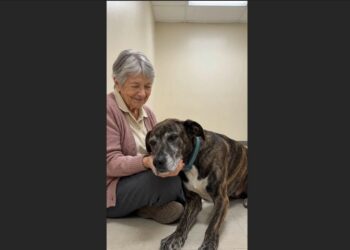
When he finally reached me, he leaned forward and rested his head against my chest.
I remained still.
The contact was gentle and quiet.
Buddy wasn’t demanding that I play with him or offering the enthusiastic greeting I had seen from younger dogs near the entrance.
He simply seemed comfortable leaning against someone.
Nina cleared her throat.
“He does that sometimes,” she said, her voice wavering slightly.
I placed a hand gently against Buddy.
For a while, we stayed that way.
I couldn’t know what he had experienced before arriving at the shelter or exactly what he understood about meeting me.
But I could see that he was comfortable enough to remain close.
And I knew I wanted to bring him home.
There Was a Folded Note Behind His Kennel Card
As I stood beside Buddy’s kennel, I noticed something tucked behind his information card.
It was a folded piece of paper.
“What’s that?” I asked Nina.
“It came with him,” she said quietly. “I always forget it’s there.”
I considered opening it immediately.
But Buddy was still resting against me, and I didn’t want to interrupt the interaction.
I left the paper folded for the moment.
The adoption process moved forward, and soon Buddy was leaving the shelter with me.
The ride home was peaceful.
He didn’t whine or pace around.
Instead, he curled up beside me, his paws tucked beneath him.
At a stoplight, I glanced toward him.
He was resting quietly.
I had imagined that bringing home a senior shelter dog might involve considerable uncertainty.
And there were still many things I would need to learn about Buddy.
But that first car ride was uncomplicated.
He seemed content to rest.
I was glad to give him the opportunity.
His First Evening Home Was Quiet
When we arrived, I gave Buddy time to explore.
He stepped through the doorway slowly, pausing to look around.
The house was unfamiliar, and I didn’t want to overwhelm him by demanding that he investigate everything at once.
He moved carefully through the space.
Then he turned back toward me.
And once again, he leaned against me.
It was becoming a familiar gesture.
Buddy seemed comfortable with physical contact, particularly when he could initiate it himself.
I let him remain close.
There would be plenty of time for him to learn the household routine.
He didn’t need to accomplish anything on his first evening.
Eventually, he made his way toward the couch.
He climbed up, turned in a slow circle, and settled down with a soft sigh.
Watching him rest, I remembered the folded paper from the shelter.
I took it out and opened it.
What I read made me sit down beside him.
The Message Asked Someone to Let Buddy Rest
The note was short.
It read:
If someone takes him home, please tell him he was a good dog.
He wasn’t abandoned because he wasn’t loved.
Life just got complicated.
Please let him rest somewhere he feels seen.
I read it twice.
The message didn’t explain every circumstance that had brought Buddy to the shelter.
I didn’t know who had written it or exactly what had happened before he arrived.
But the words suggested that someone had cared about him and wanted his next home to be gentle.
I looked over at Buddy.
He was still resting on the couch.
His face had gone gray with age, and his body moved more slowly than it once had.
I sat beside him and placed my hand near his head.
He leaned toward it.
Then he closed his eyes.
At that moment, I wasn’t thinking about how long we might have together.
I was thinking about what I could offer him now.
A soft place to sleep.
Regular meals.
A calm home.
And someone who would pay attention to what he needed.
I couldn’t promise Buddy more years than his body would allow.
But I could make the time he had as comfortable and meaningful as possible.
The First Night, Buddy Slept Without the Noise of a Kennel
That evening, Buddy settled onto a soft bed.
There were no rows of unfamiliar dogs around him.
No people passing his kennel gate.
No need to compete for attention.
He had a quiet place to rest.
I understood that a new home wouldn’t immediately erase every challenge associated with his age.
Buddy was still sixteen.
He would need appropriate veterinary care, a comfortable environment, and patience with whatever limitations appeared.
I was prepared for that.
I had adopted him knowing that our time together might be short.
My original hope had been to provide what people sometimes call a retirement home for an elderly dog.
Somewhere peaceful.
Somewhere he could rest without being overlooked.
I didn’t expect dramatic changes.
I certainly wasn’t waiting for him to behave like a puppy again.
But as the days passed, I began noticing small differences.
As the Weeks Passed, Buddy Became More Active
At first, Buddy spent much of his time resting.
He moved slowly and seemed content with a quiet routine.
I let him settle at his own pace.
Gradually, he began showing more interest in what was happening around the house.
His steps seemed steadier.
He started following me from room to room.
Sometimes he greeted me with a small wag of his tail.
They were modest changes, but I noticed every one.
There was something especially rewarding about seeing him become more comfortable in his surroundings.
A senior dog’s behavior can change after moving from a busy shelter into a quieter home.
Better rest, predictable routines, appropriate care, and reduced stress may help some dogs become more active.
Those improvements don’t mean aging has stopped or that underlying health problems have disappeared.
But they can make a meaningful difference to daily comfort.
Buddy was still an old dog.
His eyes remained cloudy, and he still moved carefully.
Yet he was beginning to participate more in everyday life.
Instead of spending most of his time in one place, he followed me around the house.
He seemed interested in being part of whatever I was doing.
And I began looking forward to those little moments as much as he appeared to.
I Had Expected to Give Him Comfort, Not Watch Him Find New Energy
Before adopting Buddy, I thought I understood what our life together would look like.
I imagined quiet afternoons, soft bedding, and a dog who needed a great deal of rest.
I had prepared myself emotionally for the possibility that he might not have much time left.
Those expectations were reasonable for a sixteen-year-old dog.
But I hadn’t anticipated how much personality Buddy would reveal once he became familiar with the house.
He developed his own little routines.
He followed me around.
He greeted me at the door.
He settled beside me on the couch, often choosing to rest close enough to lean against me.
The same dog who had sat quietly in the final kennel was now participating in the ordinary activities of a home.
He wasn’t suddenly young.
He didn’t run around the house with endless energy.
And there was no reason to assume that his improving comfort guaranteed more time.
But he seemed to enjoy the life we were sharing.
That was more than I had dared to expect when I first met him.
Months Later, Buddy Was Still There
Days became weeks.
Then the weeks became months.
Buddy was still with me.
He continued greeting me at the door and following me through the house.
He curled up beside me when it was time to rest.
Sometimes his tail moved in a small, gentle wag when he noticed me nearby.
I found myself thinking back to the day Nina led me down the shelter hallway.
I remembered the excited puppies at the front, the echo of barking along the concrete walls, and the old dog resting in a kennel at the very end.
Buddy had been sixteen then.
He was still sixteen when he came home.
And with every passing month, I remained aware that our time together was precious.
But I no longer spent every day thinking about how our story might end.
There was too much ordinary life happening in between.
Meals.
Quiet afternoons.
The familiar sound of Buddy moving through the house.
His head resting against me when he wanted to be close.
Those were the things that filled our days.
I Didn’t Give Buddy a Second Childhood. I Gave Him a Home.
People sometimes imagine that adopting an old dog means rescuing an animal from loneliness and watching an extraordinary transformation happen overnight.
Buddy’s experience was quieter than that.
He didn’t become a different dog.
He remained a senior pit bull mix with cloudy eyes, a gray face, and careful movements.
What changed was his environment.
He had a home where his needs could be met and where someone had time to notice the small things he enjoyed.
He no longer had to wait in a kennel while visitors walked past.
He didn’t need to impress anyone to receive attention.
He could simply be Buddy.
And over time, he became comfortable enough to show more of himself.
The dog who had seemed almost resigned to resting in his kennel began following me around the house.
The dog who moved carefully toward me during our first meeting now greeted me when I came home.
His affection was never particularly dramatic.
Often, it was simply a quiet lean against my leg or a small wag of his tail.
But those gestures became part of my favorite moments.
The Question That Brought Me to Buddy
I still think about what I asked Nina when I first walked into the shelter.
“Which dog here is the oldest and still waiting?”
I hadn’t asked to see the friendliest puppy or the dog most likely to be adopted.
I wanted to meet an animal who might not have many opportunities left.
That question led me to Buddy.
Sixteen years old.
A faded coat.
A gray muzzle.
One drooping ear.
A kennel at the far end of a quiet hallway.
I had expected to bring him home and provide a peaceful place to spend whatever time remained.
And that was what I tried to do.
But Buddy gave me something unexpected in return.
He gave me mornings when I opened my eyes and found him resting nearby.
Afternoons when he followed me from one room to another.
Evenings when he settled beside me on the couch, leaning gently against my hand.
He gave me months of companionship that I hadn’t counted on when I first read his kennel card.
The folded note from his past had asked someone to let him rest somewhere he felt seen.
I couldn’t know whether the person who wrote it ever imagined Buddy living this way.
But I hoped they would have been glad to see him.
Buddy Was Never Too Old to Be Someone’s Dog
I don’t know how much time Buddy and I still have together.
At his age, there are no guarantees.
There weren’t any when I adopted him, either.
But I have learned that the value of a relationship isn’t measured only by how many years it lasts.
Sometimes it is found in the small, familiar moments that make up an ordinary day.
A dog resting beside you.
A gentle tail wag when you come through the door.
A gray-faced companion following you from the kitchen to the living room simply because he enjoys being near you.
When I first met Buddy, he was lying quietly in a kennel most visitors never reached.
Today, he has a place in my home and a routine we share.
He still rests often.
He still moves carefully.
And when he wants affection, he sometimes approaches and leans against me, just as he did the first day we met.
I had gone to the shelter hoping to give an elderly dog a comfortable final chapter.
Instead, Buddy reminded me that an old dog can still have new experiences, form new attachments, and enjoy the everyday comforts of being loved.
I thought I was bringing him home to rest.
But as the months passed, I had the privilege of watching him live.
And every time Buddy greets me at the door, I am grateful I walked past the puppies and asked about the dog who was still waiting.
If Buddy’s story touched your heart, please share it so more people can see why senior shelter dogs deserve a chance to spend their remaining years in a loving home.