The first time Jamie Hulit saw Beaux Tox, she wasn’t standing in front of him.
She was looking at a photograph on Facebook.
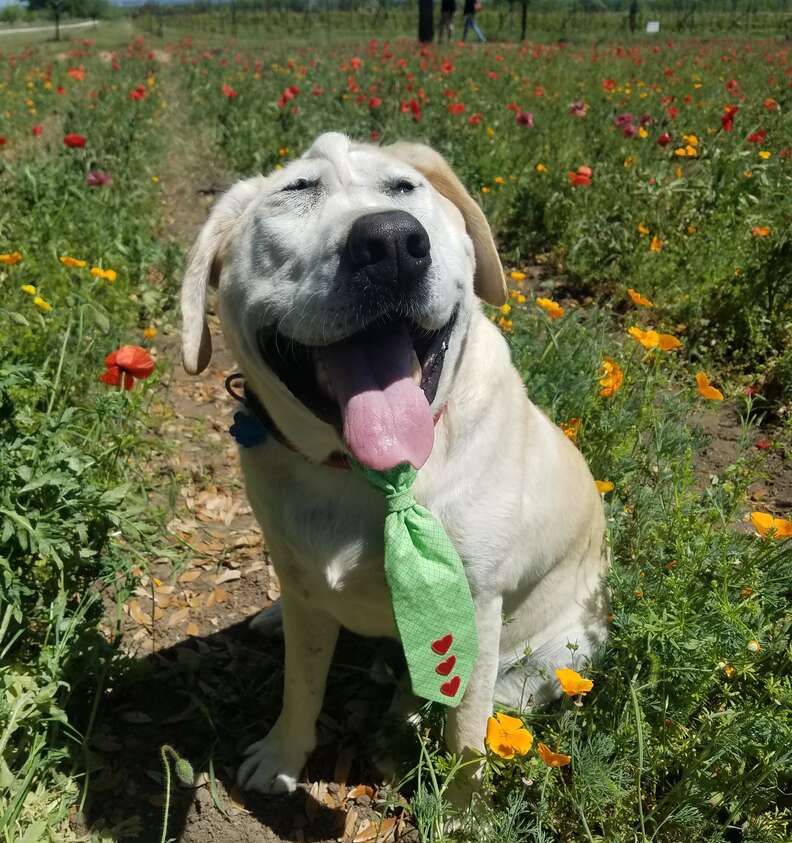
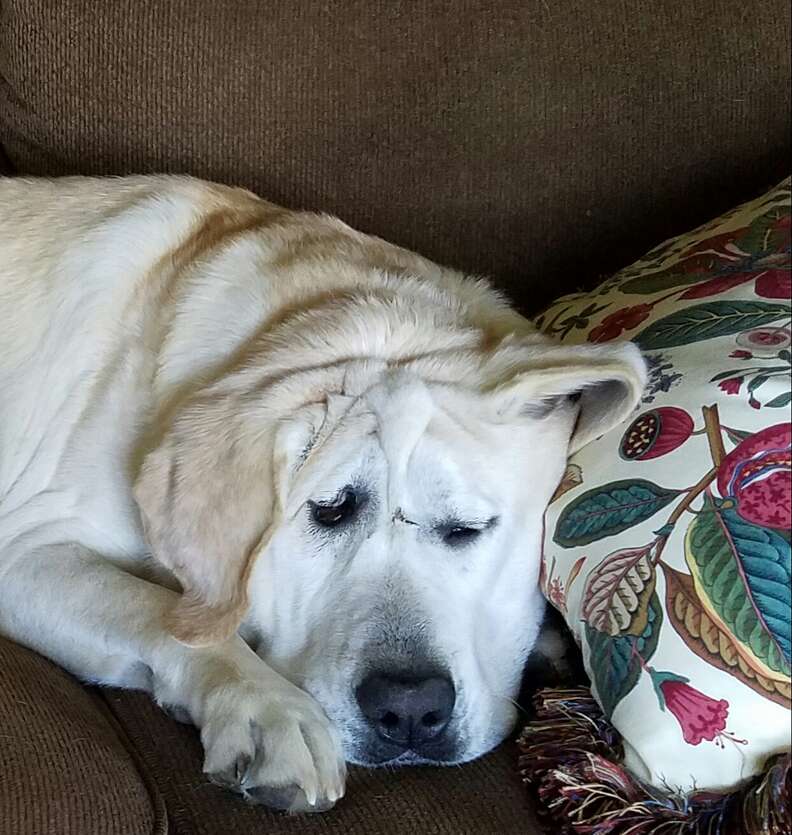
The yellow Labrador had a deeply wrinkled forehead, a sunken area around his skull, and eyes that sat unusually close together. His face gave him a permanently worried expression, even when he was happy.
Jamie knew his appearance was different.
But that wasn’t what concerned her.
The post explained that Beaux needed someone to take him in. He had spent years living outside, and previous attempts to find him a better home hadn’t worked.
Jamie looked at the photograph and sent a message.
She wanted to give him a home.
At the time, she couldn’t have known how sick he was or how difficult his recovery would become.
She only knew that a dog needed help, and she didn’t want him to spend another year being passed from place to place.
When she finally met Beaux in person, his condition was worse than she’d expected.
His ribs showed through his thin yellow coat. His body was painfully underweight, and he was suffering from fleas and ear mites.
Soon, a veterinarian would discover that he also had a serious heartworm infection.
His chances of surviving were uncertain.
But Jamie had already decided that Beaux belonged with her.
And she wasn’t going to turn away because taking care of him might be difficult.
A puppy born looking different
Beaux Tox had stood out from the beginning.
According to Jamie, his unusual facial structure developed before birth. He had been one of seven puppies competing for space in their mother’s womb.
She believed the limited space contributed to the way his skull formed, leaving him with a sunken cranium and close-set eyes.
The precise cause of his condition wasn’t independently established in the original report, but veterinary imaging provided an important reassurance.
An MRI showed that the deformity did not appear to affect his intelligence or prevent him from living a healthy life.
Beaux could learn, play, and enjoy companionship like other dogs.
His face simply looked different.
Unfortunately, the people breeding the puppies apparently saw that difference as a problem.
Jamie said they couldn’t sell him because of his appearance.
So they gave him away.
A man in the Austin, Texas, area took the puppy home and named him Lucky.
It should have been the beginning of a comfortable life.
Instead, the young Labrador soon found himself living almost entirely outdoors.
Five years in a backyard
According to Jamie’s account, Lucky didn’t get along with the man’s cats.
Rather than finding a way to manage the animals separately indoors, his owner moved the dog into the backyard.
And there he remained.
For approximately five years, the Labrador lived outside without the care and attention he needed.
Jamie later learned that he didn’t even have a proper dog bed.
Local rescue groups had tried to help him before, but the arrangements hadn’t worked out. Having spent so much of his life confined to a small yard, he lacked the experience and training that would have helped him adjust to different environments.
He was returned to the same backyard more than once.
The pattern continued.
People tried to help.
The placement didn’t last.
And Lucky ended up outside again.
By the time Jamie heard about him, he had spent almost his entire life without the stability of a permanent, caring home.
She wanted to change that.
The dog Jamie found in the yard
After seeing the Facebook post, Jamie arranged to meet him.
She was prepared for a dog with an unusual face.
She wasn’t prepared for how thin and unwell he looked.
His ribs protruded beneath his fur, and his body had lost far too much weight.
Fleas covered him, and his ears were infested with mites.
The Labrador who had once been called Lucky was clearly in need of veterinary care.
Jamie understood that taking him home could mean expensive treatment and a long recovery.
There was also the possibility that his medical problems would be more serious than they appeared.
But she didn’t want him to enter another temporary arrangement only to be sent back again.
“At that point I didn’t care how badly he might be ill,” Jamie later told The Dodo. “I just didn’t want him to go into the foster system again and be returned.”
That concern came from personal experience.
As a child, Jamie had spent two years in foster care before being adopted at the age of nine.
She remembered what it was like not to have the certainty of a permanent home.
She didn’t want Beaux to keep going through changes he couldn’t understand.
So instead of offering only temporary foster care, Jamie adopted him directly from his owner.
She gave him a new name: Beaux Tox.
And she took responsibility for everything that came next.

A diagnosis that changed everything
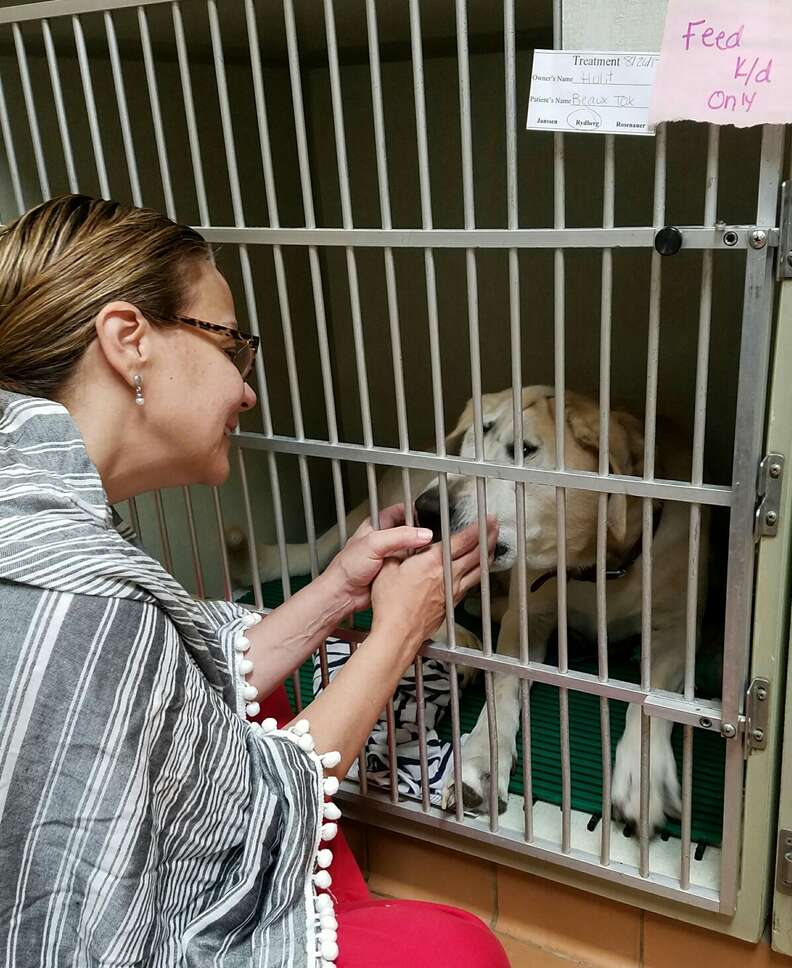
Jamie brought Beaux to Hoegemeyer Animal Clinic in Kerrville, Texas.
There, Dr. Jay Rydberg and the veterinary team examined him.
His condition was even more serious than Jamie had feared.
Beaux tested positive for heartworms, parasites that can cause severe damage to a dog’s heart, lungs, and blood vessels.
The infection had left him dangerously weak.
In fact, he was initially too ill to begin standard heartworm treatment safely.
He first needed intensive supportive care.
Dr. Rydberg estimated that Beaux had roughly a fifty-fifty chance of surviving.
For Jamie, it was devastating news.
She had brought him home hoping to give him the stable life he’d never known.
Now she faced the possibility that he might not live long enough to enjoy it.
But she was determined to pursue the care his veterinarian believed was appropriate.
The next several weeks would test that commitment.
The difficult first month
Beaux’s condition remained critical.
During the first month of treatment, he required repeated oxygen support.
His health fluctuated, and there were times when the veterinary team feared he might not survive.
Dr. Rydberg remained closely involved in his care.
At one particularly frightening point, the veterinarian called Jamie to the clinic at three in the morning because Beaux’s condition had deteriorated so badly.
She was asked to prepare for the possibility of saying goodbye.
It was the outcome she’d feared from the moment she learned how sick he was.
But Beaux survived that crisis.
Gradually, his condition stabilized.
He began gaining weight.
His strength improved, and after weeks of treatment and monitoring, he eventually became healthy enough to undergo heartworm treatment.
Progress came slowly, but it came.
There were still consequences from years of inadequate care.
Beaux had lost hearing in his left ear because of the damage associated with his ear mite infestation.
He also had difficulty seeing through his right eye.
Those problems wouldn’t simply disappear.
But his overall health improved enough that his veterinarians could finally give Jamie the news she’d been hoping to hear.
Beaux had made it through.
Learning to live inside
Once his medical condition improved, Beaux had another unfamiliar experience ahead of him.
He needed to learn what it meant to live inside a home.
For much of his life, he’d been kept in a backyard.
He hadn’t grown accustomed to sleeping near people or spending ordinary afternoons indoors with a family.
Jamie expected that adjustment to take time.
But Beaux seemed delighted by his new surroundings.
After years outside, he showed little interest in going back out unless Jamie went with him.
“He was an outside dog, but you’d never know because he does not want to go outside,” she told The Dodo.
If Jamie remained indoors, Beaux preferred to stay near her.
He could look through the window at the yard he’d previously have been confined to, then turn his attention back to the people and animals inside.
There was no reason for him to spend his days alone anymore.
He had a place in the house.
And he wanted to be part of everything happening there.
An older dog shows him the ropes
Beaux wasn’t the only dog in Jamie’s home.
He had an older canine companion named Riley, a thirteen-year-old golden retriever mix.
Riley was already accustomed to household life.
He understood the routines, knew where to rest, and was comfortable spending time inside.
For Beaux, who had spent so many years outdoors, having another dog nearby helped him adjust.
The two quickly became close.
They played together and slept beside one another, despite the difference in their ages.
Beaux was around six years old by the time of the April 2018 report, but he often behaved like a much younger dog.
His energy and enthusiasm brought some extra activity into Riley’s days.
And Riley’s calm familiarity with the household provided companionship as Beaux settled in.
“Riley and Beaux absolutely love each other,” Jamie said.
Watching them together, it was difficult to imagine that Beaux had once spent his days alone in a small backyard.
He seemed completely at home with his new family.
A house full of animals
Over time, Beaux’s world grew larger.
Jamie was involved with local animal rescue organizations and regularly welcomed foster animals into her home.
Beaux became a foster brother to dogs and kittens who needed temporary care.
He also gained a new rescue sister named Scout.
For a Labrador who had spent so long isolated from ordinary family life, the change was remarkable.
He now shared his days with people and other animals.
There were opportunities to play, companions to rest beside, and a household where his presence was welcome.
Jamie found that his unusual appearance mattered very little compared with the dog he had become.
He was playful.
He was affectionate.
And he seemed to enjoy having a busy family around him.
His forehead still had its deep wrinkles, and his eyes still sat close together.
Those features had never been something he needed to overcome.
They were simply part of him.
The cost of giving Beaux a chance
Caring for Beaux had required considerable resources.
There were veterinary appointments, emergency treatment, heartworm care, and the ongoing needs of a dog recovering from severe neglect.
Jamie didn’t pretend that bringing him home had been inexpensive.
But she believed the investment was worthwhile.
In her interview with The Dodo, she reflected on how some people spend large amounts of money buying dogs with pedigrees and registration papers.
She felt she’d spent her money on something more important.
Beaux’s health.
And she was comfortable with that choice.
What mattered to her was knowing that he was alive, safe, and enjoying life.
For years, people had judged Beaux by what made him different.
Jamie cared about whether he was comfortable, healthy, and happy.
And after the difficult first months, she was finally able to see him enjoying the life she’d hoped to give him.

One year later
By April 2018, approximately a year had passed since Beaux left the backyard.
He was now six years old and living with Jamie in the Austin area.
His recovery had been extraordinary, considering the serious condition in which he’d arrived.
He still had hearing and vision limitations, but he had survived heartworm disease and regained his strength.
The once-emaciated Labrador had become an energetic, affectionate companion.
He enjoyed playing with Riley and Scout.
He spent time around the other rescued animals Jamie brought home.
And he seemed happiest when he could stay close to his family.
“He’s so full of life,” Jamie said, “and he’s just brought so much to us.”
It was a simple description of a dog whose future had once been uncertain.
Not long before, his veterinarian had warned Jamie that he might not survive.
Now he was enjoying ordinary days with the people and animals who loved him.
A face that never needed fixing
What stays with me about Beaux’s story is the photograph that first brought him to Jamie’s attention.
His face was unusual.
There was no hiding it.
But it wasn’t the thing making his life difficult.
The problem was that he’d spent years without adequate care.
He was severely underweight.
He had parasites and an advanced heartworm infection.
And he had never been given the consistent support he needed to become comfortable in a home.
Those were the things Jamie wanted to change.
She couldn’t—and didn’t need to—change his face.
The MRI had already indicated that his skull deformity wasn’t preventing him from being an intelligent, healthy companion.
What Beaux needed was someone willing to look past his appearance and take his welfare seriously.
Jamie did.
She gave him a permanent home, brought him to a veterinarian, and stood by him when his survival was uncertain.
And when he recovered, she gave him room to enjoy being a dog.
There’s another detail in this story I find especially meaningful.
Jamie knew what it was like to spend time in foster care as a child.
She’d experienced the uncertainty of moving between homes before being adopted.
When she learned how often Beaux had been returned to the backyard after rescue attempts, she didn’t want him to go through another temporary placement.
She wanted him to have somewhere he could stay.
Somewhere familiar.
Somewhere he wouldn’t have to start over again.
“I wanted him to have stability and a place he knew was his home,” she explained.
Her own experiences helped her recognize how much that stability mattered.
And after a year with Jamie, Beaux had exactly that.
He had Riley beside him.
He had a new sister named Scout.
He had Jamie.
And he had a home where nobody expected him to look different before he could be loved.
Beaux Tox was born with an unusual facial structure and was reportedly given away because his breeders couldn’t sell him. He then spent approximately five years living outside, where his health deteriorated severely.
When Jamie Hulit saw his photograph, she adopted him directly and arranged veterinary treatment. Despite a life-threatening heartworm infection and a difficult recovery, Beaux survived and eventually settled into a loving home with other rescued animals.
He wasn’t the dog everyone had overlooked anymore.
He was Jamie’s dog.
A lively yellow Labrador who loved being indoors, playing with his canine family, and staying close to the people he trusted.
His face still looked exactly like Beaux’s face.
His forehead was still deeply wrinkled.
But the worried expression was no reflection of the happy, affectionate dog beneath it.
For Jamie, that had never been difficult to see.
Source: Lily Feinn, The Dodo, April 19, 2018. Based on interviews with Jamie Hulit and reporting on Beaux Tox’s veterinary care at Hoegemeyer Animal Clinic. The description of his prenatal development reflects Jamie’s account rather than a confirmed medical explanation.