On the third night after we brought Peggy home, my husband was sitting on the bedroom floor when she did something neither of us expected.
She walked over to him.
That may not sound remarkable, especially to anyone who has lived with an affectionate dog. But Peggy was a rescued pit bull who had already been returned to the shelter twice. She was so frightened of men that even having one walk into the same room could make her freeze.
For three evenings, she’d watched my husband from a distance.
He hadn’t tried to touch her. He hadn’t called her over or offered treats to persuade her to approach.
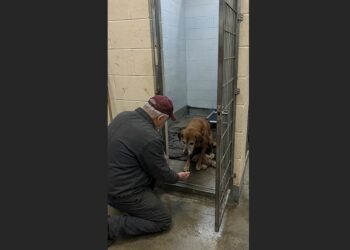
He’d simply sat on the floor, keeping his movements quiet and giving her room to leave whenever she wanted.
That third evening, Peggy finally stood up.
She looked toward him for several seconds before taking a cautious step forward.
Then another.
My husband remained still.
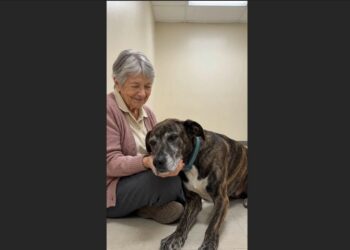
When she reached him, she hesitated, lowered herself onto the floor beside him, and gently rested her head against his.
I watched from across the room.
I could see how carefully she had approached. Her body was still a little tense, and she hadn’t suddenly become the confident dog we’d hoped she might someday be.
But she was sitting beside a man without trying to escape.
And she’d chosen to make contact with him.
My husband stayed exactly where he was, even after his legs began to ache.
He knew how much effort it had taken Peggy to cross that room.
He wasn’t going to ask her for anything more.
We had adopted Peggy only a few days earlier.
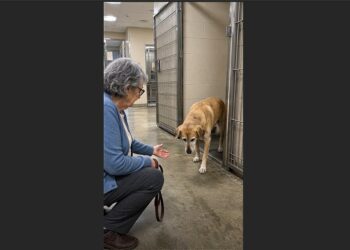
When we arrived at the shelter to bring her home, a staff member asked whether she could speak with us privately before we left.
She seemed concerned that we understood what living with Peggy might involve.
“Her name’s Peggy,” she said. “She’s been returned twice. She’s afraid of men, and it might take a long time—if she ever fully gets past it.”
We listened carefully.
We’d already noticed Peggy’s nervousness during our visits, but hearing that she’d been returned twice made us especially aware of how important it was to approach the adoption realistically.
The shelter staff couldn’t tell us exactly what had caused her fear.
There was no complete account of everything she’d experienced before entering their care.
But they knew how she behaved around men.
She became tense when they approached.
Sometimes she stopped moving entirely.
And although she generally avoided confrontation, her fear was strong enough to affect ordinary interactions.
We were told not to expect an immediate change simply because we offered her a comfortable home.
She would need time.
And even with patience, there might always be situations she found difficult.
We understood.
We wanted to bring her home anyway.
The first afternoon was quieter than I’d imagined.
We had prepared a soft bed in a peaceful part of the house, along with food, water, and a place where Peggy could retreat without being disturbed.
She investigated the room cautiously.
Then she found a spot where she could watch us from a distance.
When I moved nearby, she seemed uncertain but remained where she was.
When my husband entered, everything changed.
Her body became rigid.
She stopped moving.
Her eyes followed him closely.
There was no excited barking or aggressive rush toward him.
She simply froze.
I looked at my husband, and he stopped walking.
We had expected Peggy to be nervous.
But seeing the way her body reacted to his presence made the shelter worker’s warning feel much more serious.
Over the next several hours, we paid close attention to what made Peggy uncomfortable.
If my husband stood too close, she became tense.
If he moved suddenly, she sometimes backed away.
Once, when he approached farther than she seemed comfortable with, she let out a low growl.
He stopped immediately and gave her more space.
We didn’t scold her.
A growl can be an important warning that a dog is uncomfortable, and we didn’t want Peggy to feel that she had to tolerate contact she wasn’t ready for.
My husband understood that her reaction wasn’t personal.
She didn’t know him.
He couldn’t expect her to trust him simply because he intended to be kind.
So we began thinking about how to make his presence less overwhelming.
We had done the usual things to help a newly adopted dog settle.
Her bed was comfortable.
The house was kept as quiet as possible.
We maintained regular feeding times and avoided crowding her.
But Peggy’s fear of men required particular care.
My husband could have tried offering food whenever he entered the room.
He could have called her name, knelt beside her, or reached toward her with an open hand.
Instead, he decided not to ask for an interaction at all.
He wanted her to become familiar with him while remaining free to keep her distance.
That evening, after the house had settled down, he sat on the floor.
He chose a place where Peggy could see him without feeling trapped.
Then he stayed there.
No calling.
No reaching.
No attempt to convince her to come closer.
He simply sat quietly.
Peggy watched him.
She remained several feet away, her body positioned so she could move toward her resting place if she wanted.
For a while, she seemed almost unable to take her eyes off him.
Whenever he shifted slightly, she became alert.
My husband noticed and kept his movements slow.
After some time, Peggy lowered herself onto the floor.
She didn’t approach him.
But she stayed in the room.
Eventually, my husband stood up carefully and went about his evening.
That was all that happened.
I remember asking him afterward whether he thought it had helped.
He shrugged.
He wasn’t sure.
Peggy hadn’t wagged her tail or offered any obvious sign of affection.
But she’d spent a little time in the room with him.
And nothing frightening had happened.
For the first evening, we were content with that.
The following night, he returned to the floor.
Peggy noticed him settling into the familiar spot.
She watched carefully, just as she had the previous evening.
At first, I thought we were going to see exactly the same thing.
Then she moved.
It was only a small change in position, but she had edged a little closer.
She stopped and watched him again.
My husband stayed quiet.
After several minutes, she moved another short distance.
She was still nowhere near comfortable enough to accept a hand reaching toward her.
But she was beginning to investigate the situation instead of remaining completely frozen.
My husband didn’t try to turn that curiosity into an invitation for more contact.
He let Peggy settle wherever she wanted.
When the evening ended, she returned to her bed.
And we went to sleep hoping that the following day might be a little easier for her.
The third night began much like the others.
My husband sat on the floor.
Peggy remained across the room.
I was nearby, watching without interfering.
There was no special training exercise taking place.
No toy waiting beside him.
No food in his hands.
He simply rested quietly.
After a while, Peggy stood.
She looked toward him, then paused.
I saw her shift her weight forward.
She took a step.
Stopped.
Then took another.
Her movements were careful, as though she wanted to be certain there was nothing unexpected waiting for her.
My husband didn’t turn to face her directly.
He allowed her to approach from the side.
And slowly, Peggy closed the distance.
When she reached him, she stood for a few moments.
Then she lowered herself beside him.
Her body was still slightly tense.
She wasn’t completely relaxed, and we knew she might move away at any second.
But instead of retreating, she leaned closer.
She rested her head against his.
My husband looked toward me briefly.
I could see the surprise in his face.
Then he looked down again and remained still.
Peggy stayed beside him.
After a while, her breathing became quieter.
She adjusted her position and seemed more comfortable.
I didn’t try to approach or interrupt them.
I wanted her to have that moment without the additional attention.
For the first time since coming home, she’d chosen to rest beside my husband.
He stayed on the floor long after he would normally have moved.
His legs began going numb.
His neck was uncomfortable.
And I could tell from the way he shifted his eyes toward me that he was trying not to laugh at his predicament.
But he didn’t get up immediately.
Peggy was resting against him.
She’d taken three evenings to become comfortable enough to make that choice.
He wanted to let her decide when the contact ended.
Eventually, she lifted her head and moved away.
Only then did he carefully straighten his legs.
When he stood, Peggy watched him but didn’t retreat as far as she had on the first afternoon.
It wasn’t a dramatic transformation.
But it was a meaningful change.
The next morning, Peggy was still nervous.
I want to be clear about that, because it’s easy to imagine that one affectionate moment somehow erased everything that had come before.
It didn’t.
She still became tense around unfamiliar men.
Sudden movements could frighten her.
And even with my husband, there were times when she preferred to keep her distance.
We respected those moments.
If she moved away, nobody followed.
If she seemed uncomfortable with contact, we stopped.
We continued giving her a quiet place to rest and a predictable daily routine.
But something had begun changing in her relationship with my husband.
She was no longer avoiding him every time he entered the room.
Sometimes she watched him with curiosity.
Occasionally, she approached to sniff his hand.
And when he settled onto the floor in the evening, she often chose to stay nearby.
Over the following days, their friendship developed in small ways.
One morning, my husband walked into the kitchen and noticed Peggy following him.
She didn’t come all the way to his side.
She stopped near the doorway and watched while he prepared breakfast.
He spoke softly to her but didn’t try to touch her.
After a little while, she settled on the floor.
Another day, she followed him from the living room into the hallway.
Then she turned around and returned to her bed.
He didn’t make a fuss.
He simply let her decide where she wanted to be.
I began noticing that she was becoming familiar with the sound of his footsteps.
She seemed less startled when he moved around the house.
And sometimes, when he sat down, she approached without being invited.
These were ordinary behaviors for many dogs.
For Peggy, they were signs that she was beginning to feel more comfortable.
My husband never treated her affection as something he’d earned after three nights of effort.
He understood that she was still adjusting.
There would be moments when she wanted contact and others when she didn’t.
He didn’t expect her to become enthusiastic about every visitor or suddenly lose her fear of unfamiliar men.
What mattered was that she was learning to feel safe with him.
He made that possible by being consistent.
He didn’t chase after her when she became frightened.
He didn’t insist on petting her when she turned away.
And he didn’t interpret her nervousness as rejection.
Instead, he let each interaction begin with her.
That approach suited Peggy.
As the days passed, she began following him more frequently.
If he left the living room, she’d sometimes get up to see where he was going.
If he sat down in the evening, she often chose a resting place close to him.
And occasionally, she’d approach and rest her head against his leg.
I loved watching those moments.
Not because Peggy was suddenly a different dog.
She was still cautious.
Still sensitive to unfamiliar situations.
But she was beginning to make choices that would have seemed impossible on her first day in our house.
When my husband came into the room, she no longer always froze.
Sometimes she looked toward him and moved closer.
I think about the two times Peggy had been returned to the shelter.
We don’t know every detail of those experiences.
We don’t know exactly why each placement ended or how the people involved tried to help her.
But I imagine the repeated changes were difficult for a dog who already struggled to feel comfortable around unfamiliar people.
That was part of why we wanted to be careful.
We couldn’t promise Peggy that she’d never experience another frightening moment.
There would still be unexpected noises, visitors, veterinary appointments, and situations she might find stressful.
But we could give her a stable home.
We could learn what made her uncomfortable.
And we could respond in ways that helped her feel secure rather than overwhelmed.
That was the commitment we’d made when we adopted her.
One evening, I found my husband sitting on the couch with Peggy beside him.
She had approached on her own and settled close enough that her shoulder rested against his leg.
He was watching television.
His hand rested lightly against her back.
Every so often, he gave her a gentle scratch, and she remained comfortable.
I stood in the doorway for a moment.
It was such an ordinary scene.
A man relaxing after a long day.
A dog resting beside him.
Nothing that would seem unusual in most households.
But I remembered the first time Peggy had seen him walk into the living room.
The way her body stiffened.
The trembling.
The frightened look in her eyes.
Now she was resting against him.
And neither of them seemed to think much of it.
Before Peggy came home, I thought helping a frightened dog would involve finding the right things to do.
The right training.
The right treats.
The right words.
I assumed there would be a particular moment when she realized we weren’t going to hurt her.
But watching my husband taught me that the process was less dramatic.
There wasn’t one gesture that convinced Peggy to trust him.
There were three evenings of quiet company.
Then many more ordinary experiences.
He moved slowly.
He gave her space.
He respected her signals.
And day after day, she began learning what she could expect from him.
The moment on the third night remains my favorite memory from her first week with us.
My husband sitting on the floor.
Peggy watching from across the room.
Those hesitant steps.
And the way she finally lowered herself beside him.
He hadn’t asked her to be brave.
He hadn’t demanded affection.
He’d simply made it possible for her to approach without pressure.
And when she did, he allowed her to stay as long as she wanted.
Peggy had been returned to the shelter twice and was so frightened of men that she sometimes froze when one approached.
For three nights, my husband sat quietly on the floor without calling her or reaching toward her. On the third evening, she walked over and rested her head against his.
It was only the beginning.
Her fear didn’t disappear overnight.
But she had found someone who would let her set the pace.
And gradually, she began to feel more comfortable in our home.
Now Peggy often follows my husband from room to room.
She likes knowing where he is.
If he’s in the kitchen, she may settle near the doorway.
If he’s in the living room, she’ll sometimes come over and rest against his knee.
And in the evening, when the house is quiet, she often chooses to sleep close to him.
There are still moments when she needs extra space.
We don’t expect her to behave perfectly or enjoy every interaction.
But she no longer spends her days watching my husband as though his next movement might frighten her.
She’s learning the ordinary comfort of living with someone familiar.
The other night, I walked into the room and found them sitting together.
My husband was on the floor again.
Peggy had settled beside him with her head resting gently against his shoulder.
He looked up at me and smiled.
I thought about the first three evenings.
How little had happened at first.
How difficult it had been to watch Peggy remain so frightened.
And how easily we might have rushed her because we wanted her to feel better.
Instead, my husband had given her something simple.
Time to observe him.
Space to decide.
And the freedom to approach without being asked.
I can’t tell you exactly what Peggy experienced before she came to us.
I don’t know whether she’ll ever become completely comfortable around every man she meets.
But I know what I see now.
A dog who once froze when my husband entered the room sometimes comes looking for him when he’s gone.
A dog who was too frightened to accept attention now chooses to rest beside him.
And a man who was willing to sit on the floor for three nights because he understood that trust couldn’t be hurried.
Peggy didn’t need him to convince her that she should love him.
She needed the chance to discover that being near him could feel safe.
And when she was ready, she came closer.
He was still there.